Waiver of Premium Rider Singapore 2026: How It Works & Which Insurers Cover You
What keeps your life insurance policy alive if you’re diagnosed with a critical illness and can’t pay the premiums yourself.
A waiver of premium rider is an add-on to your Singapore life insurance policy that pays your future premiums for you if you die, become totally and permanently disabled, or are diagnosed with a covered critical illness. Your coverage stays in force even though you’ve stopped paying. China Life, AIA, Prudential and Great Eastern all offer versions, but the conditions that trigger the waiver differ a lot between them.
Not financial advice. All figures are for educational reference only. Data verified against each insurer’s official product pages as at August 2026.
- A waiver of premium rider pays your future premiums if you die, become TPD, or are diagnosed with a covered critical illness — your policy stays alive either way.
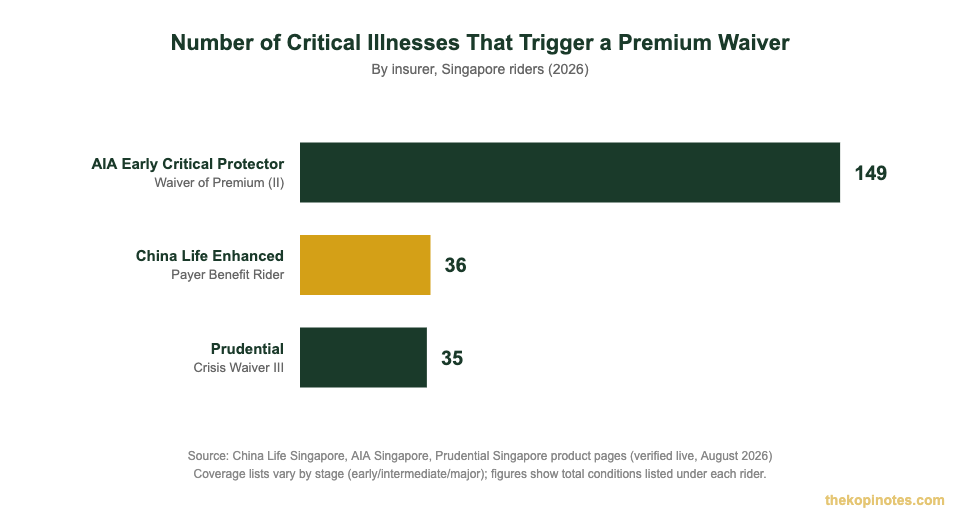
- Insurers differ a lot on what triggers it. Prudential’s Crisis Waiver III covers 35 critical illnesses, China Life’s Enhanced Payer Benefit Rider covers 36, and AIA’s version stretches to 149 conditions across three CI stages.
- You can only add it when you first buy the policy (or at a permitted anniversary) — not after you’re already diagnosed. Decide early.
Table of Contents
Contents — Click to expand
- What Is a Waiver of Premium Rider?
- The Three Trigger Events, Explained
- Waiver of Premium vs Payer Benefit Rider
- How Singapore Insurers Compare
- What Actually Happens: A Worked Example
- What It Actually Costs
- Is It Worth Adding to Your Policy?
- What It Does NOT Cover
- How to Add One to Your Policy
- Frequently Asked Questions
What Is a Waiver of Premium Rider?
A waiver of premium (WOP) rider is an optional add-on you attach to a life insurance, critical illness, or term policy when you first buy it. Once triggered, the insurer pays your future premiums for you. Your coverage doesn’t lapse, and you don’t need to keep paying out of pocket.
Think of it as insurance for your insurance. If a stroke or major cancer diagnosis stops you from working, the last thing you want is your term life policy lapsing because you missed a payment. That’s the exact gap a WOP rider closes.
It works alongside your basic plan, not instead of it. You still get your full death, TPD, or CI payout when a claim happens — the waiver only stops the premium bill, not your coverage.
The Three Trigger Events, Explained
Most WOP riders sold in Singapore respond to one or more of these events.
Death. On a joint or family policy, this waives premiums for the remaining people covered under it.
Total and permanent disability (TPD). If you’re certified TPD — usually meaning you can no longer perform your own occupation, and later any occupation — premiums stop. For more on how this works, see our guide to Total and Permanent Disability (TPD) insurance in Singapore. Insurers set an age cutoff for TPD claims. China Life’s rider, for example, only pays out if TPD is diagnosed before your 76th birthday.
Critical illness (CI). This is where insurers differ the most. Some riders only waive premiums on major-stage CIs like a serious heart attack or major cancer. Others, like AIA’s, extend to early and intermediate stages too — which means far more diagnoses qualify.
The stage matters because it changes how long the waiver lasts. A major-stage CI diagnosis under a typical Singapore rider waives premiums for the rest of your policy term. An early-stage diagnosis usually buys you a shorter, capped period instead.
Waiver of Premium vs Payer Benefit Rider
These two get mixed up constantly, and it matters because they solve different problems.
A waiver of premium rider protects you — the person who owns the policy and pays for it. If you get sick, your own premiums stop.
A payer benefit rider protects someone else’s policy instead. The classic example: you buy a policy for your child, and you’re the one paying the premiums. If something happens to you — you die, become TPD, or are diagnosed with a CI — the payer benefit rider keeps your child’s coverage alive without a premium.
China Life’s naming makes this distinction unusually clear. Its Payer Benefit Rider and Enhanced Payer Benefit Rider are explicitly designed for third-party-owned policies, where the policy owner isn’t the person insured. AIA has the same split: an Early Critical Protector Waiver of Premium rider for your own policy, versus separate Payor Benefit riders that protect a child’s policy if the paying parent is affected.
If you’re buying insurance on your own life, you want waiver of premium. If you’re the one funding a policy for a spouse, parent, or child, look for the payer benefit version instead.
How Singapore Insurers Compare
As the table below shows, the biggest difference isn’t whether a rider exists — every major insurer offers some version. It’s how many conditions trigger it, and for how long.
| Insurer | Rider | Triggers | Waiver Scope |
|---|---|---|---|
| China Life | Payer Benefit Rider | Death, TPD (before age 76), Terminal Illness | Remaining rider term, up to age 99. TPD capped at SGD 3,000,000 per life. |
| China Life | Enhanced Payer Benefit Rider | Death, TPD, 36 Critical Illnesses (before age 76) | Remaining rider term, up to age 99. CI capped at SGD 2,000,000 per life. |
| AIA | Early Critical Protector Waiver of Premium (II) | 149 early, intermediate & major-stage CIs | Waives future premiums till end of rider term, on AIA Pro Lifetime Protector (II) and eligible riders. |
| AIA | Payor Benefit riders | Payor’s death, TPD, or CI | Waives a child’s AIA Beyond Critical Care premiums up to the child’s 25th birthday. |
| Prudential | Crisis Waiver III | 35 listed critical illnesses | 5 years for early-stage (usable up to twice), 10 years for intermediate-stage, remaining term for major-stage. |
| Great Eastern | Premium waiver rider (GREAT Term 2) | Diagnosis of a covered condition, depending on the attached CI rider | Waives premiums to ease the financial commitment after a covered diagnosis. |
Source: China Life Singapore, AIA Singapore, Prudential Singapore, Great Eastern Singapore official product pages — verified live, August 2026.
AIA’s Early Critical Protector Waiver of Premium (II) rider is tied to its 149-condition critical illness list spanning early, intermediate, and major stages. That’s a wide net — you could clear the bar with a comparatively mild diagnosis and still get your premiums waived. China Life’s Enhanced Payer Benefit Rider covers 36 CIs, matching the industry-standard Life Insurance Association (LIA) 2019 severe-stage list, plus death and TPD. Prudential’s Crisis Waiver III sits at 35 CIs but adds nuance: the waiver length depends on how severe the diagnosis is, not just whether it happened.
What Actually Happens: A Worked Example
Take Prudential’s Crisis Waiver III as an illustration, since it publishes its waiver structure clearly. Say you’re diagnosed with an early-stage critical illness first. Your premiums are waived for 5 years. If, years later, you’re diagnosed with a different early-stage condition, you can use the waiver a second time for another 5 years. An intermediate-stage diagnosis buys you 10 years. A major-stage diagnosis — Stage 3 or 4 cancer, a serious heart attack — waives your premiums for the rest of your policy term. You never pay again.
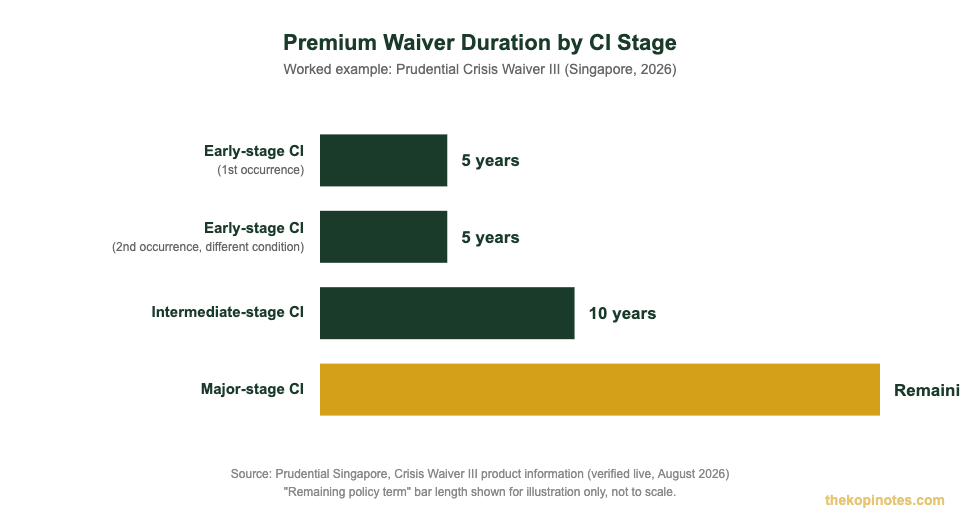
This tiered structure is common across insurers, even where the exact numbers differ. It rewards you for catching a condition early — you get some relief — while reserving the most generous protection for the most severe outcomes.
What It Actually Costs
Here’s the honest answer: no Singapore insurer publishes a standalone dollar cost for waiver of premium riders on their public product pages. The cost is folded into your total premium quote, and depends on your age, gender, smoker status, sum assured, and which base plan you’re attaching it to.
What you can expect directionally: adding a WOP or payer benefit rider typically increases your total premium by a modest percentage rather than a flat dollar figure. The increase tends to be larger the younger you are when you add it, since you’re buying a longer waiver window, and larger for riders that cover more trigger events. AIA’s 149-condition version, which pays out more readily, will generally cost more to add than a narrower major-stage-only waiver.
If you want an actual number, the only reliable way to get one is to request a quote from your insurer or financial adviser with the rider included versus excluded, then compare the two premiums side by side. Be wary of any source that quotes a specific percentage or dollar figure without citing the insurer directly — riders are individually priced.
Is It Worth Adding to Your Policy?
It’s worth considering if:
- You’re the sole income earner and your family depends on your policy staying in force.
- You’re buying direct term life insurance or a CI plan with a long premium term of 20-30 years — more years means more chances for something to interrupt your ability to pay.
- You already have limited emergency savings, and a lapsed policy would be a real financial risk on top of a health crisis.
You might skip it if:
- Your policy has a short remaining term, and the total premiums left are small.
- You have substantial savings or other income that could cover premiums even during a health crisis.
- You’re already paying for overlapping CI coverage from a plan like Prudential term life insurance or Great Eastern term life insurance that would pay out a lump sum you could use to cover premiums yourself.
However, don’t treat a waiver of premium rider as a substitute for CI or TPD coverage itself. It only stops the premium bill — you still need the base plan’s payout to replace your income or cover treatment costs. Pairing it with a plan like AIA Protect 3 critical illness insurance gives you both a lump-sum payout and continued coverage.
What It Does NOT Cover
It’s easy to assume this rider protects you against any financial shock. It doesn’t.
Retrenchment or job loss isn’t covered. Losing your job doesn’t trigger a premium waiver under any of the riders reviewed here — this is strictly a health-and-death rider, not an income-protection or unemployment product.
Short-term or partial disability usually doesn’t qualify. The bar is typically total and permanent disability, not a temporary injury that keeps you off work for a few months.
Pre-existing conditions are excluded, same as the rest of your policy. If you already had the condition before buying the rider, a later claim on it won’t trigger a waiver.
You can’t add it retroactively. Every insurer requires the rider to be underwritten at the point of application, or a permitted policy anniversary — not after a diagnosis.
How to Add One to Your Policy
You can only add a waiver of premium or payer benefit rider when you first apply for a policy, or at a later policy anniversary if the insurer allows a mid-term addition — not after you’re already diagnosed with a qualifying condition. Insurers require simplified underwriting, usually a few health questions and sometimes no medical exam, at the point of application.
If you already hold a policy without this rider, ask your insurer or financial adviser whether it can still be added. Some plans allow it at renewal; many don’t. This is also a good time to review your insurance nomination in Singapore to make sure your beneficiaries are correctly listed, since a waiver rider changes how long your policy stays active but not who receives the payout.
Frequently Asked Questions
What is a waiver of premium rider in Singapore life insurance?
A waiver of premium rider is an add-on to your life insurance or critical illness policy that pays your future premiums for you if you die, become totally and permanently disabled, or are diagnosed with a covered critical illness. Your coverage stays active even though you’ve stopped paying. It doesn’t replace your death or CI payout — it only protects against your policy lapsing.
What's the difference between a waiver of premium rider and a payer benefit rider?
A waiver of premium rider protects your own policy if something happens to you. A payer benefit rider protects someone else’s policy, typically a child’s, if the adult paying the premiums dies, becomes disabled, or is diagnosed with a critical illness. China Life and AIA both sell distinct versions of each.
Can I add a waiver of premium rider after I'm already diagnosed with a critical illness?
No. Every insurer requires the rider to be underwritten when you first apply for the policy, or at a specific permitted policy anniversary, not after a qualifying condition has already occurred. If you’re diagnosed first, the rider will no longer be available to you for that condition.
How much does a waiver of premium rider cost in Singapore?
Insurers don’t publish a standalone cost. It’s built into your total premium quote and depends on your age, sum assured, smoker status, and how many conditions the rider covers. The only way to get an exact figure is to ask your insurer or adviser for a quote with and without the rider attached.
Does a waiver of premium rider cover retrenchment or job loss?
No. These riders are triggered by death, total and permanent disability, or a covered critical illness diagnosis, not unemployment. If you’re looking for income protection during a job loss, you would need a separate product.
Which Singapore insurer offers the most comprehensive waiver of premium coverage?
By number of conditions covered, AIA’s Early Critical Protector Waiver of Premium (II) rider is broadest, tied to its 149-condition critical illness list across early, intermediate, and major stages. China Life’s Enhanced Payer Benefit Rider (36 CIs) and Prudential’s Crisis Waiver III (35 CIs) are narrower but still cover the LIA-standard severe-stage conditions. The best choice depends on which insurer underwrites your base policy, since these riders are usually only available on that insurer’s own plans.
Reviewing Your Life Insurance Coverage?
Check how your policy compares, and make sure your beneficiaries are set up correctly.
Get Free Insurance Advice
Speak with a licensed insurance advisor. No obligation, no cost.
By submitting this form, you agree to our Privacy Policy.
This article was researched with the help of AI. While we strive to keep all information accurate and up to date, there may be errors. If you notice any discrepancies, please contact us.