MediSave for CareShield Life & ElderShield Premiums 2026: Limits, Coverage & How to Pay
A practical guide to using MediSave for long-term care insurance premiums — base plans, supplements, and family payment options.
MediSave fully covers your CareShield Life and ElderShield premiums — no cash needed. Annual CareShield Life premiums start from about $206 for males and $254 for females entering at age 30, rising modestly until age 67. For supplement plans, MediSave covers up to $600 per year per insured person. Spouses, parents, children and siblings can also use their own MediSave to pay your premiums.
Not financial advice. All figures are for educational reference only. Data verified as at 21 September 2026.
- CareShield Life premiums are fully paid by MediSave — zero cash required from your pocket.
- Supplement plan premiums are capped at $600/year from MediSave; you pay the rest in cash.
- Family members (spouse, parents, children, siblings) can tap their own MediSave to cover your premiums.
What Are CareShield Life and ElderShield?
CareShield Life is Singapore’s mandatory long-term care insurance scheme. It pays a monthly cash benefit for life if you are severely disabled — meaning you cannot perform at least three of the six Activities of Daily Living (ADLs): bathing, dressing, feeding, toileting, walking, and transferring.
All Singapore Citizens and Permanent Residents born from 1980 onwards are automatically enrolled in CareShield Life from age 30. Premiums are deducted annually from your MediSave — no cash is needed.
ElderShield is the older long-term care scheme designed for those born before 1980. Unlike CareShield Life, ElderShield benefits are paid for a fixed period (not for life). ElderShield is now closed to new applicants — the opt-in window closed on 31 December 2023.
Both schemes rely on MediSave to fund premiums, making it important to understand the withdrawal rules and limits. For a detailed overview of CareShield Life, see our CareShield Life complete guide.
How MediSave Covers CareShield Life Premiums
Your CareShield Life annual premium is fully covered by MediSave. The premium is deducted automatically each January from your MediSave account. You do not need to set aside cash for this.
Premiums are gender- and age-based. They start lower when you are younger and increase by roughly 3% each year until age 67. After 67, premium payments stop — but your coverage and payout entitlement continue for life.
Female premiums are higher because women statistically live longer and may spend more years in a state of severe disability. Here are the approximate 2026 annual premiums by age of entry:
| Age of Entry | Male (Approx.) | Female (Approx.) |
|---|---|---|
| 30 | ~$206/year | ~$254/year |
| 35 | ~$238/year | ~$293/year |
| 40 | ~$276/year | ~$340/year |
| 45 | ~$320/year | ~$394/year |
| 50 | ~$372/year | ~$458/year |
Source: CPF Board, CareShield Life Premium Calculator, September 2026. Premiums are personalised — log in to your CPF account or visit careshieldlife.gov.sg to check your exact amount.
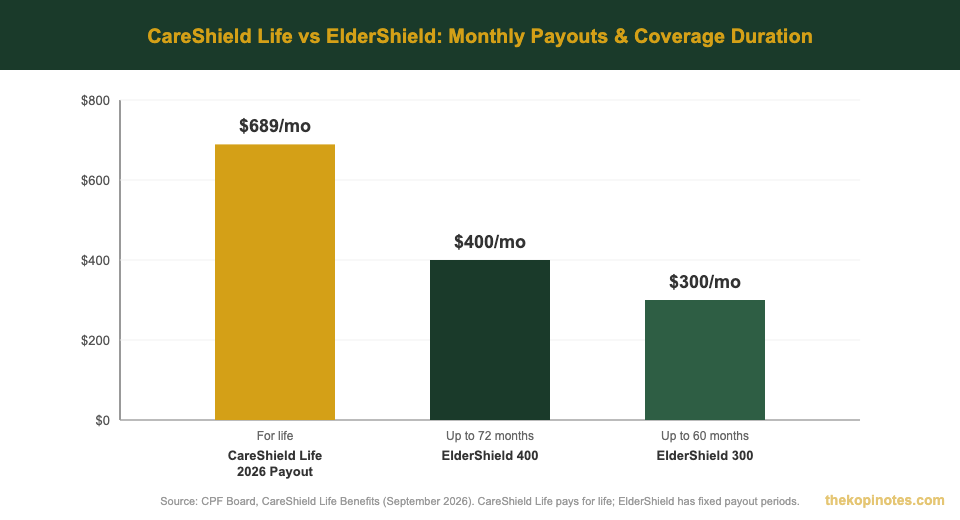
A successful CareShield Life claim in 2026 pays $689 per month for life. This amount increases by 4% per year until 2030, at which point it will be reviewed. So the younger you are when you start contributing, the longer you pay in — and the higher your payout will be when you eventually claim.
Means-tested subsidies are also available for lower-income households, reducing premiums by up to 50%. These are assessed automatically — you do not need to apply separately.
How MediSave Covers ElderShield Premiums
If you are on ElderShield — born before 1980 or opted in before CareShield Life launched — your annual ElderShield premium is also fully payable from MediSave. Premium payments stop at age 65, and coverage pays out for a fixed period if you meet the disability criteria.
| Scheme | Monthly Payout | Maximum Payout Period | MediSave Coverage |
|---|---|---|---|
| ElderShield 300 | $300/month | 60 months (5 years) | Full premium |
| ElderShield 400 | $400/month | 72 months (6 years) | Full premium |
Source: CPF Board, ElderShield scheme information, September 2026.
Unlike CareShield Life, ElderShield benefits are finite. They stop after the maximum payout period, even if you are still severely disabled. This is one reason many ElderShield policyholders top up with a supplement plan to extend or increase their coverage.
Note: ElderShield is no longer open for new applicants. The last window to opt in closed on 31 December 2023. If you are a Singapore Citizen or PR born from 1980 onwards, you are covered under CareShield Life instead.
Want to understand your MediSave withdrawal limits more broadly? Our MediSave withdrawal limits and ISP premiums guide explains how ISP and CareShield Life premiums together affect your MediSave balance.
Supplement Plans and the $600 MediSave Cap
CareShield Life and ElderShield supplement plans are add-ons sold by MOH-approved insurers — Singlife, Income, and Great Eastern — that enhance your base coverage. Common upgrades include:
- Higher monthly payouts (e.g. topping up the $689 base to $3,000/month or more)
- Cashier independence benefit — a one-off lump sum when you first make a claim
- Premium waiver while you are receiving disability payouts
- Daily hospital cash benefit for hospitalisation stays
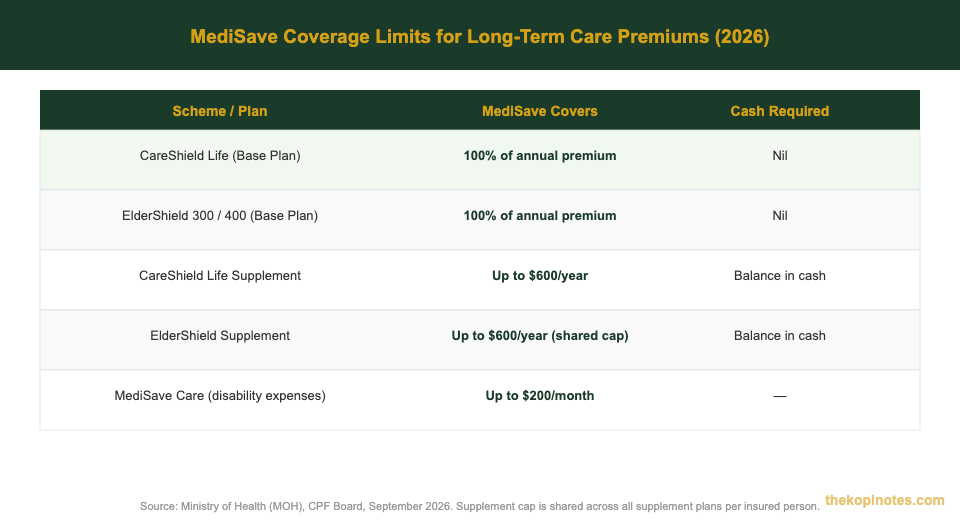
MediSave covers supplement premiums — but only up to $600 per year per insured person. If your supplement premium is $1,200 per year, you use $600 from MediSave and pay the remaining $600 in cash.
Crucially, this $600 cap is a shared cap across all supplement plans you hold. If you have both a CareShield Life supplement and an ElderShield supplement, your combined MediSave use across both cannot exceed $600 per year.
For a comparison of the supplement plans available, see our guide on CareShield Life payouts, premiums and supplements.
Can Family Members Pay Using Their MediSave?
Yes. Singapore allows you to use your MediSave to pay for CareShield Life or ElderShield premiums of immediate family members. This is useful if a family member has a low MediSave balance. The eligible relationships are:
- Spouse
- Children
- Parents / parents-in-law
- Grandparents / grandparents-in-law
- Siblings
For example, if your mother’s MediSave is running low, you can authorise your MediSave to cover her annual CareShield Life premium — or pay in cash on her behalf. This helps ensure her coverage remains active without placing a financial strain on her.
To set this up, log in to CPF Online Services or use the MyCPF mobile app. You will need the NRIC of the family member whose premium you are paying.
For a full breakdown of which family MediSave payments are allowed and the steps involved, see our guide on using MediSave for family members.
Key MediSave Rules to Know in 2026
Your MediSave balance is capped at the Basic Healthcare Sum (BHS), which is $79,000 in 2026. Contributions above the BHS are redirected to your Special Account (SA) or Retirement Account (RA). Understanding your BHS matters because a low MediSave balance can affect your ability to pay long-term care premiums automatically.
Here are the key rules to keep in mind for your CareShield Life or ElderShield premium payments in 2026:
- Annual deduction date: CareShield Life premiums are deducted in January each year. Ensure your MediSave balance is sufficient before then.
- Insufficient balance: If your MediSave is too low, CPF Board will notify you. You can top up in cash or ask a family member to pay from their MediSave or in cash.
- Tax relief on cash top-ups: Cash top-ups to your own MediSave account qualify for personal income tax relief of up to $8,000 per calendar year. Family members who top up your MediSave in cash may also claim up to $8,000 relief (separate from their own top-up relief).
- MediSave Care: A separate programme that lets severely disabled individuals withdraw up to $200/month from MediSave for long-term care expenses (caregivers, day rehabilitation). This is separate from your premium deductions.
Want to understand how MediSave balances work more broadly? Our MediSave cap and BHS 2026 guide explains the limits in detail. You can also use our Singapore retirement calculator to see how your long-term care costs fit into your overall retirement plan.
For the latest on MediSave payment procedures, see our MediSave payment guide 2026.
Frequently Asked Questions
Do I need cash to pay CareShield Life premiums?
No cash is required for the base CareShield Life plan. Your MediSave account is automatically deducted each January. For supplement plans, only the amount above $600/year needs to be paid in cash.
What if my MediSave balance is not enough to pay the CareShield Life premium?
CPF Board will notify you if your MediSave balance is insufficient. You can then top up your MediSave in cash, or ask an eligible family member to pay the premium from their MediSave account or in cash on your behalf.
Can I use MediSave to pay my parents' CareShield Life premium?
Yes. Parents and parents-in-law are eligible family members. Log in to CPF Online Services or the MyCPF app to authorise the deduction from your MediSave account. You can also pay in cash directly.
How much does CareShield Life pay out in 2026?
A successful CareShield Life claim in 2026 pays $689 per month for life. The amount increases by 4% per year until 2030, after which payout growth will be reviewed. CareShield Life payouts are fixed based on the year you start receiving them — they do not continue to increase once you are on claim.
Is the $600 MediSave supplement cap per plan or total?
The $600 limit is a total cap per insured person across all supplement plans. You cannot use more than $600 combined from MediSave for your supplement premiums in a calendar year, even if you hold multiple supplement plans.
Can I still buy ElderShield in 2026?
No. ElderShield is closed to new applicants — the opt-in window closed on 31 December 2023. If you are born from 1980 onwards and are a Singapore Citizen or PR, you are automatically covered under CareShield Life instead.
Does MediSave Care's $200/month limit affect my CareShield Life premium deductions?
No. MediSave Care is a separate withdrawal programme for care-related expenses such as paying caregivers or attending day rehabilitation. CareShield Life and ElderShield premium deductions operate independently and are not counted against the MediSave Care withdrawal limit.
Disclaimer: This article is for educational purposes only and does not constitute financial or insurance advice. Premium amounts are approximate and may vary based on your exact age, gender, and CPF account details. Always verify figures with CPF Board at cpf.gov.sg or careshieldlife.gov.sg before making decisions. Data verified as at 21 September 2026.
Get Free Insurance Advice
Speak with a licensed insurance advisor. No obligation, no cost.
By submitting this form, you agree to our Privacy Policy.
This article was researched with the help of AI. While we strive to keep all information accurate and up to date, there may be errors. If you notice any discrepancies, please contact us.