Integrated Shield Plan for PRs in Singapore: Eligibility, Subsidies & Costs (2026)
What Singapore Permanent Residents need to know before topping up MediShield Life with a private Integrated Shield Plan.
Singapore Permanent Residents are automatically covered by MediShield Life, and can buy an Integrated Shield Plan (IP) from any major insurer to upgrade to a higher ward class or private hospital. The key difference from citizens: PRs get lower public hospital subsidies (up to 50% vs 80%) and reduced MediShield Life premium subsidies, which makes an IP more valuable for PRs who want cost certainty.
Not financial advice. All figures are for educational reference only. Data verified as at 22 July 2026 against official MOH and MoneySense sources unless otherwise noted.
- You’re automatically covered by MediShield Life the day you become a PR — no application needed, same as citizens.
- Government hospital subsidies cap out at 50% for PRs, versus 80% for citizens, so a big bill hits you harder without an IP.
- Every major insurer sells IPs to PRs, but you’ll need to pass medical underwriting first — unlike MediShield Life, which covers you regardless of health history.
Table of Contents
Contents — Click to expand
- Are Singapore PRs Eligible for an Integrated Shield Plan?
- MediShield Life vs Integrated Shield Plan: What Changes for a PR
- Why the Subsidy Gap Matters More If You’re a PR
- Deductibles, Co-Payments and the April 2026 Rider Reform
- Which Insurers Sell Integrated Shield Plans to PRs?
- How to Apply for an IP as a PR (Step-by-Step)
- Should You Upgrade Beyond MediShield Life?
- Frequently Asked Questions
Are Singapore PRs Eligible for an Integrated Shield Plan?
Yes. If you hold Singapore Permanent Resident status, you’re eligible for both MediShield Life and a private Integrated Shield Plan (IP) on top of it. You don’t need to apply for MediShield Life — it kicks in automatically the day you become a PR, exactly as it does for Singapore Citizens.
An IP works differently. It’s an optional product sold by a private insurer that combines your MediShield Life coverage with an additional private insurance layer. That extra layer is what lets you claim for a higher ward class (Class A or B1) in a public hospital, or admission to a private hospital altogether. You have to actively buy it, and you pay extra for it — either from your MediSave (up to the Additional Withdrawal Limit) or in cash.
Here’s the part that trips up many PRs: MediShield Life accepts you regardless of your health history, but the private IP component doesn’t. When you apply for an IP, or for a rider on top of it, the insurer will ask you to complete medical underwriting. If you have a pre-existing condition, the insurer may exclude it, load your premium, or in rare cases decline the private component — even though your MediShield Life cover continues unaffected either way.
MediShield Life vs Integrated Shield Plan: What Changes for a PR
It helps to see the two layers side by side before you decide whether to top up. The table below shows what stays the same for PRs and citizens, and where an IP changes the picture.
| Feature | MediShield Life | Integrated Shield Plan (IP) |
|---|---|---|
| Enrolment | Automatic for all SC and PR | Opt-in, you apply directly with an insurer |
| Medical underwriting | None — guaranteed acceptance | Required for the private component |
| Ward coverage | Subsidised Class C / B2 wards | Up to Class A or private hospital, depending on plan tier |
| Premium payment | Fully payable by MediSave | MediSave (up to a limit) plus cash; riders are cash-only |
| Pre-existing conditions | Covered from day one | May be excluded or loaded at underwriting |
Source: MoneySense (MAS/MOH), “Understanding Integrated Shield Plans”, last updated 2 July 2026
Why the Subsidy Gap Matters More If You’re a PR
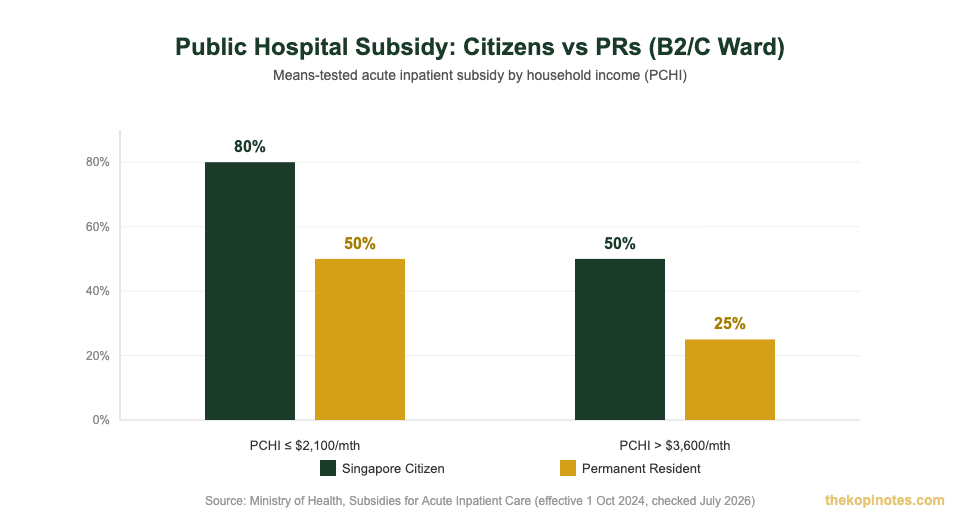
This is the part most PRs underestimate. Even if you never touch an IP and stay in a subsidised C or B2 ward, your government subsidy ceiling is lower than a citizen’s. According to MOH, Singapore Citizens can receive up to 80% subsidy on acute inpatient bills, while Permanent Residents are capped at 50% — a 30 percentage point gap at every income tier.
The gap doesn’t just apply at the top end. At the lowest household income tier (monthly per capita household income of $2,100 or below), a citizen gets 80% off their bill while a PR at the same income level gets only 50%. At the highest tier (above $3,600 per capita), a citizen still gets 50%, while a PR gets just 25%.
| Household PCHI | Singapore Citizen subsidy | PR subsidy |
|---|---|---|
| $0 – $2,100/mth | 80% | 50% |
| $2,100 – $2,600/mth | 70–75% | 35–42.5% |
| $3,000 – $3,600/mth | 55–60% | 27.5–30% |
| Above $3,600/mth | 50% | 25% |
Source: Ministry of Health, “Subsidies for Acute Inpatient Care at Public Healthcare Institutions”, effective 1 October 2024, verified July 2026. Applies to Class C, B2 and B2+ wards.
Say you’re a PR earning above $3,600 PCHI, and you’re hospitalised in a subsidised B2 ward with a $15,000 bill. You’d get 25% off, leaving $11,250 for MediShield Life and MediSave to work through. A citizen at the same income level would only pay $7,500 before MediShield Life kicks in. That $3,750 gap is exactly the kind of shortfall an IP is designed to absorb — either by moving you to a higher ward class with fuller private coverage, or by cushioning what MediShield Life alone won’t cover.
It’s worth noting that A and B1 wards, and all private hospitals, aren’t subsidised at all — for citizens or PRs. The subsidy gap above only applies if you stay in a C, B2 or B2+ ward. If you already prefer private care, the citizenship-based subsidy gap is less relevant; your IP tier matters more than your residency status.
Deductibles, Co-Payments and the April 2026 Rider Reform
Whether you’re a citizen or a PR, an IP claim isn’t 100% covered. You’ll always pay two things first: a deductible and a co-payment. Neither of these differs by citizenship — they’re the same for every IP policyholder.
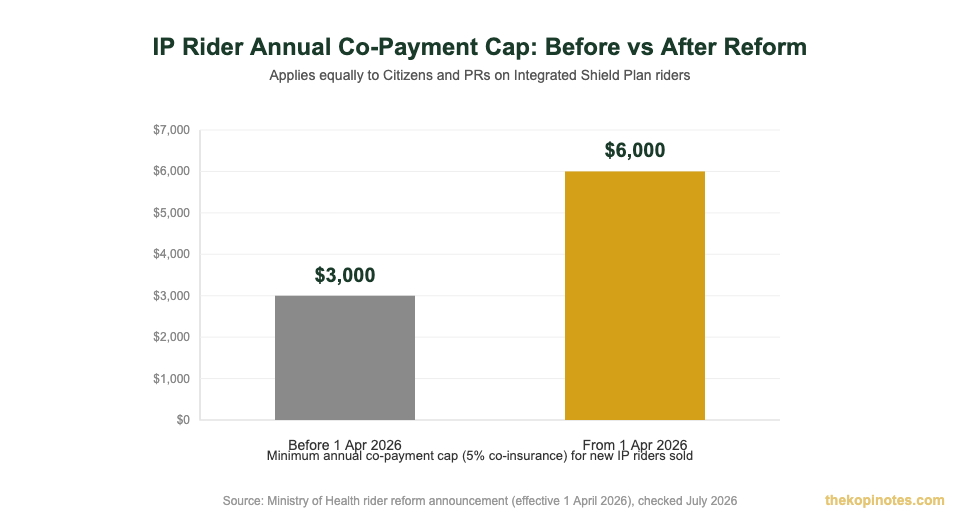
The deductible is a fixed amount you pay each policy year — ranging from $1,500 to $3,500, depending on your ward class — before your IP pays out anything. After that, you co-pay 5% of the bill, capped at a minimum of $6,000 per year. This 5% co-payment can be covered by an optional rider, but riders must be paid in cash — MediSave can’t be used for rider premiums.
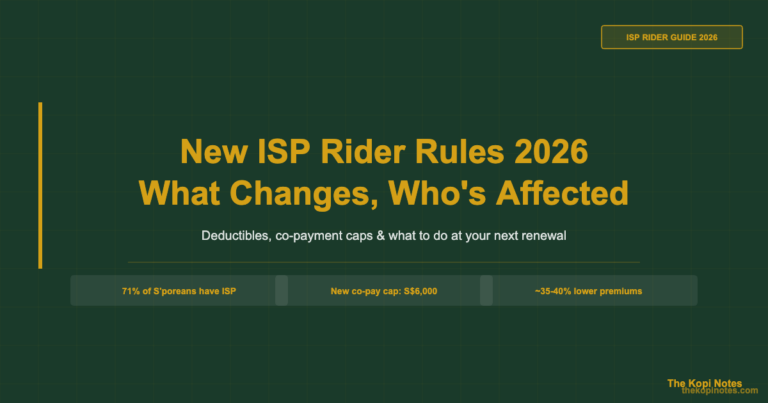
From 1 April 2026, MOH tightened the rules on riders. New riders sold can no longer cover your deductible, and the minimum annual co-payment cap rose from $3,000 to $6,000. In exchange, insurers have priced the new riders roughly 30% cheaper on average than the older, fuller-coverage versions. If you bought your rider before 27 November 2025, your existing benefits are grandfathered — you don’t need to switch.
Which Insurers Sell Integrated Shield Plans to PRs?
Because an IP is legally structured as MediShield Life plus a private top-up, every MediShield Life-approved IP is open to anyone eligible for MediShield Life — which includes both Singapore Citizens and PRs. In practice, that means all five major insurers in Singapore will sell you an IP as a PR, subject to underwriting.
| Insurer | Plan Name | Highest Ward Tier |
|---|---|---|
| NTUC Income | Enhanced IncomeShield | Preferred (private hospital) |
| AIA | HealthShield Gold Max | Private hospital |
| Great Eastern | GREAT SupremeHealth | P Plus (private hospital) |
| Prudential | PRUShield | Premier (private hospital) |
| Singlife | Shield Plan 1 / Plan 2 | Plan 1 (private hospital) |
Source: Respective insurer product pages and MOH Comparison of Integrated Shield Plans, verified July 2026. Confirm current PR eligibility and underwriting requirements directly with the insurer before applying.
For a full side-by-side breakdown of premiums and claim limits, see our Integrated Shield Plan comparison for Singapore. If you’re specifically weighing AIA, our AIA Integrated Shield Plan review breaks down HealthShield Gold Max tier by tier, and our Singlife Shield Plan guide covers Plan 1 vs Plan 2 in more detail.
How to Apply for an IP as a PR (Step-by-Step)
The application process is the same whether you’re a citizen or a PR — the only difference is that insurers will typically ask for proof of your PR status alongside your NRIC/FIN and health declaration.
Step 1: Check your existing coverage. Log in to the CPF Board website to confirm whether you already have an IP through a previous employer or policy. Many PRs are auto-enrolled into a basic IP through a company group scheme without realising it.
Step 2: Decide your target ward class. Do you want Class A in a public hospital, or private hospital coverage? Your choice determines both your premium and your deductible band.
Step 3: Complete medical underwriting. Every insurer will ask for a health declaration, and may request medical reports for pre-existing conditions. Be upfront — non-disclosure can void your claim later.
Step 4: Decide on a rider. If you want the 5% co-payment covered too, you’ll need a separate rider paid in cash. Weigh the rider’s extra premium against how much of a $6,000 co-payment cap you could self-fund from savings.
Step 5: Set up premium payment. You can use MediSave for the base IP premium up to the Additional Withdrawal Limit; the remainder, and any rider premium, must be paid in cash or via GIRO.
Step 6: Review annually. Your rider and IP premiums increase with age. Reassess whether the coverage still matches your budget and health needs each renewal.
Should You Upgrade Beyond MediShield Life?
An IP makes sense if you want a choice of doctor, a shorter wait for elective procedures, or you’re not comfortable with the lower 50% subsidy ceiling PRs get in a public C or B2 ward. It’s also worth considering if your employer doesn’t already provide equivalent group hospitalisation coverage.
On the other hand, staying on MediShield Life alone can be the more sensible choice if you’re early in your PR journey, have a tight cash flow, or are still deciding whether to convert to citizenship or eventually relocate. Unlike MediShield Life, IP and rider premiums rise steeply with age — a plan that looks affordable at 30 can look very different at 60. Before committing, run your numbers through the Singapore retirement calculator to see how a rising IP premium fits into your long-term budget, and read up on whether MediShield Life alone is enough for your situation before deciding.
If you eventually give up your PR status, your IP itself doesn’t automatically end — it’s a private contract, and most insurers will let you continue paying premiums as a policyholder based overseas or as a foreigner, subject to their terms. Losing PR status does end your MediShield Life cover, though, so check with your insurer directly about how that affects your specific policy before making any move.
Frequently Asked Questions
Can Singapore PRs buy an Integrated Shield Plan?
Yes. Any Singapore Permanent Resident who is covered under MediShield Life can apply for an Integrated Shield Plan from AIA, Great Eastern, NTUC Income, Prudential or Singlife, subject to medical underwriting on the private insurance component.
Is MediShield Life the same as an Integrated Shield Plan for PRs?
No. MediShield Life is a compulsory national scheme that automatically covers every Singapore Citizen and PR with no underwriting. An Integrated Shield Plan is an optional private top-up you must apply and pass underwriting for, on top of your existing MediShield Life cover.
Do PRs get lower government hospital subsidies than citizens?
Yes. According to MOH, Singapore Citizens can receive up to 80% subsidy on acute inpatient bills in C, B2 and B2+ wards, while Permanent Residents are capped at up to 50%, with the exact rate determined by household income (PCHI).
Do PRs need medical underwriting to buy an IP?
Yes, for the private insurance component. MediShield Life itself has no underwriting for anyone, but the additional IP coverage and any rider requires a health declaration, and insurers can exclude pre-existing conditions or load premiums based on your health history.
Which insurer offers the best Integrated Shield Plan for PRs?
There’s no single “best” insurer — AIA, Great Eastern, NTUC Income, Prudential and Singlife all accept PR applicants, and the right fit depends on your target ward class, budget and existing health conditions. Compare claim limits and premiums directly before applying.
What happens to my Integrated Shield Plan if I give up my PR status?
Your IP is a private contract, so it typically continues if you keep paying premiums, though terms for overseas or non-resident policyholders vary by insurer. Losing PR status ends your MediShield Life cover, so confirm with your insurer how that affects your specific IP policy before making any change.
Planning Your Healthcare Costs as a Singapore PR?
Compare Integrated Shield Plans, model your long-term costs, and see how insurance fits into your broader financial plan.
Get Free Insurance Advice
Speak with a licensed insurance advisor. No obligation, no cost.
By submitting this form, you agree to our Privacy Policy.
This article was researched with the help of AI. While we strive to keep all information accurate and up to date, there may be errors. If you notice any discrepancies, please contact us.