CareShield Life Singapore 2026: Complete Guide to Payouts, Premiums & Supplements
Everything You Need to Know About Singapore’s Long-Term Care Insurance
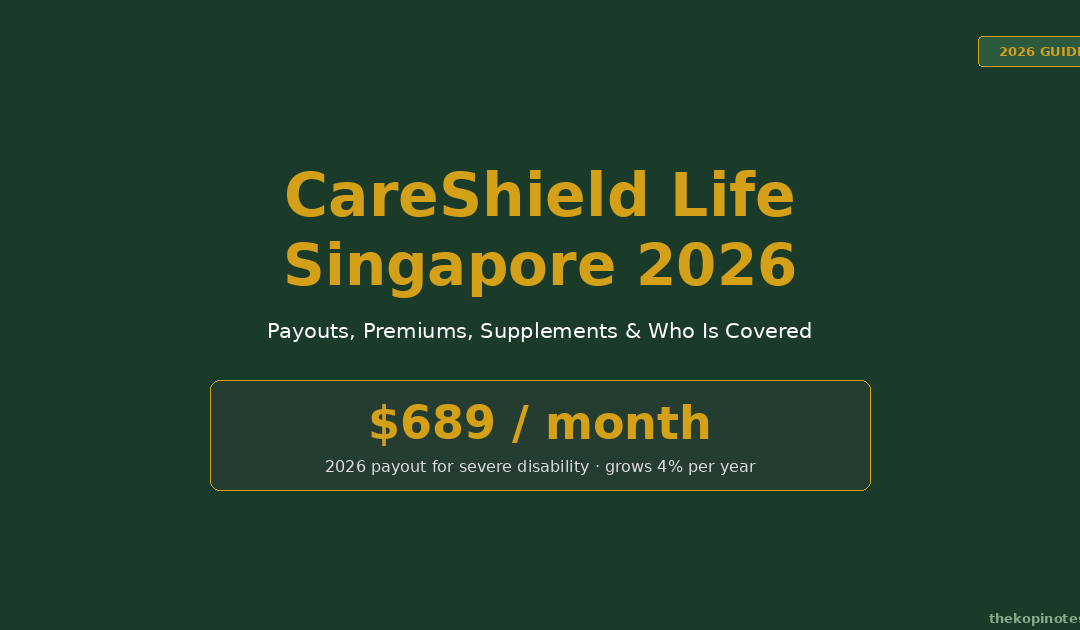
CareShield Life is Singapore’s national long-term care insurance scheme. From 2026, it pays at least $689 per month if you become severely disabled — and that payout grows at 4% per year. Premiums are fully payable by MediSave, so you never need to pay cash. Most Singaporeans born in 1980 or later are automatically enrolled when they turn 30.
Not financial advice. All figures are for educational reference only. Data verified as at 31 August 2026 against official MOH sources.
- CareShield Life pays $689/month in 2026 if you have severe disability — growing 4% per year until age 67
- Premiums increase by only ~$38/year on average (2026–2030) after $570M in government support
- You can boost your payout by buying a supplement from Great Eastern, Singlife, or Income Insurance
1. What Is CareShield Life?
CareShield Life is Singapore’s national long-term care insurance. It launched on 1 October 2020, replacing the older ElderShield scheme. Think of it as your financial safety net if you develop a severe disability in old age and can no longer look after yourself.
It does not cover hospitalisation bills. That’s the job of MediShield Life and your Integrated Shield Plan (ISP). CareShield Life is specifically for long-term care needs — nursing homes, home caregiving, day rehabilitation, and daily living support.
What counts as “severe disability”?
You qualify for a CareShield Life payout when you cannot perform at least 3 out of 6 Activities of Daily Living (ADLs):
- Washing (bathing yourself)
- Dressing (putting on clothes)
- Feeding (eating without help)
- Toileting (using the toilet)
- Walking or moving around
- Transferring (moving from bed to chair, for example)
You must be assessed by an MOH-approved assessor before you can make a claim. Once approved, payouts continue for as long as you remain severely disabled — there is no time limit.
How is it different from MediShield Life?
MediShield Life covers hospital bills. CareShield Life covers long-term care costs if you become severely disabled. You need both. Most working Singaporeans have MediShield Life (mandatory) plus an ISP on top. CareShield Life fills the separate — and often overlooked — long-term care gap.
2. Who Is Covered by CareShield Life?
Coverage depends on when you were born:
| Birth Year | Coverage Status | Notes |
|---|---|---|
| 1980 and later | Auto-enrolled at age 30 | No action needed — coverage starts automatically |
| 1970–1979 | Optional (auto on ElderShield) | Could opt in; grace period with mild/moderate disability enrollment ended Dec 2024 |
| 1969 and earlier | Optional cohort | Cohort subsidies available for long-term care services from July 2026 |
Source: Ministry of Health, CareShield Life scheme details, August 2026.
If you were born in 1980 or later, you’re already covered. Your premiums are automatically deducted from your MediSave Account once you turn 30. You don’t need to sign any forms or make any applications.
Singapore Citizens and Permanent Residents are both eligible. Foreigners are not covered under CareShield Life.
3. 2026 Payout Enhancements
The CareShield Life Council reviewed the scheme in 2025 and the government accepted all recommendations in August 2025. The biggest change: the payout growth rate doubled from 2% to 4% per year starting in 2026.
Here’s how payouts grow under the enhanced scheme:
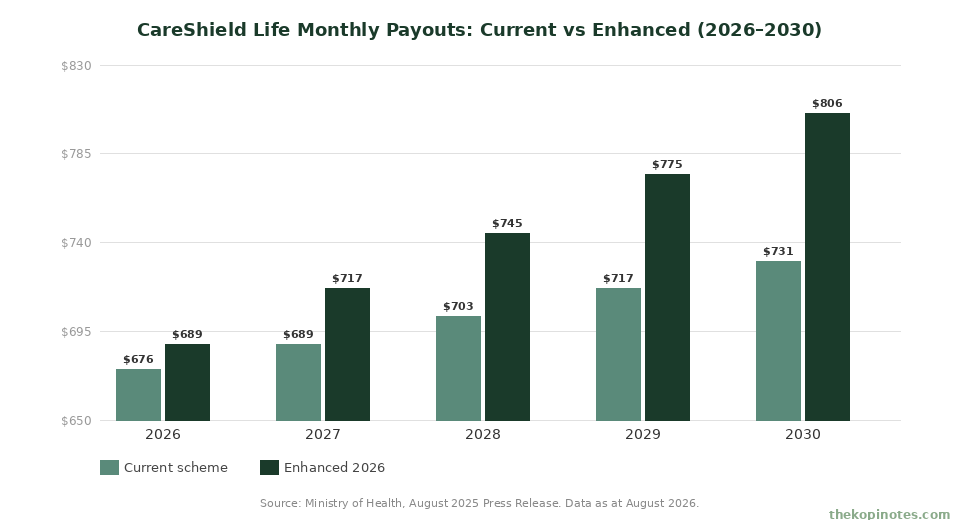
| Year | Current Scheme (2% growth) | Enhanced Scheme (4% growth) |
|---|---|---|
| 2026 | $676 | $689 |
| 2027 | $689 | $717 |
| 2028 | $703 | $745 |
| 2029 | $717 | $775 |
| 2030 | $731 | $806 |
Source: Ministry of Health, CareShield Life 2025 Review Annex A, August 2025.
When do payouts stop growing?
Your eligible payout grows every year until you reach age 67 — or until you make a claim, whichever comes first. Once either event happens, your payout is locked at that amount for life. After that, it stays the same regardless of future scheme increases.
That means a 30-year-old who develops severe disability at age 55 would receive a much larger payout than someone who only develops disability at age 68. The longer your payouts can compound before a claim, the higher your locked-in benefit.
Long-term impact of 4% growth
Under the enhanced scheme, a 30-year-old joining in 2026 who doesn’t make a claim until age 67 would receive payouts of approximately $2,324 per month. That’s more than three times the current 2026 base payout. This compounds why young Singaporeans benefit most from being enrolled early.
4. Premiums & Government Support
Higher payouts mean higher premiums. But the government is stepping in with substantial support to cushion the increase. You will see a modest rise — not a dramatic jump.
How much will your premium go up?
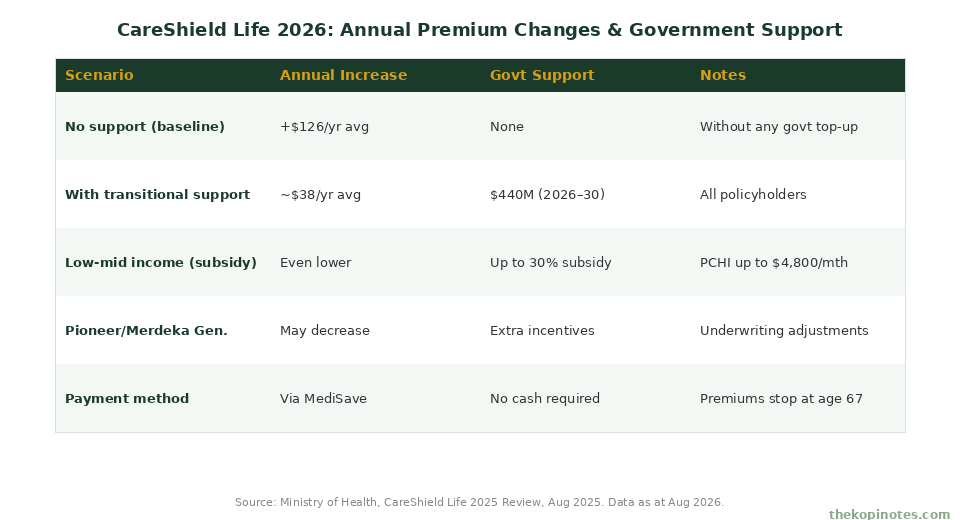
Without any government support, premiums would have risen by around $126 per year on average in 2026. With the $570 million in support the government is providing from 2026 to 2030, the actual increase is moderated to just around $38 per year on average, and never more than $75 per year.
Three layers of support
1. Broad-based transitional support ($440M): Applies to all policyholders who see a premium increase. This is automatically built into your premium — you don’t need to apply.
2. Means-tested premium subsidies ($130M+): If your per capita household income (PCHI) is $4,800 or below, you may receive subsidies of up to 30% off your base premiums. This threshold was raised from $3,600 in 2026, which means more households now qualify.
3. Additional Premium Support: If you genuinely cannot afford premiums after subsidies and without family support, you may apply for Additional Premium Support. No one loses coverage due to inability to pay.
How do you pay?
All CareShield Life premiums — base premiums and catch-up components — are fully payable by MediSave. You never need to top up with cash. Premiums automatically stop when you turn 67, or when you make a successful claim. For more on how your MediSave account works, read our MediSave contribution guide.
MediSave Care withdrawal
If you are severely disabled and have been approved for CareShield Life, you can also withdraw up to $200 per month from your MediSave Account via MediSave Care to help cover additional care costs. This is on top of your CareShield Life payout.
5. CareShield Life vs Integrated Shield Plans (ISPs)
Many Singaporeans confuse CareShield Life with Integrated Shield Plans. They serve very different purposes — and you likely need both.
| Feature | CareShield Life | Integrated Shield Plan (ISP) |
|---|---|---|
| What it covers | Long-term care (severe disability) | Hospitalisation & surgery bills |
| Payout type | Monthly cash benefit (lifelong) | Reimburses actual hospital bills |
| Trigger | Cannot perform 3+ of 6 ADLs | Hospital admission or surgery |
| Mandatory? | Yes (born 1980+) | Base plan (MediShield Life) only |
| Paid by MediSave? | Yes (100%) | Yes (base plan, partial for rider) |
| Enhanceable? | Yes (Supplements from 3 insurers) | Yes (7 insurers, various riders) |
Source: Ministry of Health, CareShield Life and ISP scheme details. Data as at August 2026.
In short: your ISP protects you when you go to hospital. CareShield Life protects you when disability prevents you from living independently. One covers the acute event; the other covers the long, slow decline. To understand more about ISPs, see our ISP comparison guide for all 7 insurers.
For the latest changes to ISP riders — including the April 2026 deductible rules — read our article on 2026 ISP rider changes and hospitalisation claim limits.
6. CareShield Life Supplements
The base CareShield Life scheme covers severe disability (3 or more ADLs lost). Three insurers offer CareShield Life Supplements that can broaden your coverage:
What supplements can do for you
- Lower the claim threshold: Some supplements pay out if you lose just 1 or 2 ADLs, not just 3
- Higher monthly payouts: Top up beyond the government scheme’s base amount
- Lump-sum benefits: Some plans offer a one-time cash benefit when you first become disabled
- Caregiver support: Some supplements include payments to family caregivers
The three supplement providers
MOH currently approves three insurers to offer CareShield Life Supplements:
- Great Eastern: GREAT CareShield supplement — one of the largest ISP insurers in Singapore, offering tiered payouts
- Singlife: CareShield supplement — from the same insurer behind Singlife Shield ISP plans
- Income Insurance: Enhanced IncomeShield supplement for long-term care — from the cooperative insurer formerly known as NTUC Income
Supplement premiums are also payable by MediSave, up to the Additional Withdrawal Limits (AWL) set by CPF. Check with each insurer directly for 2026 premium figures, as these vary by age and plan tier.
Whether you need a supplement depends on how much long-term care cost you expect your family to face, and how much you want above the government baseline. For most Singaporeans, the base scheme is a floor — not a ceiling.
7. How to Claim CareShield Life
When you or a family member believes the severe disability threshold has been met, here’s the process:
- Get assessed: Book an assessment with an MOH-approved assessor. The assessor evaluates your ability to perform the 6 ADLs.
- Submit your claim: Once assessed as severely disabled (unable to do 3+ ADLs), submit your CareShield Life claim via the CareShield Life portal or at any AIC service centre.
- Receive monthly payouts: Approved claims receive monthly payouts deposited directly to your bank account. As at 2026, the payout starts at $689 per month.
- Additional grants: From April 2026, the Home Caregiving Grant provides up to $600 per month (up from $400) for eligible policyholders with severe disability being cared for at home.
MOH is working to streamline the assessment process. From 2026, a single disability assessment for CareShield Life can simultaneously assess eligibility for related grants like the Home Caregiving Grant — so you don’t need to apply separately.
8. How to Check Your CareShield Life Coverage
You can check your CareShield Life enrolment status, premium amounts, and coverage details through these channels:
- CareShield Life website: careshieldlife.gov.sg — login with Singpass
- CPF website: Login to cpf.gov.sg under My Dashboards → Healthcare → CareShield Life
- CareShield Life premium calculator: Use TKN’s CareShield Life premium calculator to estimate your expected premiums
- AIC service centres: Visit any Agency for Integrated Care service centre with your NRIC for in-person assistance
For a broader view of your healthcare insurance coverage — including your ISP and how all the pieces fit together — see our complete ISP guide for Singapore.
FAQ: CareShield Life Singapore 2026
What is the CareShield Life payout in 2026?
The enhanced CareShield Life payout for 2026 is $689 per month. This is an increase from the previous scheme’s $676 per month in 2026. Under the enhanced scheme, payouts grow at 4% per year — double the previous 2% rate. The payout applies once a claim is approved for severe disability (inability to perform 3 or more Activities of Daily Living).
Who must pay CareShield Life premiums?
All Singapore Citizens and Permanent Residents born in 1980 or later are automatically enrolled in CareShield Life when they turn 30. Premiums are automatically deducted from your MediSave account — you don’t need to do anything. Those born in 1979 and earlier are in an optional cohort; the grace period for those with mild or moderate disabilities to enrol ended in December 2024.
How much will my CareShield Life premiums increase in 2026?
With government support, most policyholders will see an average annual premium increase of around $38 per year from 2026 to 2030, and no more than $75. Without the $570 million in government support, premiums would have risen by around $126 per year. Low-to-middle income households (PCHI up to $4,800 per month) may receive additional premium subsidies of up to 30%. All premiums remain fully payable from your MediSave account.
What is the difference between CareShield Life and an Integrated Shield Plan?
They cover different risks. CareShield Life pays monthly cash if you develop severe long-term disability (can’t do 3+ of 6 daily activities). An Integrated Shield Plan (ISP) covers your hospital bills when you are admitted for treatment. You likely need both: ISP for hospitalisation events, CareShield Life for long-term care in old age. ISP premiums also come from MediSave, and there are seven MOH-approved ISP providers.
Can I increase my CareShield Life payout beyond $689?
Yes. Three insurers — Great Eastern, Singlife, and Income Insurance — offer MOH-approved CareShield Life Supplements. These can increase your monthly payout, lower the disability threshold so you qualify with fewer ADL limitations, or add lump-sum benefits. Supplement premiums are payable from MediSave up to the Additional Withdrawal Limits set by CPF.
When do CareShield Life payouts stop growing?
Your CareShield Life payout grows by 4% each year until you reach age 67, or until you make a successful claim — whichever comes first. After that, your payout is locked at the rate in effect at that time. It does not decrease, but it also stops increasing. For example, if you make a claim at age 60, your payout is locked at the 2026 rate for someone who joined at 30 and claimed at 60.
Is CareShield Life the same as ElderShield?
No. ElderShield was the predecessor scheme that CareShield Life replaced in 2020. CareShield Life offers significantly higher payouts, a faster payout growth rate, and lifelong coverage (ElderShield had a 72-month cap). Existing ElderShield policyholders were given the option to switch to CareShield Life. If you were on ElderShield 400, you may have a catch-up premium component to pay to bring you in line with CareShield Life contributions.
Get Free Insurance Advice
Speak with a licensed insurance advisor. No obligation, no cost.
By submitting this form, you agree to our Privacy Policy.
This article was researched with the help of AI. While we strive to keep all information accurate and up to date, there may be errors. If you notice any discrepancies, please contact us.