How to Buy T-Bills in Singapore Using CPF-OA and SRS (2026 Step-by-Step Guide)
A complete guide to applying for Singapore Government T-bills through your CPF Ordinary Account, SRS, or cash — with yield comparisons and honest analysis for 2026.
Singapore T-bills are short-term government securities issued by MAS — available in 6-month and 1-year tenors — that you can buy using CPF-OA funds, SRS savings, or cash. In October 2026, the 1-year T-bill yielded 1.92% while the 6-month T-bill is expected near 2.35–2.40%. Crucially, your CPF-OA earns a guaranteed 2.50% floor rate, so this guide helps you decide whether to apply and which route to take.
Not financial advice. All figures are for educational reference only. T-bill yields change with every auction. Data as at October 2026 unless noted.
Table of Contents
Contents — Click to expand
- What Are Singapore T-Bills?
- How to Buy T-Bills Using CPF-OA (Step-by-Step)
- How to Buy T-Bills Using SRS (Step-by-Step)
- Buying T-Bills with Cash
- CPF-OA vs SRS vs Cash: Which Route Is Best?
- Current T-Bill Yields 2026 and What to Expect
- Is It Still Worth Buying T-Bills with CPF-OA?
- Key Application Dates and Deadlines
- Frequently Asked Questions
What Are Singapore T-Bills?
Singapore Treasury Bills (T-bills) are short-term debt securities issued by the Singapore Government through the Monetary Authority of Singapore (MAS). Unlike Singapore Savings Bonds (SSBs), T-bills are issued at a discount — you pay less than face value, and at maturity you receive the full face value. The difference is your return.
MAS currently issues two T-bill types: the 6-month (26-week) and the 1-year (52-week) T-bill. Auctions are held roughly every two weeks for the 6-month bill and monthly for the 1-year bill. Minimum application is SGD 1,000 with further multiples of SGD 1,000.
| Feature | 6-Month T-Bill | 1-Year T-Bill |
|---|---|---|
| Tenor | ~182 days | ~364 days |
| Auction Frequency | Bi-weekly | Monthly |
| Minimum Amount | SGD 1,000 | SGD 1,000 |
| Latest Yield (Oct 2026) | ~2.38% p.a. (est.) | 1.92% p.a. |
| Application Methods | CPF-OA, SRS, Cash | CPF-OA, SRS, Cash |
| Coupon Payments | None (discount basis) | None (discount basis) |
Source: MAS T-bill auction results, October 2026. 6M yield is an estimate based on recent auction trends.
How to Buy T-Bills Using CPF-OA (Step-by-Step)
You can invest your CPF Ordinary Account (OA) savings in T-bills through the CPF Investment Scheme (CPFIS). The process runs through three banks: DBS, OCBC, and UOB — via their ATMs or internet banking platforms. Your CPF-OA funds must first be in a CPF-OA investment account (CPFIA) with one of these banks before you can apply.
Before you start: MAS requires you to retain at least SGD 20,000 in your CPF-OA at all times. Only funds above this threshold can be invested in T-bills via CPFIS.
Step-by-Step: CPF-OA T-Bill Application
- Open a CPFIS Investment Account — if you don’t already have one, open a CPFIA with DBS, OCBC, or UOB. This is a one-time setup step, done in person or online with your bank.
- Transfer funds from CPF-OA to CPFIA — log in to your bank’s internet banking portal and transfer the amount you wish to invest (above your SGD 20,000 retained balance) from your CPF-OA into your CPFIA.
- Apply via bank ATM or internet banking — during the T-bill auction window (typically 6–10 business days before the issue date), log in to your DBS/OCBC/UOB internet banking. Navigate to Investments → Singapore Government Securities (SGS) → T-Bills and submit your application. Select Non-Competitive Bid for guaranteed allotment.
- Wait for allotment — on the issue date, MAS allocates T-bills. Non-competitive bids are always fully allotted. Any unallocated funds are returned to your CPFIA.
- At maturity — the face value (SGD 1,000 per unit) is credited back to your CPFIA, which you can then transfer back to CPF-OA.
Key tip: Always select Non-Competitive Bid when applying with CPF-OA funds. Competitive bids carry the risk of being cut off if your bid yield is too low. For CPFIS applications, non-competitive bids guarantee full allotment at the weighted average cut-off yield.
How to Buy T-Bills Using SRS (Step-by-Step)
If you have a Supplementary Retirement Scheme (SRS) account, you can also invest your SRS savings in T-bills. This is one of the most compelling use cases for idle SRS funds — your SRS bank pays a negligible 0.05% on cash balances, while T-bills offer significantly higher returns. For a deeper look at SRS investment platforms, see the passive income Singapore guide on TKN.
SRS T-Bill Application Steps
- Log in to your SRS operator’s platform — your SRS account is held at DBS, OCBC, or UOB. Access their internet banking with your SRS account credentials.
- Navigate to SGS / T-Bill applications — under Investments → Government Securities, select T-Bills. The same application window applies as cash applications.
- Enter amount and bid type — enter the amount (multiples of SGD 1,000) and choose Non-Competitive Bid. SRS funds are debited immediately upon application.
- Confirm and submit — review and confirm. You’ll receive a confirmation and await the issue date allotment.
- At maturity — proceeds (principal + discount return) are credited back to your SRS account.
Your SRS T-bill returns are sheltered within the SRS wrapper — no tax is payable until you withdraw from SRS, and withdrawals after age 62 are taxed at 50% of your prevailing income tax rate. This makes SRS T-bills highly tax-efficient for high-income earners.
Buying T-Bills with Cash
Cash T-bill applications can be made through DBS, OCBC, or UOB internet banking, or via ATMs. You will need an individual CDP (Central Depository) account linked to one of these banks. The process is straightforward:
- Log in to your bank’s internet banking → Investments → T-Bills
- Enter amount (min SGD 1,000), select tenor (6M or 1Y), choose Non-Competitive Bid
- Confirm. Funds are debited from your bank account.
- At maturity, face value is credited to your linked bank account.
Cash applications also work through the SGX website and via MAS’s primary dealer network. For a full step-by-step on cash SGS applications, see the Singapore T-bills 2026 guide.
CPF-OA vs SRS vs Cash: Which Route Is Best?
The right application route depends on where your idle funds are sitting and your tax situation. The chart below summarises the key comparison across all three methods.
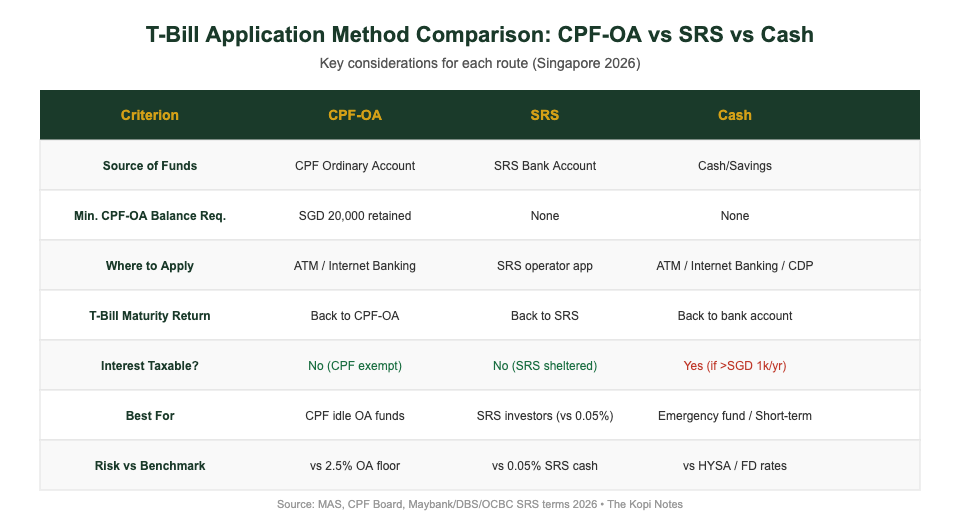
Source: MAS, CPF Board, DBS/OCBC/UOB SRS terms 2026. The Kopi Notes.
| Route | Opportunity Cost Benchmark | Tax Treatment | Verdict |
|---|---|---|---|
| CPF-OA | 2.50% p.a. (CPF-OA floor) | CPF-exempt | ⚠ Situational |
| SRS | 0.05% p.a. (SRS bank cash) | Tax-deferred to withdrawal | ✅ Recommended |
| Cash | 0.5–3.5% (HYSA / FD rates) | Taxable if >SGD 1k/yr interest | ✅ Good for idle cash |
Source: CPF Board 2026, MAS 2026, DBS/OCBC/UOB published rates. The Kopi Notes.
Current T-Bill Yields 2026 and What to Expect
T-bill yields in Singapore have trended downward from their 2023 highs of over 4%. In the current easing rate environment, yields have compressed significantly — the October 2026 1-year T-bill cleared at 1.92%, a multi-year low. The 6-month T-bill typically carries a slightly higher yield due to the inverted curve, with recent auctions settling around 2.35–2.40%.
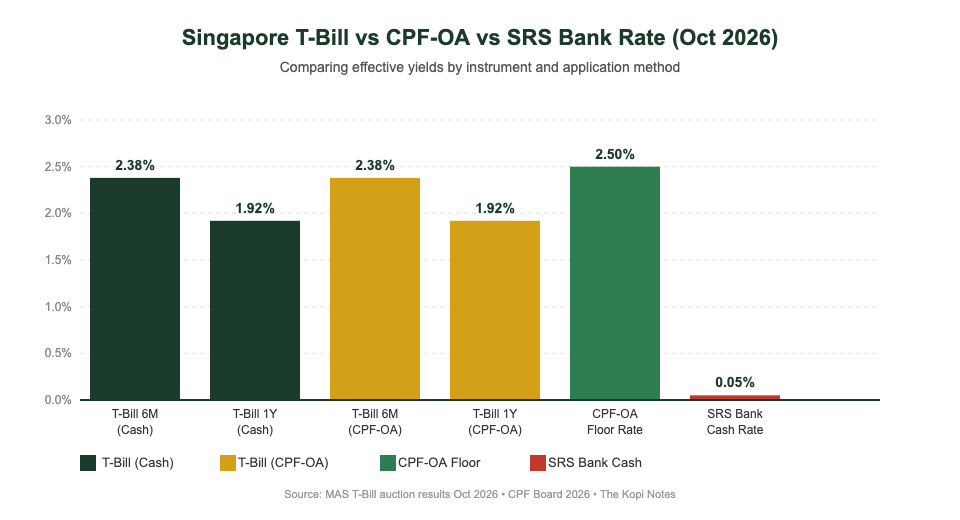
Source: MAS T-bill auction results October 2026. CPF Board 2026 rate. The Kopi Notes.
For the upcoming 6-month T-bill on 22 October 2026, market expectations point to a cut-off yield around 2.30–2.45%. You can track the latest auction announcement and results at the MAS SGS website.
Is It Still Worth Buying T-Bills with CPF-OA?
This is the most important question for 2026. With the 1-year T-bill yield at 1.92% and the CPF-OA floor rate at 2.50%, using CPF-OA to buy 1-year T-bills is no longer beneficial — you would earn less than the guaranteed CPF-OA rate. For the 6-month T-bill, with yields around 2.38%, you are still marginally below the 2.50% CPF-OA floor.
The calculus changes if you believe T-bill yields will rebound — but you would need to successfully time multiple auctions for this to pay off. For most investors, the CPF-OA T-bill application is best skipped in the current environment unless yields rise clearly above 2.50%.
However, for SRS investors, T-bills remain highly attractive. Your SRS cash sits at 0.05% in your bank — any T-bill yield above this (even 1.92%) represents a massive improvement. For retirement planning in Singapore, maximising SRS returns is critical. Pair your T-bill strategy with a Singapore retirement calculator to model your overall retirement income picture.
For cash applications, compare T-bill yields against current fixed deposit and HYSA rates. With some banks offering FDs at 2.0–2.5% for 6-12 month tenors, T-bills may still offer competitive or better returns — check the Singapore T-bills 2026 guide for a full comparison. Platforms like Endowus (referral code 2V343) and FSMOne (code P0544985) also offer fixed income funds and cash management accounts that may outperform T-bills in the current environment.
Key Application Dates and Deadlines 2026
T-bill application windows typically open about 6–10 business days before the issue date and close on the closing date (usually 9pm on a Tuesday). Check the MAS issuance calendar for all upcoming auction dates.
| Milestone | Typical Timing | Action |
|---|---|---|
| Auction Announcement | ~10 business days before issue | Check MAS website for offer details |
| Application Window Opens | ~7 business days before issue | Submit via bank/ATM/internet banking |
| Application Closes | Tuesday, 9:00pm | All bids must be submitted by this time |
| Auction / Allotment | Thursday | MAS publishes results; unallocated funds returned |
| Issue Date / Maturity (6M) | Following Thursday + 182 days | Face value credited to your account |
Source: MAS SGS issuance procedures 2026. Exact dates vary — always confirm on the MAS website. The Kopi Notes.
For a broader view of how T-bills fit into your fixed income strategy, the Singapore Savings Bonds guide covers the complementary SSB instrument, which offers more flexibility for retail savers. You can also compare platforms via the Syfe referral code page (code SRPRFFFCD) if you prefer a managed approach to fixed income within SRS.
Frequently Asked Questions
Can I buy Singapore T-bills using CPF-OA funds?
Yes. Singapore T-bills are an approved investment under the CPF Investment Scheme (CPFIS). You apply through your bank’s internet banking (DBS, OCBC, or UOB) using funds from your CPF Investment Account (CPFIA), which is linked to your CPF-OA. You must retain at least SGD 20,000 in your CPF-OA and can only invest funds above this threshold.
Should I use CPF-OA to buy T-bills when yields are below 2.50%?
Generally no. Your CPF-OA earns a guaranteed floor rate of 2.50% per annum. If the T-bill cut-off yield is below 2.50% — as is the case in October 2026 (1-year T-bill at 1.92%) — you would earn less by investing in T-bills than by leaving your CPF-OA untouched. Only consider CPF-OA T-bill applications when T-bill yields exceed the CPF-OA floor rate. Monitor yields at the MAS website before each auction.
How do I apply for T-bills using my SRS account?
Log in to your SRS operator’s internet banking (DBS, OCBC, or UOB) and navigate to Investments → Government Securities → T-Bills. Select the tenor (6-month or 1-year), enter the amount in multiples of SGD 1,000, choose a Non-Competitive Bid, and submit. Your SRS funds will be debited and at maturity the proceeds are credited back to your SRS account. SRS T-bill returns are tax-deferred until withdrawal.
What is the difference between a competitive and non-competitive T-bill bid?
A non-competitive bid means you accept whatever the weighted average cut-off yield turns out to be at auction — and your application is guaranteed to be fully allotted. A competitive bid means you specify a minimum yield you are willing to accept; if your bid is too low relative to the auction cut-off, you may not receive any T-bills. For most retail investors, especially those using CPF-OA or SRS, a non-competitive bid is recommended as it guarantees allotment without yield risk.
What happens to my CPF-OA T-bill at maturity?
At maturity, the face value of your T-bill (SGD 1,000 per unit) is credited to your CPF Investment Account (CPFIA). You then need to log in to your bank’s internet banking and transfer the proceeds back to your CPF-OA if you wish. The funds do not automatically return to your CPF-OA — you must initiate the transfer. Until you transfer them back, the funds sit in your CPFIA earning no interest, so act promptly after maturity.
Are T-bill returns taxable in Singapore?
T-bill returns for Singapore residents are generally subject to income tax if they exceed SGD 1,000 per year in total interest income — the same threshold as bank deposit interest. However, T-bill returns earned through CPF-OA are entirely exempt from tax (as CPF income is tax-exempt). Returns within an SRS account are tax-deferred until you make withdrawals from SRS. If you are applying with cash and your total interest income (from T-bills, savings accounts, fixed deposits, and bonds) exceeds SGD 1,000 in a year, you must declare and pay tax on the excess.
This article was researched with the help of AI. While we strive to keep all information accurate and up to date, there may be errors. If you notice any discrepancies, please contact us.