Shield Plan Singapore: Complete Guide (2026)
Everything you need to know about MediShield Life, Integrated Shield Plans, the new 2026 rider rules, and how to pick the right plan for your family.
A shield plan in Singapore is a health insurance policy built on top of MediShield Life. MediShield Life is the compulsory base layer that every Singapore Citizen and Permanent Resident has. An Integrated Shield Plan (ISP) extends that coverage to higher ward classes or private hospitals. As of April 2026, new ISP riders no longer cover the minimum deductible — but premiums have dropped by around 30% as a result.
Not financial advice. All figures are for educational reference only. Data as at June 2026 unless noted.
- MediShield Life covers public hospital B2/C wards only. If you want B1 or private hospital coverage, you need an ISP from one of 7 approved insurers.
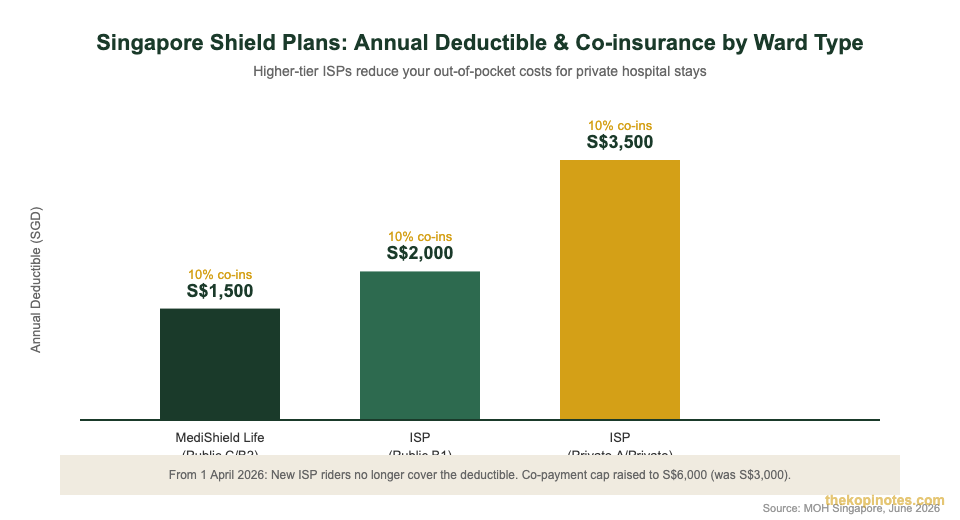
- From April 2026, new ISP riders no longer cover the deductible (S$1,500–S$3,500 depending on ward). You pay that first before insurance kicks in.
- If you bought your old rider before 27 November 2025, you’re grandfathered until your first renewal after 1 April 2028.
Table of Contents
Contents — Click to expand
What Is a Shield Plan?
A shield plan is Singapore’s term for hospitalisation insurance. It combines two layers: MediShield Life (the compulsory national base plan) and an optional Integrated Shield Plan (ISP) upgrade offered by private insurers.
Think of it this way. MediShield Life is like the basic phone plan every Singaporean gets automatically. An ISP is the optional add-on that gives you a better “plan” — in this case, access to restructured hospital B1 wards, private hospitals, or specialist care without paying entirely out of pocket.
There are 7 private insurers approved by the Ministry of Health (MOH) to offer ISPs. They are: AIA, Great Eastern, NTUC Income, Prudential, Singlife, Raffles Health Insurance, and HSBC Life. Each insurer offers multiple tiers, typically aligned to B1, A, and Private ward classes.
The shield plan you hold affects how much you pay when you’re hospitalised, which hospitals you can use, and how much cash you need upfront before your insurer reimburses you.
MediShield Life: The Base Layer
MediShield Life is mandatory for all Singapore Citizens and Permanent Residents. Premiums are paid from your Medisave account, so you don’t notice a cash deduction from your salary.
Here’s what MediShield Life covers and doesn’t cover:
| Feature | MediShield Life Coverage |
|---|---|
| Ward Class Covered | Public hospital B2 and C wards |
| Annual Deductible | S$1,500 (B2) to S$2,000 (B1 if using ISP) |
| Co-insurance | 10% of subsidised bills (after deductible) |
| Annual Claim Limit | S$150,000 |
| Lifetime Claim Limit | Unlimited |
| Premium Payment | Medisave (no cash needed) |
| Private Hospital Coverage | Not covered |
Source: MOH Singapore MediShield Life Scheme, June 2026
The key limitation: if you stay in a B1, A, or private ward, MediShield Life only pays what it would have cost at a subsidised B2 ward. You pay the rest out of pocket — often tens of thousands of dollars. That’s where an ISP becomes valuable.
Integrated Shield Plans (ISPs) Explained
An Integrated Shield Plan sits on top of MediShield Life. When you buy an ISP, your insurer takes over the full premium collection — they pay CPF for the MediShield Life portion and keep the rest as their ISP premium. You don’t hold two separate policies.
The ISP covers the gap between what MediShield Life pays and what your actual bill is. For example, if you’re admitted to a private hospital and your bill is S$15,000, MediShield Life might cover S$3,000 of that (based on public B2 rates). Your ISP covers the remaining S$12,000 — minus your deductible and co-insurance.
ISPs also come with optional riders. A rider is a supplementary policy that reduces or eliminates your deductible and co-insurance payments. However, as of April 2026, the rules around riders have changed significantly (more on this below).
The 7 ISPs in Singapore (2026 Comparison)
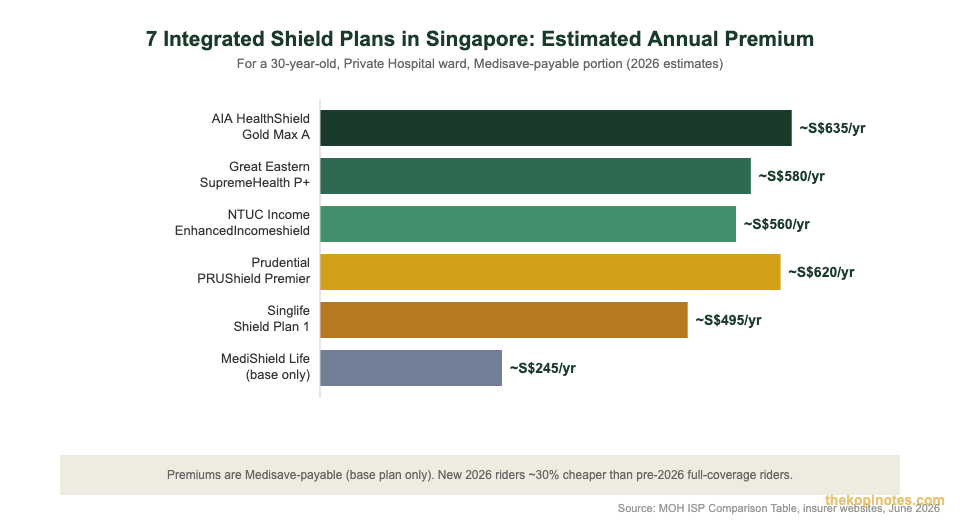
MOH approves exactly 7 insurers to offer ISPs. Here’s an overview of each, with their flagship private hospital plan tier:
| Insurer | Plan Name | Private Hospital Tier | Est. Annual Premium (Age 30) | Key Strength |
|---|---|---|---|---|
| AIA | HealthShield Gold Max A | Private | ~S$635/yr | Largest panel of private hospitals |
| Great Eastern | GREAT SupremeHealth P Plus | Private | ~S$580/yr | Strong panel for specialists |
| NTUC Income | Enhanced IncomeShield Preferred | Private | ~S$560/yr | Cooperative insurer, stable premiums |
| Prudential | PRUShield Premier | Private | ~S$620/yr | Strong brand trust, wide agent network |
| Singlife | Shield Plan 1 | Private | ~S$495/yr | Competitive pricing, digital-first |
| Raffles Health | Raffles Shield Private | Private | ~S$510/yr | Raffles Hospital network focus |
| HSBC Life | HSBC Life Shield Plan A | Private | ~S$520/yr | Strong panel access, newer entrant |
Source: MOH ISP Comparison Table & insurer websites, June 2026. Premiums are indicative for a 30-year-old, Medisave-payable base plan only.
You can find the full premium comparison table at MOH’s official ISP comparison page.
2026 Rider Changes: What Changed and Why
This is the biggest ISP shake-up since 2018. From 1 April 2026, MOH changed the rules for new ISP riders sold in Singapore. Here’s what happened in plain English.
The old system (pre-April 2026): You could buy a rider that paid your deductible AND capped your co-insurance at S$3,000 per year. That meant zero out-of-pocket for most hospital stays. Your rider absorbed every dollar above what MediShield Life paid.
The problem MOH identified: When you pay nothing out of pocket, you’re less cost-conscious about healthcare choices. This led to higher healthcare utilisation, over-servicing, and spiralling claims — which pushed ISP premiums up year after year.
What changed from April 2026:
- New riders can no longer cover the minimum deductible (S$1,500–S$3,500 depending on ward). You must pay this yourself first.
- The co-payment cap is raised from S$3,000 to S$6,000 per year. So in a worst case, you pay S$3,500 deductible + S$6,000 co-payment = S$9,500 out of pocket before your rider fully kicks in.
- In exchange: new rider premiums are roughly 30% cheaper on average than the old full-coverage riders.
The practical impact: if you’re admitted to a private hospital for a straightforward procedure costing S$12,000, you might now need to pay S$3,500 (deductible) upfront, and then 10% co-insurance on the remaining amount — up to that S$6,000 cap. Budget accordingly, especially if you’re relying on private hospital care.
For a more detailed breakdown of how these rider changes affect your wallet, see our article on the ISP rider changes 2026 Singapore guide.
How to Choose the Right Shield Plan
Choosing the right shield plan comes down to three questions: which hospital you want access to, how much out-of-pocket you can absorb, and your budget for premiums.
Step 1: Choose your ward class target.
This is the single most important decision. Your ISP tier determines which hospitals and wards your coverage is benchmarked against.
- B2/C (MediShield Life only) — public hospital subsidised wards. Zero extra premium. Suitable if you’re comfortable with shared wards and fully subsidised public hospital care.
- B1 (ISP B1 tier) — public hospital restructured B1 wards (air-conditioned, more privacy). Cost-efficient upgrade from base plan.
- A ward (ISP A tier) — single-bedded A wards in public hospitals. More privacy, faster specialist access in public hospitals.
- Private hospital (ISP Private tier) — full private hospital coverage including Mount Elizabeth, Gleneagles, Parkway East, Raffles Hospital, and Thomson Medical.
Step 2: Decide on a rider (and understand the 2026 rules).
Under the new 2026 rules, even with a rider, you’ll pay at least S$1,500–S$3,500 per admission as the deductible. If you have cash savings to cover this, a rider still makes sense to cap your annual exposure at S$6,000. If you’d rather keep premiums low and self-insure the deductible risk, skipping the rider is a legitimate choice for younger, healthier individuals.
Step 3: Compare the 7 ISPs for your chosen tier.
Once you know your target ward class, compare the 7 approved ISPs on our shield plan comparison Singapore 2026 guide, which has a full side-by-side table of premiums, panel doctors, and deductibles.
Step 4: Think about your family stage.
If you have young children or are planning to start a family, coverage for delivery and neonatal conditions may matter. If you’re older, consider how premiums escalate with age (ISP premiums jump significantly at 40, 50, and 65). Tools like the Singapore retirement calculator can help you model long-term insurance costs alongside your investment savings.
What Does a Shield Plan Cost?
Your shield plan premium has two parts: the MediShield Life premium (paid from Medisave) and the additional ISP premium (partly Medisave, partly cash depending on the tier). Rider premiums must be paid in cash — you cannot use Medisave for riders.
| Age Group | MediShield Life Premium (Medisave) | ISP Additional Premium (Private tier, est.) | Total Annual Cost (Base plan) |
|---|---|---|---|
| Age 26–30 | ~S$175/yr | ~S$320–460/yr | ~S$495–635/yr |
| Age 36–40 | ~S$280/yr | ~S$380–530/yr | ~S$660–810/yr |
| Age 46–50 | ~S$590/yr | ~S$700–950/yr | ~S$1,290–1,540/yr |
| Age 56–60 | ~S$1,100/yr | ~S$1,200–1,800/yr | ~S$2,300–2,900/yr |
Source: MOH MediShield Life premium schedule & insurer websites, June 2026. Figures are estimates; exact premiums vary by insurer and health declaration.
Key point: premiums rise steeply after age 50. If cost is a concern later in life, locking in an ISP while you’re young and healthy matters — because switching plans when you’re older and have pre-existing conditions may mean exclusions or premium loading.
Medisave can cover the base ISP premium up to the Additional Withdrawal Limit (AWL). For 2026, the AWL ranges from S$300 to S$600 per year depending on age. Anything above the AWL must be paid in cash.
How Shield Plan Claims Work
Singapore uses a direct billing system. If you’re admitted to a panel hospital, your insurer pays the hospital directly — you only settle the deductible and co-insurance portion at discharge.
Here’s the typical flow:
- You’re admitted to a hospital on your ISP’s panel.
- Give the admissions desk your NRIC and insurance details. They verify your cover directly with your insurer.
- Your insurer approves a pre-authorisation (usually within hours for planned procedures).
- At discharge, you pay only your deductible + co-insurance (or just co-insurance if deductible was already met that year).
- Your insurer settles the rest with the hospital directly.
If you visit a non-panel hospital or specialist, you’ll typically need to pay the full bill first and submit a reimbursement claim later. Reimbursement is slower (4–8 weeks) and may be capped at the panel rate.
For major procedures, get a cost estimate from your specialist first. Some insurers require pre-authorisation for surgeries above a certain cost threshold — check your policy documents for the exact limit.
Your shield plan premiums are also relevant to your overall financial planning. If you’re thinking about how insurance costs fit into your CPF investment strategy, or whether to use SRS funds to invest alongside paying insurance premiums, it’s worth mapping out the full picture. Platforms like Endowus (referral code: 2V343) let you invest your CPF OA and SRS money in a diversified portfolio while your ISP handles the hospitalisation risk.
Not financial advice. All ISP data is for educational reference only. Speak to a licensed financial adviser before making any insurance decisions. Data as at June 2026.
Frequently Asked Questions
What is a shield plan in Singapore?
A shield plan is Singapore’s term for hospitalisation insurance. It refers to MediShield Life (the compulsory national base plan) and the optional Integrated Shield Plans (ISPs) that sit on top of it. MediShield Life covers public B2/C ward stays. An ISP extends your coverage to B1, A, or private hospital wards. All Singapore Citizens and PRs are automatically enrolled in MediShield Life; upgrading to an ISP is optional but recommended for private hospital access.
Do I need a shield plan if I already have MediShield Life?
MediShield Life is sufficient if you’re comfortable with public hospital B2 or C ward treatment and don’t mind shared wards. However, if you want access to B1, single-bedded A wards, or private hospitals, you need an ISP. Private hospital bills can run S$10,000–S$50,000+ for major procedures — without an ISP, you pay that difference entirely out of pocket. Most financial advisers recommend at least a B1-class ISP for working Singaporeans.
What changed about shield plan riders in April 2026?
From 1 April 2026, new ISP riders can no longer cover the minimum deductible (S$1,500–S$3,500 depending on ward class). Previously, you could buy a rider that paid your deductible for you, meaning zero out of pocket. The co-payment cap has also increased from S$3,000 to S$6,000. In exchange, new rider premiums are about 30% cheaper. If you bought your rider before 27 November 2025, you’re grandfathered on the old terms until your first renewal after 1 April 2028.
Which is the best shield plan in Singapore for 2026?
There’s no single “best” shield plan — it depends on the ward class you want, your budget, and which hospitals or specialists you prefer. Singlife Shield Plan 1 is often cited as the most competitively priced private hospital ISP. AIA HealthShield Gold Max A has one of the widest private hospital panels. Great Eastern SupremeHealth P Plus has strong specialist network access. Compare the full premium tables on MOH’s website or use our shield plan comparison Singapore 2026 article for a side-by-side breakdown.
Can I use Medisave to pay for a shield plan?
Yes — the MediShield Life premium and the basic ISP additional premium are payable from your Medisave account, up to the Additional Withdrawal Limit (AWL) per year. For 2026, the AWL ranges from around S$300 to S$600 annually depending on your age. If your ISP premium exceeds the AWL, you pay the difference in cash. Rider premiums are entirely cash-only — Medisave cannot be used to pay for riders.
Can I switch shield plan providers in Singapore?
Yes, you can switch ISP providers. However, your new insurer may apply exclusions or premium loading for any pre-existing conditions declared at the time of application. If you switch while healthy, the process is straightforward — apply with the new insurer, and upon approval, cancel the old policy. Never cancel your old plan before your new one is confirmed and active. Switching is more complex if you have ongoing treatments or recent hospitalisations, as the new insurer may exclude those conditions.
What is the difference between a shield plan and critical illness insurance?
A shield plan covers hospitalisation bills — it pays the hospital directly when you’re admitted. Critical illness (CI) insurance is a separate lump-sum payout triggered by a diagnosis of a covered condition (e.g. cancer, heart attack, stroke). The two serve different purposes. Your shield plan covers the immediate hospital bill; your CI payout covers income replacement, rehabilitation, and lifestyle expenses during recovery. Most comprehensive financial plans include both. For more on CI insurance in Singapore, see our guide to ISP rider changes 2026 and the broader insurance landscape.
Compare All 7 Shield Plans Side-by-Side
See our full comparison table with premiums, deductibles, and panel hospitals for every ISP in Singapore.
Get Free Insurance Advice
Speak with a licensed insurance advisor. No obligation, no cost.
By submitting this form, you agree to our Privacy Policy.
This article was researched with the help of AI. While we strive to keep all information accurate and up to date, there may be errors. If you notice any discrepancies, please contact us.