Can You Use MediSave for Your Integrated Shield Plan Deductible in 2026?
The exact withdrawal limits for ISP premiums and claims, what changed under the new rider rules, and two real MOH worked examples.
Yes — MediSave can pay both your Integrated Shield Plan (ISP) premium and, separately, your deductible and co-payment when you’re hospitalised, subject to two different withdrawal limits. Since 1 April 2026, new ISP riders no longer cover the deductible, so more of that claim now runs through MediSave (or your own cash) instead of being absorbed entirely by your rider.
Not financial advice. All figures are for educational reference only. Data verified as at 12 August 2026 against the Ministry of Health’s official Integrated Shield Plan pages and MOH’s 26 November 2025 press release on the IP rider reforms.
- Your MediShield Life premium is fully payable by MediSave. The extra ISP premium is MediSave-payable too, but only up to $300–$900 a year depending on your age.
- Your deductible and co-payment (what you pay when you’re actually hospitalised) run through a separate, usually higher, MediSave claims withdrawal limit — not the premium limit above.
- Since April 2026, new riders no longer cover the deductible. MediSave can still help pay it, but you should keep more cash on hand than before.
Table of Contents
How MediSave Works With Your Shield Plan
Your Integrated Shield Plan is really two things stacked together. MediShield Life sits at the base — it’s compulsory, and CPF Board runs it. Your private insurer’s “additional” coverage sits on top, extending you to B1, A, or private hospital wards.
MediSave treats these two layers differently. According to MOH, the MediShield Life component of your ISP is fully payable by MediSave — no cap. The additional private insurance component is also MediSave-payable, but only up to your Additional Withdrawal Limit (AWL): $300 a year if you’re 40 or below, $600 if you’re 41 to 70, and $900 if you’re 71 or above. Anything above that comes out of your own pocket in cash.
That covers your premium. But what happens when you actually get hospitalised and need to claim? That’s a separate question, and it’s where most people get confused — including, often, the deductible and co-payment.
If you haven’t already, it’s worth reading our guide on using MediSave to pay your Integrated Shield Plan premium first — this article picks up where that one leaves off, focused specifically on what happens when you file a claim.
2026 Minimum IP Deductibles by Ward Class
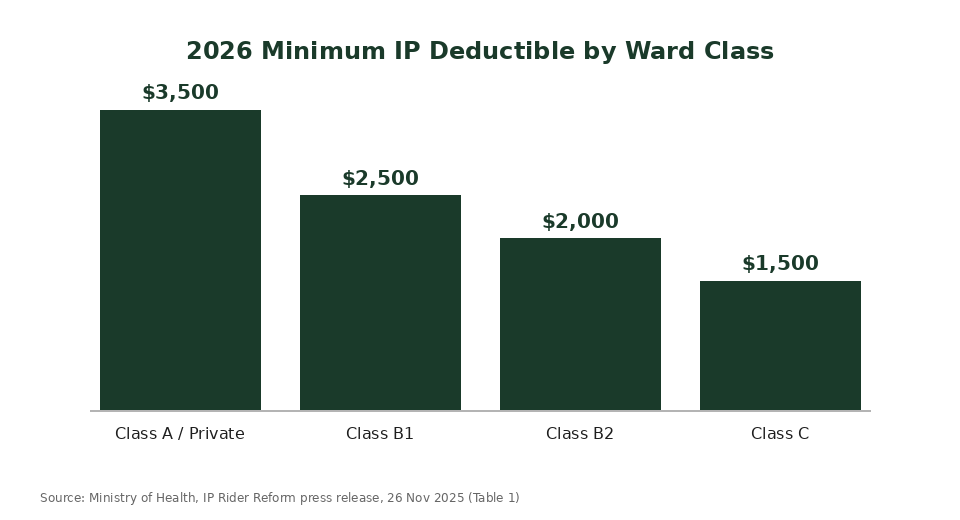
MOH sets a minimum deductible that every ISP must impose before insurance pays out. Think of the deductible as the first slice of your bill that you always pay yourself, once per policy year — it applies before your co-payment kicks in.
The amount depends on the ward class you’re targeting, or the ward class you actually use if it’s lower:
| Ward Class | Minimum Deductible |
|---|---|
| Class A / Private | $3,500 |
| Class B1 | $2,500 |
| Class B2 | $2,000 |
| Class C | $1,500 |
Source: Ministry of Health, IP Rider Reform press release, 26 November 2025 (Table 1). Day surgery deductibles are lower: $2,000 non-subsidised, $1,500 subsidised.
Here’s the part that matters for MediSave: the deductible and any co-payment above it “can be paid using MediSave, subject to prevailing withdrawal limits,” per MOH’s own wording. So MediSave doesn’t just cover premiums — it can cover the bill you face when you’re actually admitted, up to the claims withdrawal limit set for that hospitalisation or procedure.
The April 2026 Rider Reform: What Changed
This is the biggest shift to ISP riders since 2018, and it’s the reason this question (“can MediSave cover my deductible now?”) suddenly matters more than it used to.
Before 1 April 2026: a rider could pay your deductible in full and cap your yearly co-payment at a minimum of $3,000. For many policyholders, that meant close to zero cash out-of-pocket for a hospital stay.
From 1 April 2026: new riders sold can no longer cover the minimum IP deductible at all. You pay that first, yourself. The co-payment cap has also been raised, from a minimum of $3,000 to a minimum of $6,000 a year (this cap excludes the deductible itself). The 5% minimum co-payment rate is unchanged.
Why did MOH do this? Its data shows private hospital IP policyholders with riders are 1.4 times as likely to make a claim, with claims averaging 1.4 times larger, than policyholders without riders. Near-zero out-of-pocket cost was fuelling over-servicing and over-consumption, which pushed up bill sizes — and, in turn, premiums for everyone. In exchange for less generous riders, MOH expects new rider premiums to be around 30% cheaper on average, saving roughly $600 a year for private hospital rider holders and $200 a year for public hospital rider holders.
Are you grandfathered? If you bought your rider before 27 November 2025, your existing deductible coverage and $3,000 co-payment cap stay intact until your first policy renewal after 1 April 2028. If you bought between 27 November 2025 and 31 March 2026, the same transition timeline applies to you. Insurers stopped selling non-compliant riders from 1 April 2026 onward.
For the full breakdown of the reform itself, see our guide to the ISP rider changes in 2026. For how this fits into the bigger shield plan picture, our Shield Plan Singapore guide covers MediShield Life, all 7 insurers, and how to choose a plan.
Two Real MOH Worked Examples
MOH published two worked examples alongside the reform. Both show exactly how much of a real hospital bill runs through MediSave versus cash — which is far more useful than a general rule of thumb.
Case 1: Mr A, age 60, private hospital, knee replacement
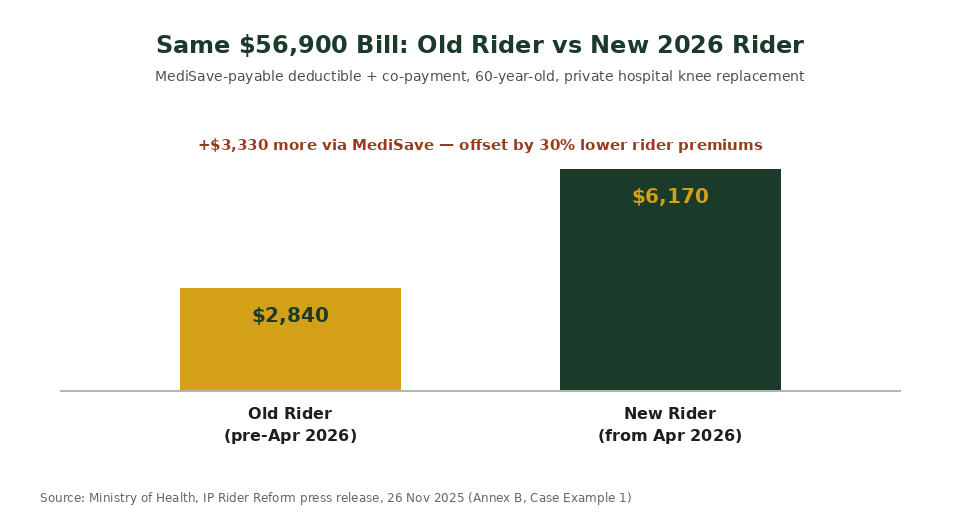
Mr A switches to the new rider in April 2026 and immediately saves 30% in premiums, worth $1,600 cash that year. Three years later, he has knee joint replacement surgery in a private hospital, with a bill of $56,900.
| Item | Old Rider (pre-2026) | New Rider (2026) |
|---|---|---|
| Bill size | $56,900 | $56,900 |
| Deductible + co-payment paid (via MediSave) | $2,840 | $6,170 |
| 3-year rider premium savings (cash) | — | $4,800 |
Source: Ministry of Health, IP Rider Reform press release, 26 November 2025 (Annex B, Case Example 1).
Mr A pays $3,330 more via MediSave for this claim under the new rider. But he had already banked $4,800 in cash premium savings over the prior three years — so he still comes out ahead overall, even though his MediSave claim payout is bigger this time.
Case 2: Mrs B, age 40, private hospital, ACL reconstruction
Mrs B never bought a rider before — premiums felt too expensive. With the cheaper new riders, she adds one in April 2026, paying $500 less a year than peers who bought riders under the old system. In December 2026, she tears her ACL and needs reconstruction surgery, billed at $38,700.
Her deductible and co-payment come to $5,260 ($3,500 deductible + $1,760 co-payment). Of that, $3,900 is covered by MediSave, based on applicable withdrawal limits — leaving her with $1,360 in cash. Without a rider at all, her out-of-pocket cash would have been $3,120 instead.
Source: Ministry of Health, IP Rider Reform press release, 26 November 2025 (Annex B, Case Example 2).
MediSave for Premiums vs Claims: Don’t Mix Them Up
This is where most people trip up, so it’s worth spelling out plainly. There are three completely separate MediSave rules at play in your shield plan:
1. Paying your ISP premium. MediShield Life premium: fully payable by MediSave. Additional private insurer premium: MediSave-payable up to your Additional Withdrawal Limit (AWL) — $300 to $900 a year depending on age. Anything above the AWL is cash. We cover this in full in our MediSave ISP premium AWL guide.
2. Paying your rider premium. Rider premiums are cash-only. You cannot use MediSave for a rider premium at all, regardless of your age or AWL. This has been the rule since riders were reformed in 2021, and it hasn’t changed in 2026.
3. Paying your deductible and co-payment when you claim. This is what this article is about. When you’re actually hospitalised, your deductible and co-payment can be paid using MediSave, subject to a separate claims withdrawal limit tied to the specific hospitalisation or procedure — not your annual premium AWL. That’s why Mr A’s $6,170 in Case 1 above could be “entirely covered by MediSave,” even though $6,170 is far more than his $600 annual premium AWL. The two limits are unrelated.
If you’re paying for a parent’s or spouse’s ISP rather than your own, the same three-way split applies — you can read the specifics in our guide on using MediSave for a family member’s ISP premium.
How Much Cash Should You Set Aside?
In the worst case, your out-of-pocket exposure under a new 2026 rider is your ward class deductible ($1,500–$3,500) plus up to $6,000 in co-payment — a maximum of roughly $9,500 in a bad year, before your rider fully takes over. MediSave will cover a large chunk of that if you have sufficient claims withdrawal limit available, but you shouldn’t assume it covers everything automatically.
A practical approach: keep at least $3,500–$6,000 in accessible cash savings (on top of your MediSave balance) specifically earmarked for a possible hospital admission, especially if you hold a private hospital IP with the new-style rider. If you don’t have a rider at all, budget for the full deductible plus 10% co-insurance instead, since MediShield Life’s base co-insurance still applies without a rider softening it.
This is also a good moment to zoom out and check your broader financial plan handles a medical shock without derailing your other goals. If you’re mapping how insurance premiums, MediSave, and investing fit together, our CPF investment strategy guide and the Singapore retirement planning calculator are both useful starting points. If you invest your CPF OA or SRS savings alongside managing insurance costs, platforms like Endowus (referral code: 2V343) let you do that from one account.
Not financial advice. Speak to a licensed financial adviser before making decisions about your Integrated Shield Plan or rider. Data as at August 2026.
Frequently Asked Questions
Can I use MediSave to pay my Integrated Shield Plan deductible?
Yes. According to MOH, the deductible and any co-payment above it can be paid using MediSave, subject to the prevailing withdrawal limits for that specific hospitalisation or procedure. This is separate from the annual Additional Withdrawal Limit (AWL) that caps how much MediSave you can use to pay your yearly ISP premium.
What is the minimum IP deductible in 2026?
The minimum deductible ranges from $1,500 to $3,500 depending on ward class: $1,500 for Class C, $2,000 for Class B2, $2,500 for Class B1, and $3,500 for Class A or private hospital coverage. These are the minimums MOH requires every ISP to impose; insurers cannot set them lower.
Can MediSave pay for my Integrated Shield Plan rider?
No. Rider premiums must be paid entirely in cash — MediSave cannot be used for rider premiums at all, regardless of your age. This rule is unchanged by the April 2026 reforms and applies to both old and new-style riders.
Why did new riders stop covering the deductible?
MOH found that private hospital IP policyholders with riders were 1.4 times as likely to make a claim, with average claim sizes 1.4 times larger, than policyholders without riders. Near-zero out-of-pocket cost was encouraging over-servicing and over-consumption of healthcare, which drove up bill sizes and, in turn, insurance premiums for everyone. Removing deductible coverage restores some cost discipline while still capping the maximum cash exposure via the co-payment cap.
Am I affected if I bought my rider before April 2026?
If you bought your rider before 27 November 2025, your existing deductible coverage and $3,000 co-payment cap remain intact until your first policy renewal after 1 April 2028. If you bought between 27 November 2025 and 31 March 2026, the same grandfathering timeline applies. You’ll only need to move to the new rider structure at that renewal.
How much MediSave can I use if I'm hospitalised?
The amount depends on your ward class, the type of treatment, and the specific hospitalisation withdrawal limits CPF Board sets for that procedure — it’s a different, generally higher, limit than the $300–$900 annual premium AWL. MOH’s own worked example shows a $56,900 private hospital bill resulting in $6,170 of deductible and co-payment being entirely covered by MediSave. Check your insurer’s claim statement or the CPF Healthcare dashboard for your exact available limit.
Does the co-payment cap include the deductible?
No. The $6,000 minimum co-payment cap applies to co-payments only, excluding the minimum IP deductible. In a worst-case year with a private/Class A plan, you could pay up to $3,500 (deductible) plus $6,000 (co-payment cap) — around $9,500 in total — before your rider’s protection fully caps further cash exposure.
Get the Full Picture on Shield Plans
Compare all 7 insurers, understand MediShield Life, and see how the 2026 rider changes affect your choice.
Get Free Insurance Advice
Speak with a licensed insurance advisor. No obligation, no cost.
By submitting this form, you agree to our Privacy Policy.
This article was researched with the help of AI. While we strive to keep all information accurate and up to date, there may be errors. If you notice any discrepancies, please contact us.