ISP Rider 2026 Changes: How MediSave Covers Your Deductible & Co-Payment
New rules from 1 April 2026 — your ward-by-ward deductible guide and MediSave payment breakdown.
From 1 April 2026, Singapore’s Integrated Shield Plan (ISP) riders no longer cover your minimum deductible. That deductible ranges from S$1,500 to S$3,500 per policy year, depending on your ward class. The good news: you can pay it using your MediSave account — not necessarily in cash. Here is exactly how much you will pay by ward class, how MediSave covers it, and whether switching to the new, cheaper rider makes financial sense for you.
Not financial advice. All figures are for educational reference only. Data verified as at 27 August 2026. Source: Ministry of Health Singapore, 26 November 2025.
- From 1 April 2026, new ISP riders do not cover the deductible (S$1,500–S$3,500/year by ward class)
- You pay the deductible via MediSave — not cash — subject to hospitalisation withdrawal limits
- New rider premiums are ~30% cheaper: private hospital riders save ~S$600/year on average
- Riders bought before 27 November 2025 are grandfathered on old terms for now
What Changed on 1 April 2026?
MOH introduced two key changes to ISP rider design, effective 1 April 2026. Both are designed to reduce over-consumption of private healthcare and moderate the spiral of rising premiums.
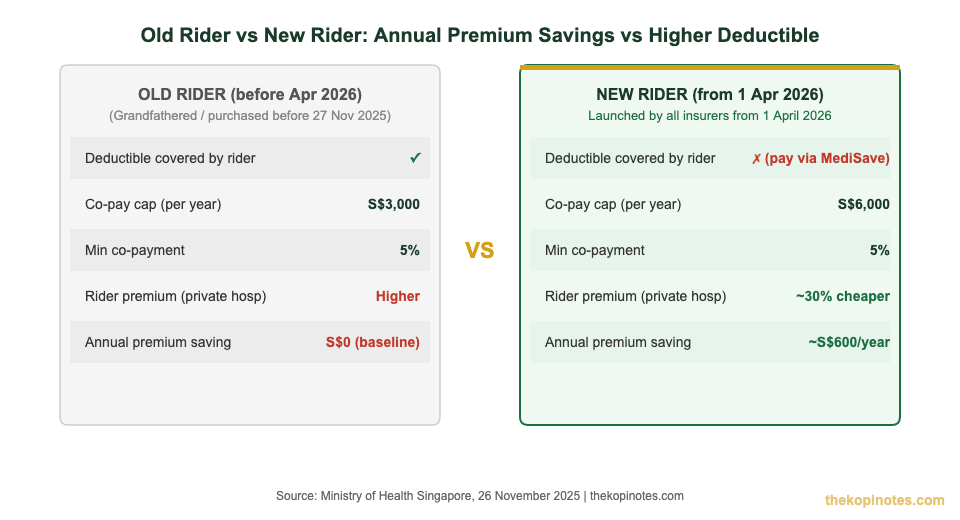
Change 1: Riders can no longer cover the minimum deductible. All new riders sold from 1 April 2026 cannot pay your minimum IP deductible. Previously, premium riders absorbed this cost entirely. Now, you bear this first portion yourself — but you can use MediSave to pay it.
Change 2: The annual co-payment cap doubles. The cap on co-payments rose from S$3,000 to a minimum of S$6,000 per year. This applies to co-payments only; the deductible sits on top. The 5% minimum co-payment rate is unchanged.
Why did MOH act? Private hospital IP policyholders with full riders were 1.4 times more likely to make a claim, with average claim sizes 1.4 times larger than those without riders. That cost pressure flowed straight into premiums. The new design restores cost discipline without leaving you exposed to catastrophic bills.
In return, new rider premiums drop by ~30% on average. Private hospital rider holders save around S$600 per year; public hospital rider holders save around S$200 per year. Older policyholders enjoy greater savings as their premiums are higher. For our full summary of the rule changes, see the 2026 ISP rider changes guide.
Your Deductible Amount by Ward Class
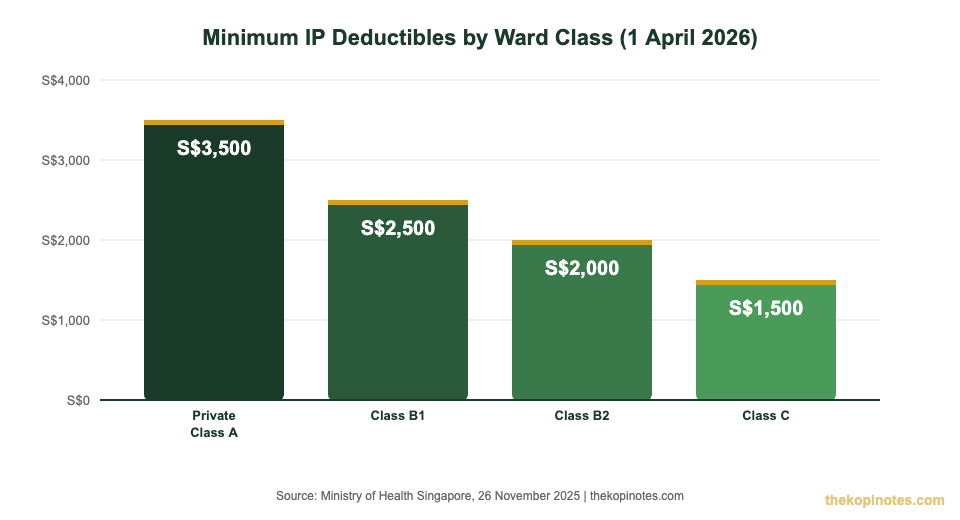
The minimum deductible you must pay depends on your ISP’s targeted ward class and the ward you actually use — whichever is lower applies. You only pay it once per policy year, even if you are admitted multiple times.
| Ward Class | Minimum Deductible (from 1 Apr 2026) | Payable via MediSave? |
|---|---|---|
| Private / Class A | S$3,500 | Yes |
| Class B1 | S$2,500 | Yes |
| Class B2 | S$2,000 | Yes |
| Class C | S$1,500 | Yes |
| Day Surgery (Non-Subsidised) | S$2,000 | Yes |
| Day Surgery (Subsidised) | S$1,500 | Yes |
Source: Ministry of Health Singapore, 26 November 2025 (Table 1: Minimum IP deductibles)
An important nuance: if your ISP targets Class B1 but you use a Class A ward, your deductible is S$2,500 — not S$3,500. The deductible is always the lower of your plan’s target class or the ward you actually use.
How MediSave Pays Your Deductible and Co-Insurance
Here is the part most people miss: you do not have to pay the deductible in cash.
According to MOH, the deductible and co-payments under the new rider design can be paid using MediSave, subject to prevailing withdrawal limits. These are the hospitalisation withdrawal limits — the procedure-based limits for inpatient stays and day surgery. They are separate from the Additional Withdrawal Limit (AWL) you use to pay your ISP base plan premium each year.
In practice, your MediSave account does two jobs. First, it pays your ISP base plan premium via the AWL (typically S$300–S$600 per year depending on age). Second, it covers your hospitalisation costs including the deductible, via the inpatient/day surgery withdrawal limits. These hospitalisation limits are procedure-specific and generally much larger than the AWL.
MOH’s own case examples — using median 2024 private hospital bill data — show how this works in practice:
- For a knee joint replacement at a private hospital (S$56,900 bill): deductible + co-payment = S$6,170. MediSave covered the full S$6,170. Cash out-of-pocket: S$0.
- For an ACL reconstruction at a private hospital (S$38,700 bill): deductible + co-payment = S$5,260. MediSave covered S$3,900. Cash out-of-pocket (with rider): S$1,360.
Your MediSave balance and the specific withdrawal limits for your procedure determine how much cash you actually need at the point of hospitalisation. For most typical procedures, MediSave absorbs a significant share of the deductible burden.
To understand your MediSave withdrawal limits and how much you can use each year, see our MediSave withdrawal limits 2026 guide. If your balance is running low, our MediSave top-up guide explains how to top it up and claim income tax relief on the contribution.
Worked Examples: What You Actually Pay
These two scenarios come directly from MOH’s published case studies (bill sizes based on median 2024 private hospital data).
Example 1: Mr A — 60 years old, knee joint replacement, private hospital, S$56,900 bill
Mr A switches from his old rider to the new rider in April 2026, saving S$1,600 in premiums that year. Three years later, he is hospitalised for a knee joint replacement.
| Item | Old Rider | New Rider |
|---|---|---|
| Deductible paid by | Rider | MediSave (S$3,500) |
| Co-payment (5% of remainder) | Partly by rider | MediSave (S$2,670) |
| Total MediSave used for bill | S$2,840 | S$6,170 |
| Cash out-of-pocket | S$0 | S$0 |
| Rider premium saved over 3 yrs | S$0 (baseline) | S$4,800 |
Source: MOH Singapore, 26 November 2025 — Case Example 1. Bill size based on median 2024 private hospital data.
The new rider uses S$3,330 more MediSave for the hospitalisation. But Mr A saved S$4,800 in cash premiums over three years — coming out S$1,470 ahead overall.
Example 2: Mrs B — 40 years old, ACL reconstruction, private hospital, S$38,700 bill
Mrs B was previously uninsured for riders because premiums were too high. With the new cheaper rider, she signs up in April 2026 at S$500 less per year than peers on old riders.
| Item | Without Rider | New Rider |
|---|---|---|
| Deductible (S$3,500) | Paid via MediSave | Paid via MediSave |
| Co-payment (S$1,760) | Paid by you | Covered by rider |
| MediSave used | S$3,900 | S$3,900 |
| Cash out-of-pocket | S$3,120 | S$1,360 |
Source: MOH Singapore, 26 November 2025 — Case Example 2. Bill size based on median 2024 private hospital data.
The new rider saved Mrs B S$1,760 in cash on this one surgery — more than three years of her annual premium savings. The rider still delivers meaningful protection even under the 2026 rules.
Should You Switch to the New Rider?
The right answer depends on your health profile, MediSave balance, and how frequently you use private healthcare.
Consider switching if: You are healthy and rarely hospitalised. Premium savings accumulate quickly, and MediSave typically covers the deductible. MOH data shows 6 in 10 rider claimants will not pay any cash out-of-pocket under the new rules. For those who do, the majority pay S$1,000 or less, and practically all pay S$3,000 or less.
Consider keeping your old rider (if grandfathered) if: You have a chronic condition requiring frequent private hospital admissions. The higher co-pay cap — S$6,000 versus S$3,000 — can add up fast if you are hospitalised multiple times a year. Speak to your financial advisor before making any changes.
Think about your healthcare costs as part of a bigger financial plan. Our Singapore retirement calculator helps you project long-term healthcare and savings capacity side by side. Before committing to any insurer, compare all five ISP providers with our integrated shield plan comparison 2026. And for the broader CPF picture, our CPF investment strategy Singapore guide shows how ISP fits alongside your CPF OA investments and SRS planning.
What If You Already Have a Rider?
Your situation depends on when you purchased your current rider.
Purchased before 27 November 2025: You are on grandfathered terms. Your insurer may let you keep your existing coverage, but each insurer will decide its own approach. Some may offer incentives to switch voluntarily. Talk to your financial advisor to understand your insurer’s position before making any changes.
Purchased between 27 November 2025 and 31 March 2026: You were informed at purchase that your rider would transition to the new requirements. This will happen no later than your next policy renewal after 1 April 2028. No immediate action is needed — but plan your MediSave balance accordingly.
Purchased from 1 April 2026 onwards: You are already on the new design. Your deductible is not covered by the rider, your co-pay cap is S$6,000 per year, and your premium is ~30% cheaper.
If you are on an old rider and thinking about proactively switching, compare your premium savings over 3–5 years against the additional MediSave you would use if hospitalised. For most working-age Singaporeans with adequate MediSave balances, switching is financially sensible. If your MediSave is low, top it up first. See our complete MediSave Singapore guide for everything about contributions, balances, and what it can pay for.
Data disclaimer: Premium savings are based on MOH’s weighted average for private hospital riders with maximum coverage as of November 2025. Actual premiums vary by insurer, age, and plan. Bill sizes and MediSave amounts are based on median 2024 private hospital data from MOH. Data verified as at 27 August 2026.
Frequently Asked Questions
What is the minimum deductible for a private hospital ISP rider in 2026?
From 1 April 2026, the minimum deductible for a private hospital or Class A ISP is S$3,500 per policy year. For Class B1 it is S$2,500, Class B2 is S$2,000, and Class C is S$1,500. New riders cannot cover this deductible — you pay it first, then the rider covers your remaining co-insurance. The deductible resets once per policy year regardless of the number of admissions.
Can I use MediSave to pay my ISP rider deductible?
Yes. According to MOH, the deductible and co-payments under the new rider design can be paid using MediSave, subject to prevailing hospitalisation withdrawal limits. These are the inpatient and day surgery withdrawal limits, separate from the Additional Withdrawal Limit (AWL) used to pay your annual ISP base plan premium. MOH case examples show that for many typical private hospital procedures, MediSave covers the full deductible with no cash required at the point of hospitalisation.
When did the new ISP rider rules take effect?
The new rules took effect on 1 April 2026. From this date, all new IP riders must comply with the revised design — they cannot cover the minimum deductible, and the annual co-payment cap must be at least S$6,000. Insurers ceased selling non-compliant riders on 31 March 2026. Existing riders purchased before 27 November 2025 may remain on their current terms subject to each insurer’s decision.
How much cheaper are the new ISP riders compared to old ones?
MOH estimates new rider premiums will be about 30% lower on average compared to existing riders with maximum coverage. In dollar terms, private hospital rider policyholders save around S$600 per year, and public hospital rider policyholders save around S$200 per year. Older policyholders enjoy greater savings as their premiums are higher to begin with. Actual savings will vary by insurer, plan type, and age.
Will my existing ISP rider be affected by the April 2026 changes?
It depends on when you bought your rider. If purchased before 27 November 2025, you may keep your existing terms — each insurer will determine its own approach for existing policyholders. If purchased between 27 November 2025 and 31 March 2026, your rider must transition to the new requirements no later than your next renewal after 1 April 2028. Riders purchased from 1 April 2026 are already on the new design.
What is the co-payment cap under the new ISP riders in 2026?
Under the new rider rules effective 1 April 2026, the minimum annual co-payment cap is S$6,000 per policy year. This doubles the previous minimum of S$3,000 set in 2018. The cap applies to co-payments only and excludes the deductible. The 5% minimum co-payment rate remains unchanged. The cap applies to eligible claims — for example, from panel or pre-authorised doctors under your ISP.
Plan Smarter With Your ISP and MediSave
Compare all five ISP insurers, understand your MediSave balance, and plan your healthcare costs for retirement.
Get Free Insurance Advice
Speak with a licensed insurance advisor. No obligation, no cost.
By submitting this form, you agree to our Privacy Policy.
This article was researched with the help of AI. While we strive to keep all information accurate and up to date, there may be errors. If you notice any discrepancies, please contact us.