How to Invest in Singapore Tax-Efficiently: The Complete 2026 Guide
Zero capital gains tax. Lower withholding tax with Irish ETFs. Up to $15,300 in SRS tax relief every year. Here is how to keep more of what you earn.
Singapore is one of the best countries in the world for tax-efficient investing. There is no capital gains tax, no tax on most foreign dividends, and the government actively incentivises long-term saving through CPF and SRS. But three hidden tax costs can quietly erode your returns — and knowing how to avoid them can save you thousands of dollars every year.
Not financial advice. All figures are for educational reference only. Data verified as at 27 August 2026 against official sources including IRAS, CPF Board, and the Ireland Revenue Commissioners.
- Singapore has zero capital gains tax — every dollar of price gain is yours to keep
- Choose Irish-domiciled ETFs (CSPX, VWRA) over US-listed ETFs to cut withholding tax from 30% to 15%
- Contribute up to $15,300/year to SRS to reduce your taxable income and build a tax-sheltered investment pot
Table of Contents
Contents — Click to expand
- Singapore’s Tax Advantage for Investors
- The Hidden Cost: Dividend Withholding Tax (WHT)
- Irish-Domiciled ETFs: The Tax-Efficient Way to Invest Globally
- SRS: Reduce Your Tax Bill By Up to $15,300 a Year
- CPF Investments: Put Your Ordinary Account to Work
- Accumulating vs Distributing Funds: Which is More Tax-Efficient?
- Your Tax-Efficient Investing Playbook for 2026
- Frequently Asked Questions
Singapore’s Tax Advantage for Investors
Most Singaporeans do not realise how favourably the tax system treats investors. Understanding this is the first step to building wealth more efficiently.
No capital gains tax. If you buy shares at $10 and sell at $20, you keep the full $10 gain. The Singapore government does not tax capital appreciation on stocks, ETFs, property (with exceptions), or bonds. This is a significant advantage over investors in the UK, US, or Australia, who hand back 20–33% of their gains in capital gains tax.
No tax on most foreign dividends. Dividends from foreign companies, including global ETFs listed on the London Stock Exchange (LSE), are generally not subject to Singapore income tax when received by Singapore tax residents. The dividend is taxed at the fund or company level in its country of origin — but Singapore does not charge you again on top.
Progressive income tax. Singapore’s personal income tax starts at 0% for the first $20,000 of chargeable income and rises to a maximum of 24% for income above $1 million. For most working Singaporeans earning $60,000–$160,000, the effective rate is well below 15%. This matters because every dollar of SRS contribution and CPF relief directly reduces your taxable income — the savings are real.
The Hidden Cost: Dividend Withholding Tax (WHT)
Here is the tax cost that most new investors miss entirely. When you hold US stocks or US-based ETFs, the US government withholds a portion of every dividend before it reaches you. This is called dividend withholding tax (WHT).
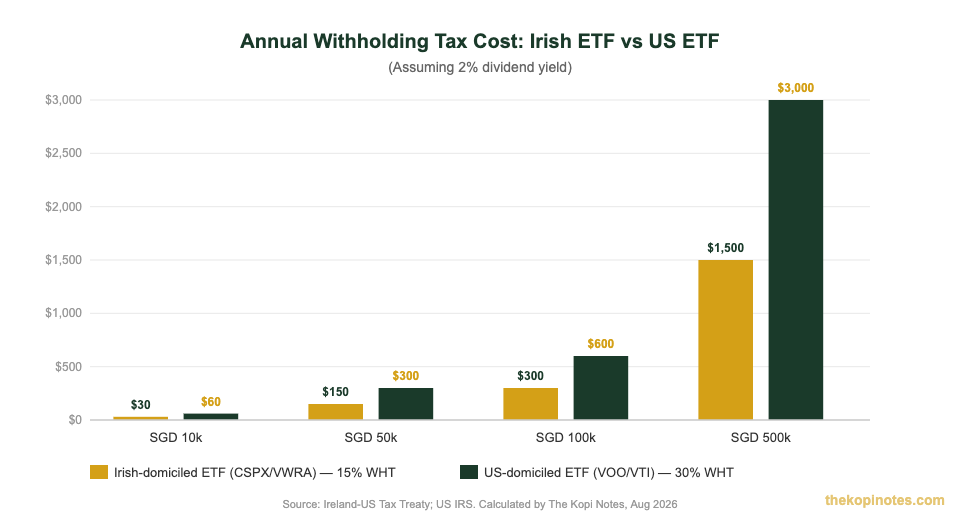
For non-US investors — which includes most Singaporeans — the standard US withholding tax rate is 30%. That means if a US company declares a $100 dividend, only $70 arrives in your brokerage account. The other $30 goes to the IRS. Singapore does not give you a tax credit for this, so it is a permanent loss.
However, this is not unavoidable. The rate drops significantly depending on how you structure your investment — which is where Irish-domiciled ETFs come in.
| Investment Type | Domicile | US Dividend WHT | US Estate Tax Risk |
|---|---|---|---|
| CSPX / VWRA (LSE) | Ireland | 15% | None |
| VOO / VTI (NYSE) | USA | 30% | Yes (above USD 60,000) |
| Individual US stocks | USA | 30% | Yes (above USD 60,000) |
Source: Ireland-US Double Taxation Convention; US IRS Publication 515. Data as at August 2026.
Irish-Domiciled ETFs: The Tax-Efficient Way to Invest Globally
Ireland has a tax treaty with the United States. Under this treaty, an Irish-domiciled fund pays only 15% WHT on US dividends — not 30%. Because the fund holds the US stocks on your behalf, you benefit from this treaty rate automatically, even as a Singapore investor.
The two most popular Irish-domiciled ETFs among Singapore investors are CSPX (iShares Core S&P 500 UCITS ETF) and VWRA (Vanguard FTSE All-World UCITS ETF). Both are listed on the London Stock Exchange (LSE) in US dollars. Both are accumulating — meaning dividends are automatically reinvested inside the fund, not paid out to you. This keeps your compounding clean and avoids any secondary tax complications.
There is a second major benefit: no US estate tax risk. Non-US investors who hold US-domiciled assets above USD 60,000 at the time of death may be subject to US estate tax at rates up to 40%. Irish-domiciled ETFs are not US assets for estate tax purposes, so this risk simply does not apply. For anyone building a long-term portfolio above $100,000, this alone is reason enough to choose the LSE route.
| Feature | CSPX (LSE) | VWRA (LSE) | VOO (NYSE) |
|---|---|---|---|
| Domicile | Ireland | Ireland | USA |
| US Dividend WHT | 15% | 15% (US portion) | 30% |
| US Estate Tax | None | None | Yes (>USD 60k) |
| TER | 0.07% p.a. | 0.22% p.a. | 0.03% p.a. |
| Structure | Accumulating | Accumulating | Distributing |
Source: iShares factsheet (CSPX), Vanguard factsheet (VWRA), Vanguard.com (VOO). As at August 2026.
You can buy CSPX and VWRA through brokers like Syfe (referral code SRPRFFFCD for a sign-up bonus), Interactive Brokers (IBKR referral: jianxiong368), or FSMOne (referral P0544985 — see the FSMOne referral code page for details). IBKR is the most cost-effective for larger portfolios above $50,000.
SRS: Reduce Your Tax Bill By Up to $15,300 a Year
The Supplementary Retirement Scheme (SRS) is a voluntary government scheme that lets you contribute cash into a dedicated account and deduct every dollar from your taxable income. It is one of the most powerful — and most underused — tax tools available to Singapore investors.
Here is how it works:
- You contribute up to $15,300/year (Singapore citizens and PRs) or $35,700/year (foreigners) into your SRS account at DBS, UOB, or OCBC.
- The full contribution is deducted from your chargeable income for that Year of Assessment. If you earn $120,000 and contribute $15,300, you are taxed on $104,700 instead.
- You invest the SRS funds in approved instruments — stocks, ETFs, unit trusts, and Singapore Savings Bonds are all eligible.
- At the statutory retirement age (currently 63, rising to 64 from 1 July 2026), you can withdraw. Only 50% of the withdrawal amount is taxable, spread over up to 10 years.
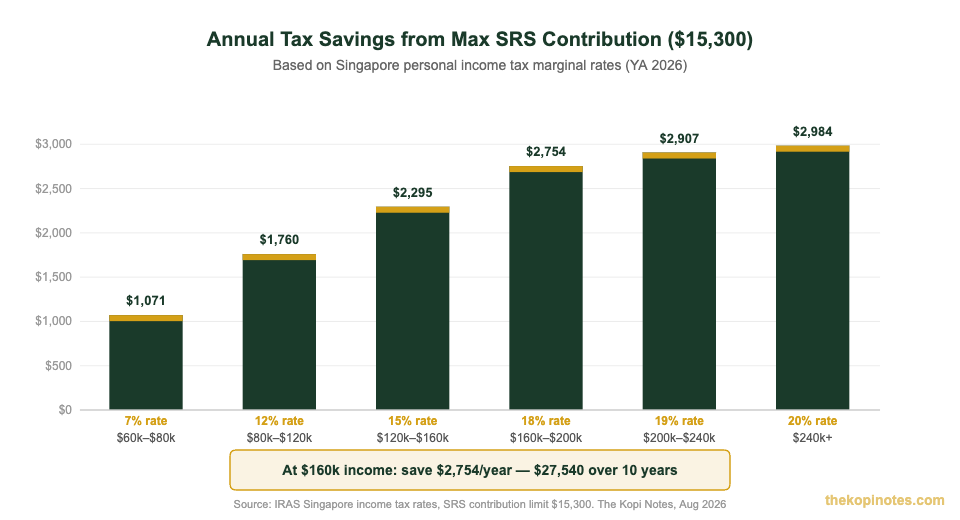
The tax savings depend on your income. At $120,000/year, the marginal rate is 15%. A $15,300 SRS contribution saves you approximately $2,295 in tax every year. Over 20 years, that is $45,900 in saved taxes — before even accounting for the investment returns inside SRS.
Note that the $80,000 total personal income tax relief cap applies across all reliefs (CPF cash top-ups, earned income relief, SRS, course fee relief, etc.). If you are already close to the cap, additional SRS contributions may not yield further tax savings. Check your position on IRAS’s SRS page before contributing.
CPF Investments: Put Your Ordinary Account to Work
Your CPF Ordinary Account (OA) earns a floor rate of 2.5% per annum (extended through 31 December 2026 by the CPF Board). Your Special Account (SA), MediSave (MA), and Retirement Account (RA) earn 4% per annum, also extended through end 2026. These are guaranteed, risk-free returns — which is already excellent compared to most savings accounts.
Through the CPF Investment Scheme (CPFIS), you can invest CPF OA funds above a $20,000 set-aside in approved unit trusts, stocks, ETFs, and other instruments. The idea is to potentially beat the 2.5% OA floor rate over the long term. However, this comes with risk — not all CPF investments have performed above 2.5% net of fees.
Key rules for CPFIS-OA:
- You must keep at least $20,000 in your OA — only funds above this can be invested
- Maximum 35% of investable savings in stocks; maximum 10% in gold
- Approved unit trusts only — most direct ETFs on the LSE are not CPFIS-eligible
For most investors, the right call is to max out your OA top-ups for the guaranteed 2.5%–4% (via voluntary CPF cash top-ups to SA for the 4% rate) before taking on investment risk through CPFIS. Read the full breakdown in our CPF investment strategy Singapore guide.
Accumulating vs Distributing Funds: Which Is More Tax-Efficient?
When you invest in a fund, you generally have two options: an accumulating version (dividends are reinvested inside the fund automatically) or a distributing version (dividends are paid out to you as cash).
For Singapore investors, accumulating funds are almost always the more tax-efficient choice for long-term wealth building. Here is why:
Compounding stays intact. When dividends are reinvested inside the fund, you automatically buy more units. You never have the dividend sitting idle in cash. Over 20–30 years, this compounding effect is enormous.
No additional tax drag from distributions. For foreign-domiciled ETFs, distributions are generally not subject to Singapore income tax. However, if you hold accumulating ETFs within your SRS account, any “dividends” reinvested inside the fund do not trigger a withdrawal — so there is no SRS withdrawal tax event.
CSPX and VWRA are both accumulating funds. Their distributing equivalents — CSPS and VWRD — pay out dividends quarterly. Unless you specifically need income (for example, you are retired and need cash flow), choose the accumulating version. Combine accumulating ETF investing with passive income strategies like building passive income in Singapore for a balanced portfolio.
Your Tax-Efficient Investing Playbook for 2026
Put it all together. Here is the priority order most Singapore investors should follow to maximise tax efficiency:
- Maximise CPF cash top-ups (if below 55). Top up your SA to earn 4% tax-free. You also get tax relief of up to $8,000 per year for self top-ups and $8,000 for topping up a family member. This is the safest return available.
- Max out your SRS contribution ($15,300/year for citizens and PRs). Do this before investing in anything else outside CPF. The immediate tax saving makes this effectively a boosted return on your investment. Invest the SRS funds in Irish-domiciled accumulating ETFs like CSPX or VWRA.
- Use remaining cash savings to buy Irish-domiciled ETFs on the LSE. CSPX for S&P 500 exposure. VWRA for global diversification. Both carry 15% US WHT (not 30%) and zero US estate tax risk.
- Avoid US-listed ETFs (VOO, VTI, SPY) as your main holding. They cost you 30% WHT on dividends and expose you to US estate tax above USD 60,000. The slightly lower TER (0.03% vs 0.07% for CSPX) does not compensate for the higher WHT burden.
- Avoid unnecessary trading. Singapore has no capital gains tax — but transaction costs, FX spreads, and poor timing can all erode returns. Buy broadly, hold long, and rebalance annually.
Use our Singapore retirement calculator to model how much you need and by when — then work backwards to set your annual CPF, SRS, and ETF contribution targets.
Frequently Asked Questions
Is there capital gains tax on stocks in Singapore?
No. Singapore does not impose capital gains tax on individuals. If you buy shares at $5 and sell at $10, the $5 gain is entirely yours to keep. This applies to stocks, ETFs, unit trusts, bonds, and most other investment assets. However, if you trade so frequently that IRAS considers you a trader (rather than an investor), your gains may be treated as income and taxed accordingly.
What is the withholding tax on Irish-domiciled ETFs for Singapore investors?
Irish-domiciled ETFs like CSPX and VWRA pay 15% US withholding tax on US-source dividends at the fund level — this is deducted before dividends are reinvested or distributed. As a Singapore investor receiving distributions from such a fund, you do not typically owe additional Singapore income tax on foreign-sourced dividends. By contrast, US-domiciled ETFs face a 30% US WHT rate, which is a permanent cost and cannot be reclaimed by Singapore investors.
How much can I contribute to SRS in 2026?
Singapore citizens and Permanent Residents can contribute up to $15,300 per year to their SRS account. Foreigners can contribute up to $35,700 per year. The higher limit for foreigners reflects the fact that they do not benefit from CPF tax relief. All contributions are deductible from your chargeable income in the Year of Assessment they are made, subject to the $80,000 total personal income tax relief cap.
Can I invest my SRS funds in CSPX or VWRA?
It depends on your SRS operator and broker. SRS funds can be invested in approved instruments including Singapore-listed stocks, unit trusts, Singapore Savings Bonds, and some ETFs listed on SGX. CSPX and VWRA are listed on the London Stock Exchange, not SGX, so they are generally not directly accessible through your SRS account. However, some SRS-eligible unit trusts track the same underlying indices (S&P 500 and global equities). Check with your SRS bank and broker for currently approved instruments.
What is the CPF OA interest rate in 2026?
The CPF Ordinary Account (OA) earns a floor interest rate of 2.5% per annum, extended through 31 December 2026. The Special Account (SA), MediSave Account (MA), and Retirement Account (RA) earn 4% per annum. Additionally, the first $60,000 of combined CPF balances (with a cap of $20,000 from the OA) earns an extra 1% per annum. Members aged 55 and above earn an additional 1% on the first $30,000 of combined balances.
Do I need to declare foreign dividend income in Singapore?
Generally, foreign-sourced dividends received by Singapore tax residents are exempt from Singapore income tax. This includes dividends from foreign stocks, ETFs, and unit trusts — provided the income has already been taxed in the country of origin and Singapore has a tax treaty with that country, or the income qualifies for exemption under the Foreign-Sourced Income Exemption. However, tax rules can change and individual circumstances vary. Consult a qualified tax adviser or check directly with IRAS for your specific situation.
How does US estate tax affect Singapore investors?
Non-US residents who hold US-sited assets — including US-listed ETFs like VOO or VTI — above USD 60,000 at the time of death may be subject to US estate tax at rates up to 40% on the excess. This threshold of USD 60,000 is extremely low compared to the $13+ million threshold for US citizens. Holding Irish-domiciled ETFs (CSPX, VWRA) eliminates this risk entirely, as these are not US-sited assets for estate tax purposes.
Start Investing Tax-Efficiently Today
Open a brokerage account, max your SRS, and start building a tax-efficient portfolio. Use our referral links for exclusive sign-up bonuses.
This article was researched with the help of AI. While we strive to keep all information accurate and up to date, there may be errors. If you notice any discrepancies, please contact us.