Critical Illness Insurance: Standalone Plan vs Rider in Singapore (2026 Guide)
Critical illness insurance in Singapore comes in two forms: a standalone policy (an independent plan that pays a lump sum if you are diagnosed with a covered condition) and a CI rider (an add-on to an existing term or whole life base policy). The key difference is that a standalone plan leaves your life insurance untouched after a claim, while a rider’s payout can reduce or end your base life cover. This guide explains both, helps you decide which suits your situation, and covers what Singapore’s LIA framework requires insurers to disclose.
Not financial advice. All figures are for educational reference only. Data verified as at October 2026. Always consult a licensed financial adviser before purchasing any insurance product.
What Is a Critical Illness (CI) Rider?
A CI rider is an optional add-on that you attach to an existing base insurance policy — typically a term life or whole life plan. When you add a CI rider, the insurer extends the base policy’s coverage to include a payout if you are diagnosed with a covered critical illness such as cancer, heart attack, or stroke.
Because the rider “rides on” the base policy, you do not purchase it independently. You must first have a qualifying base policy in place. The rider’s premium is charged on top of your base policy’s premium, and the CI benefit is typically expressed as a percentage of, or an additional amount on top of, the base sum assured.
Key mechanics of a CI rider:
- The rider cannot outlast the base policy — if your term life policy ends at age 70, the CI rider also ends at 70.
- In many cases, a CI rider claim will accelerate or reduce the life cover. For example, if you hold a SGD 300,000 whole life policy with a SGD 200,000 CI rider and you make a CI claim, the remaining life cover may drop to SGD 100,000 or end entirely, depending on the policy structure.
- Some insurers offer “non-accelerated” or “additional” CI riders that pay separately from the life sum assured, keeping life cover intact — always check the policy wording before buying.
What Is a Standalone Critical Illness Plan?
A standalone CI plan is a separate, independent insurance policy. It is not linked to any base life policy. You buy it directly from an insurer for a specific sum assured, and it pays out a lump sum if you are diagnosed with a covered critical illness during the policy term.
Because it is independent, a standalone CI payout has no effect on any life insurance you hold. If you claim SGD 200,000 from your standalone CI plan, your separate term life policy remains fully in force.
Many standalone plans also offer a multipay feature, allowing you to claim for different conditions across separate policy years — for example, claiming for cancer and then, years later, for a heart attack. This is particularly valuable given that medical advances mean more Singaporeans survive a first critical illness and live long enough to face a second.
Standalone CI Plan vs CI Rider: Key Differences
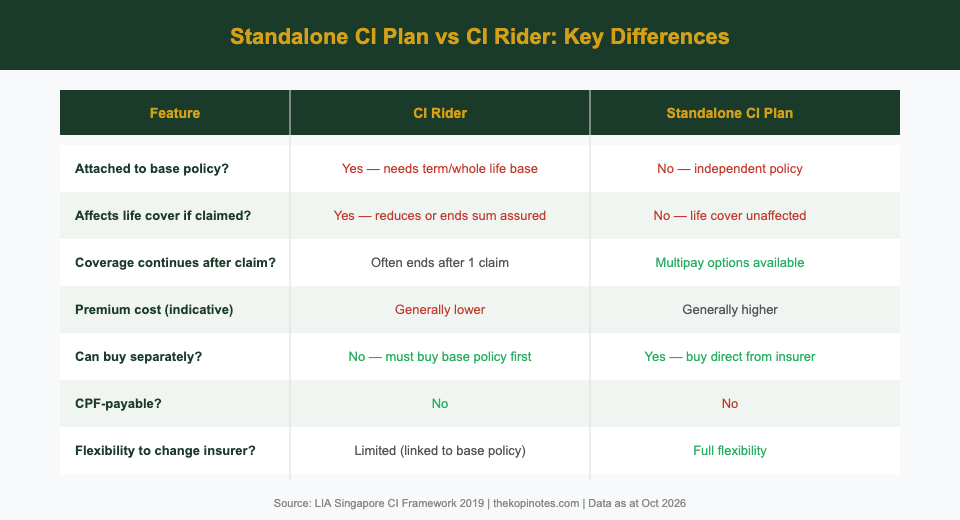
| Feature | CI Rider | Standalone CI Plan |
|---|---|---|
| Requires a base policy? | Yes | No |
| Affects life cover after CI claim? | Often yes (reduces or ends sum assured) | No — life cover unaffected |
| Multipay (repeat claims) available? | Rarely | Yes (select plans) |
| Premium cost (all else equal) | Generally lower | Generally higher |
| Can purchase independently? | No | Yes |
| Covered conditions (LIA framework) | 37 severe-stage (LIA 2019) | 37+ severe-stage; some add early-stage |
| CPF-payable? | No | No |
Source: Life Insurance Association (LIA) Singapore Critical Illness Framework 2019 | thekopinotes.com, Oct 2026
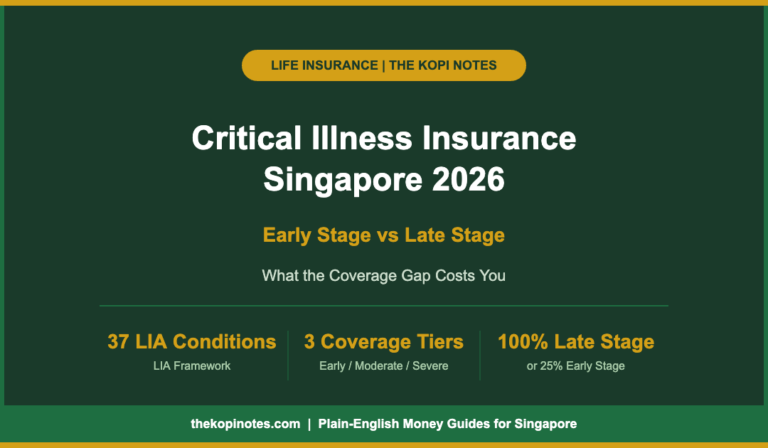
Note on LIA definitions: Under the LIA Critical Illness Framework 2019, all insurers in Singapore must use standardised definitions for 37 severe-stage critical illnesses — including the three most common: cancer, heart attack (of a specified severity), and stroke. This ensures that policyholders comparing plans across insurers are comparing apples to apples on these core conditions. Some insurers voluntarily add early-stage CI coverage or cover additional conditions beyond the LIA standard 37.
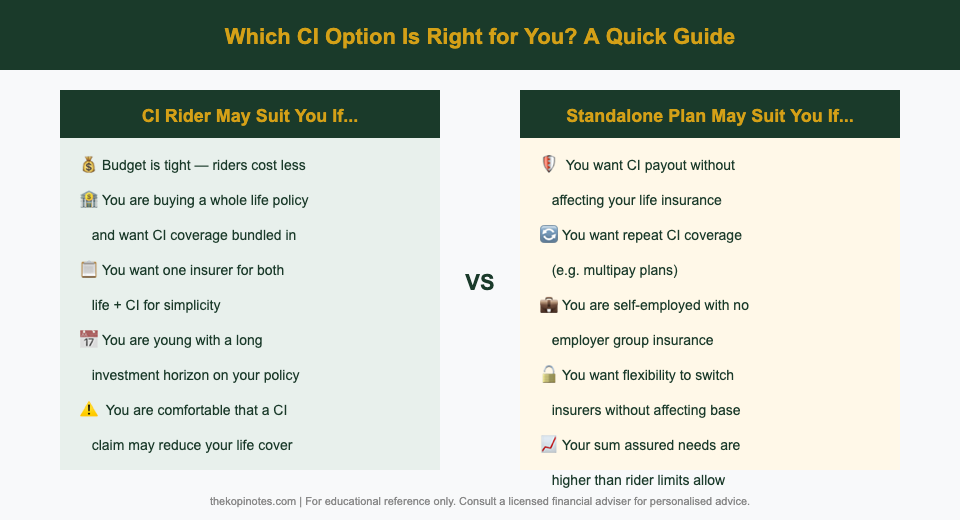
When a CI Rider May Be the Right Choice
A CI rider is often the more cost-effective entry point for Singaporeans who are buying their first life insurance policy and want to bundle critical illness coverage with it. Here are scenarios where a rider makes sense:
- Budget is a primary constraint. If you are in your 20s or early 30s and premiums are tight, adding a CI rider to a term life policy typically costs less than buying two separate policies. This lets you achieve basic CI coverage without significantly stretching your finances.
- You are buying a whole life policy for investment. If you are purchasing a participating whole life plan for its cash value and long-term protection, bundling a CI rider is common practice. The rider’s cost is absorbed into the overall premium structure.
- You want simplicity. Managing one policy and one insurer relationship is administratively easier. A CI rider eliminates the need to track a separate standalone plan’s renewal dates, premium payments, and claims processes.
- You are comfortable with life cover trade-off. If you already hold substantial life insurance (for example, through employer group coverage or a separate term life policy) and the CI rider’s impact on your base life sum assured is acceptable, the rider remains a viable option.
⚠️ Important caveat: Before adding a CI rider, always ask your insurer or adviser whether the payout is “accelerated” (reduces life cover) or “additional” (paid on top of life cover). This single distinction significantly changes the value proposition of the rider.
When a Standalone CI Plan May Be the Right Choice
A standalone CI plan is generally better for Singaporeans who have specific gaps in their protection strategy or who want maximum flexibility. Here are scenarios where a standalone plan is the stronger choice:
- You want to protect your life cover entirely. If you depend on your life insurance for dependants (children, a spouse, or elderly parents), a CI claim should not reduce or end that protection. A standalone plan ensures this separation.
- You want multipay protection. Medical survival rates are improving. Cancers, once fatal, are now often treatable — but survivors face the risk of a second cancer or a different critical illness years later. Standalone multipay plans (such as those from AIA or Singlife) allow you to claim multiple times across different conditions within the policy term, something riders rarely offer.
- You are self-employed or a freelancer. Without employer group insurance acting as a safety net, standalone CI gives you a firm, independent lump sum payout that is not tied to whether you maintain any particular base life policy.
- You need a higher sum assured than a rider allows. Riders are typically capped as a multiple of the base life sum assured. If you need SGD 400,000 in CI coverage but your term life base is only SGD 300,000, a standalone plan may be the only way to achieve the required CI sum assured.
- You want to switch insurers in the future. A standalone plan can be moved or replaced at renewal without affecting your life insurance. A rider is locked to its base policy’s insurer.
For building long-term passive income in Singapore, maintaining health coverage that does not erode your investment strategy is critical. A standalone CI plan preserves your ability to continue investing even if a health crisis strikes.
Popular Critical Illness Plans and Riders in Singapore (2026)
The table below summarises a selection of commonly referenced CI products in Singapore. Premiums vary significantly by age, health status, sum assured, and policy term — always request a personal quote from a licensed insurer or financial adviser before purchasing.
| Plan / Rider | Type | Conditions Covered | Notable Feature |
|---|---|---|---|
| FWD Big 3 Critical Illness | Standalone | 3 (cancer, heart attack, stroke) | Entry-level standalone, direct-buy |
| Singlife Multipay CI | Standalone (Multipay) | 37 severe + early-stage options | Claims up to 5x sum assured |
| AIA Beyond Critical Care | Standalone (Multipay) | 100+ conditions | Early, intermediate, and severe stage payouts |
| Great Eastern CI Rider (on GREAT SP) | Rider | 37 severe-stage (LIA) | Accelerates base policy payout |
| Prudential PRUCrisis Cover | Rider | 37 severe-stage + additional | Attached to PruLife term plans |
Source: Individual insurer product pages | thekopinotes.com, Oct 2026. Not an exhaustive list. Premiums not shown — get a personalised quote.
When comparing plans, pay particular attention to: (1) whether covered conditions use the LIA 2019 standardised definitions; (2) the survival period (typically 14 days after diagnosis before the payout triggers); and (3) whether there is a waiting period for pre-existing conditions.
How Much Critical Illness Coverage Do You Need?
The LIA Singapore has historically suggested a rule of thumb of 3.9x your annual income in CI coverage. In practice, financial advisers commonly recommend considering the following components when calculating your CI sum assured:
- Income replacement: 3–5 years of your annual take-home income, to cover the period when you may be unable to work while undergoing treatment.
- Medical expenses not covered by your Integrated Shield Plan (IP): Co-insurance, deductibles, and experimental treatments that IPs do not cover. Depending on your IP tier, out-of-pocket costs for severe illnesses can exceed SGD 50,000.
- Debt obligations: Mortgage balance, car loan, and credit card debt that must still be serviced even if you cannot work.
- Caregiver costs: If you will need full-time care during treatment, factor in domestic helper costs or home nursing fees.
As a worked example: A 35-year-old Singaporean earning SGD 7,000/month (SGD 84,000/year) with a SGD 600,000 HDB mortgage might calculate CI coverage as:
- Income replacement (3 years): SGD 252,000
- Mortgage buffer: SGD 100,000
- Medical out-of-pocket buffer: SGD 60,000
- Total target CI cover: SGD 412,000
Use our Singapore retirement calculator to check how a critical illness event might affect your long-term savings trajectory. You can also review how to optimise your CPF investment strategy to ensure your retirement savings continue growing even through a health disruption.
For those with Endowus or Syfe portfolios: if you hold a significant investment portfolio, remember that Endowus referral code and Syfe referral code platforms can hold your investments through a CI event without liquidation pressure — your CI payout covers expenses while your long-term portfolio remains invested.
Frequently Asked Questions
Can I have both a CI rider and a standalone CI plan at the same time?
Does a CI rider payout always reduce my life insurance sum assured?
Can I use CPF to pay for critical illness insurance premiums?
How many conditions does critical illness insurance cover in Singapore?
What happens to my CI rider if I surrender or lapse my base life policy?
Is there a waiting period for critical illness insurance claims?
Build Your Complete Financial Protection Plan
Critical illness insurance is one piece of the protection puzzle. Pair it with the right investment strategy to ensure a health event doesn’t derail your retirement.
- 📊 Use our retirement planning calculator to model a CI scenario
- 💰 Syfe referral code and sign-up bonus — earn bonus when you start investing
- 🏦 Endowus referral code — use your CPF and SRS for low-cost investing
- 📈 Best S-REITs in Singapore 2026 — dividend income while you recover
Not financial advice. Always consult a licensed MAS-regulated financial adviser before purchasing insurance products. Referral codes may earn The Kopi Notes a commission at no cost to you.
Get Free Insurance Advice
Speak with a licensed insurance advisor. No obligation, no cost.
By submitting this form, you agree to our Privacy Policy.
This article was researched with the help of AI. While we strive to keep all information accurate and up to date, there may be errors. If you notice any discrepancies, please contact us.