TL;DR
- CPF LIFE pays $950–$3,440/mo depending on your Retirement Sum at 65 — it is the foundation, not the full picture.
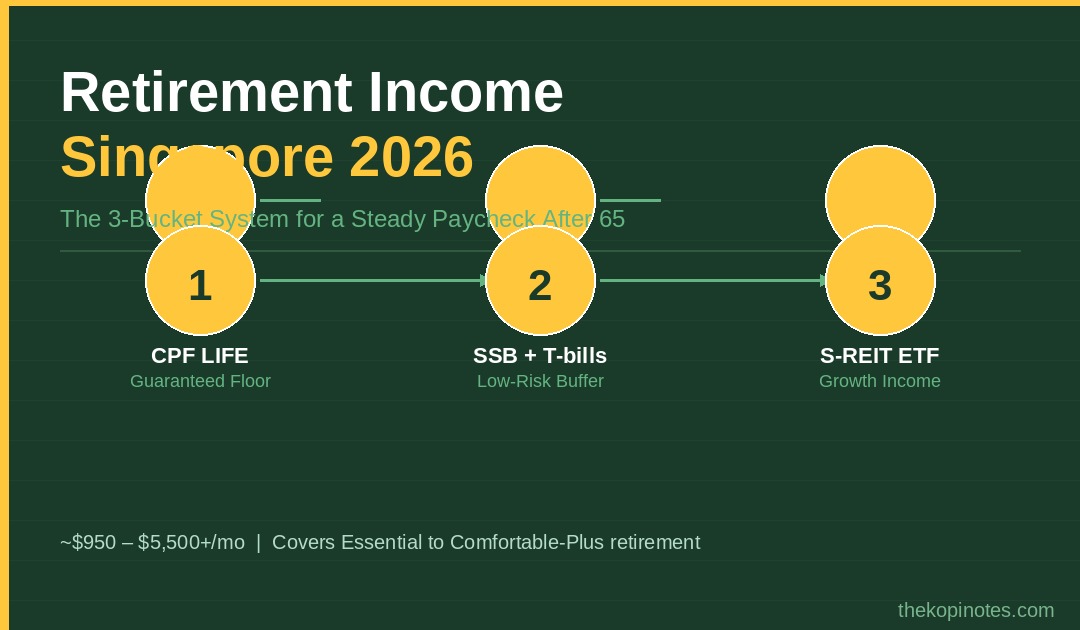
- A 3-bucket system uses CPF LIFE (Bucket 1) + SSB/T-bills (Bucket 2) + S-REIT ETF (Bucket 3) to close the gap between your CPF floor and your actual spending target.
- Comfortable retirement (~$3,200/mo): requires roughly $325,000 outside CPF across Buckets 2 and 3.
- SSB SBNOV26 10-year average rate: 2.45% p.a. (MAS, Oct 2026). S-REIT ETF trailing yield: ~6.2–7.1% (as at Apr 2026; not guaranteed).
- As at October 2026. Not financial advice — describe your situation to a licensed financial adviser before making decisions.
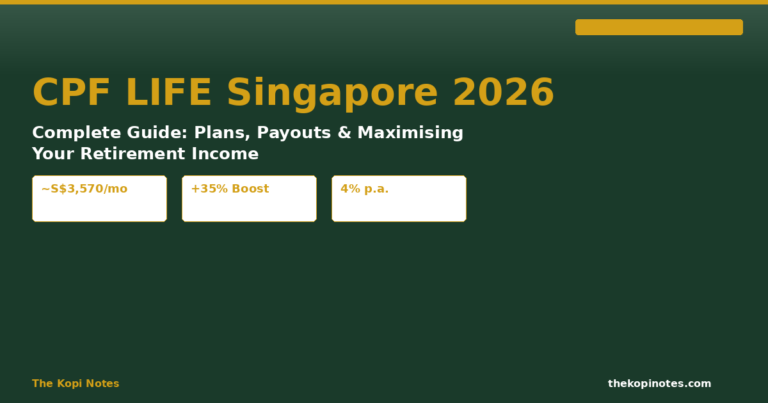
CPF LIFE is one of the most reliable retirement income instruments in the world — monthly payouts, guaranteed for life, backstopped by the Singapore government. But even at FRS level, CPF LIFE pays about $1,780 a month from age 65. For most households, that covers essential expenses and not much more.
A comfortable retirement in Singapore — dining out, occasional travel, private medical when needed — costs closer to $3,200 a month. The $1,420 monthly gap between CPF LIFE FRS and a comfortable lifestyle is the central retirement income problem this article addresses.
The answer most retirement planners in Singapore use is a layered, or “bucket”, approach: stack three income streams so each one covers a different slice of your monthly spending. This piece explains what each bucket is, how much capital each tier requires, and walks through a worked SGD example.
Why CPF LIFE Is a Floor, Not a Ceiling
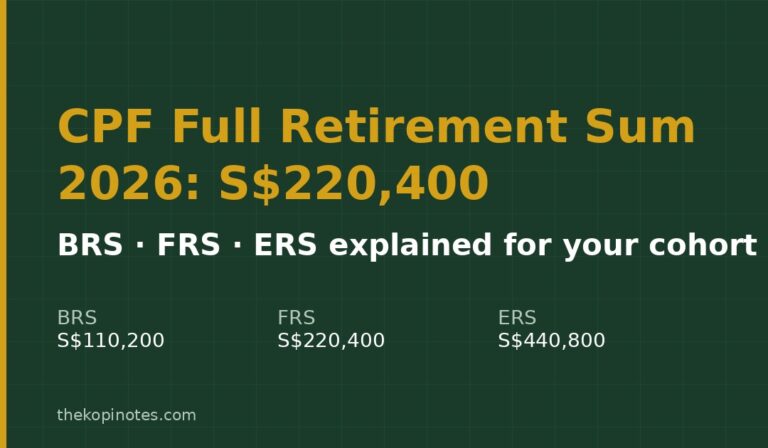
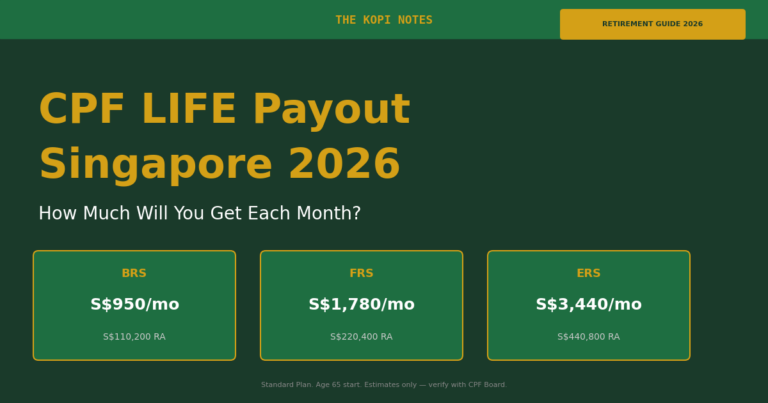
CPF LIFE payouts at 65 depend on how much you set aside in your Retirement Account at age 55. The three reference points as at Q3–Q4 2026 (CPF Board):
| Retirement Sum | Amount (2026) | CPF LIFE payout from 65 |
|---|---|---|
| Basic (BRS) | $110,200 | ~$950/mo |
| Full (FRS) | $220,400 | ~$1,780/mo |
| Enhanced (ERS) | $440,800 | ~$3,440/mo |
Source: CPF Board, as at Q3–Q4 2026. CPF LIFE Standard Plan. Actual payout varies with exact RA balance and cohort.
Cross-referencing with spending data from the Singapore Department of Statistics and MOM Elder Care Survey, three broad monthly cost tiers emerge for a single Singaporean retiree:
- Essential ($2,000/mo) — HDB flat (mortgage-free), hawker meals, MRT, basic GP and Medishield Life top-up
- Comfortable ($3,200/mo) — adds dining restaurants 2–3×/week, 1 regional holiday/year, Integrated Shield Plan (IP), occasional ride-hailing
- Comfortable-Plus ($5,500/mo) — private housing or car lease, annual overseas holiday, private specialist care, larger medical buffer
Only ERS CPF LIFE (~$3,440/mo) comfortably covers the Comfortable tier on its own. For everyone else, a supplementary income strategy is necessary.
The 3-Bucket Framework
Bucket 1: Guaranteed Floor — CPF LIFE
What it is: A government-backed lifelong annuity paid from your CPF Retirement Account. CPF LIFE pays out monthly from age 65 and continues until death — removing the risk of outliving your savings.
Current rate: RA earns 4% p.a. floor (extra +2% on first $30,000 and +1% on next $30,000 for members 55+, effective up to 6%), as at Q3–Q4 2026 (CPF Board).
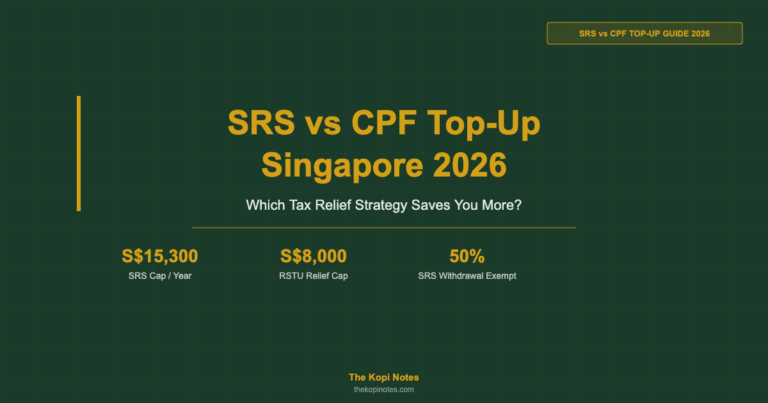
How to maximise it: Top up your RA to FRS or ERS by age 65. Cash top-ups to the RA earn at least 4% p.a. — often better than fixed deposits — and qualify for income tax relief of up to $8,000/yr for self top-ups. See the CPF Top-Up guide and the CPF Retirement Sum explainer for full mechanics.
Bucket 2: Low-Risk Income Buffer — SSB and T-Bills
What it is: Singapore government securities with zero default risk, fully backed by the Monetary Authority of Singapore (MAS). These are the safest non-CPF investments available in Singapore.
Singapore Savings Bonds (SSB):
- SBNOV26 issue (GX26110X): 10-year average yield 2.45% p.a. (Year 1: 1.67%, rising to Year 10: 3.08%)
- Application deadline: 27 Oct 2026, 9 pm; issue date 2 Nov 2026
- Minimum: $500; maximum $200,000 per individual
- Can redeem in full or partial ($500 multiples) any month with no penalty
T-bills:
- 6-month cut-off yield: 1.90% (Oct 8, 2026 auction, MAS)
- Shorter tenure — need to roll over every 6 months; future rates uncertain
- Better for short-term parking; less suitable as a long-term Bucket 2 anchor
Role in the system: Bucket 2 covers the predictable, non-discretionary portion of your income gap — recurring bills, insurance premiums, utilities, conservancy fees. Size it to cover 3–5 years of that spending so you are never forced to sell S-REITs at a market low to pay the lights bill.
For a full SSB vs T-bill comparison, see SSB vs T-Bill Singapore 2026.
Bucket 3: Growth Income — Singapore REIT ETF
What it is: S-REIT ETFs pool retail, commercial, industrial and healthcare properties across Singapore and the region, distributing rental income as quarterly or semi-annual dividends.
Current trailing yields (as at April 2026; not guaranteed):
- Lion-Phillip S-REIT ETF (CLR): ~6.2% p.a.
- NikkoAM APAC REIT ETF (CFA): ~6.8% p.a.
- Phillip SGX APAC Dividend REIT ETF (BYI): ~7.1% p.a.
Source: TKN’s S-REIT ETF Dividend Yield Comparison 2026. Trailing yield is based on the last 12 months of distributions divided by current NAV; future distributions are not guaranteed and capital is at risk.
Role in the system: Bucket 3 covers the discretionary gap — holidays, dining, home maintenance, leisure and the medical buffer above MediShield Life. Over time, REIT distributions have historically tracked inflation better than fixed-income instruments, giving your income a degree of purchasing-power protection.
Key constraint: Only use capital you won’t need for 5+ years in Bucket 3. In the first five years of retirement, REIT unit prices can fall even while distributions continue — you should never be in a position where you must sell units at a low to fund daily living costs.
How Much Capital Each Retirement Tier Requires
The table below shows the rough capital allocation in Buckets 2 and 3 needed to bridge the gap between CPF LIFE and each spending tier. Numbers are illustrative, as at October 2026.
| Tier | Monthly target | CPF LIFE (Sum) | Monthly gap | B2: SSB allocation | B3: S-REIT ETF | Total B2+B3 |
|---|---|---|---|---|---|---|
| Essential | $2,000 | ~$950 (BRS) | $1,050 | $80K → $163/mo | $165K → $894/mo | $245K |
| Comfortable | $3,200 | ~$1,780 (FRS) | $1,420 | $100K → $204/mo | $225K → $1,219/mo | $325K |
| Comfortable-Plus | $5,500 | ~$3,440 (ERS) | $2,060 | $150K → $306/mo | $325K → $1,758/mo | $475K |
SSB yield: 2.45% p.a. (SBNOV26 10-yr average, MAS, Oct 2026). S-REIT ETF yield assumed 6.5% (average of CLR/CFA/BYI trailing 12-month yields, as at Apr 2026; not guaranteed; capital at risk). CPF LIFE payouts: CPF Board, Q3–Q4 2026. Figures are illustrative; individual outcomes will vary.
Worked Example: Mei Ling, 60, Targeting a Comfortable Retirement
Mei Ling turns 60 in 2026 and plans to retire at 65. Her CPF Retirement Account currently holds enough for FRS, so her CPF LIFE Standard Plan payout from 65 will be approximately $1,780/mo. She has $325,000 in liquid savings outside her CPF — a mix of fixed deposits and cash built up over 35 years of working.
Her 3-bucket allocation:
- Bucket 1 — CPF LIFE FRS: ~$1,780/mo (CPF Board, Q3–Q4 2026)
- Bucket 2 — $100,000 in SSBs (SBNOV26, 2.45% 10-yr average): $2,450/yr → $204/mo
- Bucket 3 — $225,000 in S-REIT ETF (CLR, assumed 6.5% yield): $14,625/yr → $1,219/mo
Total monthly income at 65: $1,780 + $204 + $1,219 = $3,203/mo — matching her $3,200 Comfortable target.
What she avoids:
- Keeping all $325,000 in fixed deposits at 2–2.5%: that would yield only $6,500–$8,125/yr ($541–$677/mo), leaving a shortfall of $743–$879/mo.
- Putting all $325,000 into S-REIT ETFs: sequence-of-returns risk. If REIT markets fall 20% in her first year of retirement and she must sell units to fund living costs, she locks in losses that compound against her for the rest of retirement.
By keeping $100,000 in SSBs (about 4 years of non-discretionary expenses at ~$2,200/mo), Mei Ling can weather a prolonged REIT market downturn without ever touching Bucket 3 at a low. She only collects distributions from Bucket 3 — she never sells units.
Building Each Bucket: Practical Steps
Bucket 1 — CPF LIFE: Top Up Before 65
The most capital-efficient move is to top up your CPF Retirement Account to FRS or ERS before 65. Cash top-ups to the RA earn at least 4% p.a. — and up to 6% effective with extra interest bonuses after 55. Tax relief is available: $8,000/yr for self top-ups (on top of the $8,000/yr for top-ups to a loved one’s CPF).
If your SA was closed when you turned 55 in January 2025 or later, top-up options have changed. See the CPF Retirement Account guide for the current mechanics.
Bucket 2 — SSBs: Buy Monthly, Ladder Maturities
- Apply via DBS/OCBC/UOB internet banking or ATM in the few days before the monthly deadline (usually the 26th of the month, 9 pm)
- Use SRS funds if available — SRS operators can apply for SSBs on your behalf and the returns accumulate tax-sheltered
- Ladder your purchases across several months so you always have some SSBs with each year’s higher step-up rate locked in
- Do not redeem SSBs unless genuinely needed — every year you hold, the step-up rate increases. Redeeming in Year 2 gives you Year 2 rates, not Year 10
Bucket 3 — S-REIT ETF: Accumulate Before Retirement, Collect After
- In the accumulation phase (5+ years before retirement): invest via a Regular Savings Plan (RSP) to dollar-cost average into CLR or CFA. Many brokerages (OCBC, POSB, FSMOne) offer RSPs with no brokerage fee per trade
- If using SRS funds: Endowus offers S-REIT ETF access via SRS, which means distributions accumulate tax-deferred until you withdraw SRS at retirement
- In the income phase (at retirement): switch off dividend reinvestment and collect distributions as monthly income. Do not sell units to fund daily living — only draw from distributions
- Rebalance once a year: if REITs rise strongly, trim back to your target allocation; if they fall, top up from Bucket 2’s cash to buy at lower prices
Key Risks to Manage
1. Distribution cuts: REITs can reduce distributions if occupancy falls, refinancing costs rise, or underlying assets underperform. A diversified S-REIT ETF (CLR, CFA) spreads this risk across 20–50 holdings vs a single REIT.
2. Interest rate sensitivity: REIT unit prices tend to fall when Singapore government yields rise (higher discount rate, higher debt cost). This is a paper-loss risk — distributions may continue — but it can be painful psychologically in the first years of retirement.
3. Longevity: CPF LIFE (Bucket 1) eliminates longevity risk entirely — it pays until you die. Buckets 2 and 3 will eventually deplete if you draw down on principal. Size them to live off income only, not capital, if possible.
4. Inflation: $3,200/mo in 2026 will buy less in 2036. S-REIT distributions have historically grown over decade-long periods; SSBs reset to market rates with each new issue. CPF LIFE payouts can also increase if CPF Board adjusts reference rates.
Frequently Asked Questions
Can I use SRS funds for all three buckets?
CPF LIFE can only be funded via CPF — SRS and CPF are separate systems and cannot be commingled. However, SRS funds work well for Buckets 2 and 3: SRS holders can apply for SSBs through their SRS operator (DBS/OCBC/UOB), and SRS funds can be invested in S-REIT ETFs via platforms such as Endowus or FSMOne. Distributions accumulate tax-deferred until you begin withdrawing from SRS at retirement.
What if I haven't reached FRS by 65?
Your CPF LIFE payout will be lower than the FRS payout of ~$1,780/mo — likely closer to BRS level (~$950/mo) or proportionally between. To compensate, Buckets 2 and 3 would need to be correspondingly larger, or your monthly spending target reduced. The TKN Retirement Planning Calculator lets you model the gap for your specific CPF balance.
Is the 6.5% S-REIT ETF yield guaranteed?
No. The 6.2–7.1% trailing yields for CLR, CFA and BYI are based on distributions paid over the last 12 months divided by current NAV, as at April 2026. Future distributions can fall if underlying REITs cut distributions, face higher debt costs or see occupancy decline. Past yield is not indicative of future yield; capital invested in S-REIT ETFs is at risk.
Should I choose SSBs or T-bills for Bucket 2?
For the low-risk income buffer role, SSBs are generally better suited than T-bills for a retirement context. SSBs lock in a step-up rate for up to 10 years, pay monthly, and can be redeemed without penalty any month. T-bills currently offer 1.90% (6M, Oct 8, 2026) — slightly higher than the SSB Year 1 rate — but need to be rolled over every 6 months with no certainty on future rates. SSBs provide more predictable long-term income; T-bills are better for short-term cash parking. See the full SSB vs T-Bill comparison.
Can CPF top-ups raise my CPF LIFE payout?
Yes. Cash top-ups to your CPF Retirement Account (up to the Enhanced Retirement Sum of $440,800) compound at 4–6% p.a. and directly increase your eventual CPF LIFE payout. The difference between FRS (~$1,780/mo) and ERS (~$3,440/mo) payouts is significant. Tax relief of $8,000/yr is available for self top-ups, and a further $8,000/yr for top-ups to a spouse, parent or sibling’s CPF. See the CPF Top-Up guide for the full walkthrough.
What is sequence-of-returns risk and why does the 3-bucket system address it?
Sequence-of-returns risk is the danger of a major market decline in the first years of retirement. If your S-REIT ETF falls 25% right after you retire and you are forced to sell units to pay monthly expenses, you lock in those losses and permanently reduce the amount left to recover. The 3-bucket system mitigates this by keeping 3–5 years of non-discretionary expenses in Bucket 2 (SSBs) — which never falls in value — so you never have to touch Bucket 3 during a downturn. You only collect Bucket 3 distributions, never sell units, until the market recovers.
How does this framework connect to the FIRE strategy?
The 3-bucket system is a more conservative, Singapore-specific version of the FIRE income-withdrawal framework. Instead of relying on the US 4% rule (drawing capital from equities), it leans heavily on CPF LIFE as a guaranteed income floor and uses S-REITs for distribution income rather than capital withdrawal. This makes it better suited to Singapore retirees who have significant CPF balances. See FIRE Singapore: The Number for the broader FIRE context, and How Much to Retire in Singapore for the cost-of-living breakdown.
Where can I model my specific retirement income numbers?
TKN’s Retirement Planning Calculator lets you input your current CPF balance, target monthly spending, expected retirement age, and existing savings to estimate how large each bucket needs to be. For Coast FIRE variants (reach a target and stop actively contributing), see the Coast FIRE Singapore guide.
Related Tools and Reading
- Retirement Planning Calculator — estimate how much you need in each bucket
- FIRE Singapore: The Number — what the FIRE movement looks like in Singapore context
- How Much to Retire in Singapore — detailed breakdown of Essential, Comfortable and Comfortable-Plus tiers
- SSB vs T-Bill Singapore 2026 — choosing the right low-risk instrument for Bucket 2
- S-REIT ETF Dividend Yield Comparison 2026 — full data on CLR, CFA and BYI yields
Disclaimer: This article is for educational and informational purposes only as at October 2026. It does not constitute financial advice. CPF LIFE payouts, SSB rates and S-REIT ETF yields change over time. Before making any retirement income decisions, consult a licensed financial adviser who can assess your specific circumstances. Past performance of S-REIT ETFs and historical yields do not guarantee future results.
This article was researched with the help of AI. While we strive to keep all information accurate and up to date, there may be errors. If you notice any discrepancies, please contact us.