LIFE INSURANCE · THE KOPI NOTES
Data verified as at 26 August 2026. Premiums shown are approximate market rates from MoneySmart.sg and SingSaver.com.sg comparison portals; your actual premium will depend on your insurer, health profile, and coverage structure. Always get a personalised quote before buying.
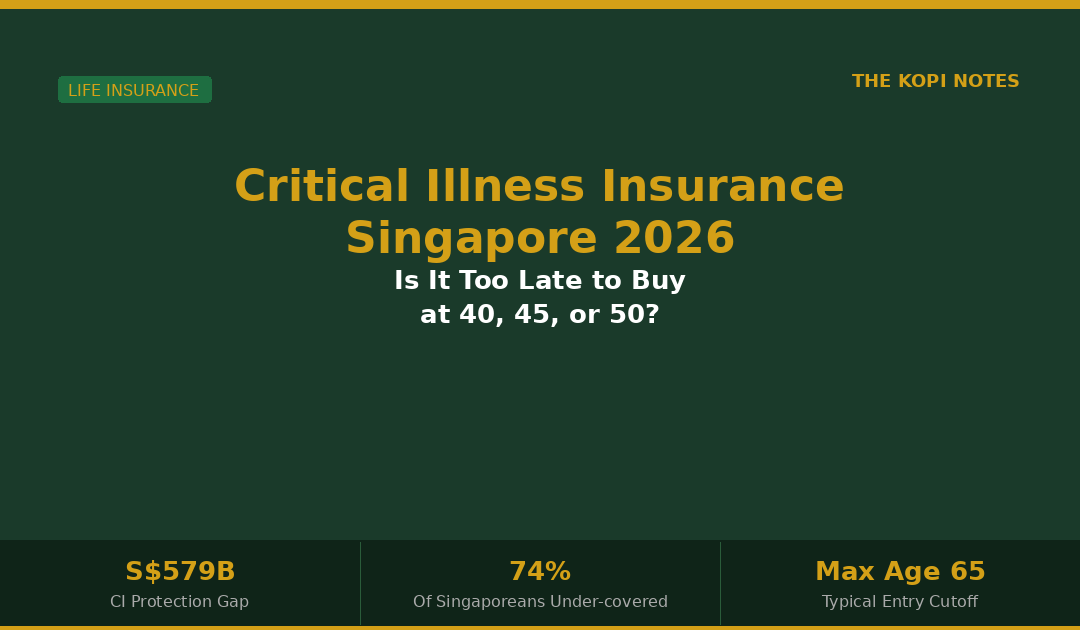
If you are in your 40s or 50s and realise you never bought critical illness (CI) insurance, you are not alone. The LIA Protection Gap Study 2022 found that Singapore’s CI protection gap stands at S$579 billion — a 74% shortfall — meaning the average Singaporean has only about S$93,300 in CI coverage against a recommended need of S$357,900.
The common assumption is that CI insurance is something you buy in your 20s or 30s and that’s it. Miss that window, and you’re stuck paying punishing premiums or getting rejected outright. But is that really true?
This guide cuts through the noise: what actually changes when you buy CI insurance at 40, 45, or 50, what it will cost you, when it stops making financial sense, and what your alternatives are.
Why Age Matters for Critical Illness Insurance
CI insurance pays a lump sum if you are diagnosed with one of the 37 standard critical illnesses defined by the Life Insurance Association Singapore (LIA), covering conditions such as cancer, heart attack, and stroke. Unlike health insurance that reimburses medical bills, CI insurance hands you cash — to replace lost income, clear a mortgage, or pay for care that MediShield Life does not cover.
Age matters for three reasons:
1. Premiums scale with risk. Actuarially, your probability of developing cancer, suffering a heart attack, or experiencing a stroke increases materially from your 40s onward. Insurers price this risk directly into your premium. The older you are when you first buy, the higher your annual outlay for the same sum assured.
2. Maximum entry ages apply. Most standalone CI plans in Singapore impose a maximum entry age — commonly 65 for new applications. Once you cross that threshold, you cannot apply for a new plan regardless of your health. Some insurers cap entry earlier for certain plan types.
3. Health declarations become more consequential. At 30, a standard application with no major health history is almost always clean. At 50, you may have borderline cholesterol, a controlled-blood-pressure diagnosis, or a family history of cancer that prompts underwriting exclusions or premium loading — or outright rejection.
None of these factors make CI insurance worthless at 40 or 50. But they do change the calculation. Let us walk through what you can actually expect.
Premium Benchmarks by Age (2026)
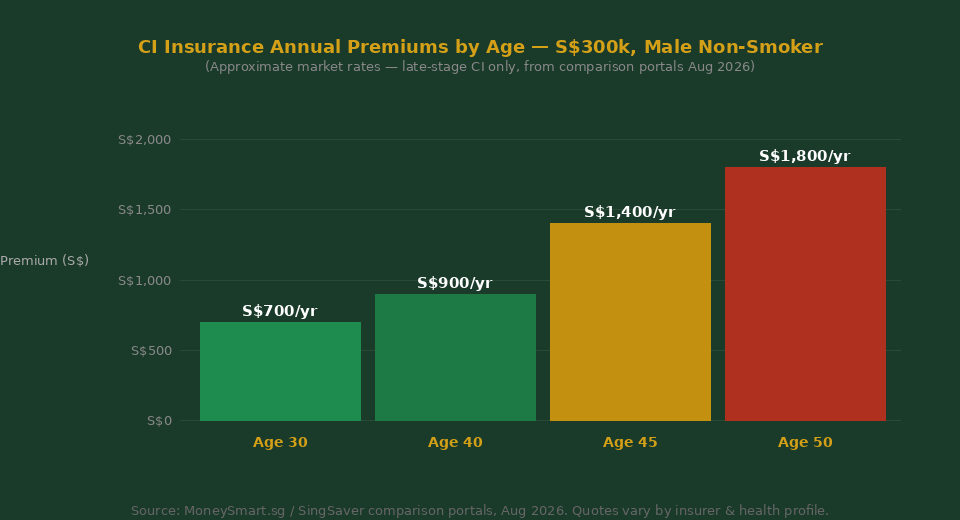
The table below shows approximate annual premiums for a male non-smoker purchasing S$300,000 in late-stage CI cover, sourced from Singapore comparison portals (MoneySmart.sg, SingSaver.com.sg) in August 2026. Actual premiums differ by insurer, plan type, sum assured, and health profile — these figures represent the lower end of market pricing to give you a directional sense.
| Age at Application | Annual Premium (Approx.) | Monthly Equivalent | vs. Buying at 30 |
|---|---|---|---|
| 30 | ~S$700/yr | ~S$58/mo | Baseline |
| 40 | ~S$900/yr | ~S$75/mo | +29% more expensive |
| 45 | ~S$1,400/yr | ~S$117/mo | +100% more expensive |
| 50 | ~S$1,800/yr | ~S$150/mo | +157% more expensive |
* Premiums shown are indicative market rates for late-stage CI only, male non-smoker, S$300k sum assured. Early CI (ECI) and multi-pay plans cost significantly more. Get a personalised quote for your exact situation.
Is CI Insurance Still Worth Buying at 40?
Short answer: Almost certainly yes, if you are in good health.
At 40, you are still typically well within maximum entry ages and, if you have no major medical history, you can often secure a clean policy without exclusions. A late-stage CI plan at ~S$900/yr for S$300k cover is still a very reasonable transfer of risk — particularly because your 40s are precisely when the probability of a major CI claim starts to climb.
Consider the math. If you buy at 40 and maintain coverage to age 70, that is a 30-year window. Total outlay at ~S$900/yr: S$27,000. Against a S$300,000 payout if you ever trigger a claim, the expected-value case holds up clearly — especially given that Singapore’s CI claim rates are well-documented. In 2023, the industry paid out over S$555 million in CI claims, with cancer, heart attack, and stroke accounting for the vast majority.
The more important question at 40 is not whether to buy, but which type of CI plan to buy. Your main options:
Late-stage CI only (standard 37 conditions): Lowest premiums, pays only on advanced diagnosis. Suitable if budget is the primary constraint and you want the most cost-efficient cover.
Early CI (ECI): Pays from early/intermediate stage of illness (e.g., early-stage cancer, before it becomes invasive). Premiums are higher but the probability of triggering a claim sooner is also higher — ECI claims are rising as screening improves. At 40, ECI premiums are still manageable.
Multi-pay CI (e.g., Singlife Multipay CI II, AIA Protect 3 launched May 2026): Allows multiple claims across different or even the same critical illness. Best value if you have a family history of cancer or cardiovascular disease, as your risk of a second CI event is real.
For most 40-year-olds without significant pre-existing conditions, a clean application for a late-stage or early-stage CI plan of S$200,000–S$300,000 remains straightforward. The main risk: buying nothing at all and crossing 45 without cover in place.
What About at 45 or 50?
This is where the calculation gets more nuanced — and the cost of delay becomes painful.
Buying at 45
At 45, premiums have roughly doubled compared to age 30. At ~S$1,400/yr for S$300k late-stage CI, you are paying a meaningful monthly commitment. However, the case for buying remains strong for two reasons:
First, your risk window has significantly shortened — the window between now and a probable retirement at 62–65 is about 17–20 years, and that is precisely the period when cancer, heart attack, and stroke risk climbs steeply for Singaporeans. A CI claim during that window, without coverage, could wipe out years of accumulated savings.
Second, many Singaporeans at 45 carry their peak financial obligations — mortgage, children in secondary or tertiary education, ageing parents, and career-stage earnings that have not yet been replaced by retirement assets. A CI event without coverage at this stage is financially devastating.
The key caveat at 45: health declarations matter more. If you have borderline results (pre-hypertension, elevated cholesterol, fatty liver, diabetes), expect underwriting scrutiny. Some conditions lead to exclusions on specific CI types or premium loading of 25–75%. This is not a reason to skip the application — it is a reason to apply sooner rather than later.
Buying at 50
At 50, standalone CI insurance is still available and still worth considering, but your options narrow. Premium costs of ~S$1,800/yr for S$300k late-stage CI means you are committing roughly S$150/month. For that outlay, the financial case depends heavily on your remaining income-replacement need and existing savings.
If you are 50 with a solid CPF balance, minimal debt, and grown children, the CI coverage need may be lower — perhaps S$150,000–S$200,000 rather than S$300,000–S$500,000. Sizing down the sum assured controls costs while still giving you meaningful protection against a multi-year cancer treatment or recovery period.
At 50, also consider whether a CI rider on an integrated shield plan (if you have one) or a standalone critical illness plan makes more sense. Riders can sometimes extend coverage beyond what a new standalone plan would offer, at a more competitive premium for your age.
One practical limit at 50: if you have any of the following, rejection or heavy exclusion is likely — Type 1 or 2 diabetes, prior cancer diagnosis, prior heart attack or stroke, chronic kidney disease. If these apply, skip ahead to the alternatives section below.
What Changes When You Apply Later
Beyond premiums, applying for CI insurance in your 40s and 50s differs from a 30-year-old’s experience in several important ways.
Longer and more detailed health declarations. You will be asked about conditions in the past 5–10 years — surgeries, hospitalisations, chronic conditions, family history of CI. A 30-year-old typically has little to declare. At 45 or 50, even benign conditions (a removed cyst, a fractured bone, elevated liver enzymes) can trigger additional medical reports. Build in extra time — the underwriting process at older ages can take 4–8 weeks rather than 1–2 weeks.
Medical underwriting exclusions. If you have a pre-existing condition related to a specific CI type, the insurer will typically exclude that condition from coverage rather than reject your application outright. For example, if you have a benign thyroid nodule, the insurer may exclude “thyroid cancer” from your CI cover. This is still worthwhile coverage for all other covered conditions — but you must read your policy document carefully.
Premium loading. Some borderline health results (BMI over 30, controlled hypertension) may not lead to exclusions but instead to a premium loading — you pay a higher base premium, often 25–100% above standard rates.
Coverage duration choices. At 50, buying a 30-year term CI plan becomes mathematically odd — you would be paying premiums to age 80, past the typical maximum coverage age of many plans. Most advisers recommend structuring CI coverage to align with your income-replacement need: if you plan to retire at 63, a 13-year CI term from age 50 covers your peak vulnerability window without over-insuring.
To understand the LIA’s updated critical illness definitions and what counts as a “qualifying” diagnosis, see our guide to the LIA Critical Illness Definitions 2024 and the October 2025 changes.
Alternatives If You Cannot Qualify for CI Insurance
If you are declined for CI insurance due to pre-existing conditions, or if premiums at your age are simply unaffordable, you still have options.
Upgraded MediShield Life / Integrated Shield Plans (IPs). These are not CI insurance — they reimburse hospitalisation costs, not income loss — but having a good IP with a rider removes the financial shock of hospitalisation bills. This is a minimum floor that every Singaporean should have.
Hospital Cash plans. These pay a fixed daily cash amount for each day you are hospitalised, regardless of diagnosis. They are not as comprehensive as CI insurance, but they are significantly easier to qualify for, including at older ages or with pre-existing conditions.
MediSave / CPF withdrawals. MediSave can cover certain outpatient cancer treatments and hospitalisation costs, though it is capped. Understanding your MediSave balance and what it can cover is essential health-financial planning for those who are uninsurable for CI.
Caregiver allowance riders. Some integrated shield plans and term life policies include caregiver allowance components that pay a monthly benefit if the insured cannot perform activities of daily living — providing a partial income-replacement function even without a standalone CI plan.
Build an emergency fund sized for a CI event. If you are uninsurable, financial planners typically recommend a liquidity buffer of at least 24 months of living expenses ring-fenced specifically for healthcare disruption — separate from your investment portfolio and CPF. This is not insurance but it is functional self-insurance.
Use our Insurance Gap Calculator to estimate your personal CI protection shortfall.
Practical Action Steps for Late Starters
If you are in your 40s or early 50s and have no CI insurance, here is a clear sequence of actions:
1. Calculate your CI coverage need first. Use the LIA’s guideline of 3.9x annual income for CI (similar to the 9x rule for death/TPD coverage). For a household income of S$8,000/month, that implies a CI need of approximately S$374,400. Adjust down if you have significant savings or CPF, adjust up if you have dependants or a mortgage. See our CI coverage amount guide for the detailed calculation.
2. Check your current CI coverage. Many Singaporeans have partial CI coverage they have forgotten about — group insurance from employers often includes CI or dread disease cover. Check your HR benefits portal before buying additional coverage.
3. Get quotes from at least 3 insurers via a comparison portal. Premium variation across insurers for the same profile can be 30–50%. See our best CI insurance comparison for a starting point. Then get personalised quotes from your preferred insurers, as comparison portals show indicative rates only.
4. Apply as soon as possible. The premium difference between 44 and 46 can be S$400–600/yr for a S$300k plan. Every year of delay is permanent — premiums reset to the higher age bracket and you cannot “lock in” a younger premium after the fact.
5. Be fully transparent on your health declaration. Non-disclosure of a known condition can void your claim entirely. If you are unsure whether a past medical event is relevant, disclose it and let the underwriter decide. The downside of over-disclosure is a small exclusion; the downside of non-disclosure is a total claim rejection when you need it most.
For a fuller picture of plan types and what each covers at different life stages, see our CI insurance comparison guide (Early CI vs Multi-Pay vs Standalone).
Grow Alongside Your Protection Plan
Once your insurance foundation is solid, put idle savings to work. These platforms are used by the TKN team.
Frequently Asked Questions
Is there a maximum age to buy critical illness insurance in Singapore?
Does group CI insurance from my employer count?
Can I use CPF to pay for critical illness insurance premiums?
What if I am rejected for critical illness insurance due to a health condition?
Is early CI (ECI) still worth buying at 45?
How much critical illness insurance do I need at 45?
What is the difference between CI insurance and MediShield Life for coverage at 45?
Which insurers offer the best CI insurance in Singapore for older applicants?
The Bottom Line
The short answer to “Is it too late to buy CI insurance at 40, 45, or 50?” is: no — but the cost of waiting is real and compounding. At 40, CI insurance is still very accessible and competitively priced for most Singaporeans. At 45, premiums have roughly doubled from age-30 rates, but the financial case for coverage remains strong given the income and mortgage obligations most people carry at that stage. At 50, CI insurance is still available and worth the premium — especially for those with family history of major critical illnesses — though the sum assured should be sized to match your actual remaining income-replacement window rather than a fixed S$300k target.
The single worst decision is deciding the question later. Every year of delay is a permanent premium increase you cannot reverse. If you have been putting this off, this week is a better time to get quotes than next year.
Data verified as at 26 August 2026. This article is for informational purposes only and does not constitute financial advice. Please consult a licensed financial adviser before purchasing any insurance product.
Get Free Insurance Advice
Speak with a licensed insurance advisor. No obligation, no cost.
By submitting this form, you agree to our Privacy Policy.
This article was researched with the help of AI. While we strive to keep all information accurate and up to date, there may be errors. If you notice any discrepancies, please contact us.