LIA Critical Illness Insurance Definitions 2024: What Changed in October 2025
Data verified as at 23 August 2026. This article covers the LIA CI Framework 2024 changes, what the 37 standard critical illness conditions cover, and how to assess your coverage needs.
What Is the LIA CI Framework?
The Life Insurance Association (LIA) Singapore Critical Illness (CI) Framework sets the standardised definitions for what counts as a critical illness — and therefore what triggers a payout on your CI insurance policy.
Before this framework existed, each insurer could define conditions differently. A “major cancer” claim at one insurer might require different staging criteria than at another. The LIA stepped in to standardise definitions so that every Singapore-licensed insurer uses the same benchmark language for all 37 severe-stage critical illnesses.
This matters because CI insurance pays a lump-sum cash benefit when you are diagnosed with any of the 37 listed conditions at the severity threshold defined by LIA. There is no reimbursement model — you receive the full sum assured regardless of actual medical bills, and you can use it for treatment, income replacement, mortgage payments, or anything else.
The most recent version is the LIA CI Framework 2024, which superseded the 2019 edition. New policies issued from 1 October 2025 onwards must use the 2024 definitions.
What Changed in the 2024 Update?
The LIA reviewed the 2019 definitions and issued the CI Framework 2024 in June 2024, with a compliance deadline of 1 October 2025 for all new policies. The changes were driven by advances in medical technology and updated clinical practice — some conditions that once required severe intervention can now be treated less invasively, and definitions needed to reflect this.
In total, 7 critical illness definitions were revised and 2 header/category names were reworded for clarity. The changes are designed to:
- Clarify the scope of coverage so claims are less ambiguous
- Accurately reflect the circumstances under which a claim can be made
- Keep definitions in step with advances in diagnostics and surgical techniques
The LIA has stated that the revision is not expected to result in premium increases, though individual insurers retain the right to reprice. The 7 revised conditions span the major disease categories including cancer-related definitions, cardiac conditions, and neurological illness staging criteria — all aligned with current clinical guidelines recognised by the Ministry of Health Singapore.
Key practical implication: If you bought your CI policy before October 2025, your policy continues under the 2019 definitions — insurer contractual obligations freeze the terms at the point of issue. Only policies taken out on or after 1 October 2025 are governed by the 2024 framework.
The 37 Standard Critical Illness Conditions
The LIA framework covers 37 severe-stage critical illnesses. These are broadly grouped into major disease categories:
| Category | Examples of Conditions Covered |
|---|---|
| Cancer | Major cancer (solid tumours and haematological malignancies at severe stage) |
| Heart & Circulatory | Heart attack (of specified severity), heart failure, coronary artery bypass surgery, heart valve surgery, aorta surgery |
| Neurological | Stroke (with permanent neurological deficit), brain tumour, motor neurone disease, Parkinson’s disease, Alzheimer’s disease |
| Organ Failure | Kidney failure, liver failure, lung disease (end-stage) |
| Other Major Conditions | Blindness, deafness, loss of speech, loss of limbs, paralysis, severe burns, coma, HIV due to blood transfusion |
Note: “Severe stage” is the key threshold. A stage 1 cancer, for instance, may not trigger a payout under standard CI insurance — only severe-stage or late-stage diagnoses do. Early CI insurance (a separate product type) covers earlier staging, but at a higher premium.
CI Claim Statistics in Singapore
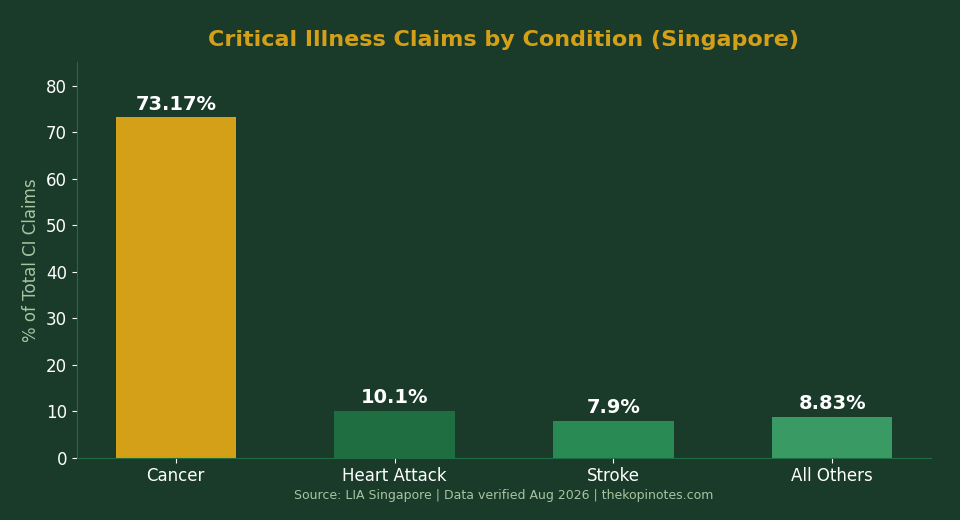
LIA Singapore publishes industry-wide claim data that tells us which conditions Singaporeans are actually claiming for — and the numbers are eye-opening.
Cancer dominates at 73.17% of all critical illness claims filed. The “Big 3” — cancer, heart attack, and stroke — collectively account for over 90% of all severe-stage CI claims. This means that structurally, your CI policy is primarily cancer insurance with added protection for cardiac and neurological events.
What does this mean for how you choose a plan? It means:
- Cancer definition quality matters most. How each insurer defines “major cancer” — what staging criteria apply, what’s excluded — will have the biggest practical impact on your likelihood of claiming successfully.
- Early CI makes the most sense for cancer risk. Most cancers are diagnosed before Stage 3. Standard CI (severe stage only) may reject a claim that early CI would pay out on.
- Stroke definition is the second most important. Stroke definitions vary more than other conditions — look for policies that don’t require permanent paralysis to trigger a claim.
The Coverage Gap Problem
Here is the uncomfortable truth: the average CI insurance payout in Singapore is approximately S$52,343. That sounds like a significant sum — until you consider that a cancer treatment course in Singapore can easily cost S$150,000 to S$400,000 over the full treatment period, excluding lost income during recovery.
Financial planners typically recommend a minimum of 3 to 5 years of annual income as your CI sum assured:
| Monthly Income | Annual Income | Recommended CI Cover (3-5x) |
|---|---|---|
| S$3,000 | S$36,000 | S$108,000 – S$180,000 |
| S$5,000 | S$60,000 | S$180,000 – S$300,000 |
| S$8,000 | S$96,000 | S$288,000 – S$480,000 |
| S$12,000 | S$144,000 | S$432,000 – S$720,000 |
The average payout of S$52,343 falls below even the lowest income bracket’s minimum recommendation. This suggests a significant underinsurance problem across the Singapore population — a gap the MAS and LIA have acknowledged as an ongoing concern.
How Much CI Cover Do You Need in Singapore?
As a benchmark for a non-smoking male aged 35 with S$300,000 sum assured on a 20-year term plan, annual premiums run approximately:
- Standard CI (severe stage only): S$198 – S$342 per year
- Early CI (covers early and severe stages): S$280 – S$480 per year
For most working Singaporeans, the sweet spot is S$200,000 – S$400,000 in CI coverage, ideally structured as a term CI plan (not bundled with whole life) for cost efficiency. You can layer early CI on top of standard CI if budget allows.
Three practical steps to close your coverage gap:
- Check your existing policy’s definitions. If your policy was issued before October 2025, verify whether the 2024 framework applies. For older policies (pre-2019), ask your insurer or advisor for a definitions comparison — the gap between 2014 and 2024 definitions can be material.
- Calculate your real coverage need (5x annual income as a conservative target).
- Compare at least 3 plans before buying — focus on the cancer definition, stroke definition, and any occupation-based exclusions.
Existing vs New Policies: What the 2024 Framework Means for You
The golden rule: your existing policy is governed by the definitions at the time of issue. Insurers cannot unilaterally change claim definitions mid-policy — that would be a contract breach. So if you bought your CI plan in 2020 under the 2019 definitions, those definitions are what your insurer must honour at the time of a claim.
What the 2024 framework means in practice:
- New buyers (from Oct 2025 onward): Your policy will use the 2024 definitions — generally clearer and in some cases slightly broader in scope due to updated medical criteria.
- Existing policyholders: No change to your current policy. However, if you are considering topping up your coverage with a new policy, the top-up plan will use the 2024 definitions — creating a slight definitional mismatch between your plans (usually not a practical problem since each policy is assessed independently).
- Old policies (pre-2019 definitions): If you have a CI policy from before 2019 that has never been reviewed, it may use substantially older definitions that are more restrictive. These are the policies most worth reviewing with a licensed financial adviser.
For a full comparison of how TKN rates the best CI plans in Singapore, including which policies use the most policyholder-friendly cancer and stroke definitions, see our Best Critical Illness Insurance Singapore 2026 guide.
Compare CI Plans with Endowus
Endowus offers fee-transparent access to insurance plans including critical illness cover. Use referral code 2V343 to get started.
Frequently Asked Questions
What is the LIA CI Framework 2024?
Does the 2024 update affect my existing CI policy?
How many critical illnesses are covered under the LIA standard?
Which condition is most commonly claimed under CI insurance in Singapore?
How much critical illness insurance cover do I need?
What is the difference between standard CI and early CI insurance?
Is critical illness insurance the same as health insurance in Singapore?
Get Free Insurance Advice
Speak with a licensed insurance advisor. No obligation, no cost.
By submitting this form, you agree to our Privacy Policy.
This article was researched with the help of AI. While we strive to keep all information accurate and up to date, there may be errors. If you notice any discrepancies, please contact us.