Critical Illness Insurance vs MediShield Life Singapore: What’s the Difference? (2026)
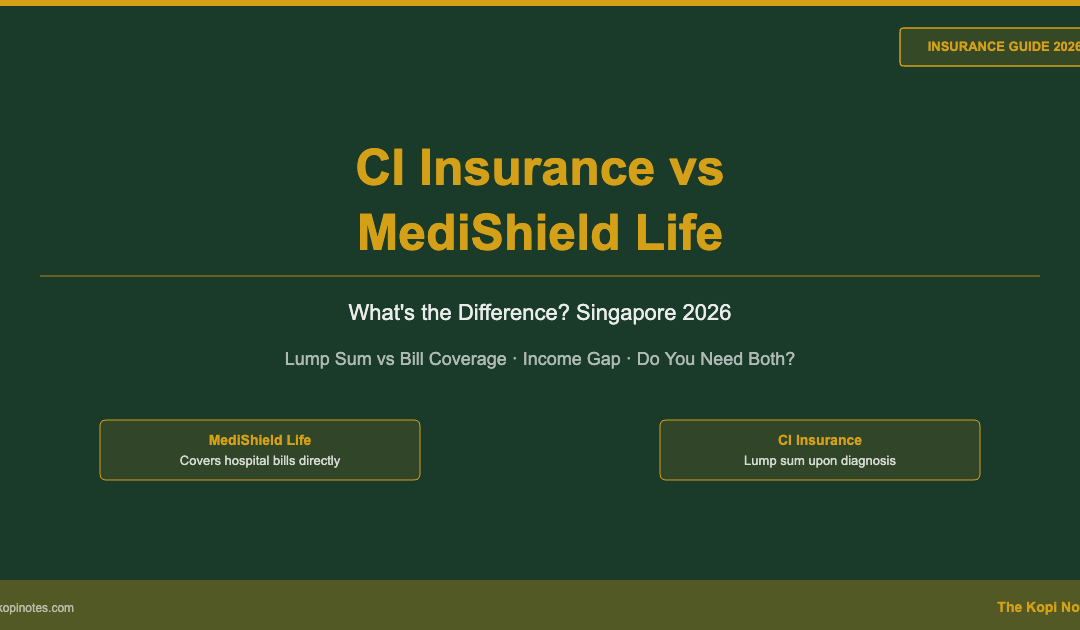
MediShield Life covers your hospital bills. Critical illness insurance pays a lump sum directly to you upon diagnosis of a covered condition — regardless of what your medical bills cost. Both are different financial tools solving different problems: MediShield Life is compulsory and government-administered; CI insurance is voluntary and purchased privately. Most Singaporeans need both for complete protection against a serious illness.
Not financial advice. All figures are educational reference only. Data verified as at September 2026 from CPF Board and MOH Singapore unless otherwise noted.
Table of Contents
- What Is MediShield Life?
- What Is Critical Illness Insurance?
- MediShield Life vs CI Insurance: Key Differences
- The Coverage Gap MediShield Life Doesn’t Fill
- Do You Need Both?
- How Much CI Insurance to Buy Alongside MediShield Life
- 2026 MediShield Life Changes
- Where to Buy CI Insurance in Singapore
- Frequently Asked Questions
What Is MediShield Life?
MediShield Life is Singapore’s national health insurance scheme, administered by the CPF Board. Every Singapore Citizen and Permanent Resident is automatically enrolled — premiums are deducted from your Medisave account. It was designed to protect Singaporeans against large hospital bills, particularly for stays in B2 and C class wards.
Here is how it works in practice: when you are hospitalised and discharged, your hospital submits the bill directly to the scheme. MediShield Life pays its share after your deductible and co-insurance. You pay the rest out of Medisave or cash.
What MediShield Life Covers
According to the CPF Board (as at September 2026), MediShield Life covers:
- Inpatient hospitalisation at restructured hospitals (B2/C wards as baseline)
- Selected costly outpatient treatments: chemotherapy, radiotherapy, dialysis, immunosuppressants after organ transplants
- Approved day surgery procedures
- Emergency inpatient treatment at private hospitals (capped at restructured hospital rates)
Key Limits to Know (2026 Figures)
| Item | 2026 Figure |
|---|---|
| Annual claim limit | S$200,000 per policy year |
| Lifetime limit | None |
| Inpatient deductible | S$1,500–S$3,000 (age-dependent, once per year) |
| Co-insurance rate | 10% on first S$5,000; steps down to 3% above S$10,000 |
| What it does NOT cover | Lost income, rehabilitation, caregiver costs, alternative therapy |
Source: CPF Board, Ministry of Health Singapore, September 2026
You can supplement MediShield Life with an Integrated Shield Plan (ISP) — offered by private insurers like AIA, Prudential, Great Eastern, Income, and Raffles — which upgrades your coverage to private hospital ward classes and reduces your out-of-pocket costs. But even with an ISP, your financial exposure from a serious illness goes far beyond hospital bills.
What Is Critical Illness Insurance?
Critical illness (CI) insurance is a separate, voluntary insurance product that pays a cash lump sum directly to you when you are diagnosed with a covered medical condition — such as cancer, heart attack, stroke, kidney failure, or organ transplants. You receive the payout regardless of your actual medical bills.
Unlike MediShield Life, which pays the hospital directly, CI insurance puts money in your hands. You can use it for anything: replacing your salary, paying the mortgage, hiring a caregiver, funding overseas treatment, or simply buying time to recover without financial stress.
What CI Insurance Typically Covers
Most CI policies in Singapore cover a standard list of 37 conditions defined by the Life Insurance Association Singapore (LIA). These include major cancers, heart attack of specified severity, stroke with permanent neurological deficit, kidney failure requiring dialysis, and major organ transplants. Many insurers also offer early-stage CI coverage for conditions like early-stage cancer, angioplasty, or transient ischaemic attacks — though these require a separate policy or rider and typically pay 25–50% of the sum assured.
A Singapore investor in their 30s holding a S$300,000 CI policy who is diagnosed with Stage 2 cancer receives S$300,000 in cash — even if their total hospital bill is only S$80,000 after MediShield Life kicks in. The balance funds years of income replacement and recovery.
For a deeper look at coverage options, see our guide on best critical illness insurance Singapore 2026.
MediShield Life vs Critical Illness Insurance: Key Differences
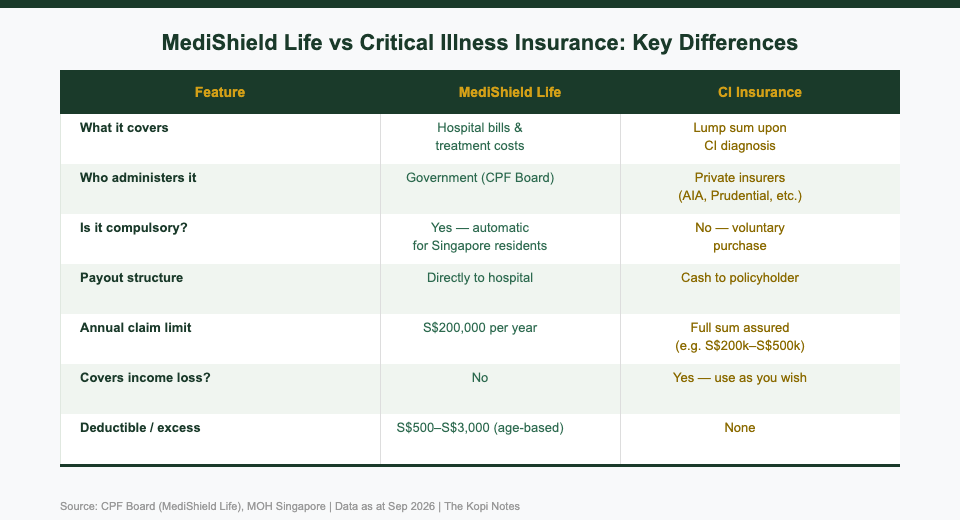
The core distinction is this: MediShield Life is a bill-payment tool. CI insurance is a financial replacement tool. They serve completely different purposes and work together rather than competing.
Source: CPF Board, LIA Singapore | Compiled by The Kopi Notes, September 2026
The critical point for Singapore residents: MediShield Life is compulsory and automatic. CI insurance must be purchased separately. Even if you have an Integrated Shield Plan, you are still missing the income-replacement and lifestyle-cost layer that only CI insurance provides.
The Coverage Gap MediShield Life Doesn’t Fill
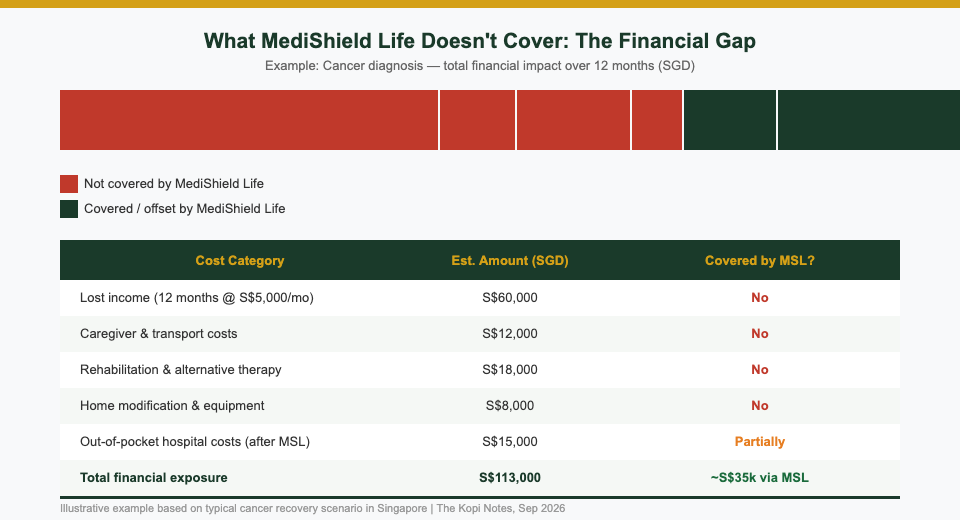
Consider a 38-year-old Singaporean salaried worker earning S$5,000 per month who is diagnosed with cancer. After surgery, they need 12 months off work. Here is the true financial picture:
Illustrative example. Actual costs vary. Source: The Kopi Notes analysis, September 2026
The four biggest uncovered costs are:
- Lost income: MediShield Life pays your hospital, not your landlord. If you cannot work, your salary stops. CI insurance replaces it.
- Caregiver and transport costs: Family members may need to reduce working hours to care for you. Taxi fares to daily treatment add up to thousands per month.
- Rehabilitation and alternative therapy: Physiotherapy, traditional Chinese medicine, dietary supplements, and mental health support are not reimbursed by MediShield Life.
- Home modification: Wheelchair ramps, grab bars, hospital beds at home — essential for recovery but not covered by any government scheme.
In a worst-case cancer scenario, the financial exposure beyond hospitalisation can easily exceed S$100,000 — more than most Singaporeans have in liquid savings. A CI policy of S$200,000–S$300,000 covers this gap.
Read also: how much critical illness insurance coverage do you need — our full calculation guide.
Do You Need Both MediShield Life and CI Insurance?
Yes. They are not substitutes — they are complements. Here is a simple way to think about it:
| Scenario | MediShield Life helps? | CI Insurance helps? |
|---|---|---|
| Hospitalised for 5 days (appendix surgery) | ✅ Yes | ❌ Not usually a CI trigger |
| Diagnosed with Stage 3 cancer | ✅ Yes (hospital bills) | ✅ Yes (S$200k–S$500k lump sum) |
| Heart attack requiring 6 months off work | ✅ Yes (hospital bills) | ✅ Yes (replaces lost income) |
| Stroke — need caregiver for 2 years | ✅ Yes (hospitalisation) | ✅ Yes (funds long-term care) |
| Rehabilitation after kidney transplant | Partial (hospital costs only) | ✅ Yes (covers rehab, supplements) |
The Kopi Notes analysis | September 2026
For life situations beyond a brief hospital stay — cancer, heart attack, stroke, or any condition requiring months of recovery — you need the financial cushion that CI insurance provides. MediShield Life alone leaves the biggest bills unpaid.
If you are building a retirement plan in Singapore, a critical illness diagnosis without CI insurance can set back your FIRE timeline by 5–10 years or more. Protecting against this risk is part of any serious financial plan.
How Much CI Insurance to Buy Alongside MediShield Life
The standard LIA-recommended guideline is 3.9x your annual income in CI coverage. However, the right number depends on your personal situation. A practical framework:
- Minimum coverage: 2 years of your gross annual income — enough to cover the most acute recovery period without touching savings
- Comfortable coverage: 4–5 years of gross annual income — covers income replacement plus rehabilitation and lifestyle adjustment costs
- Self-employed workers: 5–7 years — no employer sick pay, CPF contributions stop, business disruption costs are significant (see our CI insurance for self-employed Singapore guide)
Worked example: A 35-year-old earning S$6,000/month should target S$280,800–S$432,000 in CI coverage (using 3.9x–6x annual income). At this age, a S$300,000 standalone term CI policy from a major insurer costs approximately S$80–S$150/month — a reasonable premium for the protection provided.
Note: Your MediShield Life premium does not count toward CI coverage. They are separate products with separate premiums. Medisave funds can pay your MediShield Life premium; CI insurance premiums are paid in cash.
For passive income investors: a serious illness without adequate CI cover may force you to sell income-generating assets (S-REITs, ETFs, dividend stocks) at the worst possible time. Protecting your portfolio from forced liquidation is one of the strongest arguments for robust CI coverage. Read more: passive income Singapore 2026.
2026 MediShield Life Changes and What They Mean for CI Coverage
Several significant changes to the MediShield Life framework took effect in 2026, with more phased in from April 2027. Key updates verified from the Ministry of Health and CPF Board:
- Outpatient deductible introduced (1 June 2026): For the first time, a deductible applies to selected outpatient treatments like chemotherapy and dialysis. This increases out-of-pocket costs for cancer patients on outpatient treatment — widening the gap that CI insurance needs to fill.
- ISP rider changes (from April 2026): New Integrated Shield Plan riders must not cover the minimum deductible, and must impose a minimum co-payment cap of at least S$6,000 per policy year. This means even ISP holders now face higher out-of-pocket costs, making CI insurance more important than before.
- Inpatient deductible increase (Phase 2: April 2027): Deductibles for inpatient stays will rise further, adding to the coverage gap that CI insurance is designed to plug.
Bottom line for 2026: The trend is towards more co-payment and less full-coverage reimbursement from MediShield Life and ISPs. This makes voluntary CI insurance a more critical layer of your financial plan, not less.
Where to Buy CI Insurance in Singapore
The most cost-effective way to access CI insurance in Singapore is through an independent financial advisor or a robo-advisory platform that lets you compare multiple insurers without pressure. Three platforms TKN readers use:
- Endowus (referral code 2V343) — Access insurance and investment products from major Singapore insurers. Transparent fee structure.
- Syfe (referral code SRPRFFFCD) — Income+ and Cash+ products complement your CI coverage as a short-term emergency fund buffer.
- FSMOne (referral code) — Access a wide range of insurance products and compare premiums across major Singapore insurers.
TKN may earn a referral fee when you sign up via these links. This does not affect the advice given. Always consult a licensed financial advisor (MAS-regulated) before purchasing any insurance product.
Frequently Asked Questions
Does MediShield Life pay me a cash lump sum if I get cancer?
Can I use Medisave to pay for CI insurance premiums?
If I have an Integrated Shield Plan, do I still need CI insurance?
What are the 37 CI conditions covered in Singapore?
How does CI insurance interact with my employer's group insurance?
Does CI insurance cover pre-existing conditions?
Summary: MediShield Life and critical illness insurance are complementary — not competing — financial tools. MediShield Life handles your hospital bills. CI insurance handles everything a hospital bill cannot: your salary, your rehabilitation, your caregiver, and your peace of mind. With 2026 ISP changes raising your out-of-pocket costs, having adequate CI coverage is more important than ever. Start with a policy sized at 4x your annual income and review annually as your income and liabilities change.
For related reading: best S-REITs Singapore 2026 | CPF investment strategy | Singapore retirement calculator
Get Free Insurance Advice
Speak with a licensed insurance advisor. No obligation, no cost.
By submitting this form, you agree to our Privacy Policy.
This article was researched with the help of AI. While we strive to keep all information accurate and up to date, there may be errors. If you notice any discrepancies, please contact us.