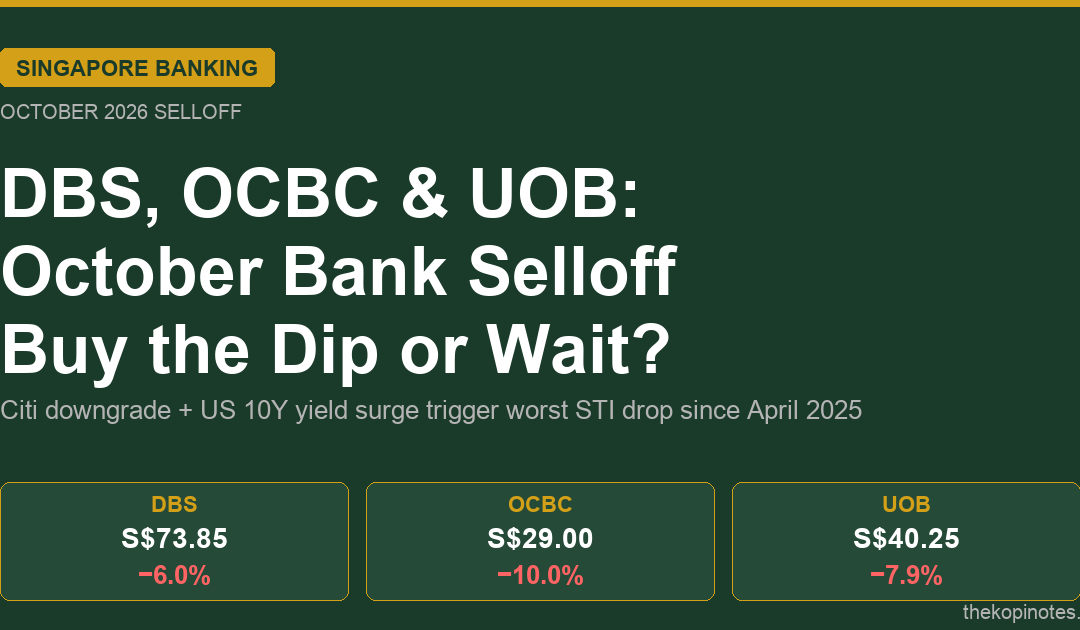
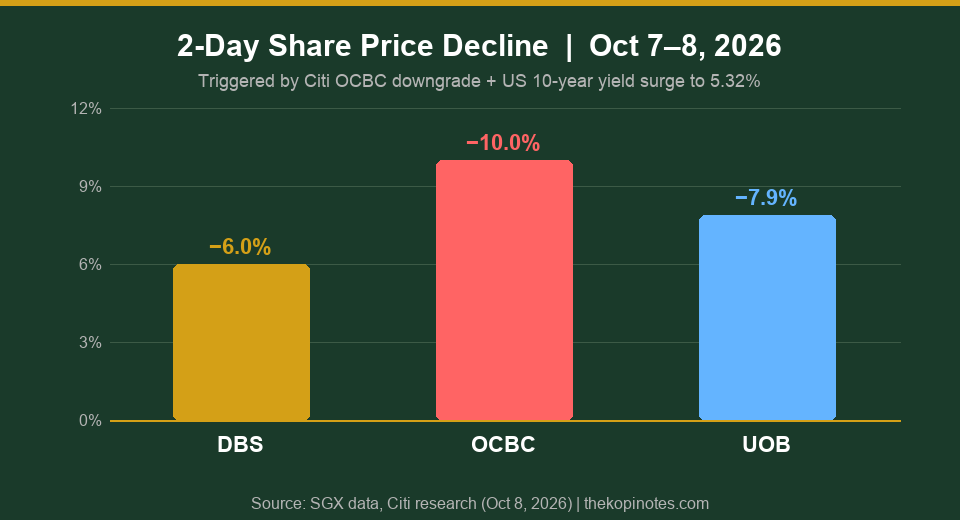
If you woke up on Wednesday 8 October 2026 and glanced at your portfolio, you may have been in for an unpleasant surprise. Singapore’s three local banking giants — DBS Group, OCBC, and UOB — collectively shed between 6% and 10% over just two trading days, wiping out months of accumulated gains in a matter of hours. The Straits Times Index (STI) fell 3.5% on 8 October alone, its steepest single-day drop since the tariff-driven panic of April 2025.
For retail investors who have held these banks as core long-term positions — or who have been eyeing them for their reliable dividends — the sudden selloff raises an uncomfortable question: Is this a buying opportunity, or an early warning sign of something bigger?
In this article, we break down exactly what happened, how each bank now looks on valuation, what the analysts are saying, and what the upcoming Q3 results season might mean for your decision.
What Triggered the Selloff?
The catalyst was a one-two punch from global and local events that arrived almost simultaneously on 7 October.
First, the US 10-year Treasury yield surged to 5.32% — a level not seen since late 2023. Higher US long-bond yields typically hurt bank stocks in Singapore for two reasons: they signal that US monetary conditions are tightening, which pressures global credit; and they make risk-free dollar assets more attractive relative to equities, pulling capital away from markets like Singapore.
Second, and more directly, Citi Research downgraded OCBC to a “Sell” rating on 7 October, assigning a target price of just S$27.50 against its prevailing price near S$32. Citi’s analysts cited concerns about margin compression from falling Singapore interbank rates (SORA), a softening wealth-management outlook, and relatively expensive valuations compared to regional peers. OCBC is seen as a bellwether for the local banking sector, and the Citi call shook sentiment across all three banks.
The KBW Nasdaq Bank Index, a gauge of US banking sentiment, had already fallen 12.3% from its mid-August peak to 8 October — adding to the global risk-off backdrop. Singapore banks, heavily owned by foreign institutional investors, could not escape the contagion.
How Far Did Each Bank Fall?
DBS Group (D05) declined approximately 6.0% over the two-day period, closing at around S$73.85 on 8 October. DBS had been the star performer of Singapore banking in 2025 and early 2026, buoyed by strong wealth management flows and its regional digital-banking franchise. The selloff brought it to its lowest level since late July 2026.
OCBC (O39) was the hardest hit, tumbling approximately 10.0% to around S$29.00. The Citi downgrade was the direct catalyst, but OCBC had also run up sharply ahead of the October correction after reporting strong 1H26 results. The 10% fall essentially returned it to where it traded in late August.
UOB (U11) fell around 7.9% to approximately S$40.25. UOB’s more cautious regional expansion strategy and its exposure to ASEAN markets — increasingly in focus as US-China trade tensions recalibrated in mid-2026 — contributed to the outsized move relative to DBS.
What Do the Valuations Look Like Now?
After the selloff, here is where each bank stands on the key metrics retail investors should know:
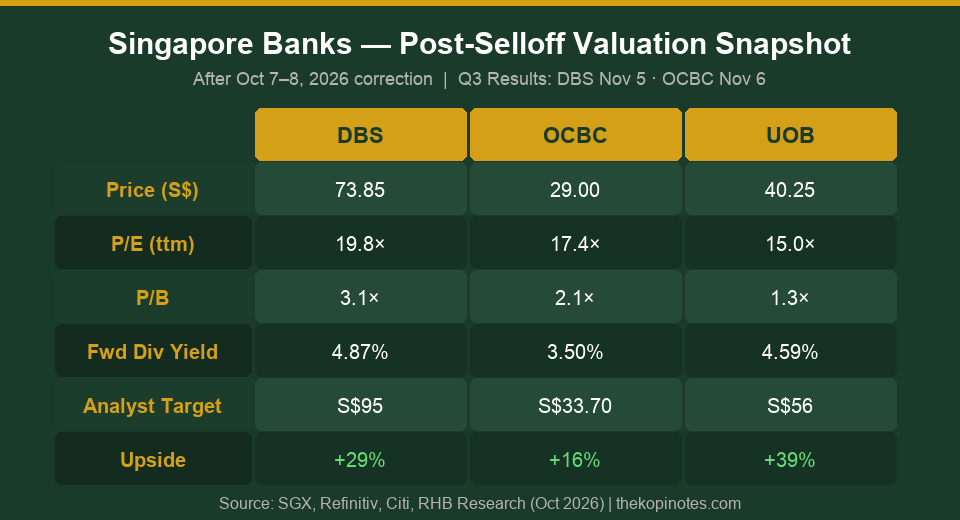
A few things stand out. UOB is trading at just 1.3× book value — historically a level at which long-term investors have been well rewarded. DBS remains the most expensive at 3.1× book, partly justified by its higher ROE (17.5% as of 2Q26) and its premium wealth management platform. OCBC at 2.1× book sits in the middle, though Citi’s S$27.50 target implies the market may not yet be done adjusting.
All three banks continue to offer forward dividend yields above 3.5%, which remains compelling relative to the current Singapore Savings Bond rate of approximately 2.6%. If you are a dividend investor building passive income to supplement your CPF returns, these yields have not disappeared — they have, if anything, improved slightly as share prices fell.
Consensus analyst target prices still imply meaningful upside for all three banks from current levels: around 29% for DBS, 16% for OCBC (blending the Citi bear case with RHB’s bull case), and approximately 39% for UOB.
What Are the Analysts Saying?
The analyst community is divided, which in itself tells you something about the uncertainty in the air right now.
Citi Research initiated a “Sell” on OCBC with a target of S$27.50, citing weaker-than-expected net interest margin (NIM) trends as SORA drifts lower, and noting that OCBC’s wealth management fee income could face headwinds if global equity markets continue to soften.
RHB Research maintained OCBC as its top sector pick with a target of S$33.70, arguing that the Citi thesis overstates the NIM risk and that OCBC’s Great Eastern integration — which closed earlier in 2026 — will provide a structural earnings uplift not fully priced in.
On DBS, most houses maintain “Buy” or “Overweight” ratings. DBS’s diversified revenue streams and strong fee income from its cash management and treasury services franchise provide some insulation from pure NIM pressure. The bank’s 2Q26 net profit of S$3.08 billion — up 9% year-on-year — underscored the quality of its earnings engine.
For UOB, bulls point to attractive valuation at 1.3× book, a clean balance sheet (NPL ratio: approximately 1.5%), and the potential re-rating catalyst if ASEAN economic growth surprises to the upside in 2H26. Bears argue that UOB’s relative underperformance has persisted for years and that there is no near-term catalyst to close the gap with DBS. UOB’s 2Q26 net profit was S$1.48 billion (+10% YoY) with ROE at 11.8%.
Historical Context: Is a Selloff Like This Normal?
Sharp corrections in Singapore bank stocks are not unprecedented — and they have, historically, often been followed by recoveries, provided the underlying earnings trajectory remained intact.
In July 2026, Singapore banks fell sharply when investors feared the US Federal Reserve would hold rates higher for longer than expected. That correction was also triggered by macro factors rather than fundamental earnings deterioration, and the banks recovered within six to eight weeks as Q2 results confirmed solid profitability. You can read our analysis of the July 2026 bank stocks pullback here.
Looking further back, the banking sector also sold off during the US regional bank crisis of March 2023, during Covid-driven volatility in 2020, and during the Global Financial Crisis. In each case, investors who added during the selloff outperformed those who waited for the dust to settle — but only when the macro environment eventually stabilised. The critical difference is earnings quality: as long as NPLs remain controlled and NIMs hold above 1.8%, the bear case for Singapore banks has limited legs. See our full Q2 2026 results analysis here.
Q3 Results Are Coming: What to Watch
The most important catalyst on the horizon is the Q3 2026 results season. DBS reports on 5 November; OCBC reports on 6 November. UOB has not yet confirmed its date but is expected in the second week of November.
Three numbers will determine whether this selloff turns into a deeper bear case or a recoverable dip.
Net Interest Margin (NIM): DBS’s NIM fell 18 basis points to 1.87% in 2Q26 as SORA drifted lower and fixed-rate loans repriced. If NIM declines further in Q3 — particularly if SORA averaged below 3.5% for the quarter — it signals a tougher 2027 outlook. A stable or slightly improved NIM would be a meaningful relief for sentiment.
Wealth Management Fees: DBS’s wealth management arm grew strongly in 1H26, driven by buoyant equity markets and mainland Chinese high-net-worth inflows. If Q3 market volatility has crimped fee income, that will show up in the wealth management line. Watch for DBS’s assets under management (AUM) figure specifically.
Credit Quality: OCBC’s 1H26 net profit came in at S$4.19 billion (+13% YoY), with ROE at 13.7%. Its credit cost guidance for FY26 is 20–25 basis points. Any deterioration above the upper end of that range, especially in China corporate or regional property segments, would be a negative surprise that could extend the selloff.
Should You Buy the Dip or Wait for Q3?
This is the question every retail investor is wrestling with right now. Here is a framework for thinking it through.
Arguments for buying now: Valuations have compressed meaningfully, especially for UOB (1.3× book) and OCBC (2.1× book). Forward dividend yields above 3.5% remain attractive relative to bonds and savings accounts. The macro trigger — a US yield surge and a single broker downgrade — is sentiment-driven rather than a signal of structural earnings impairment. If Q3 results are in line with consensus, the recovery could be swift.
Arguments for waiting: US 10-year yields at 5.32% represent a genuine headwind for global bank stocks. The Citi OCBC downgrade may not be an outlier — if other analysts follow with cuts to NIM assumptions, the selloff could extend. Waiting four to six weeks for the actual Q3 numbers reduces the risk of catching a falling knife if earnings disappoint.
A middle path: If you are a long-term dividend investor, consider adding a partial position now and reserving capital to add more after Q3 results if the macro picture worsens. Dollar-cost averaging through volatile periods is the approach that tends to work best for Singapore banking blue chips, which have historically rewarded patient investors over three-to-five year horizons. For investors managing CPF-OA or SRS funds, this article on CPF investment strategy offers useful context on how bank stocks fit into a retirement-focused portfolio.
If you have been underweight Singapore banks and have been waiting for an entry point, the current levels are materially more attractive than where these stocks traded in September. But “attractive” and “immediate bottom” are not the same thing — and it is important to size your position to survive further downside if the macro situation deteriorates further. For a broader view of how Singapore blue chips fit into a dividend portfolio, see our guide to Singapore blue chip stocks in 2026.
The Bottom Line
The October 2026 Singapore bank selloff is sharp and jarring — but based on what we know today, it is not a sign of fundamental breakdown. Earnings across DBS, OCBC and UOB have been solid throughout 2026, credit quality is well controlled, and dividends remain intact. The trigger was macro (US yields) and sentiment (one analyst downgrade), not a profit warning or an NPL spike.
What this correction has done is reset valuations to more reasonable levels, particularly for UOB and OCBC. It has also reminded retail investors that bank stocks — even Singapore’s famously stable ones — are not immune to global macro shocks. Building positions gradually, watching the November Q3 results closely, and not over-leveraging are the key disciplines for navigating a moment like this.
We will be covering the Q3 results for DBS, OCBC and UOB in detail when they are released in November. Stay tuned, and see how Singapore stocks performed earlier this year for context on how far the market has moved since the highs.
This article is for informational purposes only and does not constitute financial advice. All figures are based on publicly available data as at 10 October 2026. Past performance is not indicative of future results. Please consult a licensed financial adviser before making any investment decisions.
This article was researched with the help of AI. While we strive to keep all information accurate and up to date, there may be errors. If you notice any discrepancies, please contact us.