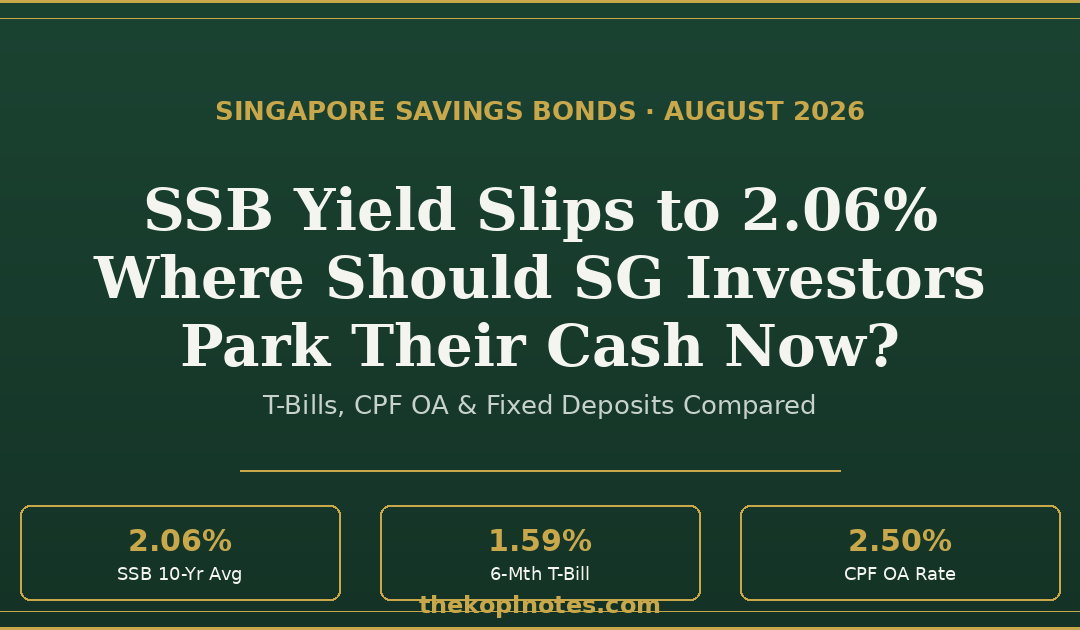
The August 2026 Singapore Savings Bond (SBAUG26) pays 2.06% p.a. over 10 years, its second straight monthly dip, while the 6-month T-bill yield climbed to 1.59% on 30 July. With CPF OA still guaranteeing 2.5% and fixed deposits capped near 1.65%, Singapore investors have four very different places to park cash this month — each with its own trade-off.
This is an editorial analysis, not financial advice. Data verified as at 4 August 2026 against MAS, CPF Board and bank sources.
What Happened: SSB August 2026 Results
MAS closed applications for the August 2026 Singapore Savings Bond (issue code SBAUG26, GX26080T) on 28 July at 9pm, with allotment announced the next day. The issue returns 1.46% p.a. if held for just one year, stepping up each year to 2.72% p.a. by year ten — which averages out to a 2.06% p.a. return if held to maturity on 1 August 2036. Every $10,000 invested and held for the full decade grows to roughly $12,081.
That 10-year average is down from 2.11% in July, the second consecutive monthly decline after a brief rebound in May and June. MAS offered S$300 million of this tranche; investors applied for S$196.6 million and, after individual allotment caps, S$179.4 million was allotted — meaning every applicant received their bonds in full, with no balloting required. The bond pays interest every six months, on 1 February and 1 August, and individuals may hold no more than S$200,000 in Savings Bonds in total.
Read our complete Singapore Savings Bond guide if you’re new to how SSBs work, or run the numbers yourself with our SSB interest calculator.
What This Means for Singapore Retail Investors
An undersubscribed tranche is itself a signal. When SSB rates were above 3% in 2023 and 2024, demand regularly outstripped supply and allotments were rationed to a few thousand dollars per applicant. This month, everyone who applied got their full amount — a sign that at 2.06%, the SSB is no longer competitive enough to draw the crowds it once did. For retail investors, that’s a cue to compare before defaulting into an SSB out of habit.
SSB Yields Have Been Choppy, Not Just Falling
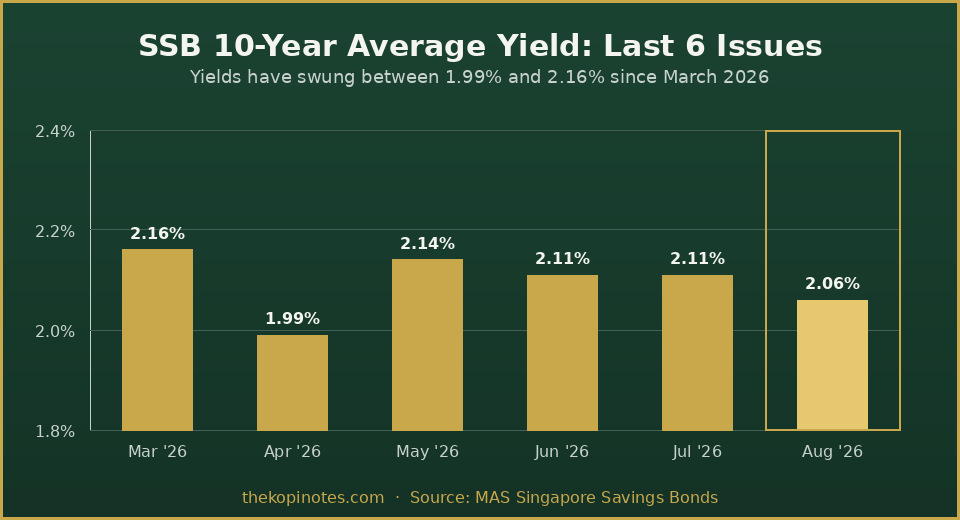
The 10-year average yield hasn’t declined in a straight line this year. It fell to 1.99% in April, rebounded to 2.14% in May, held at 2.11% through June and July, and has now eased to 2.06% in August. The chart below shows the last six issues.
SSB vs T-Bills vs CPF OA vs Fixed Deposits: Where’s the Best Home for Your Cash?
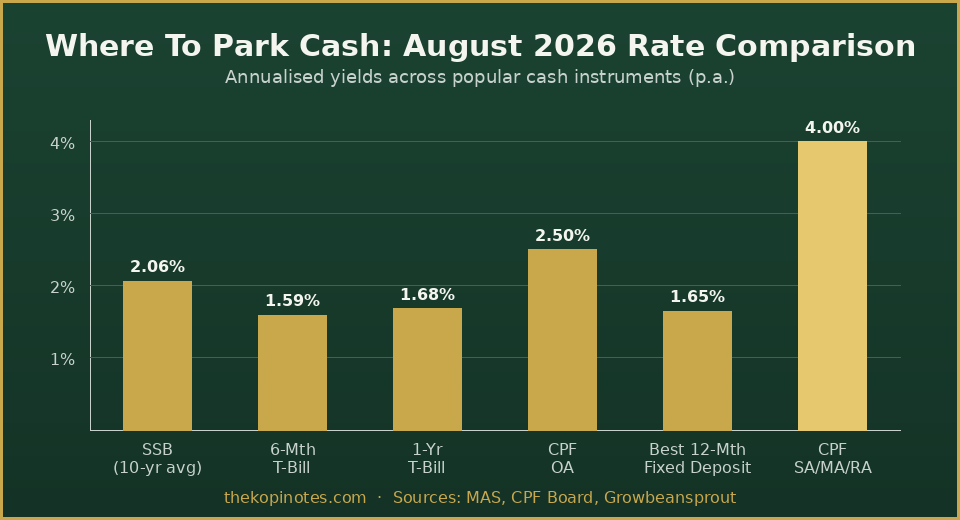
The SSB isn’t the only place to park spare cash. Here’s how the major low-risk options compare this month, based on the latest official and bank-published rates:
| Instrument | Rate (p.a.) | Lock-in | Key Notes |
|---|---|---|---|
| SSB (10-year average) | 2.06% | None — redeemable any month | 1.46% if redeemed after 1 year; step-up to 2.72% by year 10 |
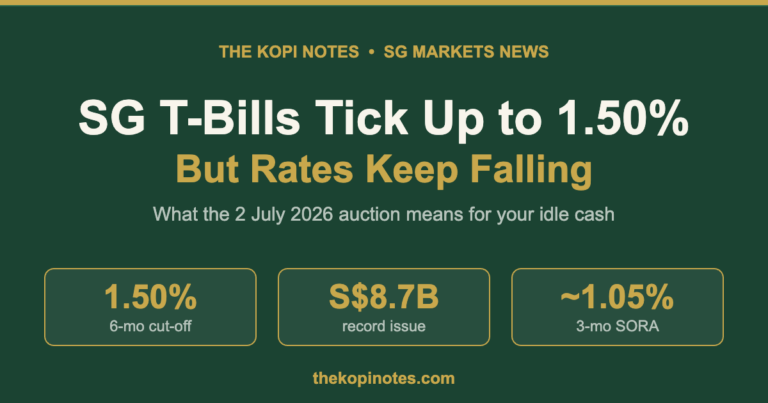
| 6-Month T-Bill | 1.59% | 6 months | Cut-off yield, 30 Jul 2026 auction — highest since the start of the year |
| 1-Year T-Bill | 1.68% | 12 months | Cut-off yield, 23 Jul 2026 auction |
| CPF Ordinary Account | 2.50% | Until eligible withdrawal age | Floor rate, unchanged for Q3 2026 (1 Jul–30 Sep) |
| Best 12-Month Fixed Deposit | ~1.60%–1.65% | 12 months | Top promotional rate (e.g. RHB), min. deposit typically S$20,000 |
| CPF Special/MediSave/Retirement Account | 4.00% | Until eligible withdrawal age | Under the extended interest floor, in place through 31 Dec 2026 |
CPF members under 55 also earn an extra 1% on the first $60,000 of combined balances (capped at $20,000 for OA), while those 55 and above earn an extra 2% on the first $30,000 and an extra 1% on the next $30,000. Digital bank flexi-accounts sit at the low end — MariBank pays a flat 0.88% p.a. with no conditions — while some conditional savings accounts advertise up to 5.85% p.a. or higher for customers who meet salary-crediting, card-spend and top-up requirements.
What This Means for Singapore Retail Investors
The gap between SSB and T-bills has effectively closed and, on a short holding period, flipped. If you only plan to hold for six months to a year, the 6-month T-bill’s 1.59% and 1-year T-bill’s 1.68% now sit close to the SSB’s 1.46% first-year rate — and T-bills settle faster with a more predictable allotment process for larger sums. The SSB’s real advantage remains its flexibility: you can redeem in any month without penalty, which T-bills and fixed deposits don’t offer once locked in.
For CPF members, the comparison is more clear-cut. Money you don’t need for at least a few years and that already sits in your Special, MediSave or Retirement Account earns 4% guaranteed — comfortably ahead of every cash instrument in the table above, with no market risk. Even the CPF Ordinary Account’s 2.5% floor now edges out this month’s SSB average. The catch is obvious: CPF savings come with withdrawal restrictions that cash in a bank account or CDP-linked SSB does not.
How the August SSB Fits Your Cash Strategy
Three practical takeaways for TKN readers deciding what to do this month:
If you’re holding an SSB from the ultra-low-rate years (2020–2021, when first-year rates fell below 0.5%), this issue is still an upgrade. SSBs redeem at par, so switching costs you nothing beyond the one-month redemption wait.
If you locked in an SSB during 2022–2024, when 10-year averages topped 3%, hold what you have. This month’s 2.06% is a step down from what you’re likely already earning.
If you’re deciding where fresh cash should go, match the instrument to your time horizon: T-bills or a fixed deposit for money you can lock away for 6–12 months, the SSB for money you want to keep fully liquid, and CPF top-ups only for savings you’re genuinely comfortable committing long term. Our T-Bill vs SSB vs Fixed Deposit calculator can help you compare exact dollar returns across all three.
For a deeper look at how T-bill auctions have moved this year, see our Singapore T-Bill auction results tracker and our T-bill interest rate guide. If fixed deposits are more your speed, our review of the Hong Leong Finance fixed deposit rates breaks down one of the more competitive standing offers in the market.
Bottom Line for SG Investors
The August 2026 SSB’s 2.06% 10-year average is the lowest since early 2026 and confirms that short-term government-backed yields have compressed across the board. It’s still a reasonable, fully liquid place to park money you don’t want locked away, but it’s no longer clearly the best rate on the table — T-bills, CPF OA and even some fixed deposits now sit close behind or ahead of it, depending on your horizon. The right move isn’t to chase whichever instrument has the highest headline rate this month, but to match each pool of cash to how long you can actually leave it untouched.
Frequently Asked Questions
What is the August 2026 Singapore Savings Bond interest rate?
The August 2026 SSB (SBAUG26, GX26080T) pays 1.46% p.a. if held for one year, stepping up to 2.72% p.a. by year ten, for a 10-year average return of 2.06% p.a. if held to maturity on 1 August 2036.
Why did the SSB yield fall in August 2026?
SSB rates are pegged to the corresponding Singapore Government Securities (SGS) yield curve at the time of issuance. As SGS bond yields eased into late July 2026, the resulting SSB coupon schedule for August came in lower than July’s, continuing a second straight monthly dip.
Is the SSB or the 6-month T-bill better right now?
It depends on your time horizon. The 6-month T-bill’s 1.59% cut-off yield (30 July 2026 auction) beats the SSB’s 1.46% first-year rate, but T-bill funds are locked for the full 6 months. The SSB can be redeemed in any month without penalty, making it more flexible for money you may need on short notice.
How much can I invest in Singapore Savings Bonds?
Each individual can hold a maximum of S$200,000 in Savings Bonds across all issues. The minimum investment is S$500, in increments of S$500.
Is CPF Ordinary Account interest better than the SSB?
Yes, on a pure rate basis. CPF OA pays a guaranteed 2.5% p.a. (unchanged for Q3 2026), ahead of this month’s SSB 10-year average of 2.06%. However, CPF savings are subject to withdrawal restrictions that don’t apply to SSB holdings.
Did the August 2026 SSB get fully allotted?
Yes. Applications totalled S$196.6 million against S$300 million on offer; after individual allotment caps were applied, S$179.4 million was allotted, meaning every applicant received their full requested amount with no balloting needed.
When does the August 2026 SSB mature and pay interest?
The bond was issued on 3 August 2026 and matures on 1 August 2036. Interest is paid every six months, on 1 February and 1 August each year, with the first payment due 1 February 2027.
Where can I check next month’s SSB rate?
MAS announces each new Savings Bond issue’s rates on the first business day of the month on its official Savings Bonds page. Applications open the same day and close on the fourth-last business day of the month.
This article was researched with the help of AI. While we strive to keep all information accurate and up to date, there may be errors. If you notice any discrepancies, please contact us.