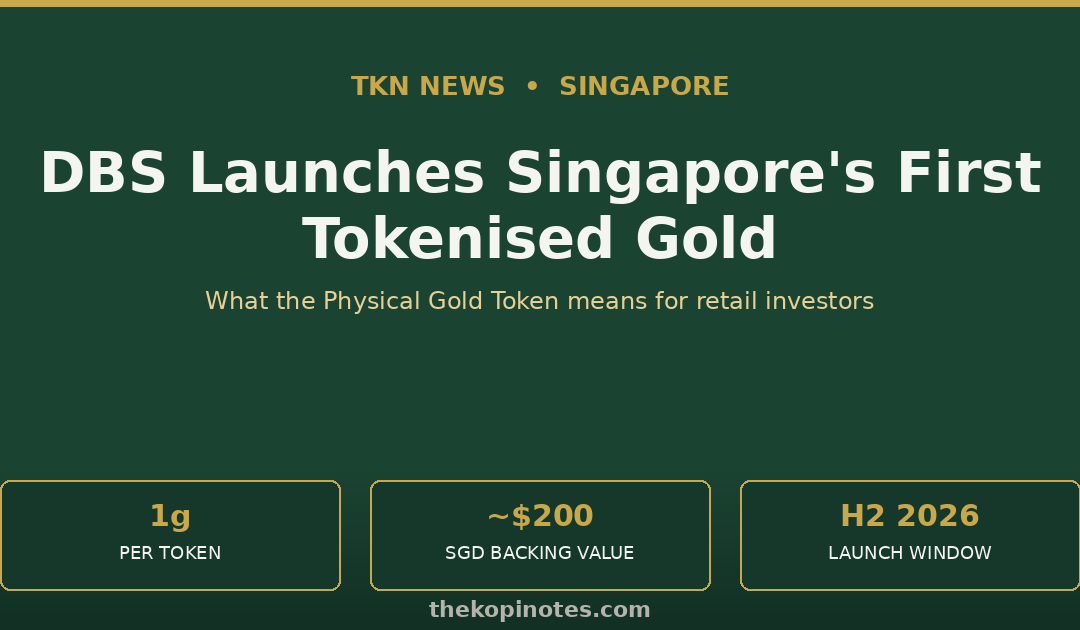
DBS announced on 11 June 2026 that it will launch DBS Physical Gold Tokens via digibank in the second half of 2026 — Singapore’s first bank-issued tokenised physical gold for retail customers. Each token represents one gram of vaulted gold, fractionally tradeable 24/7. Here’s what it means for your portfolio.
This is an editorial analysis. Not financial advice. Data verified as at 5 August 2026 against official DBS and MAS sources.
What DBS Announced
On 11 June 2026, DBS confirmed it will offer DBS Physical Gold Tokens to retail customers through the DBS digibank app starting in the second half of 2026, according to the bank’s official newsroom release. DBS describes it as a “market-first” offering: customers will be able to digitally access, hold, trade and eventually redeem tokenised physical gold through a single platform, entirely built and managed in-house by the bank.
Each token is backed by one gram of physical gold (worth approximately SGD 200 as of 11 June 2026) held in a dedicated DBS vault in Singapore. DBS is also exploring listing the token on DBS Digital Exchange (DDEx) for accredited and institutional investors, with further details to follow.
What this means for SG retail investors: for the first time, a local bank — rather than a bullion dealer, broker or ETF issuer — is putting fractional, redeemable physical gold ownership directly inside the same app most Singaporeans already use for savings and bill payments. That lowers the friction of getting into gold meaningfully.
How DBS Physical Gold Tokens Work
Per DBS, the token offering is built around four features:
- Convenience: trading is available 24/7, unlike SGX-listed gold ETFs which only trade during market hours.
- Speed: DBS says atomic settlement enables near-instant transactions.
- Affordability: fractional ownership lets customers buy, trade and hold amounts smaller than a full gram.
- Flexibility: customers will have the option to redeem tokens for physical gold bullion.
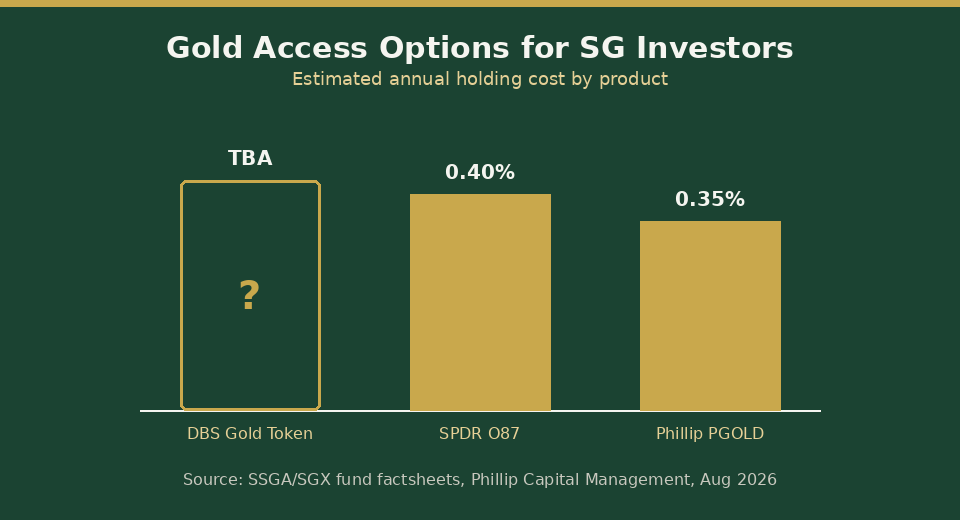
What this means for SG retail investors: the closest existing comparison is a gold ETF like SPDR Gold Shares (O87) or Phillip Gold ETF (PGOLD) — both already give exposure to physical gold at low cost. The token’s edge is 24/7 trading, smaller minimums, and physical redemption; its trade-off is that pricing, fees and exact redemption mechanics have not yet been disclosed by DBS.
Why Now: Singapore’s Push to Become a Regional Gold Trading Hub
DBS is a member of the Gold Market Development Working Group, established in January 2026 by the Monetary Authority of Singapore (MAS) and the Singapore Bullion Market Association (SBMA), per MAS’s media release. The working group — which also includes UOB, JPMorgan, UBS, ICBC Standard Bank, SGX Group and the World Gold Council — is developing gold capital-market products, vaulting and logistics standards, and a clearing system for over-the-counter settlement.
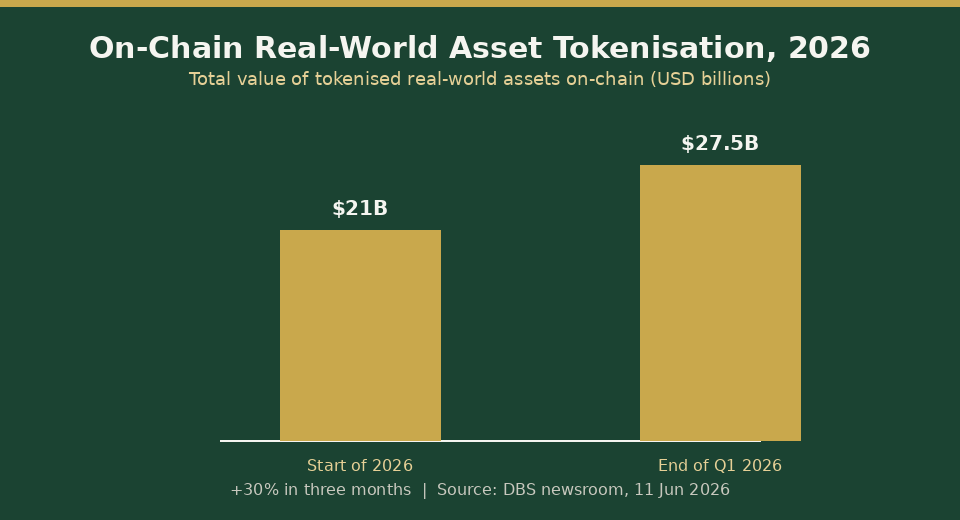
DBS also notes that on-chain real-world asset (RWA) tokenisation overall grew from roughly USD 21 billion at the start of 2026 to about USD 27.5 billion by end-Q1 2026, a 30% rise in three months.
What this means for SG retail investors: this isn’t a one-off product launch. It’s part of a coordinated national push to build out Singapore’s gold infrastructure, meaning more banks, brokers and platforms are likely to follow with similar tokenised or fractional gold products over the next year.
Gold as an Asset Class: Why the Timing Matters
DBS’s release notes that gold prices reached an all-time high of USD 5,600 per ounce earlier in 2026, before recent fluctuations. The bank has offered physical gold investments to its wealth clients since 2013 but is now extending access to the mass retail base via tokenisation.
What this means for SG retail investors: gold’s role in a portfolio is typically as a diversifier and inflation/volatility hedge, not a growth engine. A near-record gold price environment is exactly when advisers usually caution against chasing the asset purely on momentum — sizing and purpose matter more than the wrapper you use to hold it.
How the Token Compares to Existing Gold Options
| Option | Minimum Unit | Trading Hours | Est. Annual Cost | Physical Redemption |
|---|---|---|---|---|
| DBS Physical Gold Token | Fraction of 1 gram | 24/7 (per DBS) | Not yet disclosed | Yes (per DBS) |
| SPDR Gold Shares (O87, SGX) | 1 share | SGX trading hours | ~0.40% p.a. expense ratio | No (institutional-size only) |
| Phillip Gold ETF (PGOLD, SGX) | 1 share | SGX trading hours | ~0.35% p.a. expense ratio | No (institutional-size only) |
| DBS physical bullion (wealth clients, since 2013) | Bar/coin sized | Branch/dealing hours | Storage & dealing spread | Yes |
Expense ratios for O87 and PGOLD are the funds’ latest published figures as of August 2026; DBS Physical Gold Token fees have not been published and will be confirmed at launch.
How Much Gold Should You Actually Hold?
New product launches tend to trigger a rush of interest, but the more useful question for most Singapore households is sizing, not access. Financial planners commonly suggest gold occupy somewhere in the range of 5% to 10% of a diversified portfolio — enough to dampen volatility during equity drawdowns or currency stress, but not so much that you give up the long-run growth that stocks, REITs and bonds typically provide. That guideline predates DBS’s token and applies regardless of which wrapper — ETF, token or bullion — you use to hold the gold.
What this means for SG retail investors: a new, easier way to buy gold doesn’t change how much gold belongs in your portfolio. If you’re already near your target allocation through a gold ETF, the token launch is more of a convenience upgrade than a reason to add fresh exposure. If you have no gold allocation at all, this is a prompt to think about whether you should — not necessarily through this specific product on day one.
What This Means for CPF, SRS and Portfolio Diversification
DBS Physical Gold Tokens are, based on current disclosures, a cash-account digibank product — there is no indication yet that they will be eligible for CPF Ordinary Account investing or SRS funds, both of which have their own approved-instrument restrictions. Investors who want gold exposure inside CPF-OA or SRS today still need to use SGX-listed gold ETFs through platforms that support those schemes, or gold-linked funds via robo-advisors.
What this means for SG retail investors: if you’re building a diversified portfolio across CPF, SRS and cash accounts, a new cash-only gold product doesn’t replace the need for CPF/SRS-eligible gold ETFs — it adds a new option specifically for money held outside those schemes.
Risks and Open Questions
Several details remain unconfirmed as of this article’s publication:
- Exact fees, spreads and minimum trade sizes have not been disclosed.
- Redemption terms for converting tokens into physical bullion (minimum quantities, delivery vs. collection, associated costs) are not yet public.
- It is unclear whether DBS Physical Gold Tokens will carry SDIC deposit insurance protection — as a gold-backed product rather than a cash deposit, they likely will not, similar to existing gold savings accounts.
- The exact 2026 launch date within “the second half of 2026” has not been set.
What this means for SG retail investors: treat this as a product to watch, not one to plan around yet. Wait for DBS to publish fee schedules and terms before comparing it head-to-head against existing gold ETFs or other DBS savings and investment products.
Bottom Line for SG Investors
DBS’s tokenised gold launch is a meaningful step in making physical gold ownership more accessible to everyday Singapore investors, and it fits into a broader, MAS-backed effort to build Singapore into a regional gold trading hub. But until DBS discloses fees and redemption terms, existing SGX-listed gold ETFs remain the more transparent, lower-cost, CPF/SRS-compatible way to add gold to a diversified portfolio. Compare this launch against your existing banking and digital bank setup before shifting any savings into it.
What is a DBS Physical Gold Token?
When exactly does the DBS gold token launch?
How much does one DBS Physical Gold Token cost?
Can I redeem DBS Physical Gold Tokens for real gold?
Is DBS Physical Gold Token better than a gold ETF like O87 or PGOLD?
Can I buy DBS gold tokens with CPF or SRS funds?
Why is Singapore pushing to become a gold trading hub?
This article was researched with the help of AI. While we strive to keep all information accurate and up to date, there may be errors. If you notice any discrepancies, please contact us.