HOW TO INVEST IN SINGAPORE
Dollar-Cost Averaging (DCA) in Singapore: The Complete 2026 Guide
Dollar-cost averaging (DCA) means investing a fixed amount every month — regardless of whether the market is up or down. In Singapore, you can DCA into globally diversified ETFs like CSPX (S&P 500) or VWRA (global) through four main routes: IBKR recurring investments, FSMOne’s Regular Savings Plan (RSP), robo-advisors like Endowus or Syfe, or CPFIS. Each has different fees and minimum amounts, but all let you build wealth systematically without timing the market.
Not financial advice. All figures are for educational reference only. Data verified as at 24 September 2026.
TABLE OF CONTENTS
- DCA removes the pressure of timing the market — you invest a fixed amount every month no matter what.
- The cheapest route for ETF DCA is IBKR (USD 1.70/trade) or FSMOne RSP (0.08% per transaction, min S$1).
- Robo-advisors (Endowus, Syfe) cost more but handle everything automatically — great if you want zero admin.
- S$500/month into CSPX for 20 years at 7% annual return grows to roughly S$261,000 — on S$120,000 invested.
What is Dollar-Cost Averaging (DCA)?
DCA is simple: you invest a fixed dollar amount at regular intervals — usually monthly — into the same asset, regardless of its current price.
When prices are high, your S$500 buys fewer units. When prices drop, the same S$500 buys more. Over time, your average cost per unit smooths out. You’re not trying to predict the bottom — you’re removing that decision entirely.
Here’s a simple example with CSPX (which tracks the S&P 500):
| Month | CSPX Price | Amount Invested | Units Bought |
|---|---|---|---|
| Jan 2026 | USD 680 | S$500 | 0.54 |
| Feb 2026 | USD 630 (dip) | S$500 | 0.59 |
| Mar 2026 | USD 710 | S$500 | 0.52 |
Illustrative example only. USD/SGD rate at ~1.35.
You bought more units in February — automatically — because prices were lower. That’s DCA working for you without any extra effort.
Why DCA Suits Singapore Investors
DCA fits Singapore’s investing reality particularly well. Here’s why:
1. You get paid monthly. Salaries land every month. DCA naturally aligns your investment cadence with your income. Set a standing order and you never forget to invest.
2. CPF tops up automatically. Every working month, your employer and you contribute to your CPF OA at 2.5% p.a. That’s already DCA at the system level — enforced saving that compounds quietly.
3. Global markets are volatile. In 2026, we’ve seen a Fed rate hike cycle rattle global equities. DCA means you’re buying into dips without having to stare at the charts and panic-sell.
4. You don’t need a lot to start. FSMOne RSP lets you start from S$50/month. Endowus and Syfe from S$100. You don’t need S$10,000 sitting around to begin.
The alternative — trying to time the market — consistently underperforms. Research from Vanguard (US market data, 2023) shows that even “perfect” timing (always investing at market lows) beats DCA by only about 1.3% over a 10-year period. Missing just a few good days wipes that advantage out fast.
The 4 Ways to DCA in Singapore
There are four main DCA methods available to Singapore investors. Each has different fees, effort levels, and minimum amounts:
| Method | Min/Month | Transaction Fee | Best For |
|---|---|---|---|
| IBKR (Recurring Invest) | ~S$200 | USD 1.70/trade | Cost-conscious DIY investors |
| FSMOne RSP | S$50 | 0.08%, min S$1 | Beginners with small amounts |
| Endowus (Cash/SRS) | S$100 | 0.25–0.60% p.a. | Hands-off + CPF/SRS access |
| Syfe Core | S$100 | 0.35–0.65% p.a. | Simple all-in-one portfolio |
Source: IBKR, FSMOne, Endowus, Syfe official pricing pages. September 2026.
The fee comparison chart below shows the annual cost as a percentage of your invested amount for each method, combining both the platform fee and the underlying ETF expense ratio:
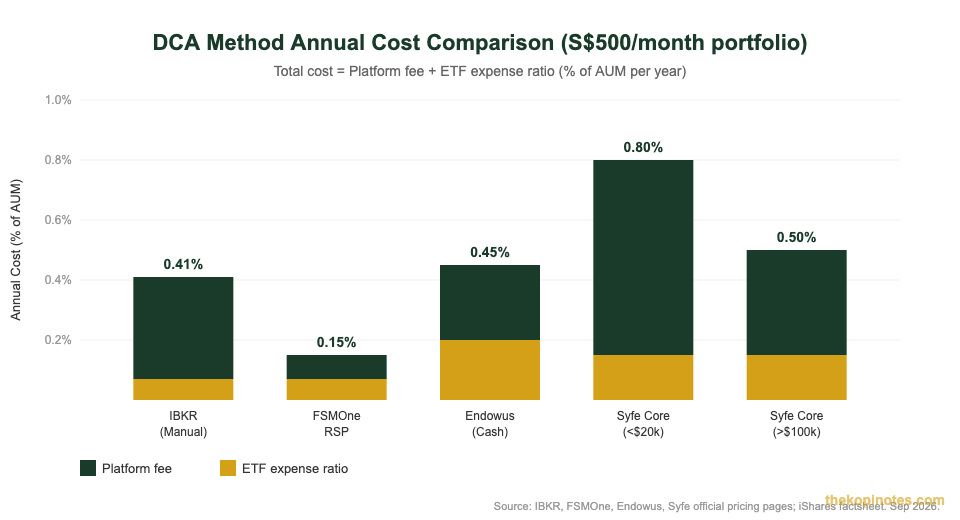
Chart: Annual all-in cost comparison across DCA methods. Lower is better. Source: Official platform pricing, September 2026.
Method 1: DCA with IBKR Recurring Investments
Interactive Brokers is the go-to platform for cost-conscious Singapore investors who want to buy LSE-listed ETFs like CSPX (iShares Core S&P 500) or VWRA (Vanguard FTSE All-World).
IBKR has a built-in Recurring Investments feature. Here’s how to set it up:
- Log into IBKR → go to Invest → Recurring Investments
- Search for CSPX (London Stock Exchange) or VWRA
- Set your monthly amount (e.g. S$500) and your preferred date
- Ensure your account has cash at least 1 business day before the trigger date
The fee is USD 1.70 per trade on the fixed pricing plan. On S$500/month (roughly S$6,000/year), that’s USD 20.40 annually — or about 0.34% of your invested amount. Add CSPX’s TER of 0.07%, and your all-in cost is around 0.41% per year.
As your portfolio grows, the fixed USD 1.70 becomes a smaller percentage of your total. At S$50,000 invested, the trade fee drops to just 0.04% of AUM annually — making IBKR significantly cheaper than any robo-advisor at scale.
Referral tip: Use referral code jianxiong368 when opening your IBKR account to get a welcome bonus.
Method 2: FSMOne Regular Savings Plan (RSP)
FSMOne’s RSP is Singapore’s most beginner-friendly way to DCA into ETFs. You can start from S$50/month, and trades execute automatically on the 15th of each month.
The fee is 0.08% per transaction, minimum S$1. So on S$500/month, you pay just S$0.40 — but since the minimum is S$1, you pay S$1. That’s effectively 0.2% on S$500, falling to 0.08% once you invest S$1,250 or more per month.
FSMOne supports a wide range of ETFs including Singapore-listed ones (like the SPDR STI ETF) and internationally-listed funds. You can also use your SRS account to invest through FSMOne RSP — useful for tax relief.
Use the FSMOne referral code when signing up to get S$30 back on your first RSP transaction.
One thing to know: FSMOne RSP executes at market price on the execution date, not at a price you choose. That’s fine for DCA — you’re not trying to pick an entry point anyway.
Method 3: DCA via Robo-Advisors (Endowus & Syfe)
Robo-advisors automate everything — portfolio selection, rebalancing, and regular investing. You set a monthly top-up, and they invest it for you.
Endowus
Endowus is uniquely powerful because it lets you invest CPF OA, SRS, and cash through the same platform. The annual access fee is 0.40% for CPF/SRS portfolios and starts from 0.25% for cash (tiered by AUM). There are no sales charges and fund trailer commissions are fully rebated — which can reduce the effective cost significantly.
Use the Endowus referral code 2V343 to get S$10,000 managed free for 6 months.
Syfe
Syfe Core is an all-in-one global equity portfolio with automatic monthly investing. Fees are tiered: 0.65% p.a. below S$20,000, 0.50% at S$20k–S$100k, and 0.35% above S$100,000.
Syfe is clean and easy to use. You set a monthly top-up in the app, link your bank account, and it handles the rest. Use the Syfe referral code and sign-up bonus SRPRFFFCD for a fee waiver on your first few months.
One trade-off: robo-advisors cost more than IBKR or FSMOne at the same portfolio size. If you have S$50,000 or more, the fee difference between Syfe (0.50%) and IBKR (0.07%) becomes meaningful over 10+ years.
For a deeper comparison, read our robo-advisor vs DIY guide.
Method 4: DCA with Your CPF (CPFIS)
Your CPF OA already earns a guaranteed 2.5% p.a. — one of the safest returns available in Singapore. But if you want to invest CPF OA savings into equities, you can do so through the CPF Investment Scheme (CPFIS).
Under CPFIS, you can invest in approved ETFs including the Nikko AM STI ETF and ABF Singapore Bond Index Fund. You keep the first S$20,000 in your OA (it earns a 1% bonus interest on the first S$60,000 across your CPF accounts).
For most investors, CPFIS makes sense only if you expect your investments to return more than 2.5% p.a. net of fees. Global equities historically have — but past performance doesn’t guarantee future results.
Read our CPF investment strategy guide for a full breakdown of when CPFIS makes sense vs leaving money in your OA.
Lump Sum vs DCA: What Does Research Say?
If you have S$30,000 sitting in savings and want to invest it, should you put it all in at once — or spread it out over 12–24 months?
Research from Vanguard (across US, UK, and Australian markets) found that lump-sum investing beats DCA about 68% of the time over a 10-year rolling period. The logic: markets go up more than they go down, so the longer your money is invested, the better.
However, the difference was modest — around 1.3–2.3 percentage points per year. And psychologically, many investors struggle to deploy a large sum at once, especially in a volatile market like 2026.
The honest answer: if you have a lump sum and a long time horizon, lump sum investing is mathematically slightly better. But DCA is better than doing nothing — and much better than waiting for “the right time” that never comes.
For ongoing income, DCA is the natural and optimal approach. You invest each month as you earn — there’s no lump sum decision to agonise over.
The chart below shows what S$500/month invested into an ETF at 7% annual return compounds to over 20 years:
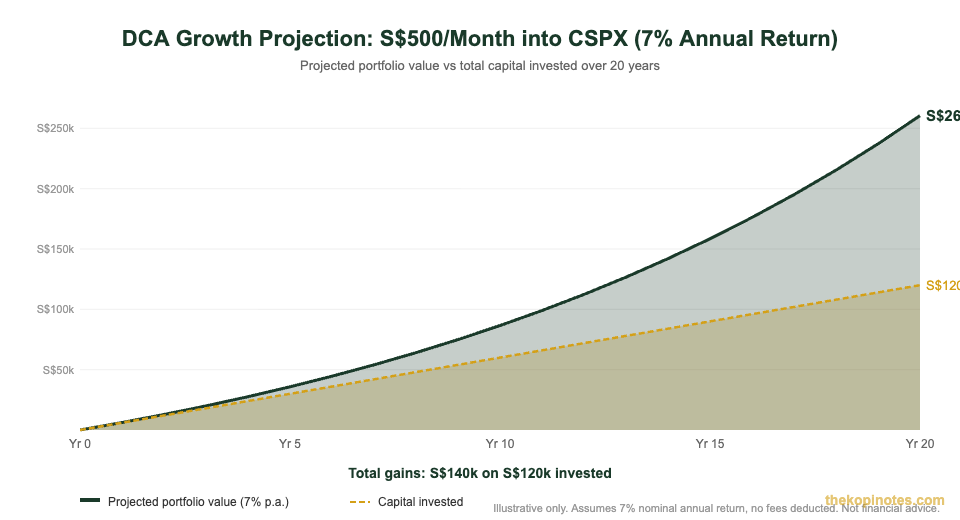
Chart: Illustrative DCA growth — S$500/month at 7% p.a. over 20 years. S$120,000 invested grows to ~S$261,000. Not financial advice.
(on S$120,000 invested, at 7% annual return)
Use our Singapore retirement calculator to run your own numbers with different monthly amounts and return assumptions.
Which DCA Method Is Right for You?
Here’s a simple decision framework based on your situation:
| Your Situation | Best DCA Method | Why |
|---|---|---|
| New investor, investing S$50–S$300/month | FSMOne RSP | Low minimum, simple, low fees at small amounts |
| Investing S$300+/month, comfortable with DIY | IBKR Recurring | Fixed USD 1.70 fee becomes cheapest at scale |
| Want hands-off, zero admin | Syfe Core | Set it, forget it — app handles everything |
| Using CPF or SRS funds | Endowus | Only robo that handles CPF OA + SRS |
| Portfolio >S$50,000, cost-sensitive | IBKR | Fee as % of AUM shrinks as portfolio grows |
The “best” method is the one you’ll actually stick to every month. Consistency beats optimisation.
Many experienced Singapore investors combine methods — for example, DCA via Endowus for their SRS allocation, and IBKR for their cash investments in CSPX. There’s no rule against using more than one platform.
For a full breakdown of which ETFs to buy through each platform, read our index funds vs active funds guide.
Frequently Asked Questions
How much should I invest each month for DCA in Singapore?
Which ETF is best for DCA in Singapore?
Can I DCA using my SRS account?
Is DCA better than timing the market?
What is the minimum to start DCA in Singapore?
Do I pay tax on my ETF investments in Singapore?
Disclaimer: This article is for educational purposes only and does not constitute financial advice. Past investment returns do not guarantee future results. All fees and rates are as at September 2026 and subject to change — verify on official platform websites before investing. Consider your own financial situation and risk tolerance before investing.
This article was researched with the help of AI. While we strive to keep all information accurate and up to date, there may be errors. If you notice any discrepancies, please contact us.