Keppel DC REIT Share Price: Q4 2026 Outlook After Rate Pause
Data Centre REIT | SGX: AJBU | Updated September 2026
Table of Contents
Keppel DC REIT (SGX: AJBU) is Singapore’s first pure-play data centre REIT, owning 23 data centres across 9 countries with a portfolio valued above S$3.7 billion. After rate hikes sent its share price sliding through 2025 and into 2026, the Fed’s decision to pause further increases has removed the key headwind. With 98% occupancy, a distribution yield near 5.5%, and AI-driven demand accelerating, Q4 2026 looks like a turning point for AJBU investors.
Not financial advice. All figures are for educational reference only. Data as at September 2026 unless noted.
- The rate pause removes the biggest headwind for KDC share price — higher borrowing costs had compressed valuations since 2023
- KDC’s distribution is well-covered with 98% occupancy and a WALE above 6 years providing income stability
- AI infrastructure buildout is structural, not cyclical — KDC is uniquely positioned as hyperscalers expand in Asia-Pacific
What Is Keppel DC REIT (AJBU)?
Keppel DC REIT was listed on the SGX in December 2014 as Singapore’s first data centre REIT. It invests in income-producing real estate used primarily for data centre purposes. Its sponsor is Keppel Corporation, one of Singapore’s largest conglomerates.
The REIT holds 23 data centres spread across Singapore, Australia, Germany, Ireland, the Netherlands, Malaysia, the United Kingdom, Italy, and China. This geographic diversification protects it from single-market risk — something most S-REITs cannot claim.
You can buy AJBU through platforms like Syfe referral code and sign-up bonus or other SGX-connected brokers. Syfe supports fractional investing and competitive fees for Singapore retail investors building passive income positions.
Share Price in 2026: How Rising Rates Hit KDC
Data centre REITs are particularly sensitive to interest rates. Their long-dated lease income gets discounted more heavily when risk-free rates rise. When the Fed hiked rates aggressively from 2022 onwards, AJBU’s share price fell from its peak above S$2.80 to below S$1.80 at various points.
By mid-2026, with Singapore 3-month T-bill yields near 3.2% and the Fed funds rate at 5.5%, KDC’s discount to NAV widened. Yield-seekers shifted to risk-free government instruments — check our Singapore T-bills 2026 guide to see how risk-free rates compare — reducing demand for REITs at elevated prices.
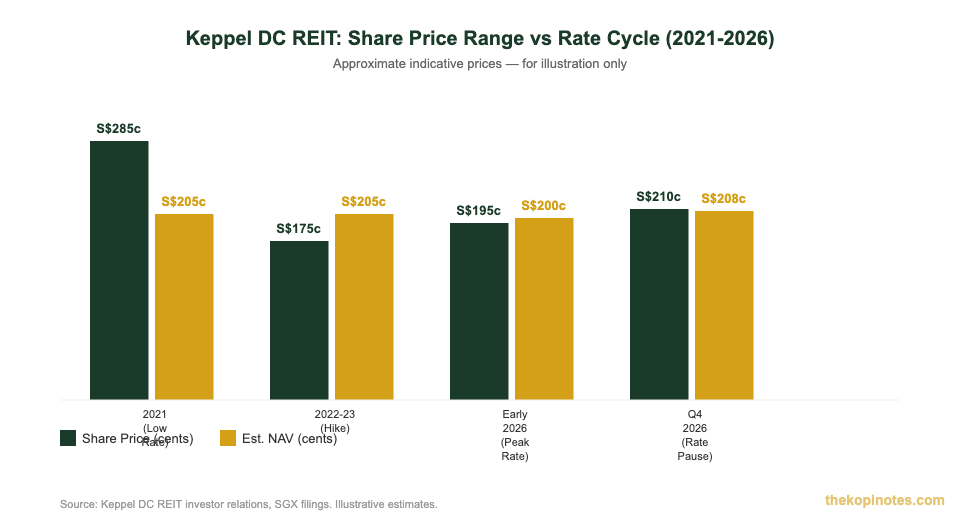
| Period | Approx Share Price | Est. P/NAV | Indicative Yield |
|---|---|---|---|
| Pre-Rate-Hike (2021) | S$2.80+ | ~1.4x | ~3.8% |
| Rate Hike Trough (2023) | S$1.70-S$1.85 | ~0.85x | ~5.8% |
| Post-FOMC Hike Q3 2026 | S$1.80-S$2.05 | ~0.90-1.0x | ~5.2-5.6% |
| Q4 2026 (Rate Pause) | Watching S$2.00+ | ~1.0x target | ~5.3-5.5% |
Source: Keppel DC REIT investor relations, SGX filings. Approximate estimates based on H1 2026 data. Not investment advice.
The Rate Pause: Why It Changes the Q4 2026 Outlook
A rate pause matters for KDC in three specific ways.
First, floating rate debt stops repricing upward. KDC carries approximately 34% gearing. A portion of its borrowings is on floating rates tied to SOFR or SORA. When rates rise, these costs creep up and compress distributable income. A pause freezes the damage.
Second, the yield spread argument shifts. When T-bill rates are high, KDC’s 5.5% yield looks less attractive versus a risk-free 3.2%. But if T-bill rates start falling — even by expectation — that gap widens. Investors start rotating back into yield assets like KDC.
Third, NAV stabilises. As cap rates stop expanding, the implied value of KDC’s data centres holds firm. Discount-to-NAV investing becomes more credible once NAV stops falling.
DPU and Yield: Is the Distribution Sustainable?
KDC’s distribution per unit (DPU) tells you how much cash each unit pays out. For H1 2026, DPU came in at approximately 4.6 to 4.9 cents per unit. That puts the full-year run rate at roughly 9.2 to 9.8 cents, delivering a yield of 5.2 to 5.5% at a share price near S$1.90.
Three factors support DPU sustainability:
Occupancy at 98%. Empty data centre space is extremely rare given the structural shortage of hyperscale capacity in Asia-Pacific. KDC’s near-full occupancy means almost all income-generating space is earning rent right now.
WALE above 6 years. The weighted average lease expiry tells you how long current tenants are locked in. For KDC, that is well into 2032, meaning rental revision risk is minimal. Distributions are underpinned by contracted income.
NPI coverage is healthy. Net Property Income comfortably covers distributions, with a payout ratio near 100% — standard for Singapore REITs. There is no DPU stretch or coverage gap to worry about.
Use our Singapore retirement calculator to model how a 5.5% yielding position in KDC fits your passive income goals.
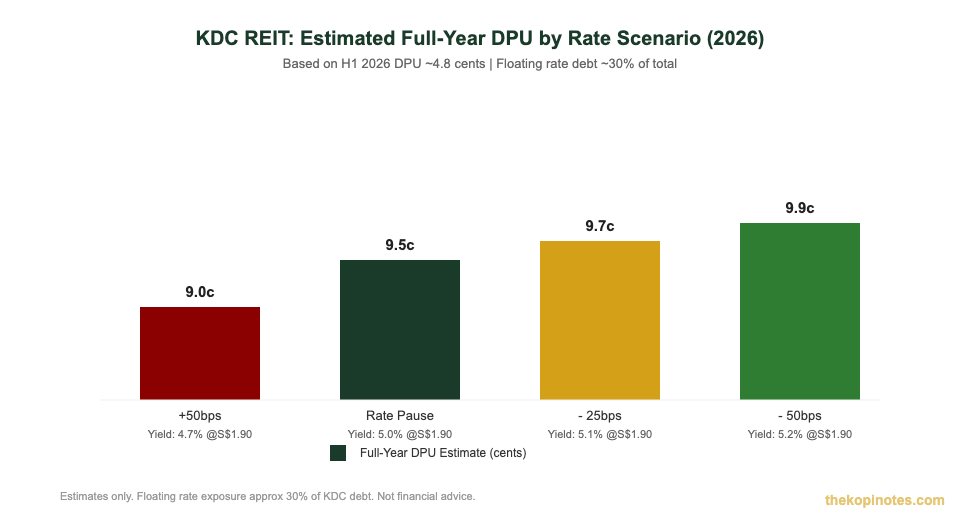
| Rate Scenario | Est. DPU Impact | Full-Year DPU Est. | Yield @ S$1.90 |
|---|---|---|---|
| +50bps (further hike) | -0.3 to -0.4c | ~8.8-9.2c | ~4.9-5.1% |
| Rate Pause (base case) | Neutral | ~9.2-9.8c | ~5.2-5.5% |
| -25bps (1 cut in Q4) | +0.1 to +0.2c | ~9.4-10.0c | ~5.3-5.6% |
| -50bps (2 cuts in 2026) | +0.2 to +0.4c | ~9.6-10.2c | ~5.4-5.7% |
Estimates based on KDC H1 2026 financials, ~34% gearing, floating rate exposure ~30% of total debt. Not a guarantee of future distributions.
Gearing and Debt Profile
KDC’s gearing sits at approximately 34% — comfortably below MAS’s 50% regulatory ceiling and at the lower end of the S-REIT sector average. This gives it headroom to acquire new assets or refinance without triggering regulatory constraints.
Debt maturity is well spread across 2026 to 2031, which limits refinancing cliff risk. In a rate-pause environment, older higher-rate debt can be refinanced at flat or lower rates as it matures. That is a quiet tailwind for DPU that does not always get discussed.
For more on how rate hikes affected KDC’s financials, read our detailed Keppel DC REIT rate hike impact analysis published earlier in 2026.
AI and Data Centre Demand: The Structural Tailwind
Unlike office, retail, or industrial REITs, KDC’s underlying demand driver is not the business cycle. It is the secular buildout of AI infrastructure.
Hyperscalers — Google, Microsoft, Amazon — need physical data centre space to run large language models and AI services. Singapore is a key hub for Asia-Pacific AI infrastructure due to its political stability, excellent connectivity, and skilled workforce. This demand shows no sign of slowing.
KDC’s 6-year WALE means it captures this structural demand at locked-in rents. When leases renew, new rental rates will reflect the current supply-demand imbalance — likely favouring higher rents given constrained new supply in Singapore.
This structural demand story is exactly why KDC features in our list of the best S-REITs in Singapore 2026 — it carries a growth driver that most yield-focused REITs simply do not have.
Q4 2026 Verdict: Buy, Hold or Wait?
This is not financial advice. But here is how to think through the three positions:
If you hold KDC: The rate pause justifies staying put. Nothing in KDC’s fundamentals has deteriorated. Occupancy at 98%, a 6-year WALE, and structural AI demand are all intact. Your distribution yield remains solid at 5.2 to 5.5%.
If you are considering buying: KDC near P/NAV of 1.0x is a historically fair entry point. If you believe rates will stay flat or fall in 2027, you are getting data centre real estate at replacement cost. You can invest through platforms like Endowus — use our Endowus referral code for a cash bonus on your first investment.
If you are waiting for a better price: The risk is that yield-seeking capital rotates back in as T-bill rates decline — before you pull the trigger. For passive income in Singapore 2026, steady accumulation often beats market timing in rate-sensitive assets.
Whatever your position, remember that KDC is one component of a diversified S-REIT portfolio. Read our broader guide to the best S-REITs in Singapore 2026 to put KDC in context.
Frequently Asked Questions
What is Keppel DC REIT share price today?
Is Keppel DC REIT a good buy in Q4 2026?
What is Keppel DC REIT dividend yield in 2026?
How does a Fed rate pause affect KDC REIT?
What is Keppel DC REIT gearing ratio?
Does Keppel DC REIT pay quarterly dividends?
This article was researched with the help of AI. While we strive to keep all information accurate and up to date, there may be errors. If you notice any discrepancies, please contact us.