Singapore T-Bill Laddering Strategy for Q4 2026: Maximise Yield After the Rate Hike
How to Stagger T-Bill Purchases to Capture Rising Yields While Keeping Cash Available
Singapore 6-month T-bills now yield an estimated 3.72% per year following the US Federal Reserve’s 25 basis point rate hike in September 2026. A T-bill ladder — staggering your purchase dates every one to three months — lets you capture rising yields while keeping some cash available at regular intervals. This guide shows you exactly how to build and run a T-bill ladder in Singapore today, and whether it beats SSBs or fixed deposits for your cash reserve.
Not financial advice. All figures are for educational reference only. Data as at September 2026 unless noted.
- T-bill yields have ticked up to an estimated 3.72% after the September 2026 Fed rate hike
- Laddering — buying across multiple auction dates — smooths out yield fluctuations and gives you rolling access to your cash
- Compared with SSBs and fixed deposits, T-bills currently offer the highest short-term yield, though they cannot be redeemed early
What Is a T-Bill Ladder?
A T-bill ladder is a cash management strategy where you split your money across several T-bill auction dates — instead of placing everything into one auction at once. Each “rung” of the ladder matures on a different date, giving you rolling access to your capital without sacrificing the yield that comes from committing for the full term.
Here is a concrete example. Say you have S$30,000 to park:
- S$10,000 into the October 2026 6-month auction (matures April 2027)
- S$10,000 into the November 2026 6-month auction (matures May 2027)
- S$10,000 into the December 2026 6-month auction (matures June 2027)
From April 2027 onwards, S$10,000 becomes available every month. You can either withdraw it for spending, or roll it into the next auction to keep the ladder running.
The ladder works because Singapore’s MAS holds 6-month T-bill auctions every two weeks. That gives you plenty of entry points to spread your purchases and stagger your maturities exactly the way you want.
For a deeper look at how T-bills work in Singapore, see our Singapore T-bills 2026 guide.
Why Ladder T-Bills in Q4 2026?
The September 2026 US Federal Reserve rate hike changes the calculus for short-term cash parking. Yields are now edging upward from the 3.5–3.6% range seen earlier this year. But nobody can say for certain whether rates will climb further, hold steady, or eventually reverse.
Laddering hedges your uncertainty. If rates rise further, your earlier rungs mature soon and you reinvest at the higher yield. If rates fall, your later rungs are already locked in at today’s better rate. You win either way — or at least avoid the worst outcome.
There is also a practical supply-and-demand angle. T-bill cut-off rates can fluctuate based on how much demand flows into each auction. Spreading your bids across multiple auctions reduces the risk of any single auction coming in lower than expected due to oversubscription driving yields down.
Finally, for investors who anticipate needing cash for a large purchase — a home deposit, education fees, or a planned investment — laddering lets you engineer specific maturity dates to match your cash needs without holding too much in low-yield savings accounts.
Current T-Bill Yields After the Rate Hike
The September 2026 FOMC meeting raised the Fed Funds Rate by 25 basis points — the first hike in over two years. Singapore’s T-bill yields are driven primarily by domestic SGD money-market conditions, not the Fed directly. However, global rate sentiment does exert upward pressure on Singapore’s short-term rates over time.
The latest 6-month T-bill auction results point to a cut-off rate of approximately 3.72% per annum. This is up from 3.65% in August 2026. The 1-year T-bill sits slightly higher at an estimated 3.85%.
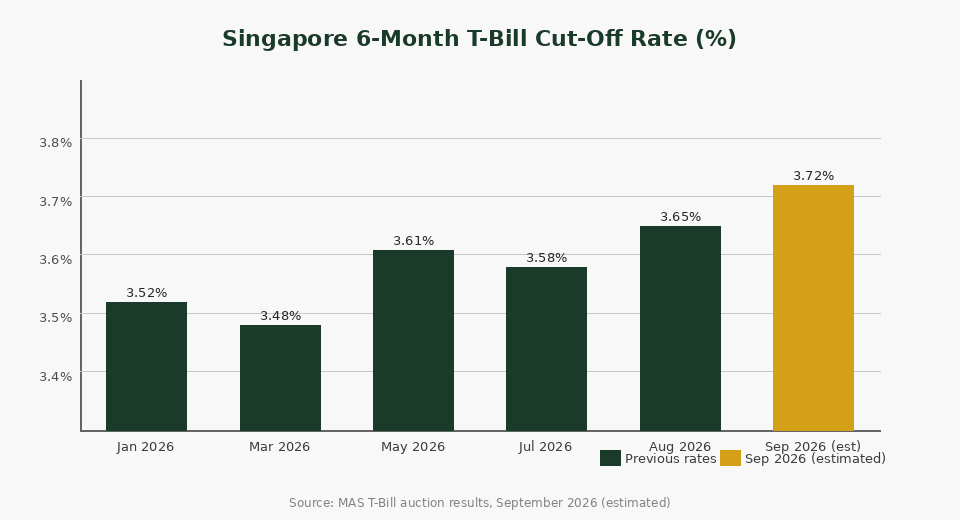
Source: MAS T-Bill auction results. September 2026 cut-off rate is estimated based on post-FOMC market conditions.
| Auction Month | 6M Cut-Off Rate | Notes |
|---|---|---|
| January 2026 | 3.52% | Pre-hike environment |
| March 2026 | 3.48% | Dipped on strong demand |
| May 2026 | 3.61% | Recovering |
| July 2026 | 3.58% | Stable |
| August 2026 | 3.65% | Pre-FOMC bid-up |
| September 2026 (est.) | ~3.72% | Post rate hike |
Source: MAS T-Bill auction results. September 2026 figure is estimated based on post-FOMC rate environment. Actual cut-off rates vary by auction demand.
For reference: a S$10,000 investment in a 6-month T-bill at 3.72% generates approximately S$186 in interest at maturity. You receive this as a discount upfront — meaning you pay S$9,814 today and receive S$10,000 in six months. No withholding tax applies for Singapore residents.
How to Build a T-Bill Ladder in Singapore
Building a T-bill ladder takes four decisions:
Step 1 — Decide your total amount. T-bills come in minimum S$1,000 lots. Most laddering investors work with S$10,000 to S$100,000, split into three to six rungs. Smaller amounts work too — the minimum per application is S$1,000.
Step 2 — Choose your rung interval. The most common approach is monthly rungs using the 6-month T-bill. Since MAS holds auctions roughly every two weeks, you can choose a bi-monthly, monthly, or bi-weekly interval. Monthly is the most practical for most investors — not too frequent to manage, not too far apart.
Step 3 — Apply at each auction. Apply through your bank’s internet banking (DBS, POSB, OCBC, UOB, Standard Chartered) or via the CDP Securities account. You can place a non-competitive bid — which guarantees allotment at whatever yield the auction clears at — or a competitive bid at a specific yield. Non-competitive is easier for most individuals.
Step 4 — Reinvest or withdraw at maturity. When each rung matures, decide whether to roll the funds into the next auction or redirect the money elsewhere. If rates have changed, reassess whether the T-bill is still the best home for your cash vs SSBs or fixed deposits.
You might also consider using your CPF investment strategy to complement your T-bill ladder — CPF OA funds can buy T-bills, and doing so earns you above the 2.5% OA base rate.
T-Bill vs SSB vs Fixed Deposit for Laddering
T-bills, Singapore Savings Bonds (SSBs), and fixed deposits all serve a cash-parking purpose. But they differ in three important ways: yield, liquidity, and minimum holding period.
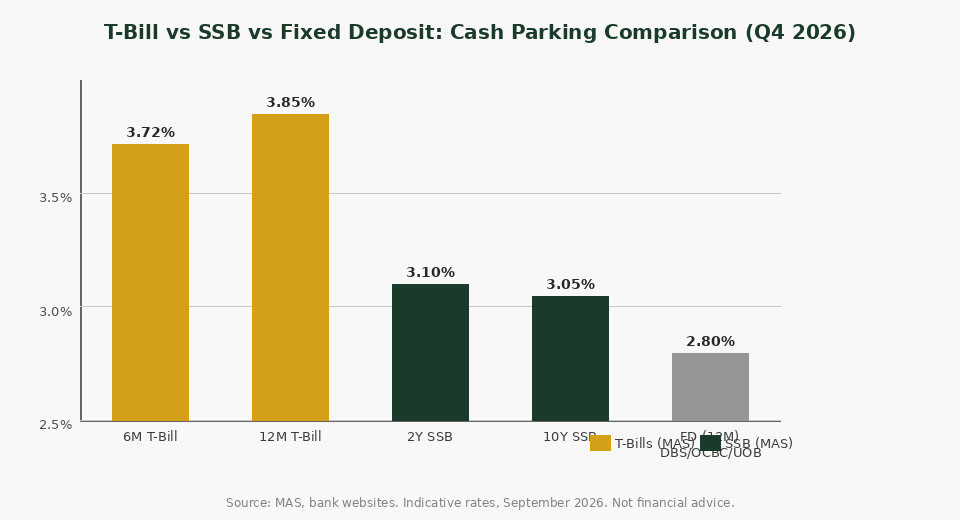
Source: MAS, bank websites. Indicative rates, September 2026. Not financial advice.
| Product | Yield (Sep 2026) | Minimum Lock-Up | Early Redemption |
|---|---|---|---|
| 6M T-Bill (MAS) | ~3.72% p.a. | 6 months | No — held to maturity |
| 12M T-Bill (MAS) | ~3.85% p.a. | 12 months | No — held to maturity |
| SSB 2-Year Avg (MAS) | ~3.10% p.a. | None | Yes, any month, no penalty |
| SSB 10-Year Avg (MAS) | ~3.05% p.a. | None | Yes, any month, no penalty |
| Fixed Deposit 12M (DBS/OCBC/UOB) | ~2.80% p.a. | 12 months | Penalty applies |
Source: MAS, bank websites. Indicative rates, September 2026. Actual rates vary. Not financial advice.
The verdict for laddering: T-bills win on yield for a defined holding period. SSBs are the better choice if you need flexibility — you can redeem any month with no penalty, which makes them a natural complement to a T-bill ladder. Fixed deposits generally offer the lowest yield for the most restrictive terms and are the least attractive option of the three for short-term laddering.
If you want to invest beyond cash, platforms like Endowus (referral code 2V343) and FSMOne (referral code P0544985) let you access diversified bond and equity funds that can complement your T-bill ladder.
How to Apply for T-Bills: Step-by-Step
Applying for Singapore T-bills is straightforward. Here is the step-by-step process for each major bank:
1. Log in to internet banking. You can use DBS, POSB, OCBC, UOB, or Standard Chartered. All major Singapore banks support T-bill applications directly.
2. Navigate to Singapore Government Securities. Look for “Investments” or “Fixed Income” in the main menu. Most banks have a dedicated “T-Bills” or “SGS Bonds” section.
3. Select the upcoming auction. Check the MAS website for the current auction schedule. The 6-month T-bill auctions run roughly every two weeks. Pick the date closest to your target.
4. Choose competitive or non-competitive bid. For most retail investors, a non-competitive bid is the right choice — you are guaranteed allotment at whatever rate the auction clears. A competitive bid lets you specify the minimum yield you will accept, but you risk not being allotted if your yield is above the cut-off.
5. Enter the amount and confirm. The funds are held from your account until the auction result. If you are unsuccessful (competitive bid only), the money is returned.
6. Receive your T-bill. After the auction, your T-bill is credited to your CDP Securities account. The interest (discount) is reflected as a lower purchase price — you pay less than face value today and receive the full face value at maturity.
To start building your retirement fund beyond T-bills, our Singapore retirement planning calculator can show you how much you need to save each month to hit your target.
Key Risks of T-Bill Laddering
Singapore T-bills are among the safest investments available — backed by the Singapore Government with zero credit risk. But laddering has a few practical risks that every investor should understand before committing.
Auction risk. On competitive bids, you may not receive an allotment if your specified yield is above the cut-off. The solution is simple: use non-competitive bids, which guarantee allotment at the final cut-off rate.
Reinvestment rate risk. If you are counting on rolling each rung over at the same yield, a rate cut between now and your maturity date could mean lower returns on the next rung. There is no way to lock in today’s rate for future rungs unless you buy longer-dated T-bills or SSBs now.
Liquidity risk. Unlike SSBs, T-bills cannot be redeemed early by approaching MAS. If you need cash urgently, your options are to sell in the secondary market — which may require you to accept a small discount — or wait for maturity. This is why laddering, not a single lump-sum purchase, is the right approach if you might need access to some of your cash.
Opportunity cost. If equities, REITs, or bond funds outperform significantly during your T-bill holding period, you will have earned less. T-bills are for your cash reserve and emergency fund — not your growth capital. Use them alongside, not instead of, your longer-term investment portfolio.
Not financial advice. All figures are for educational reference only. Always consult a licensed financial adviser if you need personal guidance.
Frequently Asked Questions
What is the minimum amount to invest in a Singapore T-bill?
How often are Singapore T-bill auctions held?
Can I sell my T-bill before maturity?
How is T-bill interest taxed in Singapore?
Should I use a competitive or non-competitive bid?
How does the Fed rate hike affect Singapore T-bill yields?
Is a T-bill ladder better than putting everything in one auction?
Ready to Put Your Cash to Work?
T-bills are a great foundation for your cash reserve. To plan how much you actually need in your emergency fund versus long-term investments, try our retirement planning calculator.
When you are ready to invest beyond cash, consider using a low-cost platform. Endowus (referral code 2V343) offers diversified fund portfolios including cash management funds. FSMOne (referral code P0544985) is another popular option for SGX securities and unit trusts.
Not financial advice. All figures are educational only. T-bill yields vary by auction.
This article was researched with the help of AI. While we strive to keep all information accurate and up to date, there may be errors. If you notice any discrepancies, please contact us.