Mapletree Business City & MIT Investor Guide 2026: DPU History, ~6.5% Yield & Singapore Industrial REIT Analysis (SGX: ME8U)
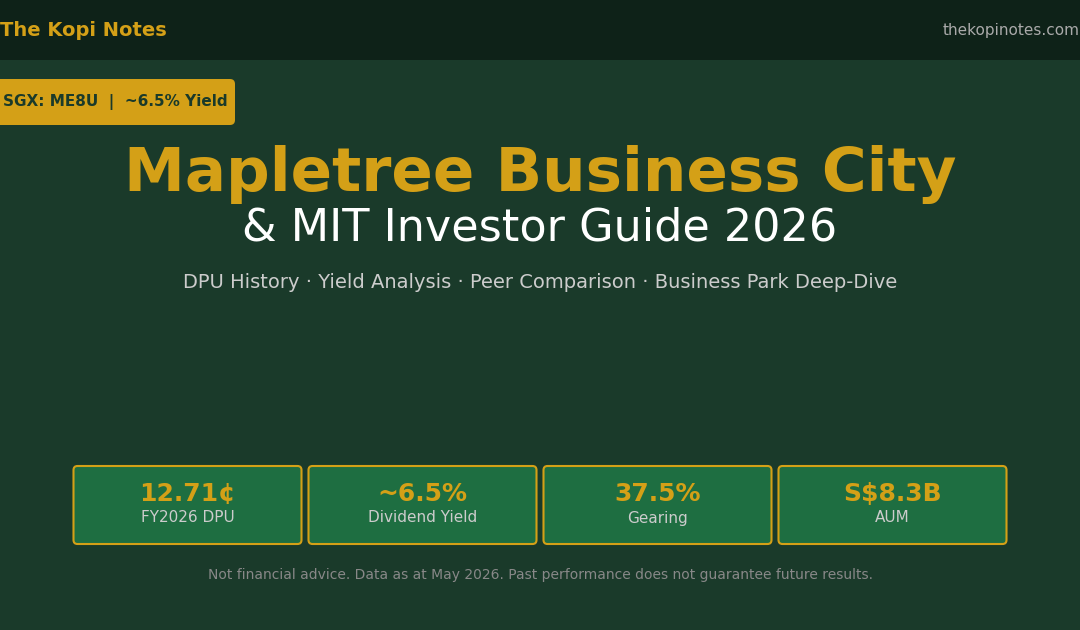
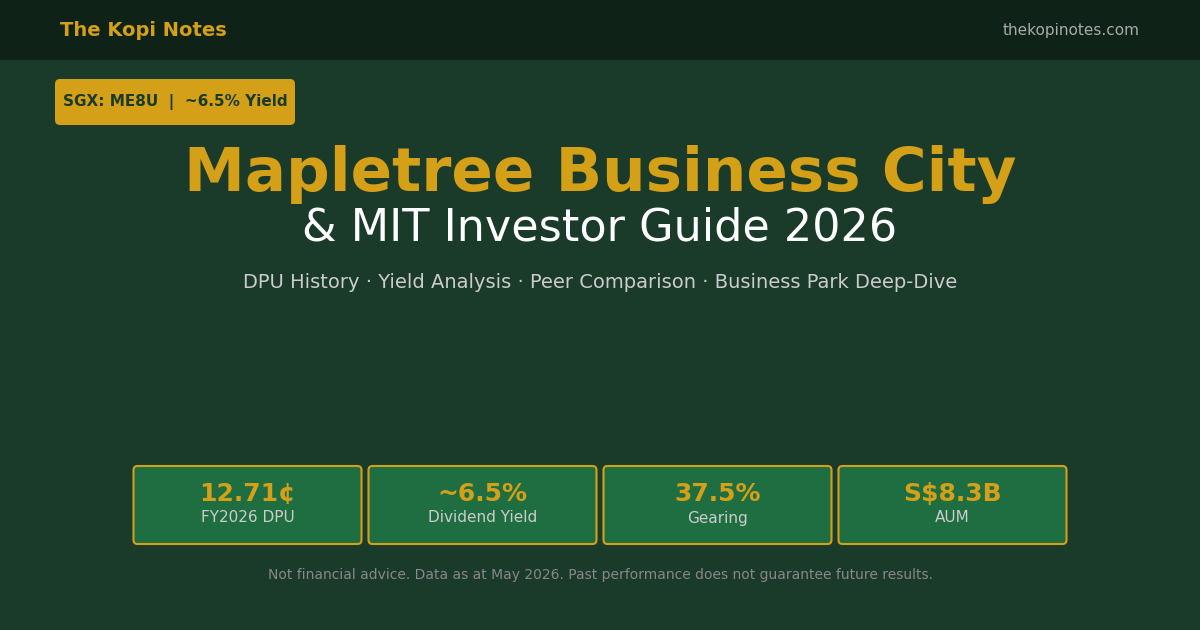
Mapletree Industrial Trust (SGX: ME8U) is Singapore’s largest diversified industrial S-REIT by AUM, with Mapletree Business City (MBC) as its crown-jewel business park asset. In FY2025/26, MIT delivered a full-year DPU of 12.71 Singapore cents at a yield of approximately 6.5% — making it one of the most competitive income plays among large-cap S-REITs. This guide covers MBC’s property profile, MIT’s complete DPU history, yield comparison with industrial peers, gearing metrics, and what investors should monitor in 2026. This is not financial advice. Data as at May 2026.
Table of Contents
Contents — Click to expand
- What Is Mapletree Business City?
- Mapletree Industrial Trust (ME8U): Overview & Portfolio
- MIT DPU History & FY2026 Results
- MIT Dividend Yield Analysis 2026
- Industrial S-REIT Peer Comparison Table
- Portfolio Breakdown: Singapore vs North America
- Gearing, Debt Maturity & Interest Coverage
- How to Buy MIT Units in Singapore
- Useful Tools & Calculators
- FAQ: Mapletree Business City & MIT
What Is Mapletree Business City?
Mapletree Business City (MBC) is one of Singapore’s largest integrated business park developments, located in the Alexandra–Queenstown precinct of Singapore’s city fringe. Developed by Mapletree Investments Pte Ltd, MBC comprises two phases:
- MBC Phase 1 (MBC I): Approximately 1.72 million sq ft of net lettable area (NLA), comprising one office tower (MBC 10) and six business park blocks (MBC 20–80). High-profile tenants include Google Asia Pacific, Pfizer, Credit Agricole, and Motorola Solutions.
- MBC Phase 2 (MBC II): An additional development extending MBC’s footprint to approximately 2.9 million sq ft combined across premium office, business park, and retail/F&B space (MBC 40).
MBC is owned partly by Mapletree Industrial Trust through its Singapore portfolio of 79 properties. The development is considered a flagship mixed-use business park and is strategically positioned near Labrador MRT on the Circle Line, with direct access to the one-north innovation district.
For investors, MBC’s significance lies in the quality of its tenant base — global multinationals in tech, pharmaceutical, and financial services — which anchors MIT’s Singapore occupancy and rental reversions.
Mapletree Industrial Trust (ME8U): Overview & Portfolio
Mapletree Industrial Trust (MIT) was listed on the Singapore Exchange (SGX) in 2010. As at 31 March 2026, MIT manages a total portfolio of S$8.3 billion in assets under management (AUM), comprising:
- 79 properties in Singapore — flatted factories, hi-tech buildings, business parks (including MBC), and stack-up/ramp-up facilities
- 55 properties in North America — primarily data centres held through a 50:50 joint venture with Mapletree Investments
Singapore properties are predominantly in mature industrial estates such as Alexandra Road, Toa Payoh, Benoi, Kallang, Tuas, and Jurong West. The Singapore portfolio has consistently maintained occupancy above 90%, with 4QFY2026 recording 93.4% occupancy.
The North American portfolio, while providing geographic diversification, has faced headwinds in FY2026 from lease non-renewals, currency depreciation of USD/SGD, and higher operating costs — factors that contributed to MIT’s DPU decline in FY2026.
MIT DPU History & FY2026 Results
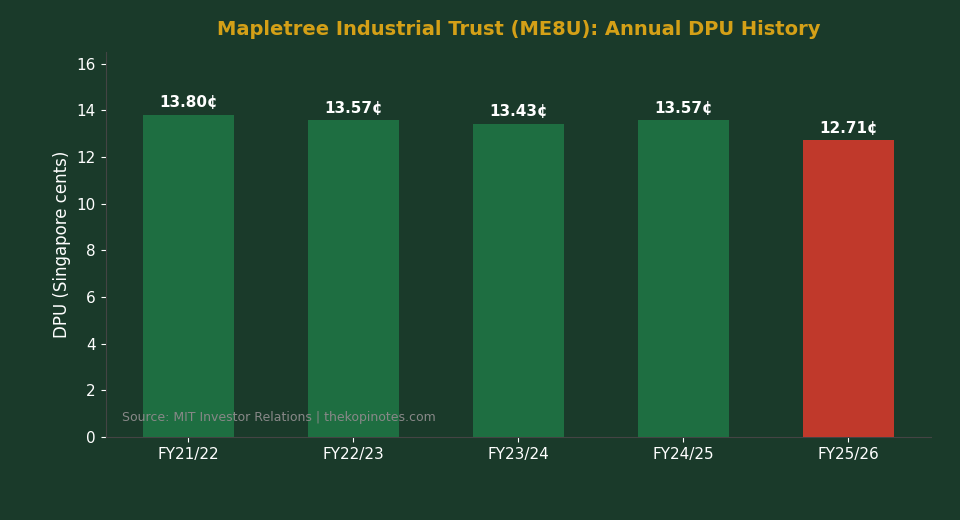
MIT’s DPU peaked around FY2021/22 before declining alongside rising interest rates and foreign exchange headwinds. The table below summarises the annual DPU from FY2021/22 through FY2025/26:
| Financial Year | Annual DPU (¢) | YoY Change |
|---|---|---|
| FY2021/22 | 13.80¢ | — |
| FY2022/23 | 13.57¢ | −1.7% |
| FY2023/24 | 13.43¢ | −1.0% |
| FY2024/25 | 13.57¢ | +1.0% |
| FY2025/26 | 12.71¢ | −6.3% |
Source: Mapletree Industrial Trust Investor Relations. Data as at April 2026.
The FY2025/26 DPU decline of 6.3% YoY was driven by three factors: (1) the absence of divestment income from three Singapore industrial properties sold in FY2025, (2) lease non-renewals in the North American portfolio (particularly in the office/light industrial segment), and (3) USD/SGD depreciation reducing the SGD equivalent of North American income. Excluding the divestment gains, the underlying DPU decline was a more moderate 3.2% — indicating the core Singapore portfolio remains resilient.
MIT Dividend Yield Analysis 2026
As at May 2026, MIT (SGX: ME8U) trades at approximately S$1.95 per unit, translating to a trailing dividend yield of approximately 6.5% based on FY2026 DPU of 12.71 cents. This is competitive for a large-cap, Singapore-listed S-REIT with investment-grade credit and a diversified industrial portfolio.
Investors evaluating MIT should note the following yield context:
- vs Singapore Government Bonds (10Y): The 10-year SGS bond yield is approximately 2.8–3.0% as at May 2026. MIT’s ~6.5% yield offers a spread of ~350–370 basis points — well above the historical 200–250 bps risk premium for large-cap S-REITs. You can compare this using the S-REIT Yield vs SGS Bond Spread Calculator.
- vs T-Bills / Fixed Deposits: With 6-month T-bills yielding approximately 2.8–3.1% and bank fixed deposits at 2.5–3.0%, MIT’s ~6.5% yield still provides a meaningful income premium for investors willing to take on equity risk.
- Price-to-NAV: MIT trades at a discount to its net asset value (NAV), which has historically attracted value-oriented investors. The discount partly reflects North American portfolio risk and FX headwinds.
For a deeper comparison of S-REIT yields against T-bills and fixed deposits, see our guide: S-REIT Dividend Yield vs T-Bill 2026.
Industrial S-REIT Peer Comparison Table (May 2026)
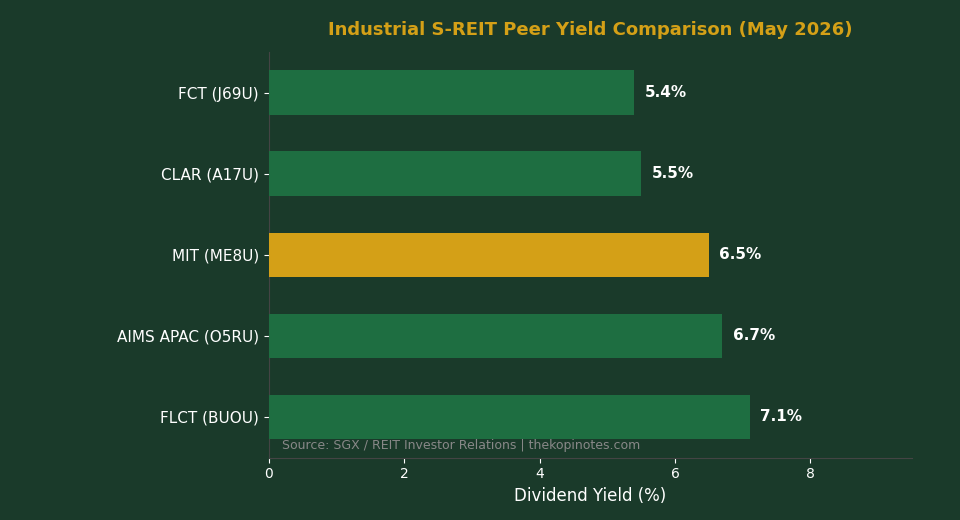
The table below compares MIT against key Singapore industrial S-REIT peers across yield, gearing, and portfolio size (data as at May 2026):
| REIT (SGX Code) | Sector | Yield (~) | Gearing | AUM |
|---|---|---|---|---|
| MIT (ME8U) ← This article | Industrial / Data Centre | ~6.5% | 37.5% | S$8.3B |
| CLAR (A17U) | Industrial / Business Park | ~5.5% | 38.6% | S$17.0B |
| AIMS APAC REIT (O5RU) | Industrial | ~6.7% | 35.2% | S$2.5B |
| FCT (J69U) | Suburban Retail | ~5.4% | 39.1% | S$7.2B |
| FLCT (BUOU) | Logistics / Commercial | ~7.1% | 38.5% | S$6.9B |
Source: SGX, REIT Investor Relations, company announcements. Data as at May 2026. Yields are approximate trailing DPU yield.
MIT sits in the middle of the industrial REIT peer group by yield — above CLAR and FCT, but below AIMS APAC and FLCT which carry higher specific risks (smaller cap / overseas exposure). MIT’s combination of large AUM, Singapore data centre exposure via MBC, and gearing at 37.5% (below the 50% MAS limit) makes it a core industrial REIT holding for income investors.
For a broader S-REIT comparison including retail, commercial, and healthcare, see: Best S-REITs Singapore 2026 — Yield Comparison Table.
Portfolio Breakdown: Singapore vs North America
MIT’s portfolio is split between its mature Singapore industrial base and its growing North American data centre exposure. Here is a snapshot of the portfolio composition as at March 2026:
| Geography | No. of Properties | Occupancy | Key Property Types |
|---|---|---|---|
| Singapore | 79 | 93.4% | Hi-tech buildings, business parks (incl. MBC), flatted factories, stack-up/ramp-up |
| North America | 55 | ~86% | Data centres (50:50 JV with Mapletree Investments), office/light industrial |
Source: MIT 4QFY2026 press release, April 2026.
Singapore Portfolio — the steady anchor: MIT’s 79 Singapore properties are the income backbone of the trust. The Singapore portfolio’s 93.4% occupancy as at 4QFY2026 reflects strong demand from tech, biomedical, precision engineering, and logistics tenants. Mapletree Business City (MBC) sits within this Singapore portfolio and houses multinational tenants on long-term leases, providing rental visibility.
North American Portfolio — the growth and risk factor: MIT’s 55 North American properties (data centres and light industrial) were a key growth driver in FY2020–FY2022. However, FY2026 saw headwinds from lease non-renewals (particularly in non-data-centre assets), higher US property taxes, and USD/SGD depreciation. Investors should monitor the percentage of North American income as a share of total NPI, and MIT’s success in releasing vacant space in the US market.
The data centre segment within North America remains strategically valuable, riding the AI infrastructure demand wave. Management has flagged active asset recycling — divesting non-core assets and redeploying into higher-quality data centre acquisitions — as a key strategy for FY2027.
Gearing, Debt Maturity & Interest Coverage
MIT’s aggregate leverage stood at approximately 37.5% as at March 2026 (post the drawdown of debt associated with the perpetual-for-perpetual refinancing strategy). This is above the mid-30% range of recent years but well below the 50% regulatory maximum set by MAS.
| Metric | FY2025/26 | Notes |
|---|---|---|
| Aggregate Leverage | ~37.5% | Post-perpetual refinancing; MAS limit is 50% |
| Weighted Avg. Debt Cost | ~3.5% | Mix of SGD and USD borrowings |
| % of Fixed-Rate Debt | ~75–80% | Hedged against near-term interest rate volatility |
| Interest Coverage Ratio | >3.5x | Above MAS minimum threshold (2.5x for REITs with ≤50% gearing) |
Source: MIT FY2026 Press Release, April 2026. Estimates based on disclosed range.
MIT’s gearing level of ~37.5% provides moderate headroom for acquisitions or capital expenditure without approaching the MAS threshold. The high fixed-rate debt proportion (~75–80%) provides near-term DPU stability — approximately 25% of borrowings are floating rate and would benefit from Fed rate cuts. As the US Federal Reserve moves towards rate normalisation in 2026–2027, MIT’s interest expense (particularly on its USD-denominated debt) is expected to decline modestly, providing a tailwind to distributions.
To understand how gearing affects REIT valuation and DPU sustainability, try the S-REIT Gearing Ratio & ICR Calculator.
How to Buy MIT Units in Singapore
Mapletree Industrial Trust (SGX: ME8U) is listed on the main board of the Singapore Exchange (SGX). Singapore investors can purchase ME8U units via any SGX-connected brokerage account. The process is the same as buying any other SGX-listed stock or S-REIT:
- Step 1: Open a brokerage account (e.g., Moomoo, Tiger Brokers, DBS Vickers, OCBC Securities, or invest via a robo-advisor like Syfe or Endowus).
- Step 2: Fund your account in SGD (Central Depository account via CDP is required for SGX-listed shares).
- Step 3: Search for “ME8U” on the trading platform and place a buy order at market or limit price.
- Step 4: Hold to receive quarterly DPU distributions, typically paid within 2–3 months after each quarter end.
CPF/SRS Eligible: ME8U is CPF Investment Scheme (CPFIS) eligible, meaning you can use CPF Ordinary Account (OA) funds to invest in MIT units. It is also SRS eligible. Use the CPF Investment Scheme (CPFIS) Calculator to model the potential returns from investing CPF OA funds into an S-REIT like MIT.
For a full guide on CPF investment strategy, see: CPF Investment Strategy Guide.
Useful Tools & Calculators
Use these free Singapore investing tools to model your MIT / S-REIT portfolio income:
- REITs Dividend Yield Calculator — calculate the annual yield on your ME8U holding
- S-REIT Yield vs SGS Bond Spread Calculator — compare MIT yield against risk-free rate
- S-REIT Total Return Calculator — model DPU + capital gain total return for MIT
- Gearing Ratio & ICR Calculator — understand MIT’s balance sheet safety
- Passive Income Goal Calculator — how many ME8U units to generate your target monthly income
FAQ: Mapletree Business City & MIT
What is Mapletree Business City (MBC)?
What was MIT's DPU for FY2026?
What is MIT's current dividend yield?
How does MIT compare to CapitaLand Ascendas REIT (CLAR)?
Can I buy MIT with CPF?
What risks should MIT investors monitor in 2026?
Where is Mapletree Business City located?
How often does MIT pay dividends?
This article was researched with the help of AI. While we strive to keep all information accurate and up to date, there may be errors. If you notice any discrepancies, please contact us.