Emerging Market Corporate Bond ETFs for Singapore Investors: EMCR vs HYEM vs CEMB (2026 Guide)
A tax-and-cost comparison of the three main ways to buy emerging market corporate bonds from Singapore.
Emerging market corporate bond ETFs like EMCR and HYEM let you earn 5.5-7% yields from companies in Brazil, Indonesia, and other emerging economies. Both are Ireland-domiciled UCITS funds listed on the London Stock Exchange, paying just 15% US withholding tax with no US estate tax exposure. Their US-listed twin, CEMB, tracks similar bonds but charges Singapore investors 30% withholding tax instead.
Not financial advice. All figures are for educational reference only. Data as at September 2026 unless noted.
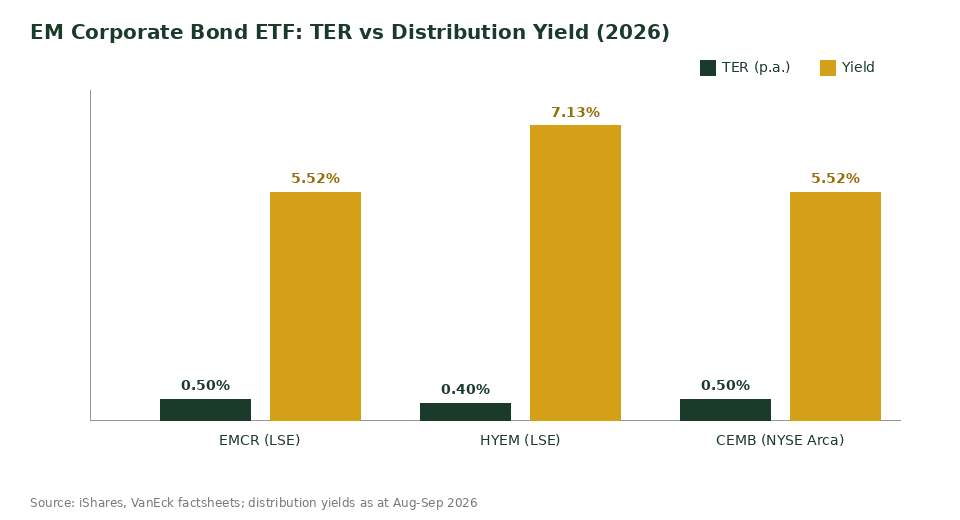
- EMCR (LSE) blends investment-grade and high-yield EM corporate bonds at a 5.52% yield, TER 0.50%.
- HYEM (LSE) is the higher-yield, higher-risk option at roughly 7% — pure high-yield EM corporates only, TER 0.40%.
- Buy the UCITS version (EMCR/HYEM), not the US-listed CEMB — you keep an extra 15% of every dollar in distributions and skip US estate tax entirely.
Quick Answer: Which Should You Buy?
If you want one diversified fund across investment-grade and high-yield EM corporates, buy EMCR (or its accumulating twin EMCA) on the LSE. If you’re comfortable with more risk for a higher yield, HYEM gives you pure high-yield EM corporate exposure at around 7%. Either way, buy the London-listed UCITS version — not CEMB, the US-listed equivalent.
Here’s why that last point matters so much. CEMB tracks nearly the same JPMorgan index as EMCR, but because it’s a US-domiciled fund, Singapore investors face 30% withholding tax on its distributions instead of 15%. You also carry US estate tax exposure above USD 60,000 in CEMB holdings — a risk that simply doesn’t exist with the Ireland-domiciled UCITS versions.
Key Differences at a Glance
| Feature | EMCR (LSE) | HYEM (LSE) | CEMB (NYSE Arca) |
|---|---|---|---|
| Full Name | iShares J.P. Morgan USD EM Corp Bond UCITS ETF | VanEck Emerging Markets High Yield Bond UCITS ETF | iShares J.P. Morgan EM Corporate Bond ETF |
| ISIN | IE00B6TLBW47 | IE00BF541080 | US4642862514 |
| Index Tracked | JPM CEMBI Broad Diversified Core | ICE BofA Diversified HY US EM Corporate Plus | JPM CEMBI Broad Diversified Core |
| Credit Quality | Investment grade + high yield blend | Below investment grade only | Investment grade + high yield blend |
| Domicile | Ireland | Ireland | USA |
| TER | 0.50% p.a. | 0.40% p.a. | 0.50% p.a. |
| AUM | ~USD 3.1 billion (Sep 2026) | ~EUR 53 million (Sep 2026) | ~USD 390-400 million (Mar 2026) |
| Distribution Yield | ~5.52% | ~7.1% (offshore sibling reference) | ~5.5% |
| Currency | USD | USD | USD |
Source: iShares.com, VanEck.com fund fact sheets, justETF, Yahoo Finance, verified September 2026.
A few numbers in that table are worth pausing on. CEMB’s AUM of roughly USD 390-400 million is smaller than you might expect for a US-listed BlackRock fund tracking a well-known index — in fact, it’s noticeably smaller than its own UCITS sibling EMCR, which holds around USD 3.1 billion. That’s unusual: normally the US-listed version of a BlackRock fund is the larger one. For Singapore investors, it’s a useful reminder that “US-listed” doesn’t automatically mean “more liquid” or “more popular” — check the actual AUM and average daily volume before assuming a US ticker is the deeper, more liquid choice.
HYEM’s much smaller EUR 53 million AUM reflects its narrower mandate. It only holds bonds rated below investment grade, which is a smaller slice of the EM corporate bond universe than EMCR’s broader investment-grade-plus-high-yield approach. A smaller AUM can mean a wider bid-ask spread when you trade, so if you’re investing a large sum in HYEM, consider using limit orders rather than market orders to avoid unfavourable fills.
Tax & Cost Comparison
This is the section that actually decides which fund you should buy. EMCR and HYEM are UCITS ETFs domiciled in Ireland. Under the Ireland-US tax treaty, distributions from these funds attract 15% US withholding tax (WHT). CEMB, being US-domiciled, applies the standard 30% non-treaty rate to non-US holders — twice as much tax on every dollar of income.
There’s a second, bigger risk with CEMB: US estate tax. If you hold more than USD 60,000 in US-situs assets (which includes US-domiciled ETFs like CEMB) when you pass away, your estate can face US federal estate tax of up to 40% on the excess — a risk your family, not you, ends up dealing with. EMCR and HYEM carry zero US estate tax exposure because they’re Irish funds, not American ones.
| ETF | Domicile | US Dividend WHT | US Estate Tax Risk |
|---|---|---|---|
| EMCR / HYEM (LSE) | Ireland | 15% | None |
| CEMB (NYSE Arca) | USA | 30% | Yes (above USD 60k) |
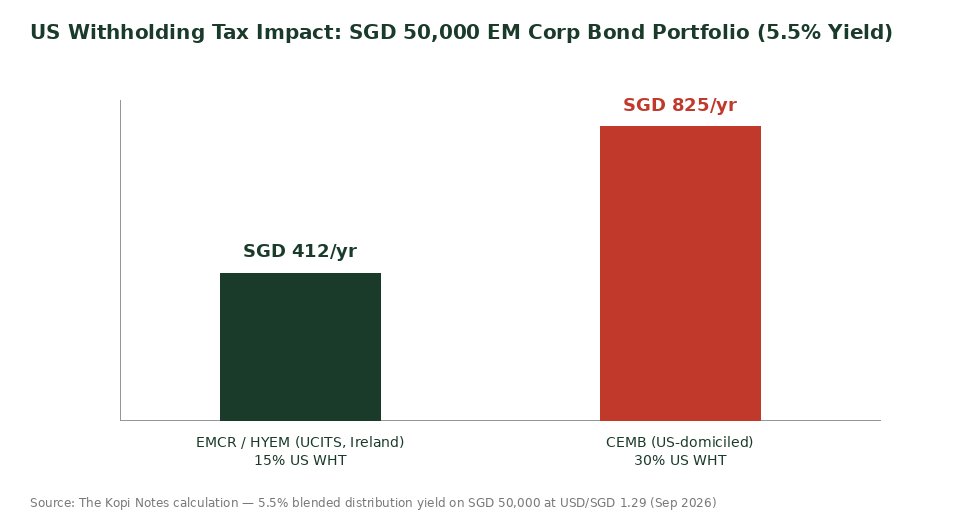
Here’s the actual math. A SGD 50,000 position yielding 5.5% generates about SGD 2,750 a year in distributions. At 15% WHT (EMCR/HYEM), you lose SGD 412.50 to tax. At 30% WHT (CEMB), you lose SGD 825. That’s an extra SGD 412.50 gone every single year, purely because of which exchange the fund happens to be listed on — for functionally the same underlying bonds.
2026 Performance and Outlook
Emerging market corporate bonds had a mixed start to 2026. The JPM CEMBI index — the benchmark EMCR and CEMB both track — returned -0.21% in Q1 2026, driven by a -0.52% hit from wider credit spreads that was partly offset by a 0.31% gain from falling US rates, according to J.P. Morgan Asset Management’s Q1 2026 fixed income commentary. Corporate balance sheets across emerging markets remain healthy, and spreads have generally stayed tight outside of episodic geopolitical shocks.
The Fed’s 16 September 2026 rate hike to 3.75-4.00% — the first hike since 2023 — adds a fresh variable. Higher US rates typically pressure EM bond prices in the short term through the “risk-free rate” channel, but J.P. Morgan notes that index yields above 6% in parts of the EM debt universe are drawing investors back in for the income alone, regardless of near-term price moves. That’s a key distinction for you as a Singapore investor: if you’re buying EMCR or HYEM for the yield and holding for years, short-term price wobbles from Fed decisions matter less than they would for a trader.
Distributions from HYEM run notably higher than EMCR because it’s a pure high-yield fund — you’re being paid more because the underlying issuers carry more default risk. That’s the trade-off, not a free lunch. There’s also a currency dimension to keep in mind: both funds are USD-denominated, so as a Singapore investor your SGD-equivalent return depends on the SGD/USD exchange rate as well as the bond market itself. If the SGD strengthens against the USD during your holding period, your effective return in SGD terms is reduced even if the underlying bonds perform well — the same dynamic that applies to any USD-denominated ETF held from Singapore, including CSPX and VWRA.
Total Cost of Ownership
TER isn’t the only cost. Add FX spread (converting SGD to USD to buy, typically 0.1-0.5% depending on broker) and any brokerage commission per trade. Here’s the full picture for a SGD 50,000 position, held for one year, bought through Interactive Brokers (low-cost) versus a full-service broker.
| Cost Component | EMCR / HYEM (via IBKR) | EMCR / HYEM (via full-service broker) |
|---|---|---|
| TER (annual) | SGD 250 (EMCR) / SGD 200 (HYEM) | Same |
| FX spread on purchase | ~SGD 25-50 (0.05-0.1%) | ~SGD 250-500 (0.5-1%) |
| Trade commission | ~SGD 2-5 | ~SGD 15-30 |
Source: The Kopi Notes estimate based on published TER figures and typical broker FX spreads, September 2026.
How to Buy EM Corporate Bond ETFs in Singapore
All three funds trade in USD. EMCR and HYEM are listed on the London Stock Exchange; CEMB (which you should generally avoid, per the tax section above) trades on NYSE Arca. Here’s how to buy the UCITS versions through the brokers most Singapore investors already use.
Interactive Brokers (IBKR)
Fund your account in SGD or USD, search “EMCR” or “HYEM” in the order entry screen, select the LSE exchange listing, and place a limit order. IBKR offers the tightest FX spreads of the major options and is generally the most cost-effective choice for portfolios above SGD 20,000.
Saxo Markets
Saxo lists both funds under their LSE tickers. Its platform fees are higher than IBKR’s but the interface is more beginner-friendly, and Saxo’s Singapore entity means your account sits under local regulation.
Syfe Brokerage
If you’d rather not hunt for individual tickers, Syfe’s referral code and sign-up bonus gets you access to a simpler brokerage interface that also lists EMCR and similar LSE UCITS ETFs, with commission-free trading up to a monthly cap.
FSMOne
FSMOne supports LSE-listed UCITS ETFs and is worth comparing if you already hold unit trusts or bonds there — see the FSMOne referral code for current sign-up terms. Note that moomoo Singapore does not support LSE trading, so it isn’t an option for EMCR or HYEM specifically.
Who Should Pick Which?
EMCR is ideal if you want diversified EM corporate bond exposure — a mix of investment-grade and high-yield issuers — as a single building block in a broader fixed-income allocation, alongside something like a developed-market USD corporate bond ETF or Singapore T-bills for the safer end of your portfolio.
HYEM is ideal if you specifically want higher income and can stomach more default risk — its ~7% yield comes from bonds rated below investment grade, so treat it as a satellite position, not a core holding.
Consider alternatives if you want zero credit risk (Singapore T-bills or Singapore Savings Bonds), or if you’d rather get EM exposure through equities via a broader global equity ETF like VWRA, which already holds EM stocks.
Neither EMCR nor HYEM is CPF-investable — LSE-listed UCITS ETFs generally aren’t on the CPF Investment Scheme’s approved list. They are SRS-compatible if bought through an SRS-linked brokerage account. If retirement income planning is part of why you’re looking at bond ETFs, run the numbers through our Singapore retirement calculator first, and read our full breakdown of US estate tax for Singapore investors if you’re holding any US-domiciled fund at all, not just CEMB.
Frequently Asked Questions
What is an emerging market corporate bond ETF?
It’s a fund that pools together USD-denominated bonds issued by companies based in emerging economies like Brazil, Mexico, Indonesia, and South Africa. You get diversified exposure to dozens or hundreds of bonds in a single trade, with yields typically higher than developed-market corporate bonds because of the extra country and currency risk involved.
Is EMCR the same as CEMB?
They track nearly the same underlying index (JPMorgan’s CEMBI Broad Diversified Core) and hold similar bonds, but they are not the same fund. EMCR is Ireland-domiciled and listed on the London Stock Exchange, while CEMB is US-domiciled and listed on NYSE Arca. That domicile difference means EMCR pays 15% US withholding tax on distributions and carries no US estate tax exposure, while CEMB pays 30% and does carry estate tax risk above USD 60,000.
Which has a higher yield, EMCR or HYEM?
HYEM yields more — around 7% versus EMCR’s roughly 5.5% — because it holds only below-investment-grade (high-yield) EM corporate bonds, while EMCR blends investment-grade and high-yield issuers together. The higher yield reflects higher credit risk, not a better deal.
Can I buy EMCR or HYEM using my CPF or SRS funds?
You generally cannot use CPF Ordinary Account funds — LSE-listed UCITS ETFs like EMCR and HYEM are not on the CPF Investment Scheme’s approved list. You can use SRS funds if your brokerage account is SRS-linked; check with your broker (IBKR, Saxo, or FSMOne) whether they support SRS trading of LSE-listed instruments before assuming it’s available.
Which broker is best for buying EM corporate bond ETFs in Singapore?
Interactive Brokers (IBKR) generally offers the lowest total cost for portfolios above SGD 20,000, thanks to tight FX spreads and low commissions. Saxo Markets is a solid middle-ground option with a more beginner-friendly interface. Note that moomoo Singapore does not support LSE trading, so it can’t be used for these specific funds.
Are emerging market corporate bonds risky?
Yes, more so than developed-market or Singapore government bonds. Risks include issuer default, currency volatility in the underlying economies, and sensitivity to global rate moves like the Fed’s September 2026 hike. EMCR spreads this risk across roughly 1,200+ bonds, and HYEM concentrates it further by holding only high-yield names — treat either as a satellite position in a diversified portfolio, not your only fixed-income holding.
Ready to Add EM Bonds to Your Portfolio?
Open a brokerage account and buy EMCR or HYEM through the London Stock Exchange. Use our referral links for exclusive sign-up bonuses.
This article was researched with the help of AI. While we strive to keep all information accurate and up to date, there may be errors. If you notice any discrepancies, please contact us.