Water ETF Singapore: How to Invest in the World’s Scarcest Resource (2026 Guide)
The AI boom is driving global water demand toward 1.2 trillion litres a year. Here’s how Singapore investors can access water-themed UCITS ETFs on the LSE.
Water ETFs let you buy a basket of global water utility, infrastructure, and treatment companies through a single London-listed fund. The two main options for Singapore investors are iShares Global Water UCITS ETF (IH2O, TER 0.65%) and L&G Clean Water UCITS ETF (GLUG, TER 0.49%) — both Ireland-domiciled, which means 15% US dividend withholding tax and no US estate tax exposure, unlike similar US-listed funds.
Not financial advice. All figures are for educational reference only. Data verified as at 23 August 2026 unless otherwise noted.
- Two LSE-listed UCITS water ETFs matter here: IH2O (66 holdings, utilities-heavy, TER 0.65%) and GLUG (59 holdings, industrials-heavy, TER 0.49%, accumulating)
- AI data centres could push global water use to 1.2 trillion litres a year by 2030 — this is a real demand driver, not just an ESG label
- Buy on the LSE through IBKR, Saxo, or moomoo. These funds aren’t SGX-listed, so no CPF or SRS eligibility
Table of Contents
What Is a Water ETF?
A water ETF doesn’t hold water itself. There’s no futures market for tap water the way there is for gold or oil. Instead, these funds hold shares of companies across the water value chain: utilities that treat and supply water, industrial firms that make pumps, pipes, valves, and meters, and specialist businesses in filtration and desalination.
You’ll see two different approaches on the London Stock Exchange (LSE). iShares Global Water UCITS ETF (IH2O) tracks the S&P Global Water Index, which leans heavily into water utilities — regulated, defensive businesses that supply drinking water to households and industry. L&G Clean Water UCITS ETF (GLUG) tracks the Solactive Clean Water Index instead, which tilts toward industrial equipment makers: pump manufacturers, pipe producers, and water-treatment technology firms.
That difference matters. Utilities behave like defensive dividend payers. Industrial equipment makers behave more like cyclical growth stocks tied to infrastructure spending. Both are UCITS ETFs domiciled in Ireland, so both carry the same tax advantages Singapore investors already get from CSPX or VWRA. This is a small, thematic corner of the ETF market — fund sizes range from EUR 665 million to USD 2.2 billion, a fraction of the trillions in S&P 500 trackers.
Why Water ETFs Are Trending in 2026
Here’s why this theme has moved from ESG footnote to genuine investment case in 2026: artificial intelligence data centres are thirsty, and they’re getting thirstier fast.
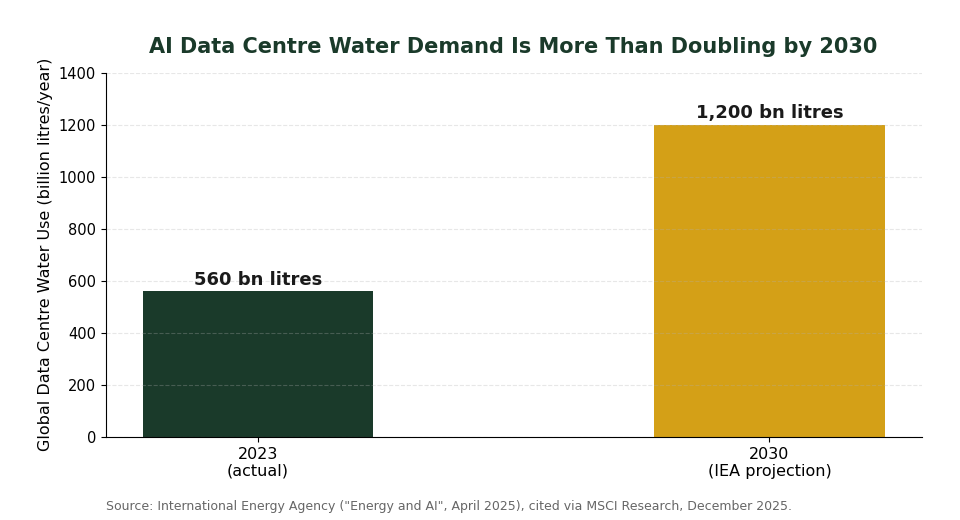
The International Energy Agency estimates global data centres used roughly 560 billion litres of water in 2023, split between direct cooling and the water used to generate the electricity they consume. That figure could more than double to around 1.2 trillion litres by 2030 — equivalent to the annual water consumption of more than four million US households, according to IEA modelling cited in a December 2025 MSCI research note.
The location of that demand is the real risk story. MSCI’s GeoSpatial analysis of over 13,500 data centre sites worldwide found that about one in four existing facilities — and nearly one in three currently under construction — sit in regions projected to face worsening water scarcity by 2050. In practice, that means data centre operators increasingly compete with farms, cities, and industry for the same limited water supply, which pushes them toward better cooling technology, water recycling, and desalination — all of which need equipment from the companies these ETFs hold. If you’re already tracking this trend through our data centre ETF Singapore guide, water ETFs are the natural second leg of the same infrastructure story.
You don’t need to look further than home for this story. Singapore has run a genuine water-scarce economy for decades. The PUB’s “Four National Taps” strategy — local catchment, imported water, NEWater, and desalination — exists because Singapore has no major rivers or aquifers of its own. NEWater alone now meets up to 40% of national water demand, a figure PUB projects will rise to 55% by 2060 as demand keeps climbing. If you’ve grown up drinking recycled and desalinated water, the idea that water infrastructure is investable shouldn’t feel exotic.
Best Water ETFs for Singapore Investors
Three UCITS-compliant water ETFs are realistically accessible to you on the LSE and European exchanges. A fourth, US-listed option exists but comes with the tax drawbacks every Singapore investor should already know to avoid.
| ETF | Ticker (LSE) | TER | Domicile | Structure | AUM | YTD 2026 |
|---|---|---|---|---|---|---|
| iShares Global Water UCITS ETF | IH2O / DH2O | 0.65% | Ireland | Distributing | USD 2.21bn | +2.12% |
| L&G Clean Water UCITS ETF | GLUG / GLGG | 0.49% | Ireland | Accumulating | EUR 665m | +7.49% |
| Amundi MSCI Water ESG Screened UCITS ETF | WATL | 0.60% | France | Distributing | EUR 1,531m | n/a |
| Invesco Water Resources ETF (US-listed) | PHO (NASDAQ) | 0.59% | United States | Distributing | USD 1.99bn | n/a |
Source: iShares fund page, justETF (L&G Clean Water, Amundi MSCI Water), MutualFunds.com (PHO). Data as at 21-23 August 2026.
IH2O is the closest thing to a “core” water holding — 66 holdings spread across utilities (46.4%) and industrials (43.4%), tracking the S&P Global Water Index since 2007, per the iShares fund page. Its trailing 12-month dividend yield sits at 1.37%, paid out semi-annually, which suits you if you want some income alongside growth.
GLUG is the more concentrated, growth-tilted option. Its top holdings — NWPX Infrastructure, CECO Environmental, Nomura Micro Science, Watts Water Technologies, and Franklin Electric — are equipment and treatment specialists rather than regulated utilities. That’s part of why GLUG has returned +7.49% year-to-date in 2026 versus IH2O’s +2.12%, though past performance says nothing about what happens next. If you already hold a position from our clean energy ETF Singapore guide, water ETFs pair naturally as a second resource-scarcity theme in a satellite sleeve.
Here’s the tax reason both LSE picks beat the US-listed PHO for you as a Singapore investor. IH2O and GLUG are Ireland-domiciled, so dividends from their US holdings are taxed at 15% under the Ireland-US tax treaty, and — because you’re a non-resident alien holding an Irish fund, not a US security — you have zero US estate tax exposure. PHO is a US-domiciled ETF. Dividends face the full 30% US withholding tax, and if your PHO holding (plus other US-situs assets) exceeds USD 60,000 at death, your estate could owe US estate tax of up to 40% on the excess. This is the same logic covered in our guide to why Singapore investors buy ETFs on the London Stock Exchange — it applies here too.
How to Buy Water ETFs in Singapore
Buying IH2O or GLUG works the same way as buying CSPX or VWRA — you’re just searching for a different ticker on the LSE. Here’s the process broker by broker.
Interactive Brokers (IBKR): Fund your account, search “IH2O” or “GLUG” in the order entry screen, and select the London Stock Exchange as the exchange. IBKR shows both the GBP and USD share classes for IH2O (tickers IH2O and DH2O respectively) — pick USD if you want to avoid an extra FX conversion from your SGD. IBKR usually offers the tightest commissions for larger, regular top-ups.
Saxo Markets: Search the ticker in the Saxo platform, confirm you’re looking at the LSE listing (not the Borsa Italiana or Xetra cross-listings), and place your order. Saxo’s platform interface makes it easy to double-check you’ve selected the correct currency share class before you submit.
moomoo Singapore: moomoo’s international markets tab covers LSE-listed ETFs, though liquidity on a small thematic fund like GLUG can be thinner than on CSPX — check the bid-ask spread before placing a market order, and consider a limit order instead.
One practical note: neither IH2O nor GLUG is SGX-listed, so you can’t buy either using CPF Ordinary Account funds under CPFIS. SRS eligibility depends on your specific broker’s SRS-linked account setup — check with your broker directly, as not every platform supports SRS funds for LSE-listed ETFs.
Risks to Consider
Water ETFs are not a substitute for a core global equity holding like VWRA. Treat this as a satellite position, not your foundation.
Concentration risk: IH2O and GLUG hold 59-66 companies each, concentrated in two or three sectors. Compare that to VWRA’s roughly 3,600+ holdings across every major sector and country. If utilities or industrial capex spending falls out of favour, these funds will feel it more than a broad-market ETF would.
Liquidity and size: at EUR 665 million to USD 2.2 billion, these funds are a fraction of the size of CSPX (over USD 100 billion) or VWRA. Smaller funds can have wider bid-ask spreads, especially during volatile trading sessions — use limit orders, not market orders.
Volatility: GLUG’s own factsheet shows a maximum drawdown of -35.42% since its 2019 inception, with 1-year volatility around 14.2%. That’s a meaningfully bumpier ride than a diversified world ETF, even though the underlying theme — water scarcity — sounds defensive.
Currency risk: both funds trade in GBP and USD share classes, neither of which is SGD. Currency swings between SGD and GBP/USD affect your returns independently of how the underlying companies perform.
None of this means water ETFs are a bad idea — it means they belong as a small thematic slice (most investors cap thematic sector bets at 5-10% of a portfolio) alongside a core holding like VWRA or CSPX, not instead of one.
Disclaimer: This article is for educational purposes only and does not constitute financial advice. The Kopi Notes may earn referral fees from some of the broker and platform links above. Always do your own research and consider speaking to a licensed financial adviser before investing.
Frequently Asked Questions
What is a water ETF and why do Singapore investors buy them?
A water ETF is a fund that holds shares in companies across the water value chain — utilities, infrastructure equipment makers, and treatment specialists — rather than water itself, which has no futures or commodity market. Singapore investors buy LSE-listed UCITS versions like IH2O or GLUG because they carry lower US dividend withholding tax (15% vs 30%) and no US estate tax exposure compared to US-listed equivalents like PHO.
Is there a Singapore-listed (SGX) water ETF?
No. As at August 2026, there is no dedicated water-themed ETF listed on the SGX. Singapore investors who want this exposure need to buy LSE-listed UCITS ETFs like IH2O or GLUG through an international broker such as IBKR, Saxo, or moomoo.
Which water ETF has the lowest fees for Singapore investors?
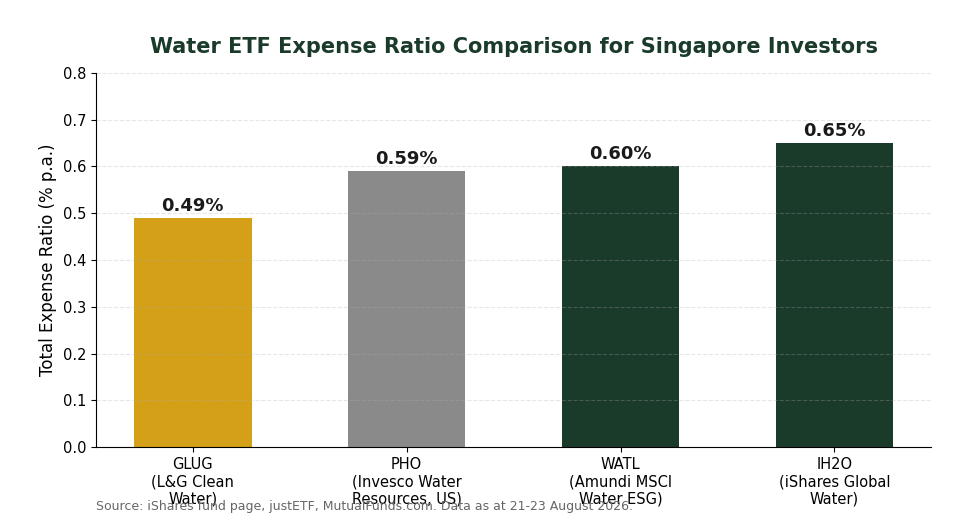
L&G Clean Water UCITS ETF (GLUG) has the lowest total expense ratio of the main LSE-listed options at 0.49% per year, versus 0.65% for iShares Global Water UCITS ETF (IH2O) and 0.60% for Amundi MSCI Water ESG Screened UCITS ETF (WATL). On a SGD 50,000 position, that’s a difference of roughly SGD 80 a year between GLUG and IH2O.
Can I buy water ETFs using my CPF or SRS funds?
You cannot use CPF Ordinary Account funds under the CPFIS scheme, because IH2O and GLUG are not SGX-listed. SRS eligibility depends on whether your specific broker offers SRS-linked trading for LSE-listed ETFs — check directly with your broker, as this varies by platform.
Are water ETFs riskier than broad-market ETFs like CSPX or VWRA?
Yes, in the sense that they’re far less diversified. IH2O and GLUG hold 59-66 companies concentrated in two or three sectors, versus VWRA’s 3,600+ holdings across every major market. They should be treated as a thematic satellite position — most investors keep single-theme sector bets to roughly 5-10% of a portfolio — rather than a core holding.
How does the AI data centre boom affect water stocks?
AI data centres use large volumes of water for cooling, both directly and indirectly through the electricity they consume. The International Energy Agency projects global data centre water use could rise from around 560 billion litres a year today to 1.2 trillion litres by 2030, which increases demand for the water treatment, recycling, and infrastructure equipment made by companies held in funds like GLUG and IH2O.
Ready to Start Investing in ETFs?
Open a brokerage account and buy your first ETF today. Use our referral links for exclusive sign-up bonuses.
This article was researched with the help of AI. While we strive to keep all information accurate and up to date, there may be errors. If you notice any discrepancies, please contact us.