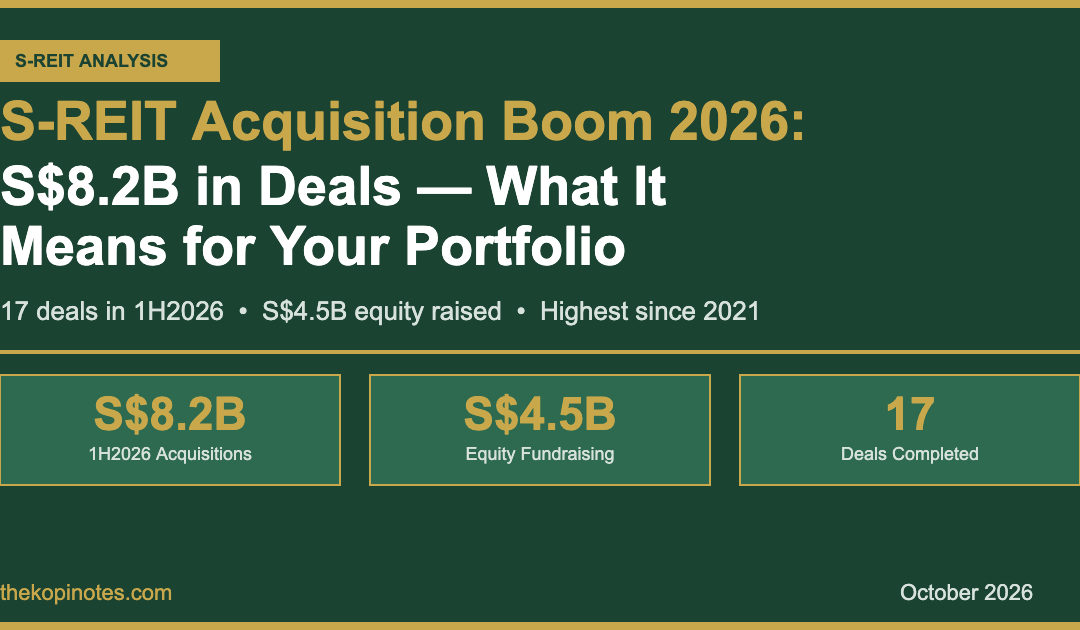
Singapore REITs have gone on their biggest buying spree since 2021, with S$8.2 billion in acquisitions across 17 deals in just the first half of 2026. Backed by S$4.5 billion in equity fundraising and a 3-month SORA rate that has fallen to approximately 1.12% — down from a 2024 peak of around 3.8% — S-REITs are aggressively expanding portfolios. Here is what every Singapore retail investor needs to know about this trend, and how to decide if it helps or hurts your returns.
This is an editorial analysis. Not financial advice. Data verified as at 8 October 2026.
The Numbers Behind the 2026 Acquisition Boom
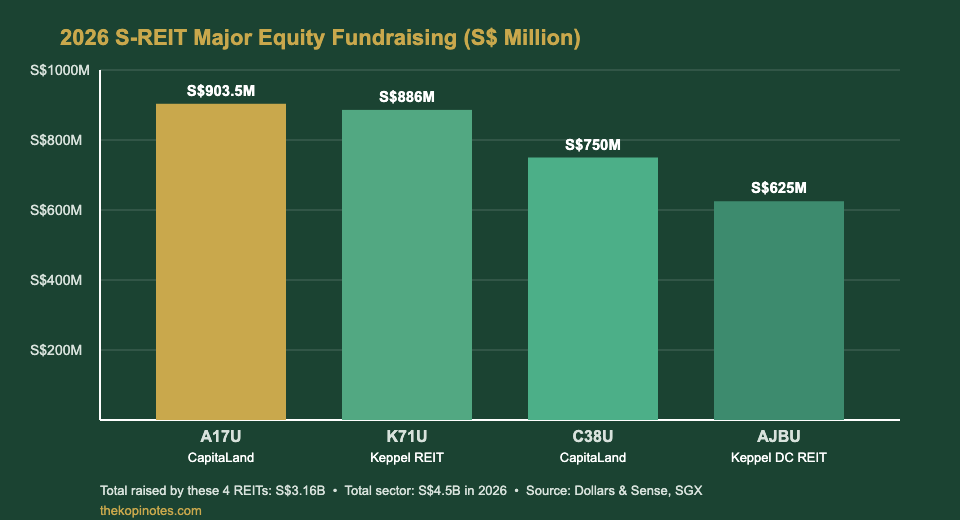
When RHB Bank Singapore analyst Vijay Natarajan raised his full-year 2026 S-REIT acquisition forecast from S$5–8 billion to S$10–12 billion, it was not just an analyst revision — it was a signal that the sector has entered a new phase of growth. The S$8.2 billion already transacted in the first six months of 2026, across 17 separate deals, compares with the entire 2021 full-year figure of S$13.3 billion, widely seen as the last boom year before interest rate hikes chilled deal-making.
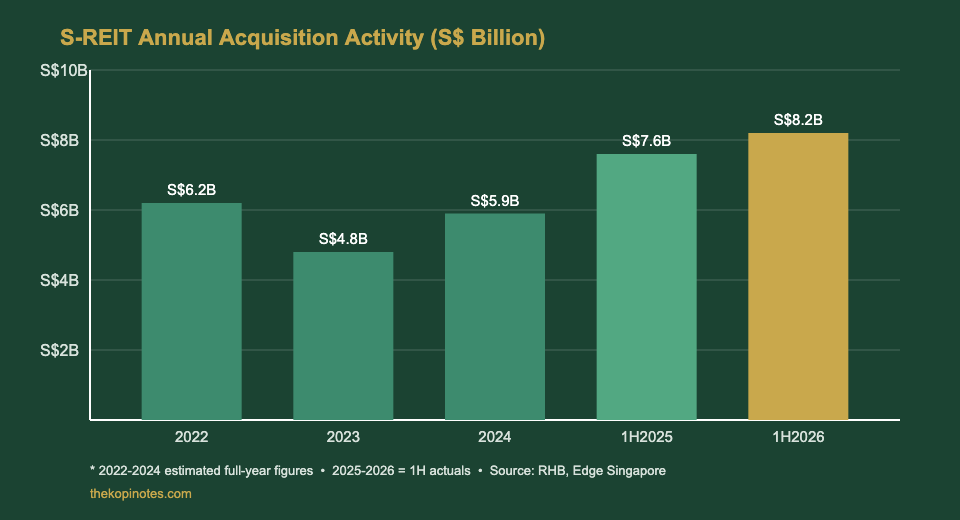
The scale of the equity capital raised is equally striking. SGX data cited by Dollars & Sense shows that S-REITs have raised at least S$4.5 billion through equity fundraising in 2026 year-to-date — already surpassing the same period in 2025. Four REITs account for S$3.16 billion of this figure alone, each completing oversubscribed fundraises that point to strong institutional demand for Singapore real estate exposure.
What changed? In one word: rates. The 3-month SORA, the benchmark rate underpinning most Singapore floating-rate debt, has eased significantly from its 2024 peak of approximately 3.8% to around 1.12% as of September 2026. This compression in borrowing costs dramatically changes the arithmetic of acquisitions. A deal that was dilutive in 2023 when SORA was elevated may now be accretive as debt refinances at lower rates. REITs are acting rationally in front of this window.
Four REITs Leading the 2026 Buying Spree
The 2026 acquisition wave is not evenly distributed. A handful of large-cap S-REITs have driven the bulk of deal volume, each with a distinct strategic rationale. Understanding what each REIT bought — and how they funded it — is critical context for any Singapore investor holding or considering these names.
| REIT (SGX Code) | Amount Raised | When | What They Acquired | Oversubscription |
|---|---|---|---|---|
| CapitaLand Ascendas REIT (A17U) | S$903.5 million | April 2026 | Logistics assets in Singapore, USA, Spain; 50% of SG business park; 49% of Japan data centre | N/A |
| Keppel REIT (K71U) | S$886 million | January 2026 | Additional one-third interest in Marina Bay Financial Centre Tower 3 | Preferential offering (1:23 units) |
| CapitaLand Integrated Commercial Trust (C38U) | S$750 million | April 2026 | 100% interest in Paragon on Orchard Road | 4.8x oversubscribed |
| Keppel DC REIT (AJBU) | S$625 million | September 2026 | 88.6% interest in two freehold hyperscale data centres in Japan | 3.4x oversubscribed |
The diversity of assets is notable. CapitaLand Ascendas REIT (CLAR) is building out a multi-geography logistics and industrial platform, while simultaneously securing a foothold in Japanese data centre infrastructure. Keppel REIT is deepening its stake in one of Singapore’s premier Grade A office towers. CICT’s acquisition of Paragon consolidates its premium Orchard Road retail exposure. And Keppel DC REIT is making its most significant international push yet, with Japan expected to contribute 23% of rental income post-acquisition, up from just 9% previously. Assets under management are expected to reach S$7.6 billion across 27 data centres in 10 countries.
For investors interested in understanding how deal funding works, the TKN guide to Singapore REIT private placements and placement shares explained provide useful background on what these equity issuances mean for existing unitholders.
Why the Rate Environment Is Driving Deal-Making Now
The collapse in Singapore overnight rates is the single biggest enabler of the 2026 acquisition spree. With 3-month SORA at approximately 1.12% as of September 2026, compared with a peak of around 3.8% in 2024, REITs are refinancing existing floating-rate debt at materially lower costs. Every 100 basis points of SORA decline translates directly into higher distributable income for REITs with floating-rate loans — and that income improvement is real money for unitholders.
The mechanism works both ways: lower rates reduce existing debt service costs, and they also lower the hurdle rate for new acquisitions. When a REIT can borrow at 3–4% all-in cost of debt to acquire an asset yielding 5–6% NPI (net property income) yield, the spread is accretive. In a high-rate environment, that same deal might be marginally dilutive or break-even. The current rate window is therefore a genuine catalyst, not just noise.
This context is explored in the TKN overview of the Singapore REIT Sector Outlook for 2026, which covers the macro backdrop in detail.
What This Means for Your DPU
The key question for retail investors is not whether REITs are buying assets — it is whether those acquisitions will translate into higher distributions per unit (DPU). This depends on three factors: acquisition yield versus funding cost, gearing headroom, and dilution from equity issuance.
On acquisition yield versus funding cost, the deals look broadly accretive. Paragon, for instance, is a trophy Orchard Road mall with high foot traffic and rental resilience — CICT’s management would not have pulled a S$750 million fundraise that was 4.8 times oversubscribed if the deal did not work financially. Similarly, Keppel DC REIT’s Japan data centres are freehold hyperscale assets at a time when AI infrastructure demand is driving occupancy above 95% globally.
On gearing, S-REITs remain within MAS limits. The sector gearing average sits at approximately 38–40%, well below the 45–50% MAS cap, leaving room for further debt-funded acquisitions without breaching limits. Keppel DC REIT’s gearing of 29.8% as of late 2025 gives it particularly significant headroom.
On dilution, this is where investors need to pay attention. When a REIT issues new units to fund an acquisition, each existing unit is worth a smaller fraction of the portfolio. In the short term, DPU may dip before the income from new assets flows through. For a deeper look at how to tell whether an acquisition will ultimately grow or shrink your distributions, see the TKN explainer on DPU-accretive acquisitions for Singapore REIT investors.
For Keppel DC REIT specifically, TKN’s dedicated analysis of Keppel DC REIT’s WALE, lease expiry profile and DPU outlook for 2026 examines income security in detail.
How to Evaluate These Deals as a Retail Investor
Not every acquisition is equal. As this wave of deal-making continues into the second half of 2026, here is a practical framework for Singapore retail investors evaluating whether to add to, hold or reduce a REIT position after an acquisition announcement.
Check the NPI yield vs. cost of debt. If a REIT is acquiring at a 5.5% NPI yield and its weighted average cost of debt is 3.2%, the deal creates a 230 bps spread — genuinely accretive. If the NPI yield is 4.5% and cost of debt is 4.0%, the cushion is thin and any occupancy shortfall turns the deal dilutive.
Watch the subscription terms. A preferential offering (existing unitholders get the first right to subscribe) is friendlier to retail investors than a private placement (institutions only), because it allows you to maintain your proportional ownership. Keppel REIT’s January fundraise used a preferential offering structure. CICT’s April raise was a private placement, meaning retail investors who did not buy in the secondary market faced dilution.
Assess sponsor quality and execution track record. CapitaLand and Keppel are Singapore’s two largest REIT sponsors, with established pipelines, strong balance sheets, and decades of execution history. Deals sourced from a strong sponsor pipeline generally carry lower execution and leakage risk than third-party acquisitions.
Consider geographic and sector diversification. CLAR’s expansion into Japan data centres, and Keppel DC REIT’s deepening of its Japanese hyperscale exposure, add foreign exchange risk — yen-denominated income hedged back to Singapore dollars. Singapore investors benefit from diversification, but need to account for FX translation volatility in DPU expectations.
For investors who prefer broad S-REIT exposure without picking individual names, the Singapore REIT ETF guide on TKN covers the available fund options including the Lion-Phillip S-REIT ETF and Nikko AM-StraitsTrading Asia ex Japan REIT ETF.
Bottom Line for SG Investors
The 2026 S-REIT acquisition boom is real, it is data-backed, and it is structurally driven by the most supportive rate environment Singapore REITs have seen in four years. S$8.2 billion in 1H2026 acquisitions, an equity fundraising machine that has raised S$4.5 billion with oversubscription rates of up to 4.8 times, and a full-year forecast of S$10–12 billion from RHB — these are not small numbers.
For long-term Singapore retail investors in S-REITs, the headline message is broadly positive: REITs are growing their asset bases at a time when the rate environment is supportive, acquisitions are broadly accretive, and the asset classes targeted (premium retail, Grade A office, logistics, data centres) are in structural demand. The risks — dilution from equity issuance, FX exposure from international assets, and the ever-present threat of rates reversing — are real but manageable if you understand what you own.
The discipline is to evaluate each deal on its own merits. Not every acquisition is DPU-accretive from day one. Not every private placement is fairly priced. But the sector-level trend in 2026 is one of growth, not contraction — and that is a constructive backdrop for patient, income-focused Singapore investors.
Frequently Asked Questions
Q: Why are S-REITs making so many acquisitions in 2026?
A: The primary driver is the significant easing in Singapore interest rates. The 3-month SORA rate has fallen from approximately 3.8% in 2024 to around 1.12% in September 2026. This lowers REITs’ cost of debt and makes acquisitions financially accretive at current property yields. It also improves the spread between NPI yields and funding costs, giving REIT managers the confidence to transact at scale.
Q: Is S$8.2 billion in acquisitions historically high?
A: It is among the highest half-year figures on record. The full-year 2021 total — widely regarded as the last REIT boom before rate hikes — was S$13.3 billion. The current 2026 pace, if sustained, could approach or match that. RHB analyst Vijay Natarajan has raised his full-year 2026 forecast to S$10–12 billion, implying the second half will see at least another S$1.8–3.8 billion in deals.
Q: Does more acquisitions mean higher DPU for me?
A: Not automatically. Whether an acquisition increases DPU depends on whether the asset’s income yield exceeds the REIT’s all-in cost of funding. A deal funded by cheap debt and generating strong NPI income is accretive — your DPU grows. A deal funded by dilutive equity at a thin yield spread may temporarily reduce DPU per unit before income ramps up. Always check the REIT’s stated DPU accretion guidance and the NPI yield disclosed in the deal announcement.
Q: What is the difference between a private placement and a preferential offering for retail investors?
A: A private placement is offered only to institutional investors, typically at a small discount to the market price. Retail investors face dilution unless they buy units in the secondary market. A preferential offering (or rights issue) gives all unitholders, including retail investors, the right to subscribe for new units proportional to their existing holdings — protecting against dilution. Keppel REIT’s January 2026 fundraise used a preferential offering; CICT’s April raise was a private placement.
Q: How do I know if a REIT’s gearing is too high after an acquisition?
A: Under MAS rules, S-REITs can borrow up to 45% of total assets (or 50% if their interest coverage ratio exceeds 2.5x). Most blue-chip S-REITs in 2026 carry gearing of 38–42%. A REIT approaching 45% gearing has limited headroom for further debt-funded deals and faces higher refinancing risk. Always check the post-acquisition pro-forma gearing disclosed by management in their fundraising prospectus or SGX announcement.
Q: Should I buy S-REITs now given the acquisition boom?
A: This is not financial advice. However, the sector is operating in a constructive environment: lower rates reduce borrowing costs, acquisitions are broadly accretive, sector yields of 5.5–6.5% remain attractive versus the 10-year SGS bond yield of approximately 2.8% (a spread of 270–370 bps), and sponsor pipelines are active. Risks include rate reversal, FX translation on overseas assets, and equity dilution from ongoing fundraises. Investors seeking diversified S-REIT exposure without stock picking may consider a Singapore REIT ETF.
This article was researched with the help of AI. While we strive to keep all information accurate and up to date, there may be errors. If you notice any discrepancies, please contact us.