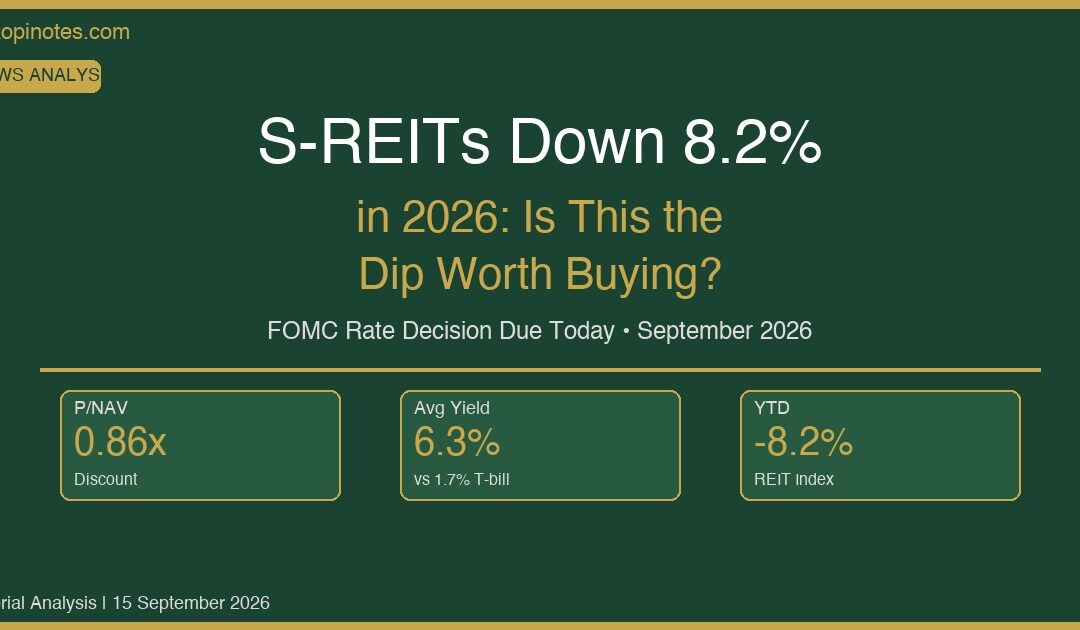
Singapore REITs have taken a 8.2% beating year-to-date as of early September 2026, even as distributions from major S-REITs remain healthy. With the US Federal Reserve holding its make-or-break FOMC meeting today (September 15–16) — where a 69% probability of a 25bps rate hike has been priced in — Singapore retail investors are asking the same question: is this the dip worth buying into?
This is an editorial analysis. Not financial advice. Data verified as at 15 September 2026.
What’s Happening: S-REITs Down 8.2% YTD
The FTSE ST All-Share REIT Index has fallen 8.2% year-to-date as of September 4, 2026, making it one of the worst-performing segments on the Singapore Exchange (SGX) in 2026. This is a sharp reversal from what many analysts had hoped would be a rate-cut tailwind year for the sector.
The culprit? A resilient US economy has forced the Federal Reserve to keep rates higher for longer — and now, the CME FedWatch tool is pricing a 69.3% probability of a 25 basis point hike at the September 15–16 FOMC meeting. Fed Chair Kevin Warsh is expected to make the announcement on September 16 at 2:00 PM ET (September 17 at 2:00 AM Singapore time).
For Singapore investors who loaded up on REITs expecting rate cuts to boost valuations, the pain has been real. Portfolios that were up modestly in early 2026 have slid back into the red.
But here’s the thing: the distributions haven’t collapsed. Operational performance across most major S-REITs remains intact. What we’re seeing is a valuation de-rating driven by macro fear — not a fundamental deterioration in most REITs’ income-generating ability.
The Valuation Case: 0.86x P/NAV and 6.3% Yields
As of early September 2026, the iEdge S-REIT Index is trading at approximately 0.86x Price-to-Net Asset Value (P/NAV). For context, REITs historically trade closer to 1.0x–1.1x P/NAV during neutral rate environments. A reading below 1.0x implies you are buying a portfolio of real assets at a discount to what those assets would cost if you were to buy them directly.
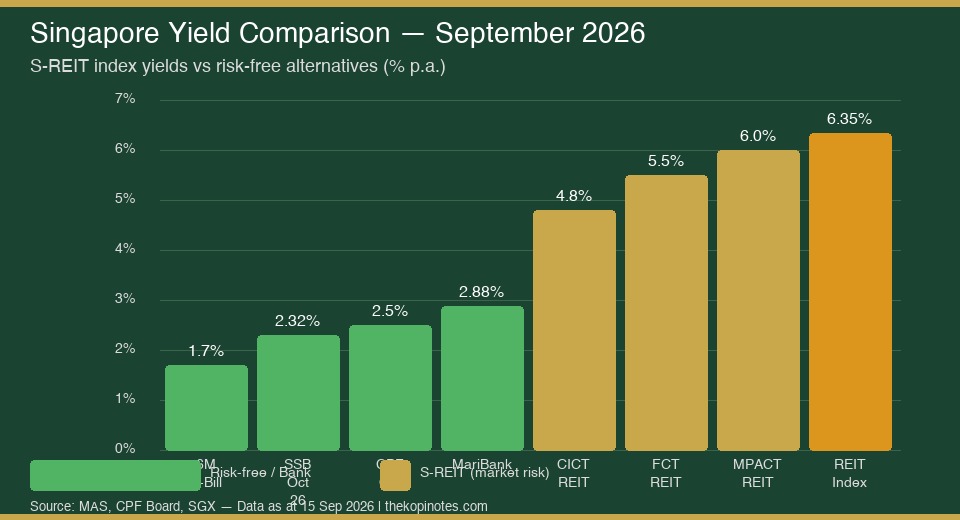
Pair that with a market-cap-weighted average distribution yield of 6.3%–6.4% across the iEdge S-REIT Index, and the income argument becomes compelling — especially when you compare it to Singapore’s other fixed-income alternatives:
| Instrument | Current Rate / Yield | Risk Profile | Liquidity |
|---|---|---|---|
| 6-Month T-Bill | 1.70% p.a. | Risk-free | At maturity |
| SSB (Oct 2026, 10-yr avg) | 2.32% p.a. | Risk-free | Monthly redemption |
| CPF OA | 2.50% p.a. | Risk-free | Restricted |
| MariBank Savings | 2.88% p.a. | Low (SDIC insured up to $100k) | Daily |
| CICT (S-REIT) | ~4.8% yield | Market risk | Daily (SGX) |
| FCT (S-REIT) | ~5.5% yield | Market risk | Daily (SGX) |
| MPACT (S-REIT) | ~6.0% yield | Market risk | Daily (SGX) |
| S-REIT Index (avg) | ~6.3–6.4% yield | Market risk | Daily (SGX) |
The yield spread between S-REITs (~6.3%) and risk-free T-bills (1.70%) is now approximately 460 basis points. Historically, a spread above 400bps has been associated with attractive entry points for long-term REIT investors. Of course, if rates rise further, the spread could compress temporarily — but the income cushion is thick.
For more background on S-REIT valuations, see our S-REIT Outlook 2026 and our high-yield S-REIT comparison for 2026.
Distribution Performance: The Fundamentals Are Holding
Despite the price decline, the majority of S-REITs reported healthy underlying operating performance in their most recent results. Key data points from the latest reporting period:
- ESR-REIT declared a total DPU of 11.510 Singapore cents for the period ending June 30, 2026, paid to unitholders on September 11, 2026.
- AIMS APAC REIT reported a 1.1% increase in DPU to 4.720 Singapore cents for 1H FY2026, with NPI growing 1.1% year-on-year to S$68.4 million.
- Mapletree Industrial Trust reported total revenue of S$170.3 million for Q3 2026, with its data centre segment continuing to anchor performance.
These are not the numbers of a sector in distress. The underlying tenants are paying rent, occupancies remain healthy, and DPU is broadly stable. What’s being punished is the discount rate applied to those future cash flows — and that discount rate is driven by interest rate expectations.
This distinction matters enormously. A REIT with declining occupancy and falling DPU is genuinely broken. A REIT with stable DPU that’s trading at 0.86x NAV because of interest rate fears is a different beast entirely — one that may reward patient investors handsomely when the rate cycle eventually turns.
The Rate Hike Risk: What Happens If the Fed Hikes Today?
Let’s be clear-eyed about the near-term risk. If the Fed raises rates by 25bps today — which markets are pricing at 69% odds — there will likely be short-term selling pressure on S-REITs. Markets often sell the news even after pricing it in, particularly in interest-rate-sensitive sectors.
The mechanism is straightforward: a Fed rate hike pushes up the US federal funds rate, which puts upward pressure on global borrowing costs. For Singapore-listed REITs, which borrow in both SGD and foreign currencies, higher rates mean higher debt financing costs and potentially lower distributable income. SORA (Singapore Overnight Rate Average) typically reacts with a lag of 2–6 weeks.
For a Singapore homeowner with a S$1,000,000 floating-rate mortgage on a 25-year term, each 25bps rise adds roughly S$130–S$150 per month in interest costs. For a REIT with S$1 billion in floating-rate debt, the annual hit could be S$2.5 million — though most large S-REITs have hedged a significant portion of their interest rate exposure.
Read our earlier analysis on what the FOMC meeting means for Singapore investors: September 2026 FOMC Rate Hike: 69% Odds — What Singapore REIT & ETF Investors Must Do Now.
The Singapore Context: Why 6.3% Still Beats the Alternatives
Here’s what many investors lose sight of in a rate-fear environment: even if the Fed hikes today, Singapore’s own alternative yields remain significantly below S-REIT distributions.
The 6-month T-bill yield hit 1.70% at the September 10, 2026 auction — a 2026 high for the 6-month tenor, but still 460bps below S-REIT index yields. The October 2026 SSB offers a 10-year average of 2.32%. MariBank, Singapore’s highest-yielding digital bank savings account, pays 2.88% with no conditions.
None of these match S-REIT yields. The trade-off, of course, is that T-bills, SSB, and bank deposits carry essentially zero capital loss risk (within SDIC limits for deposits), while S-REITs can and do fall in price.
The question is whether 460bps of extra yield is adequate compensation for that risk. At current valuation levels (0.86x P/NAV), many experienced S-REIT investors would argue: yes.
Which S-REITs Are Most Exposed to Rate Risk?
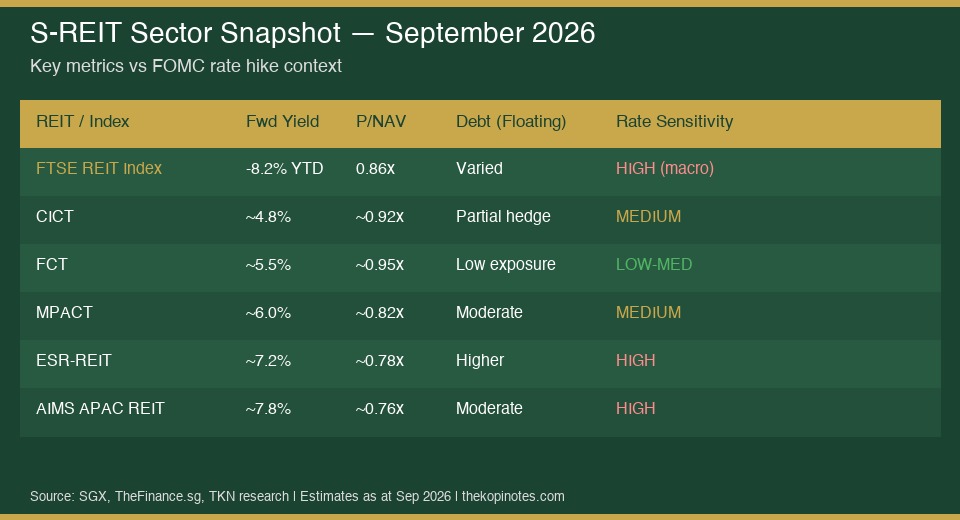
Not all REITs are equally sensitive to rate hikes. Here’s a quick framework:
Higher rate sensitivity (use caution): REITs with high floating-rate debt exposure, significant overseas borrowings, or stretched balance sheets (leverage above 45%). Industrial REITs with overseas portfolios (e.g. China, Japan) also face FX translation risk on top of rate risk.
Lower rate sensitivity (more defensive): Singapore-focused retail REITs like Frasers Centrepoint Trust (FCT), which derives most income from suburban malls with domestic-only exposure, tend to be more resilient. FCT’s forward yield of ~5.5% comes with a portfolio anchored in necessity retail — groceries, F&B, healthcare — which holds up well even in downturns.
CapitaLand Integrated Commercial Trust (CICT), Singapore’s largest REIT by market capitalisation, offers a blend of Grade-A CBD office and prime retail exposure. Its ~4.8% yield is lower, but so is the risk profile. CICT typically sees stronger performance when interest rate uncertainty eases and occupancies remain high.
For a full breakdown, see our Best S-REITs Singapore 2026 yield comparison.
The Longer View: Rate Cycles Turn
Singapore REITs dramatically outperformed during 2020–2021 when rates were near zero, and have underperformed since the aggressive rate hike cycle began in 2022. The question is not whether rates will eventually fall — they always do — but when, and how much damage gets done in the meantime.
For investors with a 3–5 year horizon, the current 0.86x P/NAV entry point on the iEdge S-REIT Index may look attractive in hindsight. The risk is that further rate hikes push valuations even lower before the cycle turns. A phased, dollar-cost-averaging approach — rather than a lump-sum bet — allows investors to accumulate at lower prices without trying to time the exact bottom.
Investors with shorter time horizons or lower risk tolerance should stick to SSB or T-bills for now, accepting lower yields in exchange for capital safety.
Bottom Line for SG Investors
- S-REITs are down 8.2% YTD and trading at 0.86x P/NAV — a historically attractive valuation for long-term investors.
- Average S-REIT yields of 6.3% represent a ~460bps spread over risk-free T-bills — among the widest spreads in recent memory.
- The FOMC rate hike decision (due September 16–17 Singapore time) may cause short-term volatility, but distributions at the REIT level remain broadly intact.
- Investors with long time horizons and stomach for volatility: consider accumulating in tranches using DCA rather than a lump sum.
- Conservative investors: T-bills, SSB, and high-yield savings accounts remain valid alternatives at 1.70%–2.88% p.a. with zero capital risk.
- Watch the FOMC decision closely — a hawkish surprise (larger-than-expected hike or hawkish commentary) could push S-REIT prices lower in the short term.
Frequently Asked Questions
Why are Singapore REITs falling in 2026?
S-REITs have fallen 8.2% year-to-date as of September 2026 primarily because interest rate expectations have shifted upward. With the US Federal Reserve now expected to hike rates at its September 15–16 FOMC meeting (69% probability), investors have been selling rate-sensitive assets like REITs. Higher rates increase borrowing costs for REITs and make risk-free alternatives more competitive, reducing the relative attractiveness of REIT distributions.
Are S-REIT distributions still being paid?
Yes. Operational performance across major S-REITs remains solid. ESR-REIT paid a DPU of 11.510 Singapore cents for the period ending June 30, 2026. AIMS APAC REIT increased its DPU by 1.1% to 4.720 Singapore cents for 1H FY2026. The decline in S-REIT prices is primarily a valuation re-rating due to rate fears, not a collapse in underlying income.
What is the current P/NAV for Singapore REITs?
As of early September 2026, the iEdge S-REIT Index trades at approximately 0.86x Price-to-Net Asset Value (P/NAV). This means investors can buy a basket of Singapore real assets at a ~14% discount to their assessed net asset value — historically an attractive entry level.
How does the Fed rate hike affect Singapore REITs?
A US Fed rate hike puts upward pressure on global borrowing costs, including Singapore’s SORA rate (with a typical lag of 2–6 weeks). For REITs with floating-rate debt, higher interest costs reduce distributable income. Additionally, higher risk-free rates reduce the relative attractiveness of REIT yields, which can push REIT unit prices lower. However, most large S-REITs have hedged a portion of their interest rate exposure.
Should I buy Singapore REITs now or wait?
There’s no definitive answer. At 0.86x P/NAV and ~6.3% yields, the current valuation is historically attractive for long-term investors (3–5 year horizon). However, if the Fed hikes today and signals further hikes ahead, S-REIT prices may fall further in the short term. A dollar-cost-averaging (DCA) approach — buying in tranches over several months — reduces the risk of buying at an exact price peak while still allowing accumulation at attractive levels.
Which S-REITs are safest in a rising rate environment?
Singapore-focused retail REITs with low overseas exposure and conservative balance sheets tend to be most resilient to rate hikes. Frasers Centrepoint Trust (FCT) and CapitaLand Integrated Commercial Trust (CICT) are often cited as more defensive S-REITs. Avoid REITs with high leverage ratios (above 45%), significant floating-rate debt exposure, or heavily overseas-exposed portfolios during periods of rate uncertainty.
What are the alternatives to S-REITs for Singapore investors right now?
Key alternatives include: 6-month T-bills (1.70% p.a., risk-free), Singapore Savings Bonds — October 2026 issue (2.32% 10-year average, risk-free with monthly redemption), CPF OA (2.5% p.a., restricted), and MariBank savings (2.88% p.a., SDIC-insured up to S$100,000). These offer lower yields than S-REITs but with zero capital loss risk.
This article was researched with the help of AI. While we strive to keep all information accurate and up to date, there may be errors. If you notice any discrepancies, please contact us.