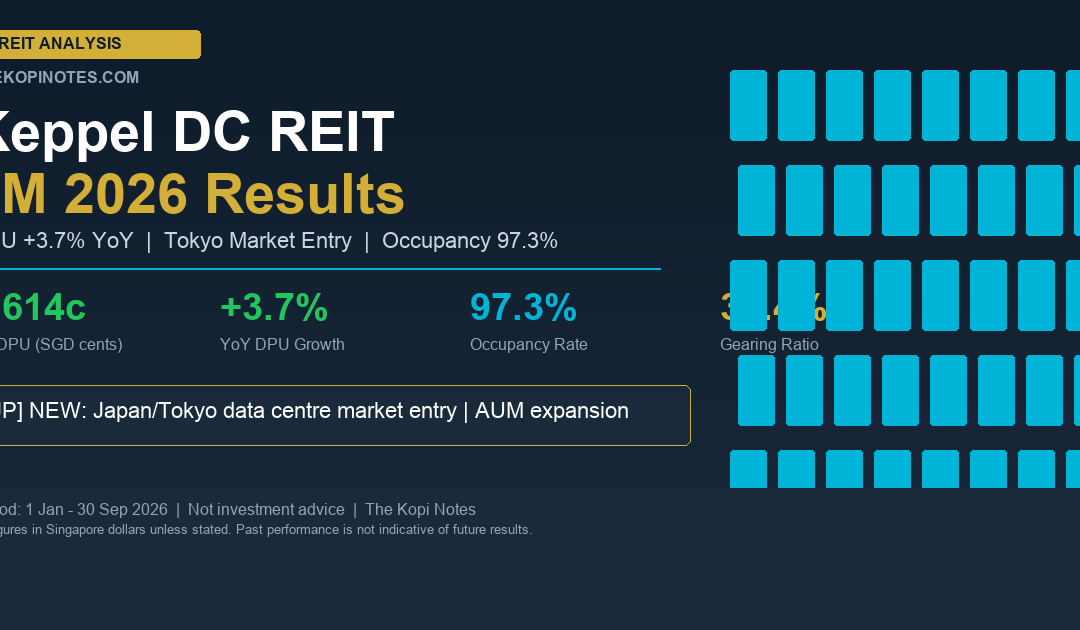
Keppel DC REIT (SGX: AJBU) delivered its strongest nine-month performance in years for the period ended 30 September 2026 — distributable income jumped 16.7% to S$228 million, pushing the 9M 2026 DPU up 11.7% to 8.571 cents. The October completion of the S$1.55 billion Tokyo Data Centre 4 & 5 acquisition — two AI-ready hyperscale facilities — puts the REIT on track for continued DPU growth heading into 2027. Here is what Singapore retail investors need to know.
This is an editorial analysis. Not financial advice. Data verified as at 3 November 2026.
What Happened in Keppel DC REIT's 9M 2026?
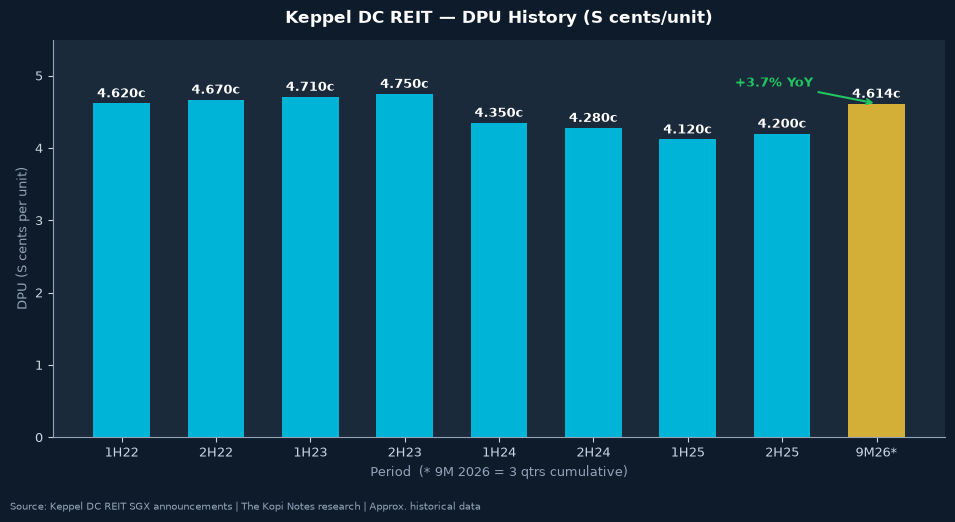
Keppel DC REIT's nine-month results, announced on 22 October 2026, showed broad-based improvement across every key metric. Gross revenue climbed 13.3% year-on-year to S$365.3 million, while net property income (NPI) grew 13.1% to S$316.8 million. Distributable income surged even faster at 16.7% to S$228 million, reflecting the REIT's operational leverage and disciplined cost management.
The 9M 2026 DPU of 8.571 cents represents a 11.7% increase from the 7.67 cents paid in the same period last year. This means unitholders on the books as of the upcoming ex-dividend date will receive approximately 2.857 cents per unit on the distribution payment date of 23 November 2026 — the third quarter's slice of income.
Two major drivers stand out. First, organic rental reversion across the portfolio averaged approximately 14% for the nine months — a sign that market rents are significantly above in-place rates at lease renewal time. This trend has room to run, particularly in Singapore and Australia, where data centre demand continues to outpace supply. Second, AI-driven demand for data centre capacity is translating directly into pricing power: tenants are renewing at substantially higher rates, and the REIT is reaping the benefit.
Finance costs did rise — up 28% to S$46.69 million — reflecting higher borrowing costs on the acquisition loans drawn in late 2025 and the funding for the Tokyo deal. Investors should note that this headwind is already baked into the 9M DPU of 8.571 cents, which still came in well above expectations.
The Tokyo Data Centre Game-Changer
The headline event of Q3 2026 was the completion of the Tokyo Data Centre 4 and 5 (TDC 4 & 5) acquisition on 1 October 2026. Keppel DC REIT acquired an effective 88.62% interest in two hyperscale colocation facilities in Inzai City, Greater Tokyo, for a total acquisition price of approximately JPY 168.4 billion (roughly S$1.38 billion for the REIT's stake).
On a 100% basis, the two assets were transacted at JPY 190 billion (approximately S$1.55 billion) — a 2.1% discount to their independent valuation of JPY 194 billion. This means the REIT acquired quality assets below market value, which is relatively rare in the current environment.
What makes TDC 4 and TDC 5 strategically valuable? Several factors:
- 100% occupancy — both assets are fully leased to four investment-grade clients, providing immediate income from day one.
- Long WALE — the weighted average lease expiry (WALE) is 4.5 years for TDC 4 and 10.6 years for TDC 5, giving income visibility into the 2030s.
- Below-market rents — in-place rents are estimated to be at least 30% below current market rates, creating built-in reversion upside at renewal.
- Built-in escalations — contracted rent escalations average approximately 2.8% per year, providing inflation protection.
- DPU accretion — on a pro forma basis, FY2025 DPU would have been 2.6% higher at 10.649 cents versus the actual 10.381 cents reported.
Post-acquisition, the REIT now owns 27 data centres across 10 countries, with 87.4% of the portfolio located in Asia Pacific — a region that is increasingly becoming the centre of gravity for global AI compute demand. For Singapore-based investors focused on S-REIT yield investing, this geographic concentration in high-growth markets is a meaningful differentiator.
How Did They Fund It? Understanding the Placement Dilution
The Tokyo acquisition was partly funded through a private placement in September 2026, which raised at least S$600 million in new equity at a price range of S$2.096 to S$2.142 per unit. This resulted in a meaningfully larger unit base — which explains why distributable income grew faster (16.7%) than the DPU (11.7%). The difference is purely mechanical: more units in issue means each unit gets a slightly smaller slice of the same larger income pool.
This dilution is a one-time adjustment. Going forward, the full income contribution from TDC 4 and 5 will flow through to DPU without further dilution — making FY2027 DPU growth projections more straightforward.
Pro forma aggregate leverage (gearing ratio) stands at approximately 38.8% post-acquisition, up from 36.2% pre-acquisition. While this is higher than pre-deal levels, it remains within MAS guidelines and the REIT's stated target band.
S-REIT Comparison: How Does Keppel DC REIT Stack Up?
To understand whether Keppel DC REIT is attractive at current prices, it helps to compare it against peers in the S-REIT universe. The table below uses data as of late October / early November 2026.
| S-REIT | Sub-Sector | Unit Price (SGD) | Annualised DPU Est. | Est. Forward Yield | Gearing | 9M 2026 NPI Growth |
|---|---|---|---|---|---|---|
| Keppel DC REIT (AJBU) | Data Centre | 2.130 | ~11.4–11.7c | ~5.4% | 38.8% | +13.1% |
| CapitaLand Integrated CT (C38U) | Commercial | ~1.90 | ~10.8c | ~5.7% | ~37.5% | +13.8% |
| Frasers Centrepoint Trust (J69U) | Suburban Retail | ~2.20 | ~12.35c | ~5.6% | ~36.8% | +15.7% |
| Keppel REIT (K71U) | Office | ~0.95 | ~5.5c | ~5.8% | ~38% | +9% |
| Mapletree Industrial Trust (ME8U) | Industrial / DC | ~2.20 | ~13.5c | ~6.1% | ~38% | +5% |
Source: SGX filings, company announcements, analyst estimates. For reference only. Verify current prices before investing.
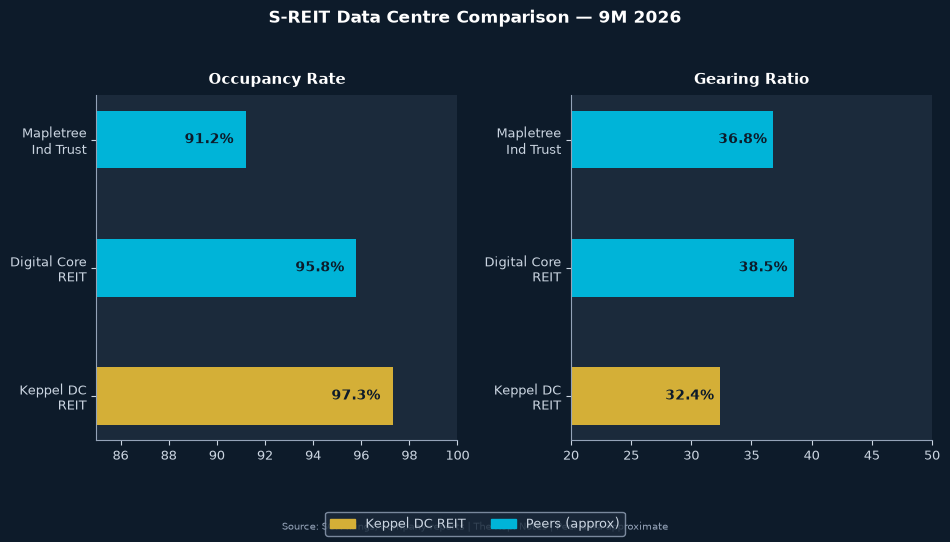
At approximately 5.4% forward yield, Keppel DC REIT sits slightly below the S-REIT average. However, investors are essentially paying a growth premium here — the 13.1% NPI growth rate is among the highest in the sector. If you believe AI-driven data centre demand will sustain for the next 3–5 years (and the evidence suggests it will), the current yield may understate the REIT's compounding potential.
Compare this to CICT's 3Q 2026 results, where the commercial REIT also delivered strong NPI growth of 13.8% — but with a slightly higher headline yield. Data centre REITs tend to trade at lower yields precisely because their long-term demand drivers are structurally stronger.
Risks That Could Dent Future DPU
No REIT analysis is complete without a clear-eyed look at downside risks. For Keppel DC REIT, four risks deserve attention heading into 2027.
1. Cardiff Data Centre Vacancy
The REIT's Cardiff asset in the UK has seen occupancy pressure. A prolonged vacancy or lease-up delay could create a drag on NPI, particularly as the asset is priced into analyst models at full occupancy. Management has guided for lease-up but provided no firm timeline.
2. Higher Finance Costs
Finance costs rose 28% year-on-year in 9M 2026, driven by the acquisition loans for the Japan expansion. If interest rates remain elevated into 2027, the incremental cost of the S$600 million placement debt could continue to compress distributable income margins.
3. Currency Risk from Japan
With the Tokyo acquisitions now representing a significant portion of the portfolio, the REIT has material JPY exposure. A strengthening SGD relative to JPY would reduce the SGD value of Tokyo rental income when translated back to Singapore dollars. Keppel DC REIT hedges some of this risk, but currency headwinds remain a factor to monitor.
4. Unit Base Dilution
The September 2026 private placement expanded the unit base. Any future equity fundraising for new acquisitions would add further dilution. However, management has indicated that near-term capital recycling will be funded from existing capacity and asset sales rather than new placements.
Despite these risks, the fundamental thesis remains intact: data centre demand driven by AI, cloud migration, and enterprise digitalisation is structurally strong, and Keppel DC REIT sits at the intersection of this secular trend in Asia Pacific — the world's fastest-growing data centre market.
What This Means for Singapore Retail Investors
For Singapore investors building an S-REIT portfolio, Keppel DC REIT's 9M 2026 results serve as a useful reminder that not all REITs are created equal. The 11.7% DPU growth — at a time when many traditional REITs are struggling to grow distributions — reflects the premium that comes with owning assets in genuinely structurally undersupplied markets.
- The November 23 distribution is locked in — if you hold units before the ex-dividend date, you will receive approximately 2.857 cents per unit. At the current price of S$2.13, that represents a quarterly yield of about 1.3%.
- The Tokyo acquisition is earnings-accretive from Day 1 — the full DPU benefit of TDC 4 and 5 will only flow through from Q4 2026 onwards, making the FY2026 full-year result (to be released in early 2027) a potential positive catalyst.
- Gearing is elevated but manageable — at 38.8%, the REIT has limited room for additional debt-funded acquisitions without first recycling capital through asset sales. This is a signal to watch in 2027 commentary.
If you are currently holding Keppel DC REIT as part of a diversified S-REIT portfolio alongside Frasers Centrepoint Trust's retail exposure or CICT's commercial portfolio, the Q3 results reinforce the case for data centre diversification.
Bottom Line for SG Investors
Keppel DC REIT's 9M 2026 performance was not just good — it was structurally good. Organic rental reversion of 14%, NPI growth of 13.1%, and the completion of the transformative S$1.55 billion Tokyo Data Centre 4 & 5 acquisition set the stage for a strong FY2027 DPU outlook. The portfolio now spans 27 data centres in 10 countries, with 87.4% anchored in Asia Pacific — the epicentre of AI-driven demand growth.
At S$2.13 with a forward yield of approximately 5.4%, the valuation is not cheap by traditional S-REIT standards. But the growth story — and the compounding effect of in-place rents that are at least 30% below market at renewal — justifies that premium for investors with a 3–5 year horizon.
The key near-term catalyst to watch is the Q4 2026 / FY2026 full-year results in early 2027, which will show the first full quarter of income contribution from TDC 4 and 5. If rental reversions stay strong and the Cardiff vacancy is resolved, a meaningful DPU beat versus the current 11.4–11.7 cents annualised estimate is entirely possible.
For now, keep Keppel DC REIT on your watchlist — and if it's already in your portfolio, the 9M results give you plenty of reason to hold.
Frequently Asked Questions
What is Keppel DC REIT's 9M 2026 DPU?
Keppel DC REIT's nine-month 2026 DPU was 8.571 cents, representing an 11.7% increase from the 7.67 cents in 9M 2025. The Q3 2026 portion (approximately 2.857 cents per unit) will be paid on 23 November 2026.
When is Keppel DC REIT's next distribution payment date?
The upcoming distribution for Q3 2026 is scheduled for payment on 23 November 2026. Unitholders must be on the register before the ex-dividend date to receive this distribution. Check SGXNet for the exact ex-dividend date.
What is Keppel DC REIT's current yield (November 2026)?
Based on the unit price of approximately S$2.13 and an estimated annualised DPU of 11.4–11.7 cents, the forward yield is approximately 5.4%. This yield will rise once the full income from the Tokyo Data Centre 4 & 5 acquisition flows through in Q4 2026.
What is Keppel DC REIT's gearing ratio?
Post the Tokyo Data Centre 4 & 5 acquisition completed on 1 October 2026, Keppel DC REIT's pro forma aggregate leverage is approximately 38.8%, up from 36.2% pre-acquisition. The MAS regulatory limit is 50% (or 60% with certain conditions).
Can I buy Keppel DC REIT using CPF OA or SRS?
Yes, Keppel DC REIT (SGX: AJBU) is eligible for investment using CPF Investment Scheme – Ordinary Account (CPFIS-OA) and Supplementary Retirement Scheme (SRS) funds. You can invest via a CPFIS-approved broker. For a full guide, see our Keppel DC REIT investor guide.
How does the Tokyo Data Centre acquisition affect future DPU?
On a pro forma basis, FY2025 DPU would have been 2.6% higher. Since the deal completed on 1 October 2026, the first full quarter of income contribution will appear in Q4 2026 / FY2026 results, expected in early 2027. In-place rents are estimated to be at least 30% below current market rates, with 2.8% annual contracted escalations — providing a DPU growth runway for years.
Is Keppel DC REIT's 14% rental reversion sustainable?
Rental reversion of ~14% in 9M 2026 reflects the structural supply-demand imbalance in Asia Pacific data centre markets. Demand from AI workloads, cloud providers and enterprise digitalisation is outstripping new supply in Singapore and Tokyo. Near-term, the pipeline remains constrained by power availability and construction timelines, suggesting positive reversions will continue — perhaps modestly lower at 8–10% range as more supply eventually comes on.
This article was researched with the help of AI. While we strive to keep all information accurate and up to date, there may be errors. If you notice any discrepancies, please contact us.