Best Investment Options in Singapore 2026: T-Bills, ETFs, REITs & CPF Ranked
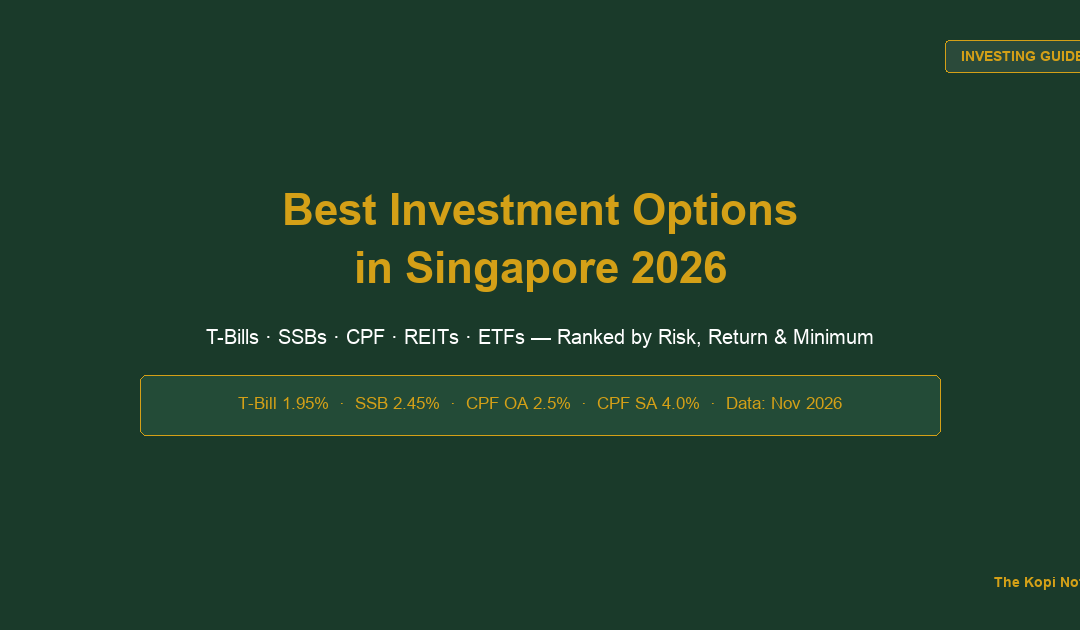
Singapore investors in November 2026 have eight major investment options to choose from — each with a different risk level, minimum amount, and expected return. The safest choices (T-bills at 1.95%, CPF SA at 4%) are guaranteed, while ETFs tracking global indices have historically returned around 8–10% p.a. over the long term but carry market risk. This guide ranks every major option side-by-side so you can match the right vehicle to your goal.
Not financial advice. All figures are for educational reference only. Data verified as at 2 November 2026 unless noted.
In This Guide
- Why Picking the Wrong Investment Costs You Money
- The 7 Best Investment Options in Singapore (2026)
- Returns Compared: Side-by-Side Data Chart
- Minimum Amounts, Liquidity & Risk at a Glance
- Which Investment Is Right for You? (3-Question Framework)
- Best Platforms to Get Started
- Frequently Asked Questions
Why Picking the Wrong Investment Costs You Money
Leaving $50,000 in a bank savings account earning 0.05% interest for a year earns you $25 in interest. Put the same amount into a 6-month T-bill at 1.95% and you earn $975 — with zero credit risk and a government guarantee. That $950 difference is the cost of not knowing your options.
Conversely, a retiree who puts their entire retirement sum into a globally-diversified equity ETF might experience a 40% drawdown in the first year of retirement and be forced to sell at the worst moment. The right investment is never the one with the highest number — it’s the one whose risk, liquidity, and time horizon match your actual goal.
Singapore offers a rare combination of government-backed guaranteed options (CPF, SSBs, T-bills) alongside liquid equity markets (SGX, LSE ETFs) and a tax-free environment with no capital gains tax and no dividend tax for individuals. Understanding all eight options in one place is the essential first step.
The 7 Best Investment Options in Singapore (2026)
1. Fixed Deposits
Fixed deposits (FDs) at Singapore banks currently offer around 1.5–1.8% p.a. for 6 to 12-month tenors (November 2026). They are SDIC-insured up to $75,000 per depositor per bank, making them one of the safest places to park short-term cash. The trade-off is low liquidity — breaking an FD early typically forfeits the interest earned. Minimum amounts vary by bank but are usually $1,000–$10,000 for promotional rates.
Best for: cash you need in 6–12 months that you want to earn slightly more than a savings account without any market risk.
2. Singapore T-Bills
The MAS 6-month T-bill cut-off yield at the most recent auction (22 October 2026) was 1.95%. T-bills are short-dated Singapore government bonds sold by the Monetary Authority of Singapore at a discount and redeemed at face value. The minimum subscription is $1,000 in multiples of $1,000, you can apply via DBS/POSB, OCBC, or UOB internet banking, and your CPF OA funds can also be used.
T-bills are backed by the Singapore Government (AAA-rated) and are completely risk-free if held to maturity. They are the cleanest short-term “parking” vehicle for idle cash above what a savings account offers. Read more: Singapore T-bills 2026 guide.
3. Singapore Savings Bonds (SSBs)
The November 2026 SSB issue pays a 10-year average return of 2.45% p.a. (up for the second consecutive month). SSBs are issued monthly by the Singapore Government and offer step-up interest — the longer you hold, the higher the rate. The minimum is $500, maximum individual holding is $200,000, and — uniquely — you can redeem early every month with no penalty and receive full accrued interest.
SSBs are arguably the best short-to-medium-term safe investment in Singapore when you want some flexibility. Read our Singapore Savings Bonds guide for the full application process.
4. CPF Ordinary Account (OA)
CPF OA earns 2.5% p.a. (the floor rate, confirmed by CPF Board for Q4 2026). Your employer and you both contribute to your OA automatically as long as you are an employed Singapore Citizen or PR. The first $20,000 in your OA earns an additional 1% extra interest. CPF OA funds can be used to pay for HDB housing, CPFIS-OA investments, and will flow to your Retirement Account at 55.
Think of CPF OA as a guaranteed 2.5% government bond that you are required to invest in — often better than what banks offer for the same zero-risk profile.
5. CPF Special / MediSave / Retirement Account (SA/MA/RA)
CPF SA and MA earn 4.0% p.a. (floor extended through 31 December 2027 per the CPF Board’s latest announcement). The SA closed for members aged 55+ from 19 January 2025, with balances transferred to the Retirement Account which also earns 4%. MA earns 4% and covers approved medical expenses.
The CPF SA/RA 4% floor is one of the best risk-free returns anywhere in the world for money you do not need until retirement. Voluntary cash top-ups to your SA/RA also qualify for up to $8,000 in tax relief annually. CPF investment strategy Singapore covers this in detail.
6. Singapore REITs (S-REITs)
S-REITs are real estate investment trusts listed on the SGX, required by law to distribute at least 90% of taxable income to unitholders. As at November 2026, the average distribution yield across the SGX REIT index is approximately 5–6% p.a., though individual REITs vary significantly. Key names include CapitaLand Integrated Commercial Trust (CICT), Mapletree Logistics Trust, and Keppel DC REIT.
S-REITs offer passive income Singapore seekers a tax-exempt distribution stream (REIT dividends are not subject to withholding tax for Singapore individual investors) with the liquidity of a listed stock. The trade-off is market price risk — unit prices fluctuate with interest rate expectations and property fundamentals.
7. Stock Market ETFs (STI ETF & Global ETFs)
ETFs offer broad market exposure at very low cost. The STI ETF (ES3, TER ~0.30%) tracks the Straits Times Index of the top 30 Singapore companies, with a long-term historical return of approximately 7% p.a. including dividends reinvested. For global diversification, Ireland-domiciled UCITS ETFs like CSPX (S&P 500, TER 0.07%) and VWRA (global all-world, TER 0.22%) have posted historical returns of around 8–10% p.a. over long periods.
Singapore investors prefer UCITS ETFs listed on the London Stock Exchange over US-domiciled ETFs to avoid US estate tax (USD 60,000 threshold for non-residents) and reduce dividend withholding tax to 15% (from 30%). moomoo Singapore review compares platforms for buying LSE-listed ETFs affordably.
| Option | Return (Nov 2026) | Capital Risk | Best Time Horizon |
|---|---|---|---|
| Fixed Deposit | 1.5–1.8% p.a. | Zero (SDIC insured) | 3–12 months |
| T-Bill (6-month) | 1.95% p.a. | Zero (SGov backed) | 6 months |
| Singapore Savings Bond | 2.45% 10Y avg | Zero (SGov backed) | 1–10 years |
| CPF OA | 2.5% p.a. | Zero (CPF guaranteed) | Until age 55+ |
| CPF SA/MA/RA | 4.0% p.a. | Zero (CPF guaranteed) | Long term (retirement) |
| S-REITs (SGX listed) | ~5–6% yield* | Medium (price volatility) | 5+ years |
| Global ETF (CSPX/VWRA) | ~8–10% p.a. (hist.)* | Medium–High (market) | 10+ years |
Source: MAS (T-bill Oct 22 2026), CPF Board (Nov 2026), SGS.gov.sg (SSB Nov 2026 issue). * Indicative historical averages — past performance does not guarantee future results.
Returns Compared: Side-by-Side Data
The chart below shows the annualised return of each investment option as at November 2026. The guaranteed rates (T-bills, CPF, SSBs) use actual current figures. The equity and REIT figures are historical long-term averages and are not guaranteed.
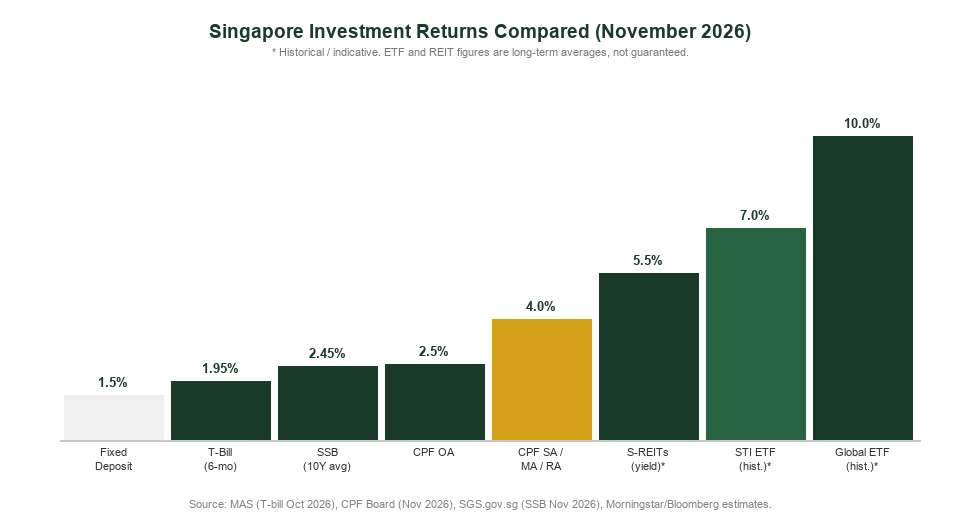
A few key observations from the chart:
- CPF SA at 4% beats every guaranteed product available in the market today. If you haven’t maximised your CPF SA top-up and SRS contributions before investing elsewhere, you may be leaving risk-free return on the table.
- SSBs at 2.45% beat T-bills (1.95%) on a 10-year horizon while offering monthly liquidity — a rare combination that makes them the default for medium-term safe money.
- REITs and ETFs offer far higher long-term potential but are suited only to money you genuinely do not need for 5–10+ years. They can, and do, fall 30–40% in a market downturn.
The Singapore retirement calculator can help you work out how much of each bucket you might need to hit your retirement income goal.
Minimum Amounts, Liquidity & Risk at a Glance
One practical question that often stops new investors: “How much do I actually need to start?” Here is the honest answer for each option in Singapore.
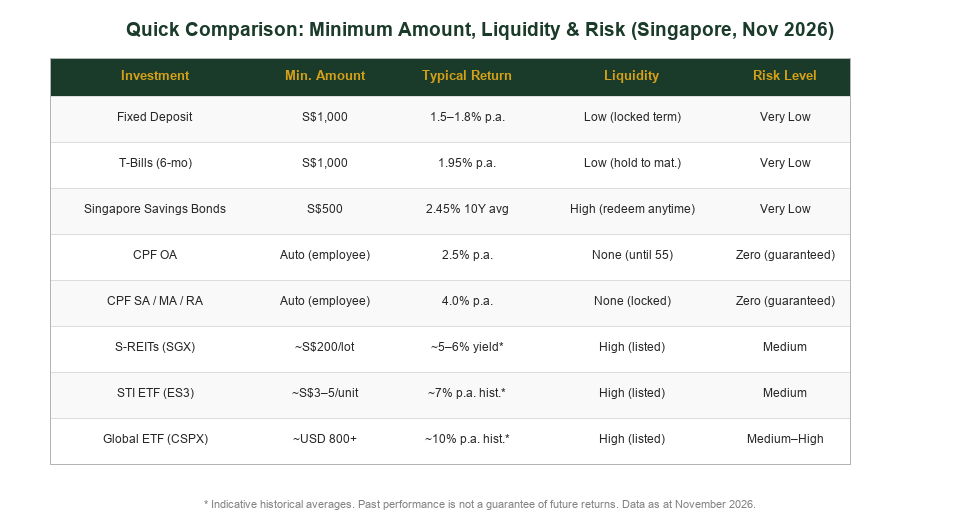
A few nuances to be aware of:
- T-bills require $1,000 minimum — but you can use CPF OA funds so there’s no need to tie up cash if your OA exceeds $20,000 (after the mandatory set-aside).
- SSBs accept as little as $500, making them the most accessible government-guaranteed investment for smaller amounts.
- Global ETFs like CSPX trade on the London Stock Exchange in USD. One unit costs approximately USD 800–900 (November 2026), so you’ll want at least SGD 1,000–1,500 to start. Brokers like IBKR, Syfe, and FSMOne make this accessible from Singapore.
- REITs trade in board lots of 100 units on the SGX, and prices vary from under $1 (some smaller REITs) to $3–4 for large-cap ones like CICT. You typically need $200–$500 per lot.
- CPF OA funds for CPFIS-OA investments require a minimum $20,000 OA balance after the set-aside, meaning small balances are effectively locked in the OA at 2.5% until you accumulate enough.
The practical minimum to start investing in Singapore: As little as $500 for an SSB, or $1,000 for a T-bill. For equity ETFs, a regular savings plan (RSP) at FSMOne accepts $50/month, making it the most accessible route to equity market exposure in Singapore.
Which Investment Is Right for You? (A 3-Question Framework)
Rather than chasing the highest return, match your choice to your situation using three questions:
Question 1: When do you need this money?
- Under 1 year: Fixed deposit or T-bill. Do not invest in anything with market risk for money you will need within 12 months.
- 1–5 years: Singapore Savings Bonds (SSBs). The step-up structure and monthly redeemability make them the natural choice. You can park up to $200,000 per person.
- 5–10 years: A mix of SSBs and dividend-paying REITs or the STI ETF may be appropriate, depending on your risk tolerance.
- 10+ years: A globally-diversified ETF like CSPX or VWRA gives you the full benefit of long-term compounding and is the most efficient vehicle for long-term wealth building after CPF and SRS are maximised.
Question 2: Is this money in CPF/SRS?
If yes, your options narrow — but the guaranteed rates are already excellent. CPF SA earns 4% guaranteed, which is extremely hard to beat on a risk-adjusted basis with any other investment. The general principle is: CPF SA → SRS (top up to the $15,300 annual cap for tax relief) → Cash investments, in that priority order. See the CPF investment strategy Singapore guide for the full framework.
Question 3: Can you handle seeing this money drop 30–40%?
If the answer is no — even temporarily — stick to the guaranteed options: CPF, T-bills, and SSBs. There is no shame in this. The guaranteed 4% CPF SA rate is objectively excellent for money you cannot afford to see fall in value. If the answer is yes and your time horizon is 10+ years, the evidence overwhelmingly favours a low-cost index ETF for long-term wealth building.
| Your Situation | Best Investment Option |
|---|---|
| Emergency fund overflow | SSBs (flexible, safe, 2.45%) |
| Short-term goal in 6–12 months | T-bills (1.95%, government backed) |
| Retirement savings (long-term) | Maximise CPF SA/RA top-ups (4%), then SRS ($15,300), then VWRA/CSPX |
| Passive income (5–6% yield) | Dividend-paying S-REITs via SGX |
| Long-term wealth building (10+ years) | Low-cost global ETF (CSPX/VWRA) via IBKR, Syfe, or FSMOne |
This is a general framework, not personalised financial advice. Individual circumstances vary. Data as at November 2026.
Best Platforms to Get Started in Singapore
Your choice of platform matters — fees, CPF/SRS support, and user experience differ significantly between brokers and robo-advisors in Singapore.
For T-Bills & SSBs
Apply through any of the three local bank internet banking platforms: DBS/POSB, OCBC, or UOB. You can also apply using CPF OA funds directly. No brokerage account needed. The entire process takes about 15 minutes online.
For REITs & STI ETF (SGX)
A local brokerage account (CDP-linked or custodian) is needed. Options include:
- moomoo Singapore — 0.03% commission (min $0.99), zero US stocks commission, user-friendly app. Good for active buying. moomoo Singapore review covers fees and features.
- FSMOne (referral code: P0544985) — 0.35% platform fee for SRS/cash RSPs, $50/month minimum. Best for regular savings plans (RSP) into STI ETF or REIT funds. FSMOne referral code gets you fee waivers on sign-up.
- Syfe (referral code: SRPRFFFCD) — managed REIT+ and Income+ portfolios. Good for hands-off exposure to S-REITs with automatic rebalancing. Syfe referral code for sign-up bonuses.
For Global ETFs (CSPX/VWRA on LSE)
- Interactive Brokers (IBKR) (referral code: jianxiong368) — lowest commissions for LSE-listed ETFs (~USD 0.35–1.70 per trade, tiered). Recommended for portfolios above SGD 10,000.
- Endowus (referral code: 2V343) — flat 0.40% CPF / 0.30% SRS annual platform fee, no transaction cost. The cleanest way to invest CPF OA or SRS funds into global equity portfolios. Endowus referral code for first $10,000 managed free.
- FSMOne (referral code: P0544985) — 0.08% RSP fee (min $1), $100/month minimum for ETF RSPs. Best for small regular purchases.
Tip: Start with your CPF and SRS accounts before opening a cash brokerage — the guaranteed rates and tax benefits are hard to beat for the same effective risk level. The Singapore retirement calculator can show you how much you need to allocate to each bucket to hit your retirement number.
Frequently Asked Questions
What is the best investment in Singapore right now?
For guaranteed returns, the CPF Special Account at 4% p.a. is hard to beat, followed by November 2026 SSBs at 2.45% (10-year average). For long-term wealth building (10+ years), a globally-diversified low-cost ETF like CSPX or VWRA has historically returned 8–10% p.a. The “best” investment depends on your time horizon, risk tolerance, and whether the money sits in CPF, SRS, or cash. There is no single answer — use the 3-question framework in this article.
Is CPF a good investment for Singaporeans?
Yes, CPF is one of the best risk-free investments available in Singapore. The SA earns 4% guaranteed, and the OA earns 2.5% — both significantly better than savings accounts or fixed deposits for the same zero-credit-risk profile. Voluntary cash top-ups to the SA also qualify for up to $8,000/year in tax relief. The main constraint is that CPF funds are locked until age 55 and restricted to approved uses (housing, medical, CPFIS investments).
What is the minimum amount to start investing in Singapore?
As little as $500 for a Singapore Savings Bond (SSB), or $1,000 for a T-bill. For ETFs via a regular savings plan (RSP), FSMOne accepts $50/month. For REITs on the SGX, you need the funds to buy at least one board lot (100 units), which can be as low as $100–$500 for smaller REITs. Most platforms in Singapore have no minimum account opening requirement.
Are Singapore investments tax-free?
Singapore has no capital gains tax, meaning profits from selling shares, ETFs, or REITs are tax-free for individual investors. Singapore-listed REIT distributions are also exempt from withholding tax for individual investors. However, dividends from Singapore-listed companies and from foreign ETFs may be subject to withholding tax at source (e.g., 30% US WHT on dividends from US-domiciled ETFs, reduced to 15% for Ireland-domiciled UCITS ETFs). Interest income from bonds, fixed deposits, and savings accounts is generally not taxable for individuals in Singapore.
Can foreigners invest in Singapore T-bills and SSBs?
Foreigners can apply for T-bills but Singapore Savings Bonds (SSBs) are only available to individuals with a Singapore bank account and are intended for Singapore residents (citizens, PRs, and long-term pass holders). SRS accounts are available to Employment Pass, S Pass, and Dependent Pass holders, with a higher annual contribution cap of $35,700 (vs $15,300 for citizens/PRs). Foreigners can also invest in SGX-listed REITs and ETFs through a standard brokerage account.
Should I invest CPF OA in ETFs or leave it earning 2.5%?
The 2.5% CPF OA rate is risk-free and guaranteed. To justify moving OA funds into CPFIS investments (stocks, ETFs), your expected investment return needs to exceed 2.5% after fees AND after accounting for the $20,000 OA set-aside requirement and the 35% cap on equities/unit trusts. Historically, a globally-diversified ETF has exceeded this threshold over 10+ year periods, but it comes with market risk. Many financial planners recommend maximising CPF SA top-ups first (4%) before considering CPFIS-OA, since the guaranteed 4% is extremely competitive on a risk-adjusted basis.
Ready to Start Investing in Singapore?
Open a platform account through our referral links below for sign-up bonuses and fee waivers.
This article was researched with the help of AI. While we strive to keep all information accurate and up to date, there may be errors. If you notice any discrepancies, please contact us.