How to Invest in Singapore When You Have Debt: Pay Off Loans or Invest First? (2026)
A practical framework for Singapore investors juggling loans and investment goals — compare your debt’s interest rate against realistic returns before you decide.
Whether to pay off debt or invest first in Singapore depends on one number: your debt’s interest rate. As a rule of thumb, clear any debt charging more than 6% p.a. — credit cards, personal loans — before investing. For lower-rate debt like an HDB loan at 2.6% p.a., investing in a globally diversified portfolio usually wins over the long run.
Not financial advice. All figures are for educational reference only. Interest rates and CPF figures are verified against CPF Board and HDB official sources. Data verified as at 3 August 2026.
- Debt above 6% p.a. (credit cards, most personal loans) — pay it off before investing. No investment reliably beats that guaranteed “return.”
- Debt below 4% p.a. (HDB loan, many car loans) — you can invest alongside repayment. Long-term equity returns have historically outpaced these rates.
- Whichever path you pick, keep a small emergency fund and never miss a minimum payment.
Table of Contents
Contents — Click to expand
The Problem: Should You Pay Off Debt or Invest First?
Many Singaporeans start investing while they still carry a car loan, a personal loan, or a credit card balance. You might have $10,000 sitting in a robo-advisor while also paying interest on a $15,000 renovation loan. That’s not automatically a mistake — but it often is.
Here’s why this matters. Paying off debt gives you a guaranteed “return” equal to the interest rate you stop paying. Investing gives you a higher expected return, but nothing is guaranteed. If your debt costs more than your investments are likely to earn, you’re paying to lose.
Singapore makes it easy to hold both at once. Credit limits are generous, personal loans are quick to approve, and platforms like Syfe and Endowus make it just as quick to start investing $100 a month. That convenience is exactly why you need a clear framework — not a gut feeling.
The confusion usually comes from good intentions. You’ve read that “time in the market beats timing the market,” so you feel pressure to start investing immediately. At the same time, you know debt is generally bad, so you feel guilty for not clearing it first. Both instincts are reasonable — they just apply to different situations, and this guide shows you how to tell which one you’re in.
The Interest Rate Ladder: How to Compare Debt vs Investment Returns
Here’s a simple mental model. List every debt you have, from highest interest rate to lowest. That’s your interest rate ladder. Any debt sitting above what you could reasonably expect to earn by investing is “bad debt” — pay it off first.
Why does this matter so much? Long-term globally diversified equity portfolios — like those tracking the MSCI World Index — have historically returned around 7% to 8% p.a. over the long run. That figure is not guaranteed and varies year to year, sometimes sharply negative.
A guaranteed 26% “return” from clearing credit card debt beats an uncertain 7-8% almost every time. However, a 2.6% HDB loan is a different story. Investing while keeping that loan running usually works out ahead over a long enough horizon.
That’s the entire framework: compare your debt rate to a realistic, honest expected return — not a lucky year, not a friend’s story about doubling their money on a hot stock.
One more nuance worth knowing: this is sometimes called the “debt avalanche” approach in personal finance, because you tackle debt from the highest interest rate down, like snow sliding off a slope. There’s a rival method called the “debt snowball,” where you clear your smallest balance first for a quick psychological win, regardless of its rate. The avalanche method saves you more money. The snowball method is easier to stick with for some people. Either is better than doing nothing — pick whichever keeps you consistent.
Singapore Debt Interest Rates in 2026
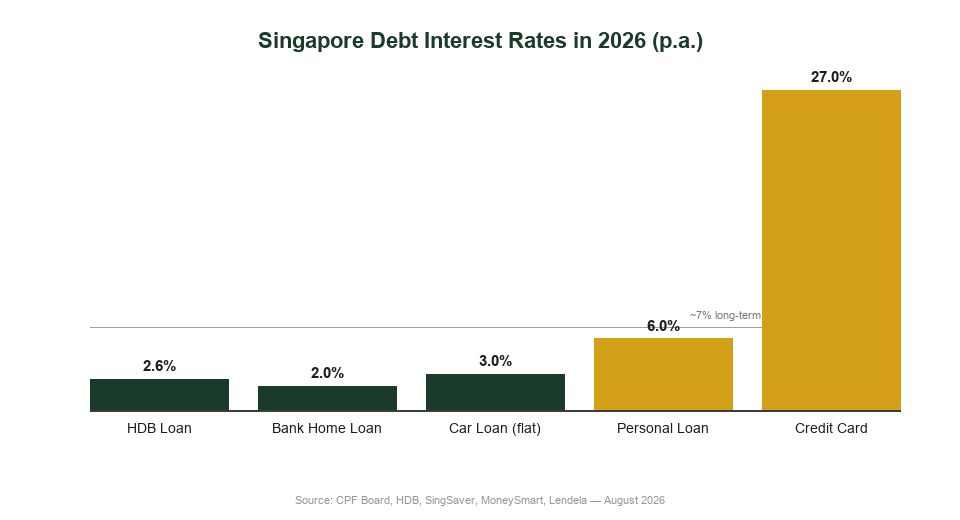
Here’s what different types of debt actually cost Singapore borrowers today. Use this table to find where your own loans sit on the ladder.
| Debt Type | Typical Rate (p.a.) | Pay Off First, or Invest Alongside? |
|---|---|---|
| Credit card | 26%–28% | Pay off first |
| Personal loan | ~6% advertised (often 12%–20%+ effective) | Pay off first |
| Car loan | 2.48%–3.5% flat (~5%–7% effective) | Usually pay off first — flat-rate loans cost more than they look |
| Bank home loan | ~1.6%–2.5% (SORA-pegged, varies) | Invest alongside |
| HDB concessionary loan | 2.6% | Invest alongside |
Source: CPF Board and HDB official interest rate pages; SingSaver, MoneySmart, and Lendela advertised rate surveys. Data as at 3 August 2026. Car and personal loan rates use flat-rate quotes, which understate the true effective interest rate (EIR) once fees and monthly reducing balances are factored in.
Notice the huge gap between “good” debt and “bad” debt in Singapore. A car loan quoted at “3% flat” doesn’t mean 3% effective — because it’s charged on the original loan amount every year, not the shrinking balance, the real cost is closer to 5%–7% once you convert it to an effective annual rate. That’s still worth weighing carefully against your expected investment return.
A Worked Example: SGD 20,000 Credit Card Debt vs Investing
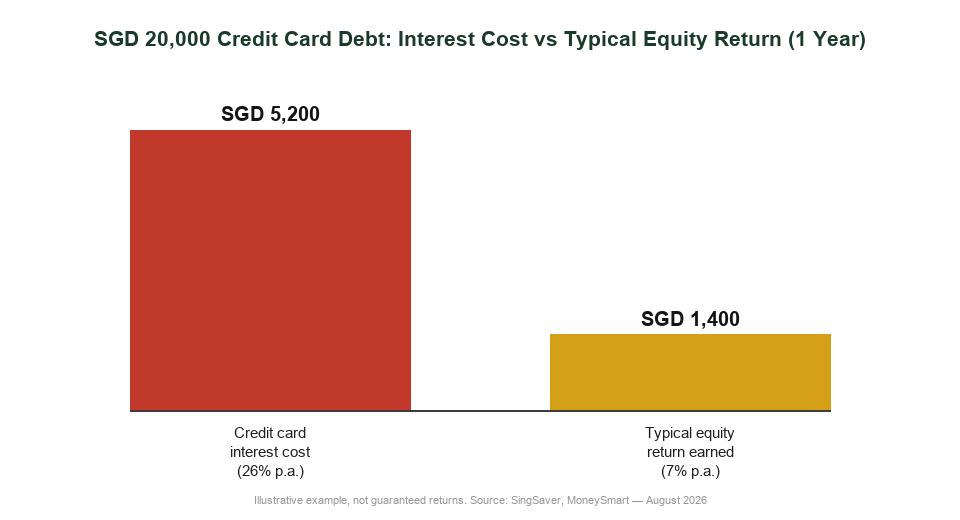
Let’s make this concrete with real numbers. Say you have SGD 20,000 in credit card debt at 26% p.a., and also SGD 20,000 you could invest. Should you invest that cash, or use it to clear the card first?
If you carry that $20,000 credit card balance for one year, you pay roughly $5,200 in interest. That’s the guaranteed cost of not paying it off. If you instead invested $20,000 in a globally diversified ETF earning a typical 7% p.a., you’d gain around $1,400 for the year — assuming a normal year, with no guarantee.
| Scenario | 1-Year Outcome (approx.) | Net Position |
|---|---|---|
| Carry the $20,000 credit card debt, invest the $20,000 cash | −$5,200 interest, +$1,400 investment gain | −$3,800 |
| Pay off the $20,000 credit card debt with the cash | $0 interest paid | +$5,200 saved |
Source: Illustrative calculation based on SingSaver and MoneySmart 2026 credit card rate surveys (26% p.a.) and a 7% p.a. long-term equity return assumption. Actual investment returns vary year to year and are never guaranteed.
The gap is nearly $9,000 in a single year. That’s the real cost of investing while carrying high-interest debt — you’re not just missing out on gains, you’re actively going backwards.
Now flip the example to an HDB loan at 2.6% p.a. On a $20,000 slice of that loan, a year’s interest is about $520. If you invested that $20,000 instead and earned 7%, you’d gain around $1,400 — roughly $880 ahead of paying down the loan faster. That’s the case for investing alongside cheap debt, though remember it can go the other way in a bad year for markets.
Where CPF Fits In
Your CPF accounts are already a “risk-free investment” you can use as a benchmark. As at Q3 2026, the CPF Ordinary Account (OA) pays a 2.5% p.a. floor rate, while the Special, MediSave and Retirement Accounts (SMRA) pay a 4% p.a. floor, guaranteed by the government through to 31 December 2026.
If you’re under 55, you also earn an extra 1% on the first $60,000 of your combined CPF balances (up to $20,000 from your OA). If you’re 55 and above, you earn an extra 2% on the first $30,000 and an extra 1% on the next $30,000. These extra tiers push effective OA returns as high as 3.5%–4.5% on smaller balances.
That 4% SMRA rate is a useful yardstick. If a debt costs more than 4% p.a., you’re paying more than what a completely safe, government-backed CPF account earns you — a strong sign to prioritise clearing it. If your debt costs less than 4%, a guaranteed CPF top-up can sometimes make more sense than early repayment, especially if you’re also building retirement savings. Read our CPF investment strategy guide for how to use the CPF Investment Scheme (CPFIS) or SA top-ups alongside your debt plan.
One caution: don’t confuse CPF’s guaranteed rate with what you’d get investing your CPF-OA savings in the stock market through CPFIS. Those returns aren’t guaranteed, and fees eat into gains — CPFIS is a separate decision from the debt-versus-investing question in this guide.
It’s also worth checking your Singapore Savings Bonds (SSB) or T-bill options as a low-risk comparison point. As at 2026, SSBs and 6-month T-bills have typically yielded somewhere in the 1.5%–2% p.a. range — lower than CPF-OA, which means CPF is usually the better “safe” home for spare cash if you’re weighing it against clearing a low-rate loan.
What Singapore Investors Should Do: A 4-Step Action Plan
Here’s how to put the interest rate ladder into practice, step by step.
Step 1: Build a starter emergency fund first. Before extra debt repayment or investing, save at least one month of expenses in a savings account. Without this buffer, an unexpected bill often gets charged straight to a credit card — undoing your progress.
Step 2: List every debt by interest rate and attack the worst first. This is the “debt avalanche” method. Pay minimums on everything, then throw every spare dollar at the debt with the highest rate — usually your credit card — until it’s cleared.
Step 3: For debt under 4%–6% p.a., consider a hybrid approach. Keep making minimum or slightly-above-minimum payments on your HDB loan or car loan, and start a small Syfe referral code regular savings plan alongside it. You don’t need to choose one extreme.
Step 4: Reassess every year. As your high-interest debt shrinks, shift more of your monthly cash flow toward investing. Use a Singapore retirement calculator to check whether your investing pace still gets you to your goals on time.
If you’re not sure how much you can safely invest given your income and goals, our guide on investing based on what you’re saving for walks through matching your timeline to the right account. And if you’re deciding which CPF, SRS, or cash account to fund first once your debt is under control, see our guide on the right order for CPF, SRS, and cash investing.
Whichever path you choose, remember the discipline matters more than the exact numbers. A Singapore investor who clears a 26% credit card in eight months, then invests consistently for the next ten years, will almost always end up ahead of someone who tried to do both at once and stayed stuck in debt.
Not financial advice. Interest rates change — always check your bank, broker, or CPF Board statement for your exact current rate before making a decision. Data verified as at 3 August 2026.
Frequently Asked Questions
Should I invest or pay off debt first in Singapore?
It depends on your debt’s interest rate. If it charges more than 6% p.a. — most credit cards and personal loans — pay it off first, since that’s a guaranteed return no investment reliably matches. If it charges less than 4% p.a., like an HDB loan, you can usually invest alongside repayment.
Is it worth paying off my HDB loan early instead of investing?
Usually not, on pure numbers. HDB’s concessionary rate is 2.6% p.a. as at 2026, while a globally diversified equity portfolio has historically returned around 7%–8% p.a. over the long run. Many Singaporeans still choose to pay down their HDB loan faster for peace of mind — that’s a valid personal choice, not just a math one.
Should I pay off my car loan before investing in ETFs?
Most Singapore car loans are quoted as a “flat rate” of around 2.5%–3.5% p.a., but because that rate applies to the full loan amount every year rather than the shrinking balance, the true effective interest rate is closer to 5%–7% p.a. That’s high enough that clearing it early is often worth prioritising over investing.
Is credit card debt always bad, even with Singapore's current CPF rates?
Yes. Singapore credit card interest rates run around 26%–28% p.a. as at 2026 — far above even the CPF Special Account’s 4% p.a. floor rate, and nowhere close to typical long-term equity returns. There is no everyday investment that reliably outpaces credit card interest, which is why clearing it comes first.
Should I use my CPF savings to pay off debt?
You generally cannot use CPF Ordinary Account savings to pay off consumer debt like credit cards or personal loans — CPF-OA funds are restricted to approved uses such as housing, insurance, and investing under CPFIS. CPF-OA can be used to service an HDB or eligible bank home loan directly, which is a common way Singaporeans manage housing debt.
What if my debt interest rate is close to my expected investment return?
When the gap is small — for example, a 5% car loan against a 7% expected equity return — the “safer” choice is usually to pay off the debt first. Investment returns are never guaranteed and can turn negative in a given year, while paying off debt is a certain result. Treat a close call as a tiebreaker in favour of debt repayment.
Ready to Start Investing Once Your Debt Is Under Control?
Open a brokerage account and start investing the moment your high-interest debt is cleared. Use our referral links for exclusive sign-up bonuses.
This article was researched with the help of AI. While we strive to keep all information accurate and up to date, there may be errors. If you notice any discrepancies, please contact us.