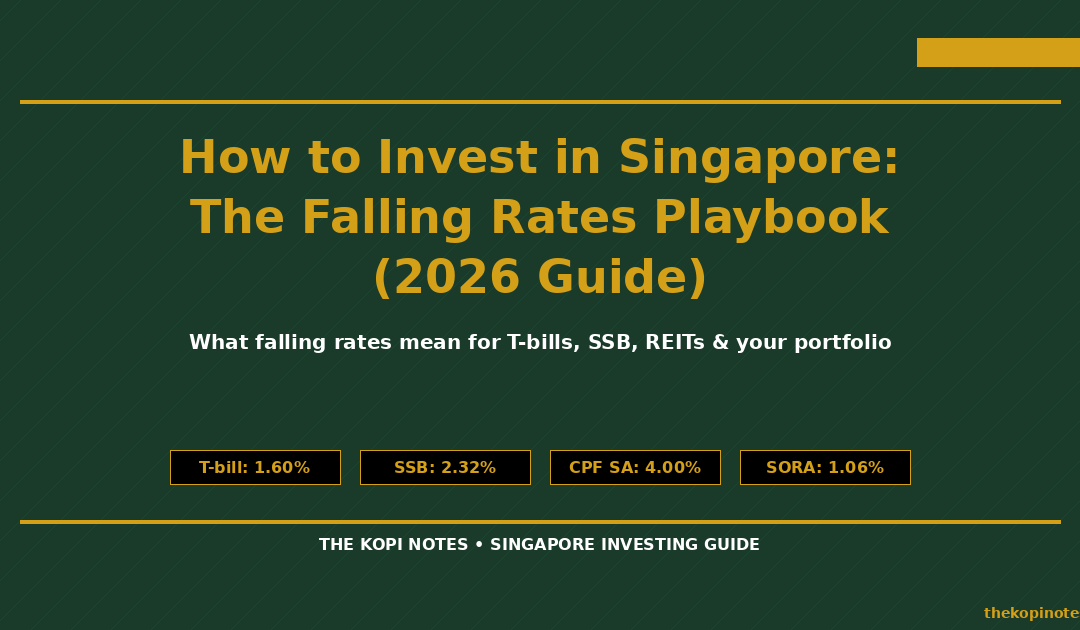
How to Invest in Singapore: The Falling Rates Playbook (2026 Guide)
What falling T-bill, SSB and SORA rates mean for your money — and what to do now
Singapore’s interest rates are falling sharply in 2026. The 6-month T-bill cut-off yield has dropped to 1.60%, SSB year-1 rates are at 1.65%, and 3-month compounded SORA is hovering near 1.06% — down from near-3% peaks in 2023. If you’re wondering how to invest in Singapore right now, the old playbook of parking cash in T-bills and SSBs for 3–4% no longer works. This guide shows you exactly what to do instead, asset class by asset class.
Not financial advice. All figures are for educational reference only. Data verified as at 17 September 2026 unless noted.
- T-bills and SSBs are paying less — lock in SSB Oct 2026 at 2.32% (10-yr avg) before rates fall further
- CPF SA/MA remains at 4.00% until Dec 2026 — use the CPFIS cap and consider topping up SA first
- S-REITs benefit from falling rates — selectively accumulate quality names as DPUs recover
Why Singapore Rates Are Falling in 2026
Singapore is a small, open economy. Our interest rates move closely with global rates — especially the US Fed Funds Rate. When the US Federal Reserve hiked rates aggressively from 2022 to 2023, Singapore’s SORA, T-bill yields and bank deposit rates all shot up. Now the cycle is reversing.
Here’s where we stand today:
| Rate / Instrument | Peak (2023) | Current (Sep 2026) | Change |
|---|---|---|---|
| 6M T-bill yield | ~3.75% | 1.60% | ▼ 2.15% |
| SSB year-1 rate | ~3.47% | 1.65% | ▼ 1.82% |
| SSB 10-year avg | ~3.22% | 2.32% | ▼ 0.90% |
| 3M SORA (compounded) | ~3.00% | 1.06% | ▼ 1.94% |
| CPF OA | 2.50% | 2.50% | — |
| CPF SA/MA | 4.00% | 4.00% | — |
Source: MAS, CPF Board. Data as at September 2026.
The driver? The US Fed began cutting rates in late 2024 and has continued into 2026. On 17 September 2026, the Fed raised rates by 25bp to 3.75–4.00% — but markets expect the cutting cycle to resume by end-2026 given slowing US growth. Singapore’s MAS, which manages monetary policy through the exchange rate rather than interest rates, cannot fully insulate us from global rate movements.
What does this mean for you? Simple: the era of earning 3–4% risk-free on T-bills and SSBs is over. You need to rethink how to invest in Singapore for a lower-rate environment.
T-Bills & Singapore Savings Bonds: What to Do Now
If you held T-bills at 3.75% in 2023, congratulations — those were exceptional returns for zero credit risk. But as each T-bill matures and you roll it over, you’re now reinvesting at 1.60%. That’s a big income cut.
T-Bills: Should You Keep Rolling?
The short answer: T-bills still make sense for emergency funds and short-term cash you need back in 6 months. The 1.60% yield beats most savings accounts (which are now offering 0.5–1.5% on flexible savings). But for any money with a 1-year+ horizon, you should look elsewhere.
One important consideration: T-bill yields are likely to keep falling through 2026 as SORA tracks global rates lower. If you’re sitting on maturing T-bills, rolling into SSBs now locks in today’s relatively higher long-term rate before it drops further. Here’s a quick guide on Singapore T-bills 2026 if you need the basics.
Singapore Savings Bonds: Lock In Now
SSBs are the smarter choice in a falling rate environment. Here’s why:
- Oct 2026 SSB pays 2.32% per year on average over 10 years — versus just 1.60% on a 6-month T-bill
- You can redeem SSBs at any time with no penalty (next calendar month)
- They’re backed by the Singapore government — zero credit risk
- If rates fall further, today’s SSB rate looks even better in hindsight
The maximum you can hold in SSBs is S$200,000 across all your SSBs. Applications open via DBS/POSB/OCBC/UOB iBanking or ATM. The October 2026 issue is currently open — you can read the full Singapore Savings Bonds guide for the application process.
CPF Strategy When Rates Are Low
CPF is the great anomaly in a low-rate world. While market rates have crashed, CPF rates are legislated floors — they don’t fall just because SORA does.
Current CPF Rates (Q3 2026)
| Account | Rate | Notes |
|---|---|---|
| Ordinary Account (OA) | 2.50% p.a. | Legislated minimum floor |
| Special Account (SA) | 4.00% p.a. | Floor extended to 31 Dec 2026 |
| MediSave Account (MA) | 4.00% p.a. | Same floor as SA |
| Retirement Account (RA) | 4.00% p.a. | For those 55 and above |
Source: CPF Board, Q3 2026. Subject to quarterly review.
In today’s environment where SSB pays 2.32% and T-bills pay 1.60%, the CPF SA’s guaranteed 4.00% is extraordinary. It’s higher than most private bonds, higher than Singapore government bonds, and higher than most global fixed income.
What This Means For Your CPF Strategy
The falling-rate playbook for CPF is straightforward:
- Maximise SA before touching OA for investments. Your SA is already earning 4.00% risk-free. Don’t rush to invest OA funds in the market when your SA floor is this attractive.
- Consider Voluntary Top-Up (VTU) to SA. You can top up your SA with cash up to the Enhanced Retirement Sum (ERS) limit. Cash top-ups to SA earn 4.00% per year and you get tax relief on up to S$8,000 per year.
- Use CPF OA for CPFIS carefully. If you invest CPF OA funds in stocks or ETFs via CPFIS, you’re giving up the guaranteed 2.50% OA rate. This makes sense only if you’re confident your investment will outperform 2.50% — which isn’t guaranteed in a volatile market.
For a deeper dive on how to structure your CPF investment strategy for 2026, including the CPFIS eligible instruments and how to avoid common mistakes, we’ve covered it in full detail.
S-REITs: The Big Winner of Falling Rates
If there’s one asset class that directly benefits when Singapore rates fall, it’s S-REITs (Singapore Real Estate Investment Trusts).
Here’s the simple logic: REITs borrow money to buy and manage properties. When borrowing costs (SORA, bank lending rates) fall, REITs spend less on interest. That means more cash flow left over for distributions — which means higher Distribution Per Unit (DPU) for you.
There’s also a valuation angle. When risk-free rates fall, investors are willing to pay more for REIT yields that previously looked average. A REIT yielding 5% looks much more attractive when the “risk-free” alternative pays 1.60% (T-bill) instead of 3.75%.
Where Do S-REITs Stand Now?
The iEdge S-REIT Index is down 8.2% year-to-date as of September 4, 2026. That might seem bad — but it’s actually an opportunity signal. REITs have been beaten down as investors rotated to T-bills and high-yield deposits in 2023–2024. Now that those rates are falling, the calculus is reversing.
Many quality S-REITs are now trading at historically attractive valuations:
- Yields in the 5–7% range (vs 1.60% T-bill)
- Price-to-NAV ratios below 1.0x for several blue chips
- DPU recovery expected as refinancing cycles lock in lower rates in 2026–2027
The key risks: a global recession would hurt occupancy rates and rental income. Property-specific risks (retail vs office vs industrial) also vary. And if rates reverse course and spike again, REIT valuations would compress. These are real risks — don’t allocate money you can’t afford to see fall 20–30% in a bad scenario.
For a curated view on which names to consider, see our guide on the best S-REITs in Singapore 2026 — or for income investors, our piece on passive income Singapore.
Equities & Bonds: What the Rate Environment Means
Singapore Equities (STI)
Falling rates are generally positive for equities. Lower borrowing costs reduce debt servicing for companies, which can expand profit margins. The Straits Times Index (STI) has historically performed well in rate-cutting cycles.
That said, the relationship isn’t mechanical. If rates are falling because the economy is slowing badly (a recession scenario), corporate earnings could fall too, dragging stocks down despite lower rates. The 2026 environment is nuanced: global growth is moderating but not crashing, making a soft-landing scenario the base case.
For Singapore investors, the STI’s heavy weighting toward banks, REITs and industrials means the index has mixed sensitivity to rates. Banks (DBS, OCBC, UOB) typically see net interest margins compress when rates fall — which can hurt profitability in the near term.
Singapore Government Bonds and Corporate Bonds
Bond prices move inversely to interest rates. When rates fall, existing bonds become more valuable — because they pay higher fixed coupons than newly issued bonds.
If you hold Singapore Government Securities (SGS) bonds with longer maturities, you’ll see capital appreciation as rates fall. This is the “bond rally” that bond investors have been waiting for since 2022. For retail investors, the simplest bond exposure comes through:
- Singapore Savings Bonds (SSB) — no price risk, flexible redemption
- Bond ETFs (e.g. the ABF Singapore Bond Index Fund) — for those who want secondary market bond exposure
- Endowus, Syfe or FSMOne’s fixed income portfolios — professionally managed bond allocation
The Falling Rates Portfolio Playbook
Here’s how to think about your portfolio given today’s rate environment. The right allocation depends on your age, risk tolerance and goals — this is a framework, not a one-size-fits-all prescription.
| Asset Class | Rate Impact | Playbook Action |
|---|---|---|
| CPF SA/MA | 4.00% (protected) | Maximise voluntary top-ups; delay investment until SA capped |
| Singapore Savings Bonds | 2.32% (10-yr avg) | Lock in now before rates fall further; great for emergency fund |
| T-bills | 1.60% (6M) | Hold only for very short-term cash needs (under 6 months) |
| S-REITs | Rising (beneficiary) | Selectively accumulate quality REITs at today’s attractive yields |
| STI / Equities | Positive (broadly) | Stay invested via monthly DCA; non-bank sectors benefit most |
| Singapore bonds | Capital gain potential | Consider bond ETFs or Endowus fixed income for diversified exposure |
Source: TKN Research, September 2026. Not financial advice.
One more thing: don’t forget to factor in your timeline. If you’re saving for a goal in 1–2 years, SSBs are your best friend. If you’re investing for retirement 20+ years away, the falling rate cycle matters less — compound growth over time will dwarf short-term rate movements. Use our Singapore retirement calculator to check if you’re on track given today’s rate assumptions.
Where to Invest in Singapore in 2026
Once you’ve decided on your asset allocation, you need the right platform. Here’s a quick summary of the main options and what they’re best for:
| Platform | Best For | Min. Start |
|---|---|---|
| IBKR (referral: jianxiong368) | DIY ETF investing, US stocks, low commissions | No minimum |
| Syfe (code: SRPRFFFCD) | Managed portfolios, REIT+, Core portfolios | S$1 |
| Endowus (code: 2V343) | CPF/SRS investing, fund-based portfolios | S$1,000 |
| FSMOne (code: P0544985) | Unit trusts, bonds, ETFs with RSP plans | S$100/RSP |
| DBS/POSB, OCBC, UOB | SSBs, T-bills, bank FDs, simple SG stocks | Varies |
For most beginner Singapore investors, the path of least resistance is: max out CPF SA top-up → apply for SSBs monthly → build a simple IBKR or Syfe portfolio with broad-market ETFs. Don’t overcomplicate it. Consistent monthly investing in a diversified portfolio beats market-timing attempts almost every time.
If you want to explore DCA vs lump sum investing in more depth, we’ve compared both approaches in our earlier guide on DCA vs Lump Sum investing in Singapore.
Frequently Asked Questions
Is it still worth investing in T-bills in Singapore in 2026?
What is the best Singapore Savings Bond rate in 2026?
Should I top up my CPF SA now that market rates are low?
Are S-REITs a good investment when interest rates are falling?
What is the CPF SA interest rate in 2026?
How much should I keep in T-bills vs invest in the stock market?
Which broker is best for investing in Singapore stocks in 2026?
Not financial advice. Always do your own research and consult a licensed financial adviser before making investment decisions. Rates and data verified as at 17 September 2026.
This article was researched with the help of AI. While we strive to keep all information accurate and up to date, there may be errors. If you notice any discrepancies, please contact us.