VWRA Magnificent Seven Concentration Risk: How Much of Your “Global” ETF Is Really US Tech? (2026 Guide)
A clear-eyed look at how concentrated the Vanguard FTSE All-World ETF has become, and what it means for Singapore investors who think they are “diversified.”
As at Q3 2026, the “Magnificent Seven” mega-cap tech stocks (Nvidia, Apple, Microsoft, Alphabet, Amazon, Meta and Tesla) make up roughly one-fifth of VWRA, the Vanguard FTSE All-World UCITS ETF that many Singapore investors treat as their globally diversified “core” holding. Because VWRA is market-cap weighted, every rally in these seven names pulls the whole fund’s fortunes closer to Silicon Valley’s — even though it holds nearly 3,780 stocks across roughly 49 countries.
Not financial advice. All figures are for educational reference only. Data as at Q3 2026 unless noted, sourced from StockAnalysis.com, Vanguard fund factsheets and TradersUnion — figures move daily and vary slightly between data providers and share classes.
Table of Contents
Contents — Click to expand
- The Problem: “Global” Doesn’t Mean “Diversified”
- How Much of VWRA Is the Magnificent Seven?
- Why Market-Cap Weighting Makes This Worse Over Time
- What This Means for a Singapore Investor’s Portfolio
- VWRA vs an Equal-Weight or Ex-US Alternative
- What Singapore Investors Should Actually Do About It
- Frequently Asked Questions
The Problem: “Global” Doesn’t Mean “Diversified”
VWRA (Vanguard FTSE All-World UCITS ETF, USD Accumulating) is the default “one-fund portfolio” recommended across Singapore’s investing forums and by robo-advisors building DIY satellite sleeves. It tracks the FTSE All-World Index, holding roughly 3,780 large- and mid-cap stocks across about 49 developed and emerging markets. On paper, that is about as diversified as a single equity fund gets.
But the FTSE All-World Index is market-cap weighted — bigger companies get a bigger slice. And in 2026, a handful of US mega-cap technology companies have grown so large that they now dominate the index’s return and risk profile. A Singapore investor who buys VWRA believing they are spreading risk across thousands of companies globally is, in practice, taking a large and growing bet on seven US tech stocks and the broader US market. That is not a reason to avoid VWRA — it is a reason to understand exactly what you own.
How Much of VWRA Is the Magnificent Seven?
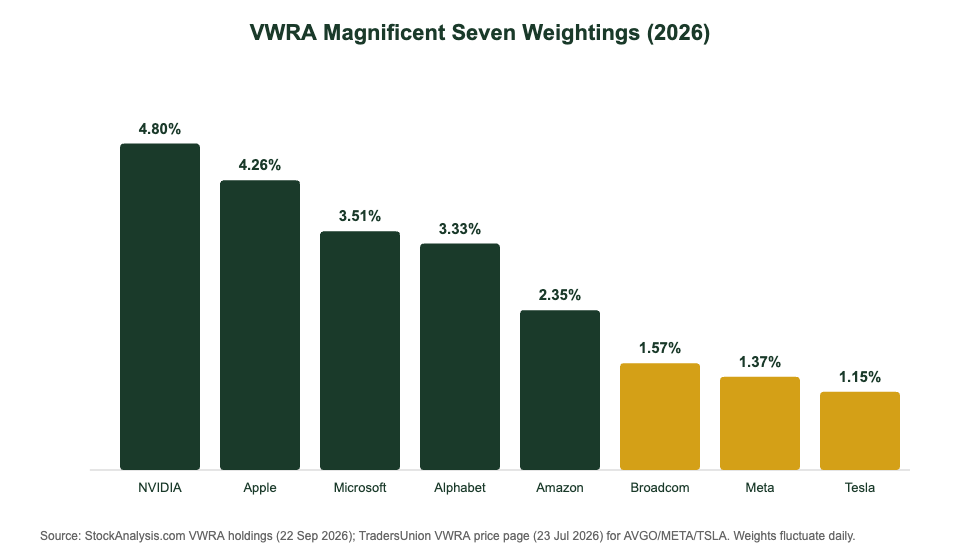
Based on VWRA’s holdings data as at Q3 2026, the seven “Magnificent Seven” stocks — Nvidia, Apple, Microsoft, Alphabet, Amazon, Meta and Tesla — together account for roughly 20–21% of the entire fund, out of nearly 3,780 total holdings. For context, that means seven companies (0.2% of the names in the fund) represent about a fifth of the money.
| Company | Ticker | Approx. Weight in VWRA |
|---|---|---|
| Nvidia | NVDA | 4.80% |
| Apple | AAPL | 4.26% |
| Microsoft | MSFT | 3.51% |
| Alphabet | GOOGL | 3.33% |
| Amazon | AMZN | 2.35% |
| Broadcom | AVGO | ~1.57% |
| Meta Platforms | META | ~1.37% |
| Tesla | TSLA | ~1.15% |
Source: StockAnalysis.com VWRA holdings (22 Sep 2026) for NVDA/AAPL/MSFT/GOOGL/AMZN; TradersUnion VWRA price page (23 Jul 2026) for AVGO/META/TSLA. Weights are approximate and change daily with share prices and quarterly index reviews. Broadcom is sometimes included in an informal “Magnificent Eight” alongside the traditional seven.
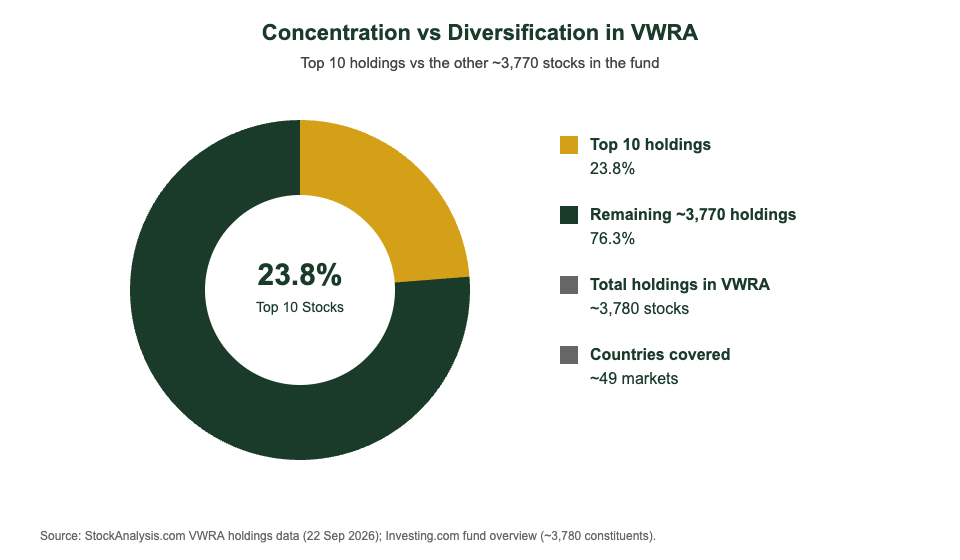
Zooming out further: VWRA’s top 10 holdings alone account for about 23.75% of the entire fund as at 22 September 2026 (StockAnalysis.com), out of roughly 3,780 constituents. That means the other 3,770-odd companies — spanning Japan, the UK, China, India, and dozens of other markets — share the remaining three-quarters of the fund between them. For a Singapore investor holding SGD 50,000 in VWRA, that works out to roughly SGD 11,875 sitting in just ten stocks, most of them US tech names.
Why Market-Cap Weighting Makes This Worse Over Time
VWRA isn’t “broken” — it is doing exactly what a market-cap-weighted global index is designed to do: reflect the real-world size of companies. The issue is a feedback loop. As Nvidia, Apple and Microsoft’s share prices rise faster than the rest of the market, their weight in the FTSE All-World Index automatically rises too, because the index is rebalanced to track market value, not an equal split. More money flowing into passive global funds like VWRA then buys proportionally more of the stocks that are already the largest — reinforcing the concentration. This is sometimes called “passive flows chasing momentum,” and it is one reason Vanguard and FTSE Russell periodically review index methodology and caps, though FTSE All-World currently has no hard single-stock cap.
Total net assets tracking the FTSE All-World Index across all Vanguard share classes were about USD 65.9 billion as at the April 2026 factsheet (Vanguard), and VWRA’s own expense ratio was cut to 0.14% p.a. in 2026 — cheap, but cost has nothing to do with concentration risk.
What This Means for a Singapore Investor’s Portfolio
Most Singapore investors hold VWRA specifically because they want to avoid stock-picking and single-country risk — many are coming from a STI-heavy or S-REIT-heavy local portfolio and want genuine overseas diversification. The nuance that often gets missed: VWRA’s roughly 60%+ allocation to the US market (itself concentrated in mega-cap tech) means a Singapore investor who holds VWRA alongside, say, individual US tech shares, a Nasdaq-tracking ETF, or even CSPX (S&P 500) is likely double-counting their Nvidia, Apple and Microsoft exposure without realising it.
This is not unique to VWRA — it is a characteristic of every global-cap-weighted index fund in 2026, including CSPX and the S&P 500 itself, where the top 10 holdings now represent an even larger share of the index than within VWRA, because VWRA at least dilutes US mega-caps with Japan, UK, emerging markets and small-and-mid-cap exposure. Holding VWRA alone is still meaningfully more diversified than holding CSPX alone — the concentration point matters most for investors layering multiple US-heavy funds on top of each other.
VWRA vs an Equal-Weight or Ex-US Alternative
Investors uncomfortable with mega-cap concentration sometimes look at equal-weight US funds or ex-US global funds to dilute the Magnificent Seven’s influence. Here is how the main approaches compare for a Singapore investor:
| Approach | Top 7 Weight | Pros | Cons |
|---|---|---|---|
| VWRA (as-is) | ~20-21% | One fund, ~3,780 holdings, 0.14% TER, no rebalancing needed | Concentration rises automatically as mega-caps grow |
| VWRA + ex-US tilt (e.g. world ex-US fund) | Lower, diluted | Reduces US/tech weight without stock-picking | Two funds to manage and rebalance; extra trading cost |
| Equal-weight global/US fund | Far lower | Directly caps single-stock influence | Fewer liquid LSE-listed options, higher TER, historically more volatile in momentum-driven years |
What Singapore Investors Should Actually Do About It
Three practical takeaways for a Singapore-based VWRA holder in 2026:
1. Check for overlap first. Before buying a second US-heavy fund (Nasdaq ETF, CSPX, individual US tech shares) alongside VWRA, work out how much extra Nvidia/Apple/Microsoft exposure you are really adding — you may already own more than you think.
2. Accept that some concentration is the cost of market-cap investing. Trying to “fix” this by stock-picking against the index has historically underperformed simply holding the index over long periods — concentration risk is a known trade-off of passive investing, not a flaw unique to VWRA.
3. Diversify the things VWRA doesn’t fix — not the thing it already does well. VWRA already diversifies you across ~49 countries and thousands of companies. If concentration genuinely worries you, consider pairing it with asset classes outside equities altogether, such as Singapore T-bills or S-REITs for income, rather than adding another equity fund that overlaps with its top holdings. Use our retirement calculator to see how much of your long-term plan actually depends on seven stocks’ performance.
For more on how VWRA’s underlying holdings break down by country and sector, see our VWRA Holdings Breakdown, and for how this concentration has translated into historical returns, read VWRA Historical Returns: CAGR Since 2019. If currency exposure from this US-heavy tilt concerns you, our VWRA Currency Risk guide covers the USD angle in depth. You can open a brokerage account to start investing via our Syfe referral code, and if you want a structured approach to balancing CPF, SRS and equity holdings, see our CPF investment strategy guide.
Not financial advice. Weights and figures in this article are approximate, sourced from third-party data providers as dated in each table, and will have changed by the time you read this — always check live holdings data (e.g. via your broker or Vanguard’s factsheet) before making investment decisions. VWRA remains, by most measures, one of the lowest-cost, most broadly diversified single-fund options available to Singapore investors; concentration risk is a factor to understand, not a reason to avoid it.
Frequently Asked Questions
What percentage of VWRA is invested in the Magnificent Seven?
As at Q3 2026, the Magnificent Seven stocks (Nvidia, Apple, Microsoft, Alphabet, Amazon, Meta and Tesla) together make up roughly 20-21% of VWRA, based on holdings data from StockAnalysis.com and TradersUnion. This figure moves daily with share prices and is updated at each quarterly index review, so always check live data before relying on an exact number.
Is VWRA too concentrated in US tech stocks?
VWRA is more concentrated than many investors assume, but it is still far more diversified than a US-only fund like CSPX, because it spreads the remaining ~80% of assets across roughly 49 countries and thousands of smaller companies. Whether 20% in seven stocks is “too much” depends on what else is in your portfolio — the risk is mainly for investors who also hold separate US tech or S&P 500 positions on top of VWRA.
Does VWRA's concentration change how diversified my portfolio really is?
Yes — if you hold VWRA plus a separate Nasdaq, S&P 500, or individual US tech stock position, your effective exposure to Nvidia, Apple and Microsoft is higher than it looks at a glance, because those names already sit inside VWRA. It’s worth tallying your total exposure across all funds before assuming each holding adds fresh diversification.
Can I buy VWRA using my CPF or SRS funds?
VWRA is not CPFIS-approved, as it is listed on the London Stock Exchange rather than SGX, so it cannot be bought with CPF Ordinary Account or Special Account funds. It can be bought using SRS funds if your brokerage supports SRS-funded trades on foreign exchanges — check with brokers like Interactive Brokers, Saxo or Syfe for current SRS eligibility.
Should I add an ex-US or equal-weight ETF to reduce concentration risk?
This depends on your risk tolerance and conviction. Adding a world-ex-US or equal-weight fund will reduce Magnificent Seven exposure, but introduces extra complexity, trading costs, and historically has underperformed cap-weighted indices during momentum-driven years like much of 2023-2026. Many investors instead choose to simply understand the concentration and accept it as part of holding a market-cap index.
How often does VWRA's Magnificent Seven weight change?
VWRA’s constituent weights shift daily with share price moves, but formal additions, removals and weight resets happen at FTSE Russell’s quarterly index reviews (typically March, June, September and December). A stock’s weight can rise significantly between reviews purely from price appreciation, without any index rebalancing event.
Know What You Own Before You Add Another Fund
Check your total portfolio overlap before stacking more US tech exposure on top of VWRA.
This article was researched with the help of AI. While we strive to keep all information accurate and up to date, there may be errors. If you notice any discrepancies, please contact us.