VWRA Currency Risk: Is USD Denomination a Problem for Singapore Investors? (2026 Guide)
Unpacking VWRA’s unhedged currency exposure, what the USD “price” actually means, and how much a weaker or stronger SGD can move your returns.
VWRA is quoted in USD on the London Stock Exchange, but that is not the same as being a “USD investment.” Its ~3,821 underlying holdings are priced in dozens of currencies — about 62% US dollar exposure via American stocks, the rest in yen, sterling, euro and more. For Singapore investors, the real currency risk sits in the SGD-to-foreign-currency conversion at the time you buy and sell, not in VWRA’s USD ticker.
Not financial advice. All figures are for educational reference only. Data verified as at 27 October 2026 unless otherwise noted.
Table of Contents
Contents — Click to expand
- Understanding Currency Risk in VWRA
- The Three Layers of Currency Exposure
- VWRA’s Real Currency Exposure (Not Just USD)
- Worked SGD Example: What a Moving Exchange Rate Does to Your Money
- Historical USD/SGD Volatility and Long-Term Impact
- Should You Buy a Hedged Alternative Instead?
- Who Should Actually Worry About This?
- Frequently Asked Questions
Understanding Currency Risk in VWRA
The Vanguard FTSE All-World UCITS ETF (USD) Accumulating — ticker VWRA on the London Stock Exchange — tracks roughly 3,821 stocks across developed and emerging markets, with total fund assets of USD 87.3 billion as at 30 September 2026. The “USD” in its name is simply the currency the fund’s net asset value (NAV) is calculated and quoted in on the LSE. It is not a statement about where the underlying money actually sits.
That distinction matters enormously for a Singapore investor. When you buy VWRA through a broker, SGD is converted into USD (or sometimes GBP, depending on the trading currency your broker offers) to settle the trade. Inside the fund, Vanguard then holds stocks denominated in whatever currency each company trades in — US dollars for Apple and Microsoft, yen for Toyota, euros for LVMH, sterling for AstraZeneca, and so on. There are two separate currency conversions happening, and only one of them is visible on your trading screen.
The Three Layers of Currency Exposure
Most explanations of “VWRA currency risk” conflate three distinct layers. Separating them is the key to understanding what actually moves your returns:
Layer 1 — Your trading currency (SGD → USD/GBP). This is the conversion your broker performs when you fund a trade. If you hold SGD and buy VWRA quoted in USD, you are exposed to the SGD/USD rate at the moment of purchase and, eventually, at the moment of sale.
Layer 2 — The fund’s quoting currency (USD NAV). VWRA’s unit price is published in USD. If the broker lets you trade it in GBP (its LSE listing currency) instead, that simply adds a GBP/USD cross-rate on top — it does not change what the fund actually owns.
Layer 3 — The underlying holdings’ currencies (USD, JPY, GBP, EUR, and dozens more). This is the layer investors most often overlook. VWRA is unhedged and physically replicated using optimised sampling — Vanguard does not use currency forwards or swaps to neutralise the yen, euro or sterling exposure embedded in the stocks it holds. As the US dollar strengthens or weakens against the yen or euro, the USD value of VWRA’s non-US holdings moves too, before you even get to the SGD conversion.
In practice, Layer 3 is diversified across dozens of currencies and tends to average out over long holding periods — a weaker yen hurting Japanese holdings can be partly offset by a stronger euro helping European ones. Layer 1 (your own SGD conversion) is the layer with the most direct, immediate effect on what you actually see in your brokerage statement, which is why the rest of this guide focuses there.
VWRA’s Real Currency Exposure (Not Just USD)
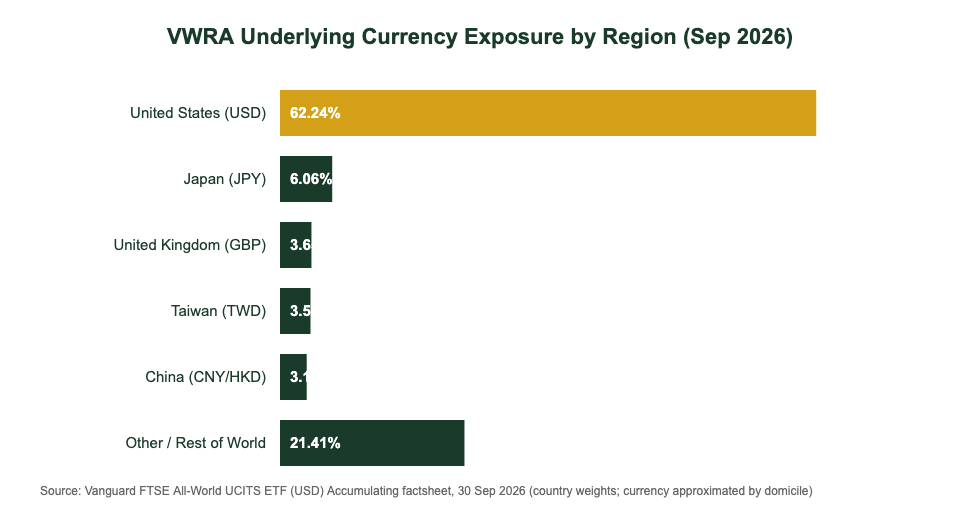
Using Vanguard’s country-weight data as at 30 September 2026, the United States accounts for about 62.24% of VWRA by value — meaning roughly 62 cents of every dollar invested sits in USD-denominated stocks. The remainder is spread across Japan (6.06%), the UK, Taiwan, China and dozens of smaller markets, each contributing its own currency exposure.
| Metric | Detail |
|---|---|
| Fund | Vanguard FTSE All-World UCITS ETF (USD) Accumulating |
| Ticker (LSE) | VWRA |
| Quoting Currency | USD (NAV); also tradable in GBP on LSE |
| Currency Hedging | None — fully unhedged, physical replication (optimised sampling) |
| US Dollar Exposure (via holdings) | ~62.24% (as at 30 Sep 2026) |
| Non-USD Exposure | ~37.76% across JPY, GBP, EUR, TWD, CNY/HKD and ~40 other currencies |
| Total Fund Assets | USD 87.3 billion (30 Sep 2026) |
| TER | 0.14% p.a. |
Source: Vanguard FTSE All-World UCITS ETF (USD) Accumulating factsheet, 30 September 2026.
The practical takeaway: a Singapore investor in VWRA is never “just” exposed to USD. You are exposed to a basket of currencies weighted by global market capitalisation, and the USD happens to be the largest single slice because the US is the largest slice of global equity markets — not because Vanguard chose to concentrate currency risk there. For a deeper look at how the US weight interacts with sector concentration, see our VWRA holdings breakdown.
Worked SGD Example: What a Moving Exchange Rate Does to Your Money
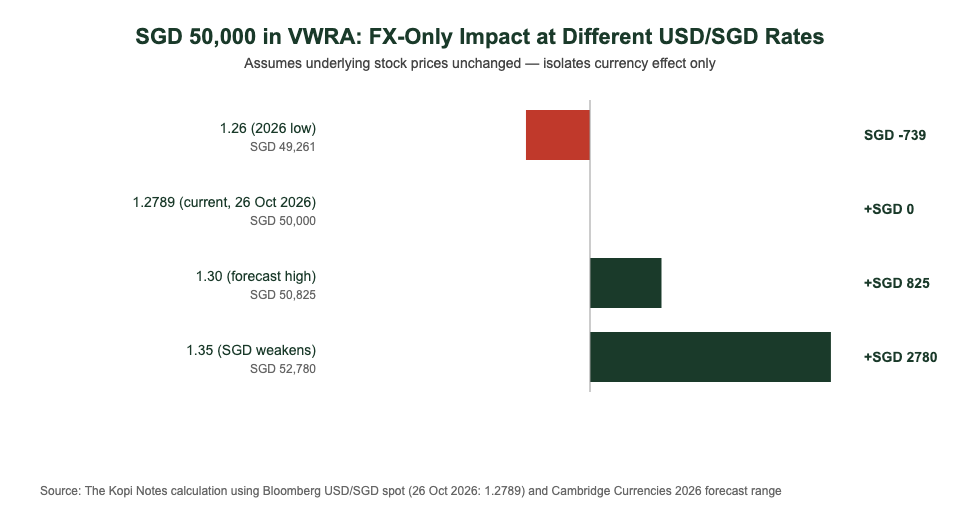
To isolate the FX effect from stock-price movements, assume a Singapore investor puts SGD 50,000 into VWRA today and the underlying portfolio value in USD stays completely flat — only the USD/SGD rate changes. As at 26 October 2026, USD/SGD traded at approximately 1.2789, meaning SGD 50,000 converts to roughly USD 39,096 at the point of purchase.
| USD/SGD Rate | Scenario | SGD Value of Position | FX-Only Gain/Loss |
|---|---|---|---|
| 1.2609 | 2026 low (SGD strengthens) | SGD 49,286 | -SGD 714 |
| 1.2789 | Current rate (26 Oct 2026) | SGD 50,000 | SGD 0 (baseline) |
| 1.3000 | Forecast high (Cambridge Currencies) | SGD 50,825 | +SGD 825 |
| 1.3500 | SGD weakens further | SGD 52,780 | +SGD 2,780 |
Source: The Kopi Notes calculation using Bloomberg USD/SGD spot (26 Oct 2026: 1.2789), Macrotrends 2026 range (1.2609–1.30+) and Cambridge Currencies 2026 forecast. Illustrative only — assumes zero change in underlying stock prices.
Across the plausible 2026 trading range (1.26 to 1.35), a SGD 50,000 position would swing by roughly SGD 700 to SGD 2,800 from currency movement alone — a band of about 1.4% to 5.6% of the position’s value. That is a real number, but it is smaller than most investors assume, and it is dwarfed over any multi-year holding period by the actual performance of the underlying 3,821 companies VWRA holds. For context on how VWRA’s low 0.14% expense ratio compares against this FX noise, the annual fee is a fixed, predictable drag — currency swings are not.
Historical USD/SGD Volatility and Long-Term Impact
USD/SGD has traded in a relatively narrow band for a developed-market currency pair. Over the course of 2026, the rate has ranged from a low of about 1.2609 to the mid-1.30s, averaging roughly 1.2788 for the year — only about 1.3% weaker than the equivalent period in 2025 (1.2954). MAS’s managed float policy for the Singapore dollar, which tracks a trade-weighted basket (the SGD Nominal Effective Exchange Rate, or S$NEER) rather than pegging to any single currency, is a key reason SGD volatility against the USD tends to be more contained than, say, emerging-market currency pairs.
Over a 10- or 20-year holding period — which is the realistic horizon for most VWRA investors using it as a core retirement holding — currency swings of a few percentage points in either direction are typically swamped by compounded equity returns. The bigger practical risk is not the long-run average, but sequencing: converting a large lump sum into VWRA right before a sharp SGD strengthening episode, or needing to cash out right after one. Dollar-cost averaging into VWRA over time — rather than investing a single lump sum — reduces this timing risk in the same way it reduces equity-market timing risk.
Should You Buy a Hedged Alternative Instead?
A currency-hedged global equity ETF would, in theory, remove Layer 3 (the underlying holdings’ currency exposure) by using forward contracts to lock in exchange rates. In practice, there is no SGD-hedged share class of the FTSE All-World index available to retail Singapore investors on the LSE, and hedging introduces its own costs — forward contract rollover fees, higher TER, and tracking error against the unhedged version. For a globally diversified core holding like VWRA, most Singapore-based financial educators (including this site) do not recommend paying for a hedge: the currency diversification embedded in a 3,821-stock global portfolio already provides a natural offsetting effect that a single-currency hedge would not meaningfully improve, while the hedge itself adds a guaranteed cost.
The more relevant decision for most investors is not hedged-vs-unhedged, but how much to allocate to a globally diversified fund like VWRA versus Singapore-dollar-denominated assets that carry no FX risk at all — such as CPF savings or SGD-denominated bonds. Holding both reduces the portfolio-level impact of any single currency’s movement.
Who Should Actually Worry About This?
Currency risk in VWRA matters most to a narrow set of investors: those planning a large lump-sum entry or exit at a specific, non-negotiable date (e.g. funding a house deposit or your child’s university fees within the next 1–2 years), and those investing a very large portion of near-term liquid net worth in a single tranche. For these investors, timing the SGD conversion — or spreading it across several tranches — is worth real attention.
For the much larger group using VWRA as a long-term, dollar-cost-averaged core equity holding inside a retirement or FIRE plan, currency movements are background noise relative to the compounding effect of owning a piece of nearly 4,000 global businesses. Our Singapore retirement calculator can help model how FX assumptions (or ignoring them) change your long-run retirement number.
If you are using a broker like Syfe to dollar-cost average into VWRA monthly, you are already naturally averaging out short-term currency fluctuations in the same way you average out market-price fluctuations — which is one of the strongest practical arguments against trying to “time” the SGD/USD rate at all.
Frequently Asked Questions
Is VWRA's currency risk the same as holding US dollars?
No. VWRA is quoted in USD on the London Stock Exchange, but its underlying holdings span dozens of currencies. As at 30 September 2026, only about 62.24% of the fund’s value sits in USD-denominated US stocks — the rest is in yen, sterling, euro and other currencies. Holding VWRA is closer to holding a diversified currency basket than holding pure USD.
Does VWRA hedge its currency exposure?
No. VWRA is fully unhedged and uses physical replication with optimised sampling, per Vanguard’s own factsheet. It does not use currency forwards or swaps to offset movements in the yen, euro, sterling or other currencies its holdings are denominated in.
How much does a weaker SGD actually cost a VWRA investor?
Based on 2026’s trading range of roughly USD/SGD 1.26 to 1.35, a SGD 50,000 position in VWRA would see a currency-only swing of approximately SGD 700 to SGD 2,800 — about 1.4% to 5.6% of the position’s value — assuming the underlying stock prices stayed flat. In practice, actual portfolio returns are driven far more by the performance of the ~3,821 underlying companies than by this FX band.
Should Singapore investors buy a currency-hedged version of VWRA instead?
There is no SGD-hedged share class of the FTSE All-World index readily available to retail Singapore investors on the LSE. Even where hedged global equity ETFs exist, the hedging mechanism adds cost and tracking error. For a globally diversified holding like VWRA, the natural currency diversification across ~40 currencies already reduces single-currency risk, making a dedicated hedge largely unnecessary for most long-term investors.
Does dollar-cost averaging reduce VWRA's currency risk?
Yes. Investing a fixed SGD amount into VWRA on a regular schedule (e.g. monthly) means you convert SGD to USD at many different exchange rates over time, rather than a single rate on one day. This averages out short-term currency fluctuations in the same way it averages out stock-price fluctuations, reducing the risk of a poorly timed lump-sum conversion.
Can I buy VWRA using CPF or SRS funds?
VWRA, as an LSE-listed UCITS ETF, is not on the CPF Investment Scheme’s approved list and cannot be bought with CPF Ordinary Account funds. It can be bought with SRS funds through brokers that support SRS-funded international trades, such as Endowus or FSMOne, subject to each platform’s product list.
Ready to Start Investing in VWRA?
Dollar-cost averaging naturally smooths out the currency swings discussed above. Open a brokerage account and start building your global equity position today.
This article was researched with the help of AI. While we strive to keep all information accurate and up to date, there may be errors. If you notice any discrepancies, please contact us.