Singapore’s private home prices rose at the fastest pace in nearly two years in Q3 2026, fresh URA data shows — yet condo rental yields sit below 3% while S-REITs pay more than 5%. For Singapore retail investors deciding where their next dollar goes, the numbers tell a clear story.
This article is for information and educational purposes only. It does not constitute financial advice. Past performance of any asset class is not indicative of future results. Consult a licensed financial adviser before making investment decisions.
Q3 2026 Home Prices Hit Fastest Growth in Two Years
Singapore’s private residential property market re-accelerated sharply in the third quarter of 2026. The Urban Redevelopment Authority’s (URA) flash estimates, released on 23 October 2026, showed the Private Residential Property Index (PPI) rising 1.4% quarter-on-quarter — the steepest single-quarter gain since approximately Q4 2024 and a significant step up from the 0.5% QoQ gain seen in Q2 2026.
On a year-on-year basis, the overall index stands at 222.5, representing a 3.4% increase from Q3 2025.
Breaking it down by property type, landed homes led the charge with a 2.8% QoQ rise, while non-landed properties — the condominiums and apartments that most retail buyers target — posted a more modest 0.9% gain.
The regional picture reveals a tale of two markets:
| Segment | Q3 2026 Price Change (QoQ) |
|---|---|
| Overall PPI | +1.4% |
| Landed | +2.8% |
| Non-landed (overall) | +0.9% |
| Outside Central Region (OCR) | +2.2% |
| Rest of Central Region (RCR) | +0.2% |
| Core Central Region (CCR) | -0.1% |
Source: URA Flash Estimates, 23 October 2026
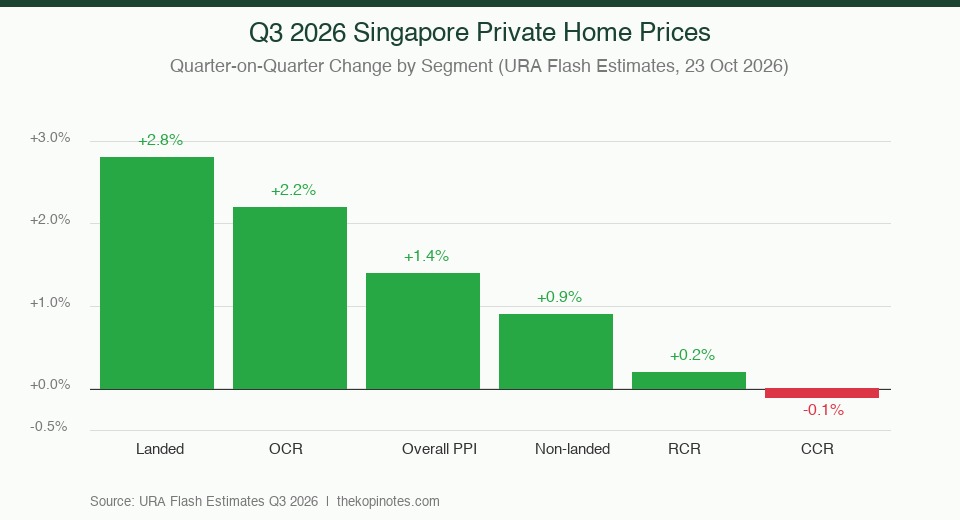
The OCR — encompassing mass-market areas like Tengah, Woodlands, Jurong, and Tampines — is driving the current upcycle. This is consistent with demand from HDB upgraders and first-time private buyers who are price-sensitive but eager to enter the market.
Meanwhile, the CCR (prime districts including Orchard, Marina Bay, Sentosa) edged slightly lower, reflecting continued caution among luxury buyers, particularly given the high Additional Buyer’s Stamp Duty (ABSD) rates that have chilled foreign interest since 2023.
Transactions fell sharply to 4,296 units in Q3 2026, down roughly 30% from the 6,148 units transacted in Q2 2026. This volume dip during a quarter of rising prices suggests supply constraints and selective buying — quality launches are moving while the overall volume normalises post the Q2 launch surge.
ABSD Makes Your Second Property Very Expensive
Before you get excited by those price charts and start eyeing your second property, the ABSD math is sobering.
Current ABSD rates (effective since 27 April 2023, unchanged as at October 2026):
For Singapore Citizens (SC):
- 1st property: 0% ABSD
- 2nd property: 20% ABSD
- 3rd and subsequent: 30% ABSD
For Singapore Permanent Residents (SPR):
- 1st property: 5% ABSD
- 2nd property: 30% ABSD
- 3rd and subsequent: 35% ABSD
For foreigners: 60% ABSD on all purchases.
On a S$1.5 million OCR condo — a typical mass-market new launch today — a Singapore Citizen buying their second property pays S$300,000 in ABSD alone, before factoring in legal fees, BSD, renovation, and furniture. That S$300,000 is gone from day one and must be recovered purely through price appreciation or rental income.
A Singapore PR buying their first condo pays S$75,000 in ABSD on that same property. That’s a significant hurdle rate built into every investment property purchase.
What Singapore Landlords Are Actually Earning
The optimistic pitch for buy-to-let always sounds compelling: “collect rent while the property appreciates.” But what are the actual rental yields on Singapore condos today?
According to DollarsAndSense (2026 analysis of URA caveats and rental data), the median gross rental yield for non-landed private residential properties stands at:
- Islandwide median: 2.88%
- CCR: 2.60%
- RCR: 2.93%
- OCR: 3.07%
The OCR looks marginally better on yield, but even 3.07% gross is before deducting property tax (currently 12% on annual value for investment properties), maintenance fees (easily S$300–600/month), agent commissions (typically one month’s rent per new tenancy), and periods of vacancy.
A back-of-envelope calculation for a District 14 one-bedder at current market rates might show a net rental yield of around 2.6–3.0% — assuming no void periods and no major repairs.
On top of all this, if you’re financing the purchase, the financing cost matters enormously. SORA-pegged floating rates sit around 1.12% as of October 2026, while fixed-rate packages run approximately 1.40–1.50% for a 2-year lock-in. That looks manageable — but these are all-in rates that banks quote for leveraged investments, and rising rates in any future cycle could compress net yields further.
The URA’s rental index for non-landed private residential properties rose 1.2% QoQ in Q3 2026, extending a recovery trend (up 1.9% YoY). Rents are stabilising after the post-pandemic surge, meaning landlords cannot expect significant rent increases to boost their yield story over the medium term.
S-REITs vs Property: The Yield Comparison
Now let’s stack property against S-REITs and other passive investment options available to Singapore investors right now.
| Investment | Gross Yield / Return | Entry Cost | Liquidity |
|---|---|---|---|
| Singapore condo (OCR, buy-to-let) | ~3.07% gross / ~2.5–2.8% net | S$1M+ (with 20–25% down) | Low (months to sell) |
| S-REIT (average basket) | ~5.6% | From S$200 (any lot) | High (T+2 settlement) |
| CPF Ordinary Account | 2.5% | Existing CPF savings | Very restricted |
| CPF SA/MA/RA (SMRA) | 4.0% (floor to Dec 2027) | Existing CPF savings | Very restricted |
| 6-month T-bill | ~1.95% | S$1,000 minimum | Medium (held to maturity) |
| Bank fixed deposit (12-month) | ~2.10% | S$10,000–20,000 typical | Low (early-withdrawal penalty) |
Sources: Lion-Philip S-REIT ETF basket (Sep 2026); URA; MAS; major Singapore banks as of Oct 2026
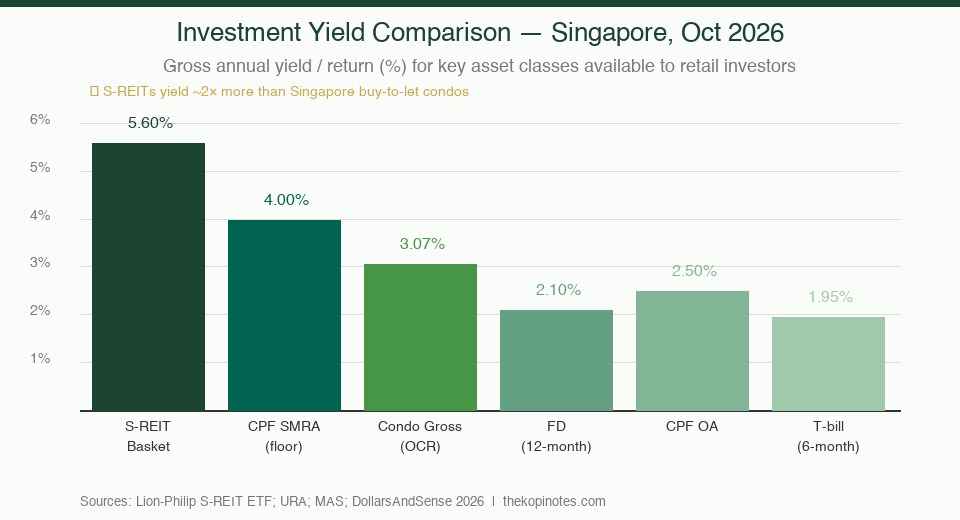
The S-REIT basket yield of approximately 5.6% — tracked via the Lion-Philip S-REIT ETF — is almost double the gross rental yield on Singapore condos, and more than double the net yield after property costs.
Within S-REITs, 1H2026 DPU (distributions per unit) growth has been uneven but several names are performing well. OUE REIT posted +28.6% DPU growth in 1H2026, Suntec REIT +25.5%, and Keppel DC REIT reported +11.7% DPU growth in Q3 2026 alone. CapitaLand Integrated Commercial Trust (CICT) — one of the blue-chip anchors in most Singapore dividend portfolios — grew its DPU by 7.1% in 1H2026.
On the other side, some industrial and office-heavy REITs have seen DPU pressure. Mapletree Industrial Trust (MIT) saw DPU fall 4.9% in 1H2026, Keppel REIT dropped 4.0%, and IREIT Global experienced a much steeper decline due to European office market headwinds.
For investors who want diversified real estate exposure, the S-REIT ETF approach sidesteps stock selection risk and delivers a blended yield above what most individual Singapore condos can provide.
For our full analysis of the best S-REITs in Singapore for 2026, including individual REIT deep dives, see our dedicated guide.
Beyond Yield — Why REITs Win on Liquidity and CPF Strategy
Yield alone doesn’t capture the full picture. S-REITs have two structural advantages over direct property that matter greatly for Singapore retail investors.
Liquidity. A Singapore condo can take 3–6 months (or longer in a soft market) to sell. An S-REIT or S-REIT ETF can be sold in seconds during trading hours, with funds settling in 2 business days. If your financial circumstances change — job loss, family emergency, better opportunity — S-REITs give you flexibility that property does not.
CPF integration. Singapore investors can use CPF Ordinary Account (OA) funds to purchase SGX-listed REITs (subject to CPF Investment Scheme eligibility checks). Your CPF OA is currently earning 2.5% — on funds above the first S$20,000. Deploying OA savings into S-REITs yielding 5.5–6.0% represents a meaningful yield pickup, compared to deploying that same CPF into a property purchase where the net yield might be under 3%.
The CPF SMRA interest rate floor of 4% has been extended to December 2027, meaning money locked in SA, MA, and RA continues to compound at a guaranteed 4% — better than any available bank product today. This makes a strong case for maximising CPF SMRA top-ups first, and only then deploying excess capital into S-REITs or other investments.
For more on dividend investing as a wealth-building strategy in Singapore, including how to construct a portfolio around S-REITs and dividend stocks, see our comprehensive guide.
The Case for Property — When It Still Makes Sense
To be fair, property is not a one-dimensional story. There are scenarios where buying Singapore real estate still makes clear sense for investors.
Owner-occupiers get the best deal. If you’re buying your first home to live in, you pay 0% ABSD as a Singapore Citizen, you eliminate rent (which is a form of return), and you gain exposure to Singapore’s long-term land-scarcity story. The PPI has risen over 60% over the past decade, and Singapore’s urban planning constraints are structural.
Leverage amplifies returns. A S$1.5M property with S$375K down (25%) and a 75% mortgage means that a 5% price appreciation in a year generates a return of approximately 20% on the equity deployed — far exceeding any REIT yield. Of course, leverage also amplifies losses, and property is indivisible, so the downside risk is concentrated.
Inflation hedge. Physical property has historically been a reasonable long-term store of value against Singapore dollar purchasing power erosion, particularly for those with a 15–30 year holding horizon.
CPF usage for owner-occupation. You can use CPF OA to service the mortgage of an owner-occupied property, reducing your cash outflow significantly — this benefit doesn’t apply when buying a second investment property after your OA has been substantially committed.
However, for those specifically looking at a second or investment property, the arithmetic against S-REITs has rarely looked as unfavourable as it does today. The combination of 20% ABSD, sub-3% net yield, rising entry prices, and a 5%+ REIT yield alternative creates a very high bar.
Bottom Line for SG Investors
The Q3 2026 URA data confirms Singapore private home prices are in a new upcycle. That’s good news for existing homeowners and a validation of the market’s long-term resilience. But for investors asking “where should my next investment dollar go?”, the data-driven answer skews toward S-REITs.
S-REITs offer approximately twice the yield of a Singapore buy-to-let condo, can be purchased with as little as a few hundred dollars, settle in 2 days instead of months, and can use CPF OA funds. For investors already owning their home (which handles the inflation hedge and leverage exposure), S-REITs make a compelling complement — not competition — to property in a well-rounded Singapore portfolio.
If you are considering direct property investment, run the full numbers including ABSD, transaction costs, ongoing maintenance, and vacancy before comparing against REIT yields. The gap may surprise you.
For a current snapshot of Singapore investment themes our readers are watching, see our Singapore Market Watch October 2026 roundup. For current fixed deposit rates in Singapore, see our updated comparison.
Frequently Asked Questions
Did Singapore home prices really rise in Q3 2026?
What is the average rental yield for Singapore condos in 2026?
How much ABSD do Singapore Citizens pay on a second property?
What yield do Singapore REITs (S-REITs) currently pay?
Can I use CPF to buy S-REITs?
Is property still a good investment in Singapore despite high ABSD?
What happened to Singapore property transaction volumes in Q3 2026?
This article was researched with the help of AI. While we strive to keep all information accurate and up to date, there may be errors. If you notice any discrepancies, please contact us.