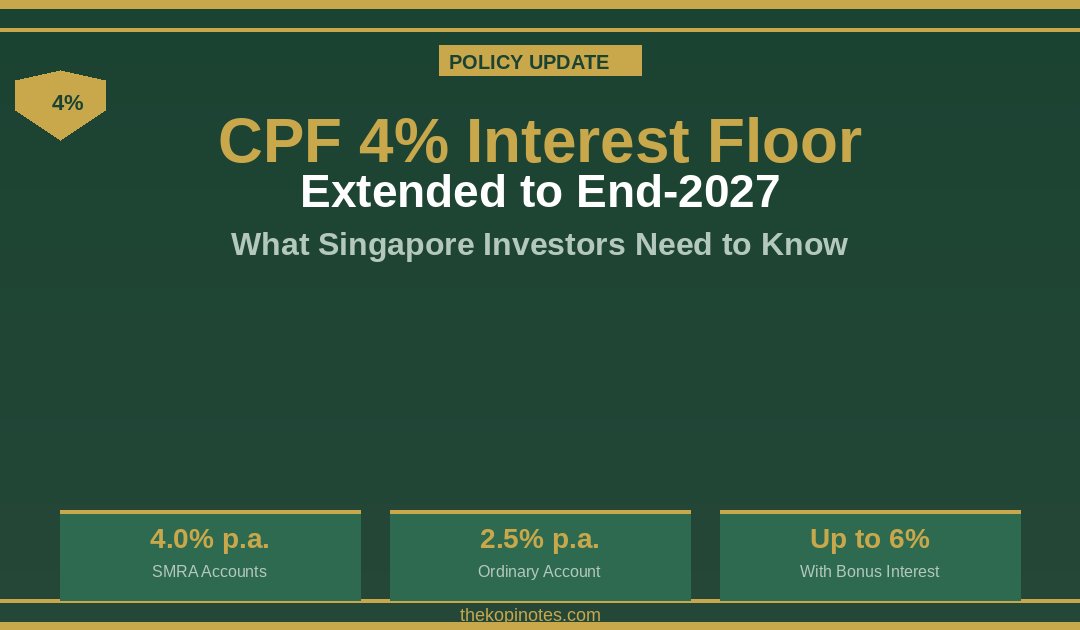
Singapore’s CPF Board confirmed this week that the 4% interest rate floor on Special, MediSave, and Retirement Accounts (SMRA) will remain in place through December 31, 2027 — a full year beyond the previous end-2026 guarantee. With T-bill yields sitting at 1.92% and Singapore Savings Bond 10-year averages at 2.32%, the CPF’s guaranteed return is now more than twice what the open market offers. Here’s exactly what changed, and what you should do about it.
This is an editorial analysis. Not financial advice. Data verified as at 3 October 2026.
What Just Changed: The 4% SMRA Floor Extended to End-2027
The Central Provident Fund Board and the Housing and Development Board made a joint announcement extending the minimum guaranteed interest rate for Special, MediSave, and Retirement Accounts to December 31, 2027. The previous guarantee only ran to end-2026, so this gives CPF members an additional year of certainty during a period of falling global interest rates.
To understand why the floor matters, you need to know how CPF rates are actually calculated. The SMRA rate is normally pegged to the 12-month average yield of 10-year Singapore Government Securities (SGS) plus 1%. For the August 2025 to July 2026 period, that computed rate worked out to just 3.06% — well below the 4% guarantee. Without the floor, your Special Account, MediSave Account, and Retirement Account would have been earning 3.06%, not 4%. The floor directly put more money in your pocket.
Similarly, the Ordinary Account’s 2.5% floor is also in place because the market-computed rate — based on local bank deposit rates — came in at just 0.32% for the May to July 2026 period. The OA floor has been in place continuously since 1999 and is less frequently discussed, but it’s equally significant for anyone parking money there for housing or education purposes.
CPF Interest Rate Breakdown for Q4 2026 (October–December)
Here’s the complete picture of CPF rates for the current quarter, as confirmed by CPF Board:
| CPF Account | Base Rate (p.a.) | Market-Computed Rate | Applicable Rate |
|---|---|---|---|
| Ordinary Account (OA) | 2.5% (floor) | 0.32% | 2.5% |
| Special Account (SA) | 4.0% (floor) | 3.06% | 4.0% |
| MediSave Account (MA) | 4.0% (floor) | 3.06% | 4.0% |
| Retirement Account (RA) | 4.0% (floor) | 3.06% | 4.0% |
The HDB concessionary housing loan rate, which is pegged at 0.1% above the OA rate, remains at 2.6% per annum.
These rates apply to all CPF members uniformly. The extension to end-2027 means you can plan around these numbers for the next 15 months without worrying about a rate reset.
Why CPF Now Beats T-Bills, SSBs, and Fixed Deposits Hands Down
The CPF’s guaranteed 4% looks even more attractive when you stack it against what’s available in the open market right now. After the US Federal Reserve adopted a more hawkish stance following the February 2026 geopolitical developments, Singapore’s short-term rates have drifted lower. Here’s how CPF compares:
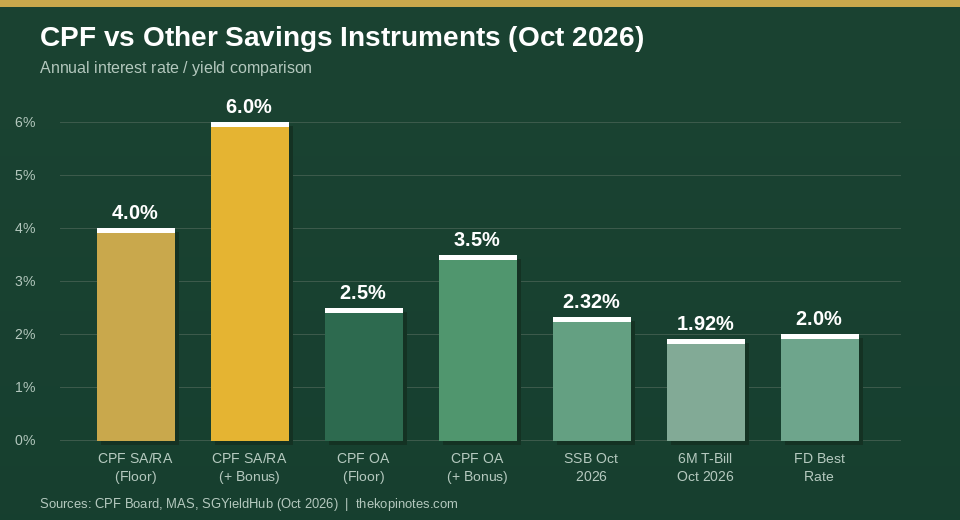
| Savings Instrument | Current Yield / Rate | Term | Liquidity |
|---|---|---|---|
| CPF SMRA (Base) | 4.00% | Till age 55+ | Restricted |
| CPF SMRA + Bonus | Up to 6.00% | Till age 55+ | Restricted |
| 6-month Singapore T-Bill | 1.92% | 6 months | At maturity |
| Singapore Savings Bond (Oct 2026) | 1.65% (Year 1) / 2.32% (10-yr avg) | Up to 10 years | Monthly redemption |
| Best Fixed Deposit (CIMB, Oct 2026) | 2.00% | 12 months | At maturity |
| CPF OA (Base) | 2.50% | Till withdrawal age | Restricted |
The gap is stark. CPF’s SMRA base rate of 4% is more than double the 6-month T-bill yield. Even the SSB’s 10-year average of 2.32% falls 168 basis points short of the CPF floor. For Singapore retail investors who regularly chase T-bill and SSB applications, this comparison matters: the money you lock into CPF through top-ups earns substantially more on a risk-adjusted basis — provided you don’t need access before your payout eligibility age.
The trade-off is liquidity. Unlike Singapore Savings Bonds, which can be redeemed monthly, or fixed deposits, which mature in months, voluntary CPF contributions are irreversible. Once you top up your SA or RA under the Retirement Sum Topping-Up Scheme (RSTU), that money is committed until CPF Life payouts begin. Factoring this in is critical before deciding whether to top up.
How Bonus Interest Can Boost Your Returns to 6% Per Annum
The headline 4% figure understates what many CPF members actually earn, because the government layers additional bonus interest on top of base rates. Here’s how the bonus system works:
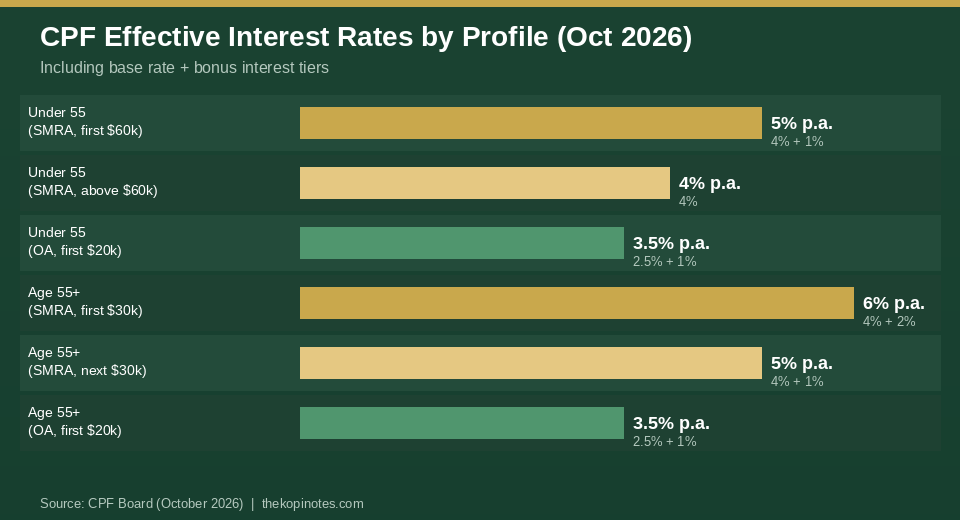
For members under age 55:
- An extra 1% per annum is earned on the first $60,000 of combined CPF balances
- The Ordinary Account contribution is capped at $20,000 within this $60,000 pool
- Result: SA/MA at 5% on first $40,000; OA at 3.5% on first $20,000
For members aged 55 and above:
- An extra 2% per annum on the first $30,000 of combined CPF balances (OA capped at $20,000)
- An extra 1% per annum on the next $30,000
- Result: RA can earn up to 6% per annum on the first $30,000
To put this in dollar terms: if you are 58 years old with $30,000 in your RA, you earn $30,000 x 6% = $1,800 per year in CPF interest alone. No T-bill, SSB, or fixed deposit comes close to matching that on an equivalent risk-free basis.
Voluntary Top-Up Strategies Worth Considering Now
With the 4% floor extended to end-2027, this is a useful planning window. Here are the key strategies TKN’s readers commonly consider — each with important caveats:
Retirement Sum Topping-Up Scheme (RSTU) — Cash Top-Ups
Cash top-ups to your SA (if under 55) or RA (if 55 and above) earn tax relief of up to $8,000 per year for your own account, and an additional $8,000 for top-ups to eligible family members. The money earns 4% immediately. The irreversible nature makes this best suited for those with a clear retirement timeline who do not anticipate needing these funds. See our CPF Retirement Sum guide for the 2026 thresholds (BRS: $110,200; FRS: $220,400; ERS: $330,600).
CPF Voluntary Contributions (VC) to OA, SA, and MA
For self-employed Singaporeans and those with income gaps, voluntary contributions allow topping up the three accounts within the Annual Contribution Limit ($37,740 for 2026). Unlike RSTU cash top-ups, voluntary contributions to OA can still be withdrawn later for permitted housing or education purposes, giving more flexibility.
Matched Retirement Savings Scheme (MRSS)
For eligible CPF members aged 55 and above who have RA balances below the Basic Retirement Sum ($110,200) and meet income and property criteria, the government provides dollar-for-dollar matching of up to $2,000 per year in RA top-ups (lifetime cap: $20,000). This effectively doubles your return on that portion. See our full MRSS guide for eligibility criteria and the October 31 GIRO deadline.
One strategic note: if you are considering both SSB applications and CPF top-ups, the math usually favours CPF for any locked-up portion of your emergency fund tier. The SSB’s flexibility is genuine, but the 1.65% Year 1 yield barely keeps pace with inflation and cannot compete with CPF’s 4-6% compound growth for retirement-earmarked capital.
Who Benefits Most — and Who Should Think Twice
The extension is universally good news for all CPF members, but the practical benefit varies significantly by life stage:
Highest beneficiaries: Members aged 55 to 65 with RA balances in the $30,000-$60,000 range earn the maximum 6% on the first tranche, creating a compounding advantage that is difficult to replicate with any liquid instrument. For this group, maximising RA balances before CPF Life payouts begin is a high-conviction strategy.
Mid-career earners (35-50): This group benefits most from RSTU cash top-ups if they have consistent taxable income and want to lock in the 4% floor plus the tax deduction at their marginal rate. Those in the 15% tax bracket save $1,200 on an $8,000 top-up — a 15% instant return before a dollar of CPF interest is credited.
Younger members (under 35): The benefit exists but the opportunity cost of liquidity is highest here. The 4% floor is attractive, but those still building emergency funds, managing housing downpayments, or with significant investment goals in equities (like FIRE-planning investors) may prioritise liquidity over the CPF premium.
Those who should think twice: Anyone who may need funds before their CPF payout eligibility age (55 for the first tranche, CPF Life from 65) should treat RSTU top-ups cautiously. The higher yield does not compensate for a genuine liquidity crisis, and CPF top-ups cannot be reversed.
MAS October 2026 Meeting Context
This CPF extension arrives against a backdrop of a complex monetary policy environment. As our MAS October 2026 meeting preview noted, the Monetary Authority of Singapore has already tightened twice in 2026 (April and July), but domestic rate conditions have not fully transmitted to short-term saving products. The disconnect between MAS’s tight policy stance and low T-bill yields reflects Singapore’s unique monetary policy transmission mechanism — MAS manages the exchange rate, not interest rates directly. This means short-term deposit rates can remain suppressed even when the SGD is being strengthened. CPF’s administered floors sidestep this entirely, which is precisely why they matter more in this environment.
The SSB interest calculator on TKN can help you compare the compounded returns between an SSB allotment and a CPF top-up scenario over your specific time horizon.
Bottom Line for SG Investors
The CPF 4% floor extension to end-2027 is one of the most straightforward wins in Singapore personal finance right now. With market rates on T-bills and savings bonds sitting at half or less of CPF’s guaranteed return, the spread in CPF’s favour has rarely been wider. The key decision is not whether CPF is attractive — it clearly is — but whether you have capital that is genuinely retirement-earmarked and can afford to lock up for the long term.
If you are already making RSTU top-ups: this confirmation means your plan remains on solid footing for at least another 15 months. If you have been considering your first top-up: the certainty of the 2027 extension removes the quarterly rate-reset uncertainty that previously made timing a concern.
The one risk to monitor is what happens after December 2027. There is no guarantee that the floor will be renewed again, and if SGS yields remain below 3%, a transition to the market rate would reduce SMRA returns. CPF Board has historically renewed the floor to protect members, but it’s worth noting this is a policy choice, not a legal right.
Frequently Asked Questions
What is the CPF interest rate for Q4 2026 (October to December)?
Until when is the 4% CPF floor guaranteed?
How do I earn 6% interest on CPF?
Is a CPF RSTU top-up reversible?
Can I get a tax deduction for topping up my CPF?
How does CPF's 4% compare to Singapore Savings Bonds and T-bills?
Does the CPF 4% floor apply to SRS funds too?
What happens if I turn 55 this year — how does the interest rate change?
This article was researched with the help of AI. While we strive to keep all information accurate and up to date, there may be errors. If you notice any discrepancies, please contact us.