Oil Prices Surge, Inflation Rises: What It Means for Singapore REIT Investors
Brent crude near a 2026 high, MAS lifting its inflation forecast, and a hawkish Fed — here is how it flows through to your S-REIT dividends.
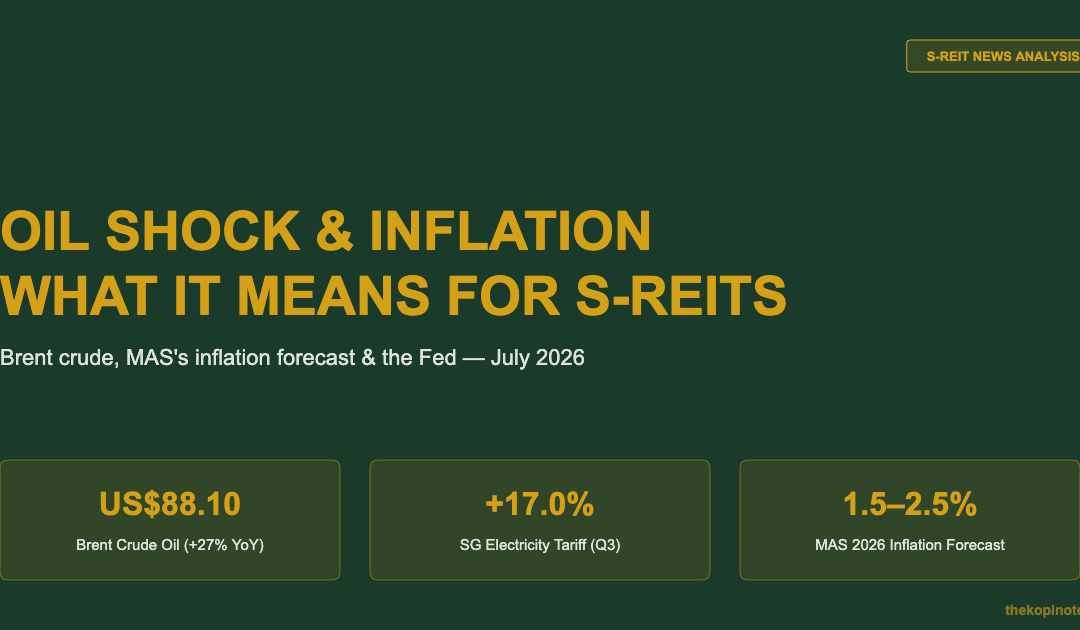
Brent crude jumped to US$88.10 a barrel on 17 July 2026 as the US-Iran conflict disrupted the Strait of Hormuz, pushing Singapore’s Q3 electricity tariffs up 17% and prompting MAS to raise its 2026 inflation forecast to 1.5%-2.5%. The US Federal Reserve has also turned hawkish. Together, these shifts squeeze S-REIT expenses even as Singapore’s own borrowing costs keep falling.
This is an editorial analysis. Not financial advice. Data verified as at 20 July 2026.
- Oil is up 27% year-on-year on Middle East conflict. That’s pushed Singapore’s Q3 electricity tariffs up 17% and MAS’s 2026 inflation forecast to 1.5%-2.5%.
- The Fed just turned hawkish and held US rates at 3.50%-3.75%. But Singapore’s own SORA benchmark has been falling — a divergence that actually helps S-REIT funding costs.
- Energy-heavy and overseas-earning REITs face the most cost pressure. SG-focused REITs with fixed-rate SGD debt are better insulated.
Table of Contents
Contents — Click to expand
- What Happened This Week
- Why Oil Is Driving Up Your Cost of Living
- Key Numbers at a Glance
- Your Electricity Bill Just Jumped 17%
- The Fed Turned Hawkish — But Singapore Rates Are Falling
- Case Study: CapitaLand Ascendas REIT
- Which S-REITs Are Carrying the Most Risk
- What This Means for Your Portfolio
- Bottom Line for SG Investors
- Frequently Asked Questions
What Happened This Week
Oil markets have been on edge since late February 2026, when shipping through the Strait of Hormuz became severely constrained. Iran and the US have since exchanged strikes, and Washington reimposed a naval blockade on Iranian ports. Brent crude touched US$88.10 a barrel on 17 July 2026 — up 27.2% from a year ago and its highest level in a month, according to Trading Economics.
The knock-on effects have landed squarely on Singapore households and businesses. SP Group confirmed on 30 June 2026 that electricity tariffs for July to September would rise 17.0%, the steepest quarterly jump since the crisis began. Two weeks earlier, MAS had already lifted its 2026 inflation forecast, citing the same energy shock. And in the US, the Federal Reserve’s June meeting produced a notably more hawkish rate outlook than markets had expected in March.
Why Oil Is Driving Up Your Cost of Living
MAS’s Monetary Policy Statement on 14 April 2026 was blunt about the cause. Singapore’s import prices for crude oil, natural gas, and fuel have risen sharply, MAS said, and that will keep adding to electricity, gas, and transport costs in the months ahead.
As a result, MAS raised its forecast for both Core Inflation and CPI-All Items inflation to 1.5%-2.5% for 2026, up from 1.0%-2.0% previously. Core inflation — which strips out accommodation and private transport — had held at 1.2% year-on-year in January and February, before the oil shock fully worked through the numbers.
MAS’s response wasn’t to raise interest rates. Singapore doesn’t set policy that way. Instead, MAS tightened its exchange rate policy, letting the Singapore dollar appreciate slightly faster against a basket of trading-partner currencies. A stronger SGD makes imports cheaper, which is meant to offset some of the imported inflation. For REIT investors, this detail matters — it’s the reason Singapore’s interest-rate story is playing out so differently from America’s.
Key Numbers at a Glance
| Indicator | Figure | Source & Date |
|---|---|---|
| Brent crude oil | US$88.10/barrel (+27.2% y-o-y) | Trading Economics, 17 Jul 2026 |
| SG household electricity tariff (Q3 2026) | 31.91 cents/kWh (+17.0% QoQ, before GST) | SP Group, 30 Jun 2026 |
| MAS Core Inflation forecast (2026) | 1.5%-2.5% (raised from 1.0%-2.0%) | MAS Monetary Policy Statement, 14 Apr 2026 |
| US Fed funds target rate | 3.50%-3.75% (held) | US Federal Reserve FOMC, 17 Jun 2026 |
| Fed median 2026 year-end rate projection | 3.8% (up from 3.4% in March) | Federal Reserve Summary of Economic Projections, 17 Jun 2026 |
| CPF OA / SMRA interest (Q3 2026) | 2.5% / 4.0% (floor rates, unchanged) | CPF Board, Jul 2026 |
| CLAR pro forma leverage post-divestment | 41.4% (from 42.0%) | CapitaLand press release, 15 Jul 2026 |
Source: as credited per row above. All figures verified against the cited official releases as at 20 July 2026.
Your Electricity Bill Just Jumped 17% — Here’s Why REITs Care
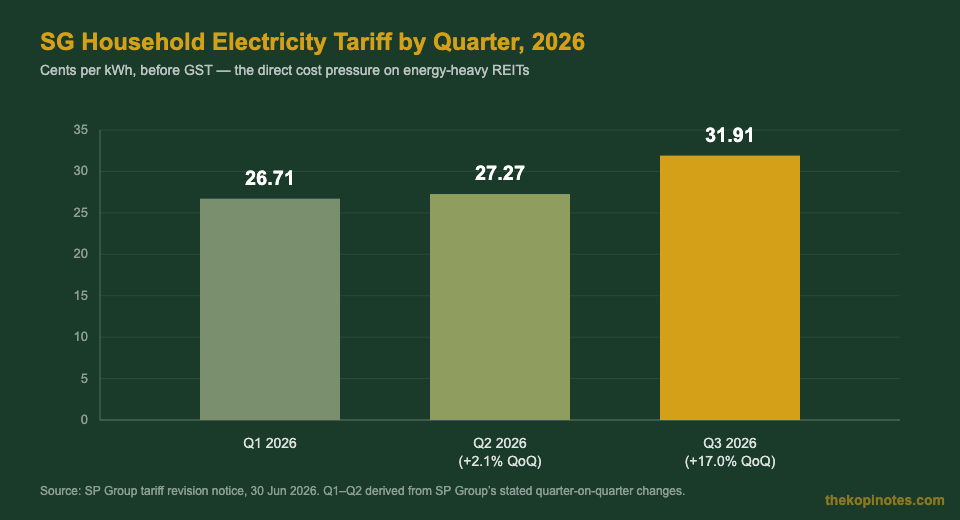
For a household in a four-room HDB flat, the July revision means an extra $17.14 a month before GST, according to SP Group’s official tariff notice. The regulated household tariff is now 31.91 cents per kWh before GST, up from about 27.27 cents in the second quarter — itself only a modest 2.1% increase from the first quarter, before the Middle East conflict pushed natural gas import costs higher.
Landlords feel this too, just at a much bigger scale. Malls run air-conditioning and escalators from morning to night. Data centres run cooling systems around the clock. Hotels and serviced residences use significant power for laundry, kitchens, and climate control. When energy costs jump 17% in a single quarter, REITs that own these asset types absorb higher operating expenses before a single dollar reaches unitholders as distributions.
Not every REIT is equally exposed. Retail and office landlords that pass utility costs through to tenants under net-lease structures are better shielded than those on gross leases. This is a detail worth checking in your REIT’s annual report before assuming a 17% tariff jump translates directly into lower dividends.
The Fed Turned Hawkish — But Singapore’s Own Rates Are Falling
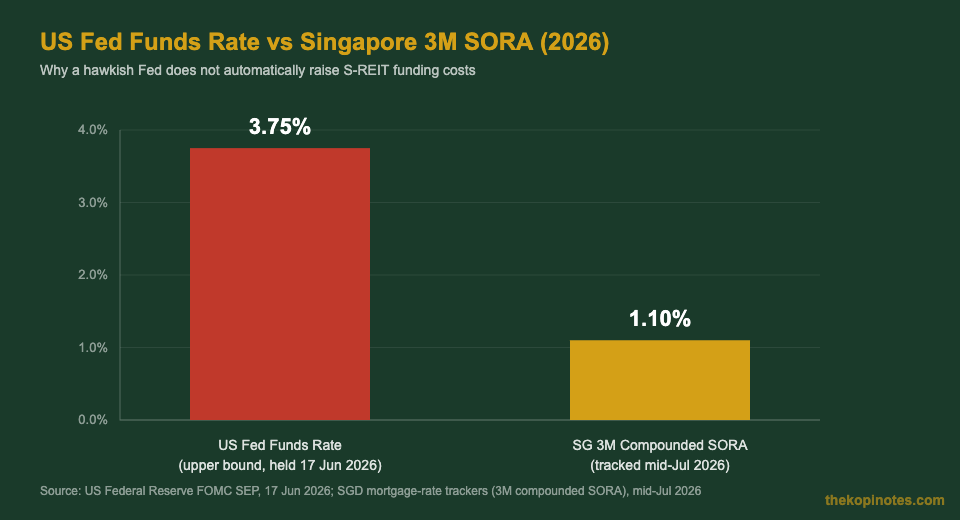
On 17 June 2026, the US Federal Reserve held its target rate at 3.50%-3.75%, but the accompanying dot plot delivered the surprise. The median projection for where rates will land by end-2026 jumped to 3.8%, up from 3.4% in the March projections — a swing from an expected cut to a likely hike, driven largely by the same energy-price inflation hitting Singapore.
Here’s the twist for Singapore REIT investors: Singapore’s own short-term borrowing benchmark has been moving in the opposite direction. The 3-month compounded SORA rate — the reference rate most S-REIT floating-rate loans are pegged to — was tracked at around 1.0%-1.1% in July 2026 by SGD mortgage-rate trackers, down sharply from levels above 3% in early 2025.
That divergence matters because S-REITs borrow mostly in SGD, not USD. A hawkish Fed pushes up US Treasury yields and can pressure REIT valuations globally through the discount-rate channel. But it doesn’t automatically raise what a Singapore REIT actually pays its SGD lenders. We’ve covered this rate-divergence dynamic in more detail in our Singapore Rates Falling vs Fed 2026 piece — worth a read if you want the fuller picture on funding costs.
A Real Example: How CapitaLand Ascendas REIT Is Playing Defence
You can see the deleveraging instinct playing out already. On 15 July 2026, CapitaLand Ascendas REIT (CLAR) announced it’s divesting Kim Chuan Telecommunications Complex, a 10-storey data centre building in Singapore, for S$200.4 million — double what CLAR paid for it in 2005, and a 32% premium over its latest independent valuation.
CLAR said the estimated S$180 million in net proceeds may go toward paying down debt, funding committed investments, or unitholder distributions. If used to repay borrowings, CLAR’s pro forma aggregate leverage would fall to about 41.4%, down from 42.0% as at 31 March 2026, according to CapitaLand’s official announcement.
This is the playbook to watch for more broadly in 2026: REIT managers recycling capital out of smaller or non-core assets to strengthen balance sheets ahead of refinancing, rather than waiting to see how the Fed-versus-MAS rate divergence plays out. It’s a sign of discipline, not distress — CLAR’s CEO called it “portfolio optimisation,” and the pricing, double the original cost, supports that framing.
Which S-REITs Are Carrying the Most Risk Right Now
Not all REITs face this environment the same way. Three factors are worth checking for any S-REIT in your portfolio.
Energy intensity. Hospitality trusts, industrial and data centre REITs, and large malls have the highest exposure to the direct cost of the tariff hike. Office and smaller neighbourhood retail REITs tend to use comparatively less power per square foot.
Currency and rate mix. REITs with significant overseas assets in the US, UK, or Europe carry both foreign-currency risk and exposure to those markets’ own, mostly higher, interest rates. SG-focused REITs benefit more directly from the falling-SORA dynamic described above.
Gearing and refinancing timeline. Since November 2024, MAS applies a single aggregate leverage cap of 50% to all S-REITs, alongside a minimum interest coverage ratio (ICR) of 1.5 times at all times. A REIT running close to that 50% ceiling, or with an ICR near the 1.5x floor, has less room to absorb higher costs before it needs to raise fresh capital or cut distributions. Our Best S-REITs Singapore 2026 yield comparison table is a useful starting point for checking where your holdings sit on gearing and coverage.
If you’re building or reviewing a REIT portfolio for income, our High Yield REITs Singapore 2026 roundup and Top Dividend Stocks 2026 guide both flag gearing and payout ratio alongside headline yield — useful context given the cost pressures above.
What This Means for Your Portfolio
Don’t panic-sell on oil headlines alone. Singapore’s REIT sector has weathered rate shocks before, and the SORA-Fed divergence is, if anything, a partial offset to the inflation story — not a compounding risk.
Do check two things in each REIT you hold: how much of its debt is SGD-denominated and fixed-rate, which is less exposed to any future funding cost swings, and what proportion of its expenses are utility costs versus rent that can be repriced to tenants.
Compare the yield you’re getting to safer alternatives. With the CPF Ordinary Account still paying a floor 2.5% and the Special, MediSave and Retirement Accounts at 4% for the July-September quarter, and fixed deposits like RHB’s offering up to 3.30% p.a. on a 6-month tenure, a REIT needs to offer a meaningfully higher yield to compensate for the added volatility and cost exposure right now.
Watch for MAS’s next GDP update. MAS said it would revise its 2.0%-4.0% growth forecast for 2026 in May — that update, plus any change in the Strait of Hormuz situation, will be the next signal for whether this inflation spike is temporary or sticky.
Bottom Line for SG Investors
The oil shock is real, and it’s already showing up in your electricity bill and in MAS’s own inflation forecast. But the read-through to S-REITs isn’t simply “rates up, REITs down.” Singapore’s funding costs are actually falling even as the Fed turns hawkish, and REIT managers like CLAR are already deleveraging in response to input-cost pressure rather than waiting it out.
For most SG retail investors, the sensible move is portfolio-level, not panic-level: check energy exposure and gearing REIT by REIT, keep some dry powder in T-bills or fixed deposits while yields there stay competitive, and use our retirement planning calculator to see how a temporary dip in REIT distributions would actually affect your long-term income plan.
Frequently Asked Questions
Why did Singapore's electricity tariffs go up 17% in July 2026?
SP Group raised household electricity tariffs by 17.0% (4.64 cents per kWh) for the July-September 2026 quarter, taking the regulated rate to 31.91 cents per kWh before GST. The increase reflects higher natural gas import costs after the Middle East conflict disrupted the Strait of Hormuz from late February 2026, driving Brent crude above US$88 a barrel by mid-July.
Will higher oil prices push Singapore interest rates up too?
Not directly. MAS manages monetary policy through the Singapore dollar’s exchange rate, not a policy interest rate. In its April 2026 statement, MAS chose to let the SGD appreciate slightly faster to offset imported inflation, rather than raising rates the way the US Federal Reserve does. That is part of why Singapore’s SORA benchmark has kept falling even as the Fed turns hawkish.
Are S-REIT dividends at risk because of rising inflation?
Some REITs face more pressure than others. Trusts with energy-intensive assets, such as hotels, industrial space and data centres, or gross leases that don’t pass utility costs to tenants, will see operating expenses rise faster. REITs with mostly fixed-rate SGD debt and net-lease retail or office portfolios are better insulated. Check each REIT’s latest results for its gearing ratio and utility cost exposure before assuming distributions will fall.
What is CapitaLand Ascendas REIT's Kim Chuan divestment, and why does it matter?
CLAR is selling a data centre building at 38 Kim Chuan Road for S$200.4 million, about double its original 2005 purchase price and a 32% premium to its latest valuation. Using the proceeds to repay debt would lower CLAR’s pro forma leverage to roughly 41.4% from 42.0%. It is an example of REIT managers proactively strengthening balance sheets amid rate and cost uncertainty, rather than a sign of financial stress.
Is now a bad time to buy S-REITs?
There is no single right answer — it depends on your time horizon and the specific REIT’s fundamentals. The inflation and oil shock is a real near-term cost headwind, but Singapore’s falling SORA rate is a genuine offsetting factor for REIT funding costs that doesn’t apply to REITs facing a hawkish Fed more directly, such as US-listed REITs. Compare individual REIT yields against safer alternatives like T-bills, CPF and fixed deposits, and check gearing before deciding.
How does the Fed's rate outlook affect Singapore REITs if SORA is falling?
It is mostly an indirect effect. Higher US rates can pressure global REIT valuations through the discount-rate channel investors use to value future distributions, and can strengthen the US dollar against the SGD, affecting REITs with US or other overseas assets and debt. But it doesn’t automatically raise what an S-REIT pays on its mostly SGD-denominated loans, which is why the SORA trend matters more for actual REIT funding costs.
Where can I check how much debt a Singapore REIT has and its cost exposure?
Each REIT publishes its aggregate leverage, interest coverage ratio, percentage of fixed-rate debt and weighted average cost of debt in its quarterly results and annual report, usually in the capital management section. Since November 2024, MAS caps aggregate leverage at 50% for all S-REITs and requires a minimum interest coverage ratio of 1.5 times at all times, so you can also check how close a REIT is running to that ceiling.
Check Your REIT Portfolio’s Rate & Inflation Exposure
Compare gearing, yield and coverage across S-REITs, and see how a dip in distributions would affect your long-term income plan.
This article was researched with the help of AI. While we strive to keep all information accurate and up to date, there may be errors. If you notice any discrepancies, please contact us.