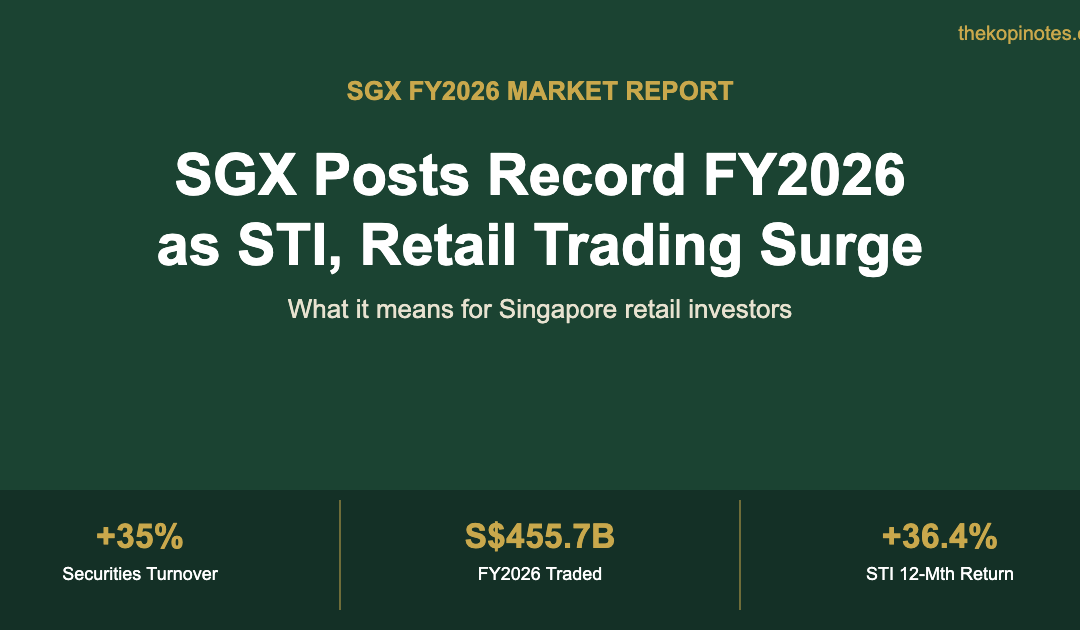
SGX Group has just posted its strongest trading year on record. FY2026 securities turnover jumped 35% to S$455.7 billion and derivatives volumes rose 15% to 363.5 million contracts, while the Straits Times Index hit an all-time high and retail investors bought in at their highest pace in 12 years.
This is an editorial analysis. Not financial advice. Data verified as at 18 July 2026 against SGX Group’s official FY2026 market statistics release and CPF Board’s official rate announcements.
What Happened: SGX’s Best Year in Nearly Two Decades
SGX Group’s full-year trading statistics for FY2026 (July 2025 to June 2026), released on 14 July 2026, show the broadest-based rally across Singapore’s markets in years. Securities market turnover climbed 35% year-on-year to S$455.7 billion, pushing securities daily average value (SDAV) to S$1.8 billion — the highest in 18 years. Derivatives volumes rose 15% to 363.5 million contracts for the full year, with June alone up 31% year-on-year to 34.3 million contracts.
For context, June’s securities turnover alone hit S$44.6 billion, a 72% jump from a year earlier, as the Straits Times Index (STI) extended its rally to an all-time high of 5,218.96 on 25 June. The index closed the month at 5,170.65, up 30.4% year-on-year, bringing its 12-month total return (including dividends) to 36.4%.
What this means for SG retail investors: this isn’t a one-off spike. It’s a market where turnover, index levels, and participation are all climbing together — a combination TKN readers haven’t seen at this scale in recent years. If you hold an STI ETF, a S-REIT, or blue-chip dividend stocks, FY2026 has likely been a good year for your portfolio on paper. The question now is whether to chase the rally or stay disciplined.
Retail Investors Are Buying at a 12-Year High
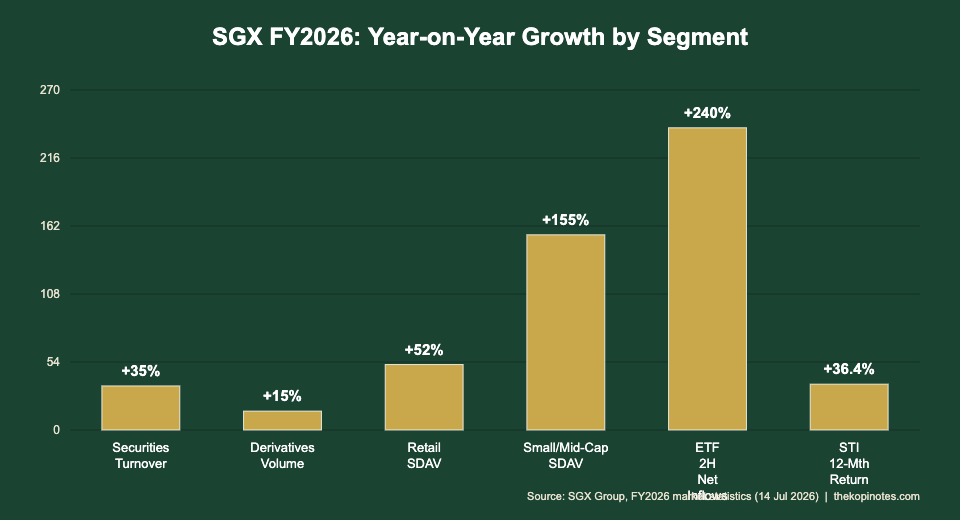
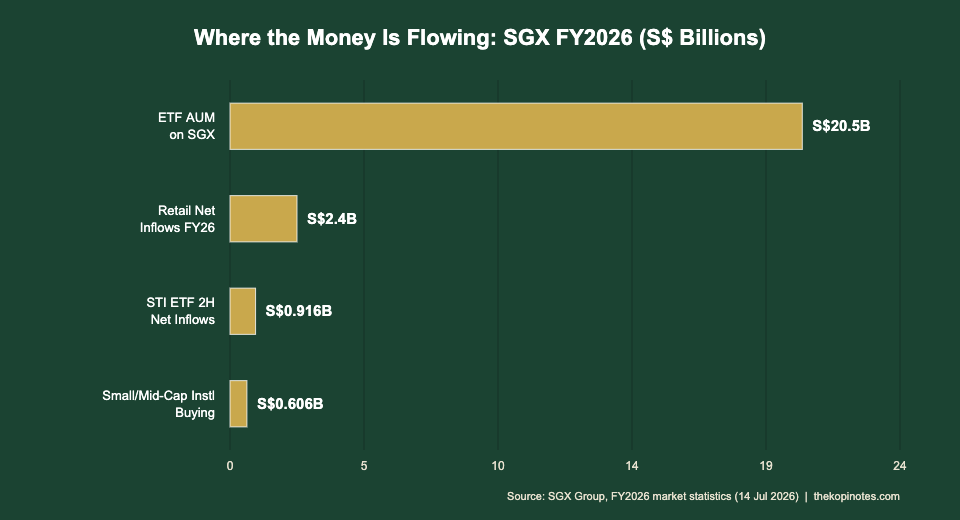
The most striking number in SGX’s release isn’t the index level — it’s retail participation. Retail SDAV surged 52% year-on-year in FY2026 to its highest level in 12 years, and retail investors were net buyers for five straight months through June, with cumulative FY2026 net inflows of S$2.4 billion.
Small- and mid-cap stocks saw an even sharper move: SDAV in that segment jumped 155% year-on-year to S$310 million, the highest since FY2014, while institutional net buying in small- and mid-caps roughly tripled to S$606 million (from S$200 million in FY2025). The iEdge Singapore Next50 Index, which tracks these smaller names, rose 23.8% year-on-year in June to 1,516.01.
What this means for SG retail investors: broadening participation beyond the usual bank-and-REIT trio (DBS, OCBC, UOB) suggests investors are hunting for value further down the market-cap ladder. That can be an opportunity, but small- and mid-cap stocks also carry wider bid-ask spreads and thinner liquidity — position sizing matters more here than in blue chips. If you’re trading actively, it’s worth comparing brokerage costs; our moomoo trading fees guide breaks down what active SG trading actually costs across platforms.
SGX-Listed ETFs Are Having a Breakout Year Too
ETF assets under management on SGX surpassed S$20.5 billion at the end of June 2026, with net inflows up 240% year-on-year in the second half of FY2026 to S$2.4 billion. Combined AUM of STI ETFs alone exceeded S$5 billion in June, extending net inflows for a 15th consecutive month — total 2H FY2026 inflows into STI ETFs were roughly five times higher year-on-year at S$916 million.
SGX also expanded its product suite, launching Gold and Silver Daily Leverage Certificates (DLCs) on 23 June, which recorded S$534,171 in turnover in their first week.
What this means for SG retail investors: steady, consistent inflows into STI ETFs (like ES3 and CLR) for 15 straight months is a sign that more Singaporeans are dollar-cost averaging into the local market rather than timing it. If you’re weighing a local STI ETF against a globally diversified fund, it’s worth revisiting how the two compare structurally — our CSPX vs VWRA comparison is a useful reference point even though those are global-market ETFs rather than STI trackers, since the same tax and structure considerations (Ireland-domiciled UCITS vs. others) apply broadly to how SG investors should think about ETF selection.
The Rates Backdrop: CPF Rates Hold Steady as Bank Stocks Rally
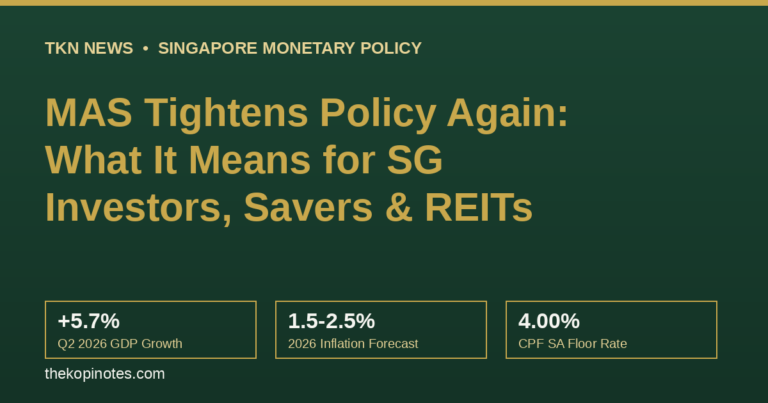
SGX’s rally has been led in large part by the three local banks, which benefit from a still-elevated rate environment. Against that backdrop, CPF Board has kept its interest rates unchanged for the third quarter: the Ordinary Account (OA) rate stays at its floor of 2.5% per annum, and the combined Special, MediSave and Retirement Account (SMRA) rate stays at its floor of 4% per annum, both for the period from 1 July to 30 September 2026, per CPF Board’s official announcement.
Separately, Singapore’s statutory retirement age rose to 64 and the re-employment age to 69 from 1 July 2026 — though CPF Board has clarified this does not change the CPF payout eligibility age, which remains 65.
What this means for SG retail investors: with CPF OA sitting at a floor 2.5% while the STI has returned 36.4% over the past 12 months, the gap between “safe” CPF returns and market returns has rarely looked wider — but that gap can close just as quickly in a downturn, which is exactly why CPF exists as the guaranteed base of a retirement plan rather than a competitor to equities. If you’re deciding how much to top up versus invest elsewhere, our CPF contribution 2026 guide walks through the current rates and ceilings in full.
SGX FY2026 By the Numbers
| Metric | FY2026 | YoY Change |
|---|---|---|
| Securities market turnover | S$455.7 billion | +35% |
| Securities daily average value (SDAV) | S$1.8 billion | +35% (highest in 18 years) |
| Total derivatives volume | 363.5 million contracts | +15% |
| Retail SDAV | Highest in 12 years | +52% |
| Retail net inflows (FY2026 cumulative) | S$2.4 billion | 5 consecutive months of net buying |
| ETF AUM on SGX (end-June) | S$20.5 billion | 2H FY2026 inflows +240% |
| STI 12-month total return | 36.4% | All-time high of 5,218.96 on 25 June |
| Total commodities volume | 78.8 million lots | +21% |
Source: SGX Group FY2026 market statistics release, 14 July 2026.
What This Means for Different Types of SG Investors
If you’re a dividend/income investor: a strong equities market often means dividend yields on blue chips compress as prices rise. It’s a good time to review whether your income stocks and REITs still offer the yield you originally bought them for, rather than assuming last year’s yield still applies. Our dividend payout calendar is a useful way to track what’s actually being paid out and when.
If you’re an ETF/index investor: the 15-month streak of STI ETF inflows suggests dollar-cost averaging is working for a lot of people right now, but a 36.4% one-year return is not the norm — don’t extrapolate it forward. If you’re comparing platforms to invest through, our Endowus Singapore guide and T-bill auction results page are both useful if you’re weighing equities against the safer end of the spectrum.
If you’re a CPF-first saver: nothing changed for you this quarter — OA and SMRA rates are flat, and that’s arguably the point. CPF isn’t designed to chase an SGX rally; it’s the floor beneath it.
Bottom Line for SG Investors
SGX’s FY2026 numbers confirm what many retail investors have felt over the past year: turnover, index levels, retail participation, and ETF inflows are all up meaningfully at the same time. That’s a genuinely rare combination for the Singapore market. The practical takeaway isn’t to chase the rally — it’s to check that your asset allocation, dividend yields, and CPF vs. investment split still make sense at these higher price levels, rather than assuming the conditions that got you here will simply continue.
Frequently Asked Questions
What was SGX’s total securities turnover in FY2026?
SGX Group’s securities market turnover for FY2026 (July 2025 to June 2026) was S$455.7 billion, up 35% year-on-year, according to SGX’s official market statistics release dated 14 July 2026.
Did the Straits Times Index hit an all-time high in 2026?
Yes. According to SGX’s official FY2026 release, the STI reached an all-time high of 5,218.96 on 25 June 2026, closing the month at 5,170.65, up 30.4% year-on-year, with a 12-month total return of 36.4%.
How much did retail investors buy in FY2026?
Retail investors were net buyers of Singapore equities for five consecutive months through June 2026, with cumulative FY2026 net inflows of S$2.4 billion. Retail trading activity (SDAV) rose 52% year-on-year to its highest level in 12 years.
What is the CPF Ordinary Account interest rate for Q3 2026?
The CPF Ordinary Account (OA) interest rate remains at its floor of 2.5% per annum for the period from 1 July to 30 September 2026, unchanged from the previous quarter, per CPF Board’s official announcement.
Has the CPF payout eligibility age changed along with the retirement age?
No. While Singapore’s statutory retirement age rose to 64 and the re-employment age to 69 from 1 July 2026, CPF Board has confirmed the CPF payout eligibility age remains unchanged at 65.
How much are SGX-listed ETFs managing in assets now?
ETF assets under management on SGX surpassed S$20.5 billion at the end of June 2026, with net inflows up 240% year-on-year in the second half of FY2026, reaching S$2.4 billion for the six-month period.
Is now a good time to invest given the SGX rally?
This is an editorial analysis, not financial advice. A strong market means valuations and yields have shifted from a year ago, so it’s worth reviewing your own asset allocation and time horizon rather than assuming past returns will repeat. Readers should consider speaking with a licensed financial adviser for personalised guidance.
Sources
This article was researched with the help of AI. While we strive to keep all information accurate and up to date, there may be errors. If you notice any discrepancies, please contact us.