TL;DR — MRSS 2026 at a Glance
- What you get: Dollar-for-dollar government matching on cash top-ups into your CPF Retirement Account (RA) — up to $2,000 per year.
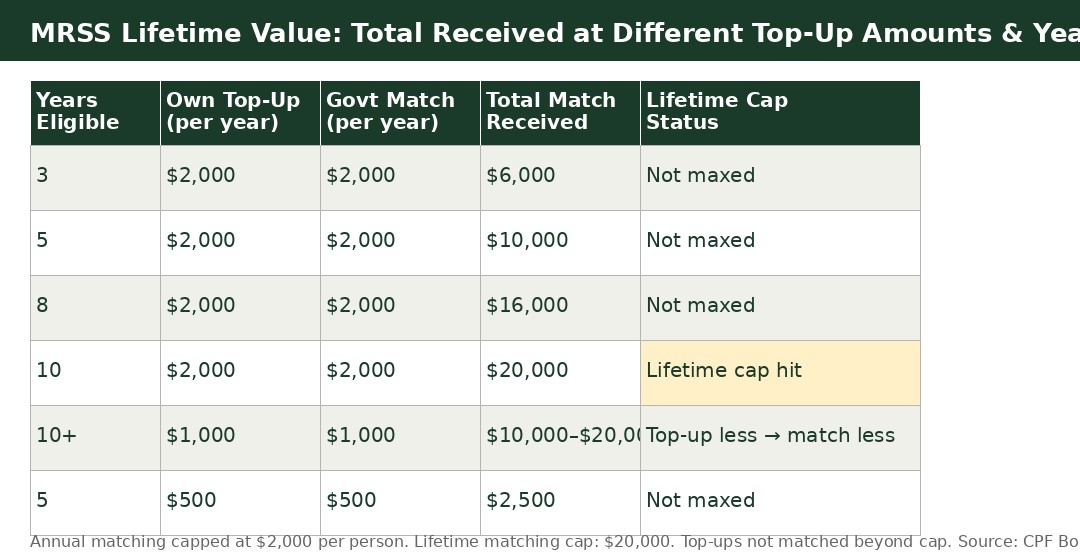
- Lifetime cap: $20,000 in total government matching per eligible person.
- Who qualifies: Singapore Citizens aged 55+ with RA/CPF savings below $110,200, monthly income ≤ $4,000, and annual property value ≤ $21,000.
- New in 2026: Persons with disabilities below age 55 now also qualify.
- No application needed: CPF Board assesses your eligibility automatically each year.
- Deadlines: GIRO recurring top-ups — 31 October; one-time PayNow/cash top-ups — 31 December.
- Key trade-off: Cash top-ups made for MRSS matching do not qualify for income tax relief.
If you are approaching retirement age and your CPF Retirement Account is below the Basic Retirement Sum, the Matched Retirement Savings Scheme (MRSS) is one of the most straightforward government grants available to you. For every dollar you — or anyone on your behalf — tops up into your RA, the government puts in an equal dollar, at no cost to you, up to a cap.
That is not an investment return. It is not a rebate. It is a 100% instant return on the first $2,000 you top up each year, guaranteed. This article explains exactly who qualifies, how the scheme works in 2026 (including the new PWD expansion), and how to make every dollar count before the year-end deadline.
Note: The CPF Board now refers to this scheme as the Matching Grant for Retirement. The acronym MRSS remains widely used in the community and on this site, so we use both interchangeably below.
What Is the Matched Retirement Savings Scheme (MRSS)?
The MRSS was introduced by the Singapore government to help lower-income seniors who may not have had the opportunity to build up their CPF savings during their working years. Many older Singaporeans — especially those who worked in jobs without mandatory CPF contributions, took time off to raise families, or were self-employed — reach their 50s with CPF balances well below what they need for a basic monthly income in retirement.
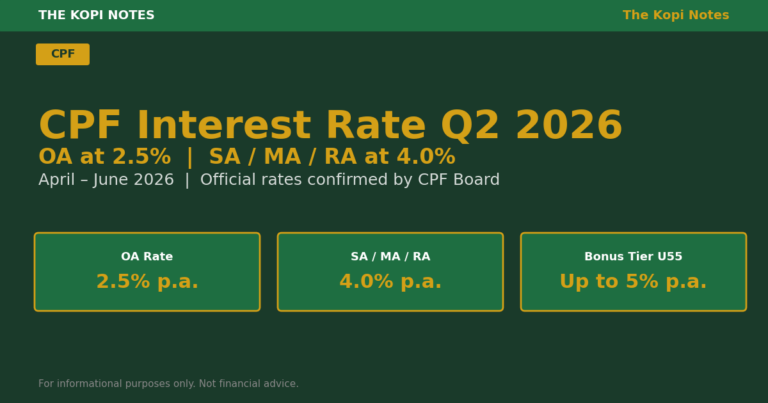
The scheme works simply. When an eligible person (or their family, friends, or community) makes a cash top-up into their Retirement Account, the CPF Board matches it dollar for dollar, up to $2,000 per calendar year. The matching grant is credited directly into the RA, where it earns interest at 4% per annum (with the possibility of an additional 1–2% for the first $30,000 under the extra interest framework) and eventually flows into CPF LIFE monthly payouts.
To understand how the RA fits into the broader retirement structure, see our guide to the CPF Retirement Sum (BRS, FRS, ERS).
MRSS Eligibility: Do You Qualify in 2026?
CPF Board assesses each eligible person automatically every year — you do not need to submit a separate application. However, you must meet all five of the following criteria as at 31 December of the qualifying year.
| Criterion | Requirement (2026) | Notes |
|---|---|---|
| Citizenship | Singapore Citizen only | Permanent Residents do not qualify |
| Age | 55 or older by 31 Dec of the year — OR — Any age, if verified disability (from Jan 2026) |
Disability must be verified by MSF (Ministry of Social and Family Development) |
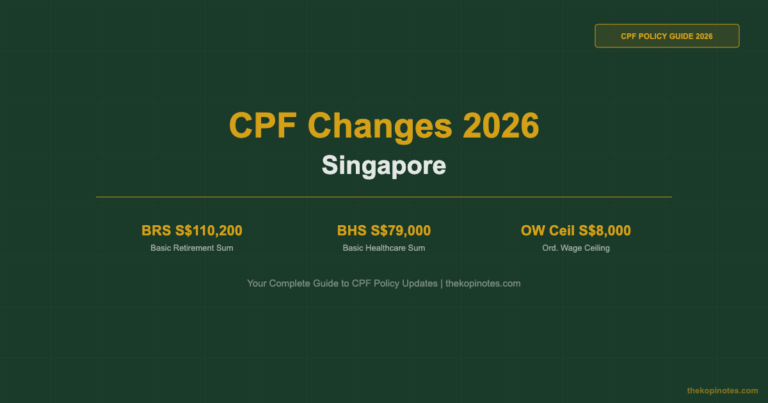
| CPF Savings | Combined RA / SA / OA savings below $110,200 | $110,200 = Basic Retirement Sum (BRS) as at 2026 |
| Income | Average monthly income ≤ $4,000 | Includes employment and business income. Retirees with no income qualify automatically on this criterion. |
| Property | Annual value (AV) ≤ $21,000; and own at most one property | AV is IRAS’s assessed annual rental value of your home. Most 3-room HDB and smaller flats qualify. Owners of private property are ineligible. |
If you are unsure about your Annual Value, you can check it on the IRAS MyTax portal or via the IRAS app. For most residents of 3-room HDB flats or smaller, the AV is comfortably below $21,000.
How Much Can You Receive?
The MRSS matching grant is structured as follows for 2026:
| Parameter | Amount |
|---|---|
| Annual matching cap | $2,000 per calendar year |
| Lifetime cap | $20,000 (cumulative, per person) |
| Minimum top-up to get any match | $1 (matching is dollar-for-dollar on whatever you top up) |
| Interest earned on matched amount | 4% p.a. (RA floor rate), up to 6% with extra interest on first $30K |
| Grant credited | By end of February of the following year |
The annual cap of $2,000 means that topping up $2,000 cash in a year gets you the maximum $2,000 matching grant — for a total of $4,000 added to your RA. Top up less, and you receive a smaller match. Top up more than $2,000, and the excess does not receive matching (though it does still earn RA interest).
Once you have received a cumulative total of $20,000 in matching grants over your lifetime, you are no longer eligible for further matching — even if you remain otherwise eligible by age, income, and property criteria.
Who Can Make Top-Ups on Your Behalf?
One of the most useful features of MRSS is that the cash top-up does not have to come from the eligible person themselves. Any of the following can top up your RA and trigger the matching grant:
- Yourself — from your own savings or bank account
- Your children or spouse — a simple and meaningful way to support ageing parents
- Siblings, relatives, or friends
- Your employer — some employers offer top-ups as part of retirement benefits for older staff
- Community organisations and caregivers — social workers and welfare organisations sometimes facilitate group top-ups for beneficiaries
This flexibility matters. If your own cash savings are tight, a child contributing $2,000 in your name triggers a government grant of $2,000 — effectively giving you $4,000 in RA savings at a cost of $2,000 to your family. That is significantly more efficient than most other ways of helping an elderly parent build retirement savings.
For context on how government schemes like MRSS complement each other, you may also want to read our guide to the Silver Support Scheme, which provides quarterly cash payments to eligible lower-income seniors.
Key Deadlines: Do Not Miss the Cut-Off
The MRSS assessment is done annually. To be eligible for matching in a given year, top-ups must be received by CPF Board within that calendar year. The specific deadlines depend on how you make the top-up:
| Top-Up Method | Deadline | Notes |
|---|---|---|
| GIRO recurring deduction | 31 October | The October instruction is processed in November/December; must be set up by Oct 31 to count in that year |
| PayNow / Online transfer | 31 December | Transfer must clear by 31 Dec; allow 1–2 business days if transacting near year-end |
| Cheque / counter | 31 December | In person at CPF Service Centre; cheques must be received and cleared by 31 Dec |
The matching grant itself is credited to your RA by the end of February of the following year. So if you top up in December 2026, expect the $2,000 government match to appear in your RA statement by late February 2027.
If you miss the year-end deadline, you lose that year’s $2,000 matching opportunity permanently — there is no carry-forward. The practical advice is to set up a GIRO top-up well before October, so it runs automatically each year without requiring you to remember the deadline.
MRSS vs RSTU: The Tax Relief Trade-Off
Cash top-ups to a CPF RA can also be made under the Retirement Sum Topping-Up Scheme (RSTU), which gives the contributor an income tax deduction of up to $8,000 per year (with an additional $8,000 for top-ups to the RA of a family member).
However, there is a critical distinction: a top-up that qualifies for MRSS matching does NOT also qualify for RSTU tax relief. You cannot have both benefits on the same dollar.
| Feature | MRSS Matching | RSTU Tax Relief |
|---|---|---|
| Government adds money to your RA | ✅ Yes ($2,000/yr) | ❌ No |
| Income tax deduction for the top-up amount | ❌ No | ✅ Up to $8,000 |
| Who benefits most | Lower-income seniors (below BRS) | Working adults with taxable income |
| Income required to benefit | None (non-taxpayers can receive it) | Yes — must have taxable income |
The practical implication: for eligible MRSS recipients who are retired and have no taxable income, the tax relief from RSTU is worthless anyway. The MRSS matching grant — a free $2,000 per year from the government — is objectively more valuable.
If you or your family member is eligible for MRSS, the top-up should go through MRSS first to capture the matching. Any additional top-ups above the $2,000 annual matching cap can then potentially be structured as RSTU top-ups for tax relief purposes, if there is taxable income to offset.
How MRSS Grows Your CPF LIFE Monthly Payout: A Worked Example
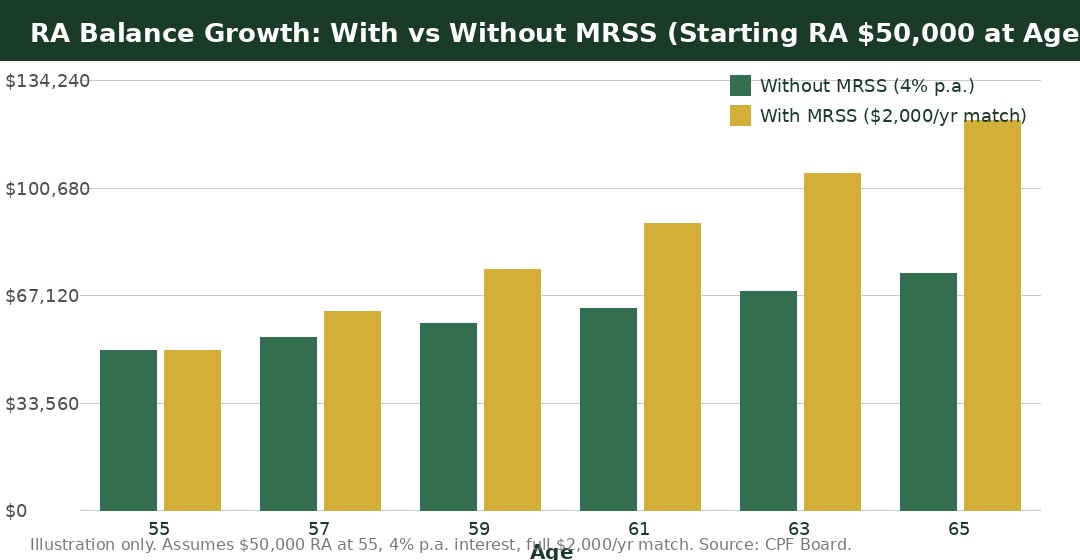
The ultimate benefit of MRSS is not the grant itself — it is the compounding that happens inside the RA over years, and the higher CPF LIFE payout that results at age 65.
Let’s follow Mdm Lim, 58, who is planning ahead for retirement.
Her situation (as at end 2026):
- RA balance: $48,000 — well below the BRS of $110,200, so she qualifies on the CPF savings criterion
- Monthly income: $2,800 (part-time work) — below the $4,000 cap
- Home: 3-room HDB flat, Annual Value $9,200 — below $21,000 cap
- No other property
- She is a Singapore Citizen
Her action: She tops up $2,000 in November 2026 via PayNow. The government matches $2,000, and by February 2027, her RA is $48,000 + $4,000 = $52,000.
She continues topping up $2,000 each year for 7 years (ages 58–64). Her combined annual contributions (own + matching) are $4,000 per year. Here is what her RA balance looks like, growing at 4% p.a.:
| End of Year | Age | Her Top-Up | Govt Match | RA Balance (approx.) |
|---|---|---|---|---|
| 2026 | 58 | $2,000 | $2,000 | $52,000 |
| 2027 | 59 | $2,000 | $2,000 | $58,080 |
| 2028 | 60 | $2,000 | $2,000 | $64,403 |
| 2029 | 61 | $2,000 | $2,000 | $70,979 |
| 2030 | 62 | $2,000 | $2,000 | $77,818 |
| 2031 | 63 | $2,000 | $2,000 | $84,931 |
| 2032 | 64 | $2,000 | $2,000 | $92,328 |
By age 64, Mdm Lim’s RA has grown from $48,000 to approximately $92,000 — her own contributions of $14,000, matching grants of $14,000, and accumulated 4% p.a. interest accounting for the rest.
At 65, the RA is converted to her CPF LIFE monthly payout. Based on CPF Board’s approximate CPF LIFE rate, every additional $1,000 in RA generates roughly $6–7 per month in additional CPF LIFE income for life. The $44,000 extra in Mdm Lim’s RA (compared to no top-ups) translates to approximately $264–$308 more per month for life — a meaningful addition to her retirement income floor.
Critically, $14,000 of that came from the government for free.
Use the TKN Retirement Planning Calculator to model your own RA growth and CPF LIFE projections.
The 2026 Expansion: Persons With Disabilities Now Included
From 1 January 2026, the MRSS was expanded to include Singaporeans with disabilities of any age — removing the previous minimum age requirement of 55 for this group.
Previously, a 40-year-old Singaporean with a severe disability who met all other eligibility criteria would not qualify for MRSS because they were below 55. Under the 2026 change, they now qualify, provided their disability is verified by the Ministry of Social and Family Development (MSF).
The other eligibility criteria remain the same: CPF savings below $110,200, monthly income at or below $4,000, and property AV at or below $21,000. The annual matching cap of $2,000 and lifetime cap of $20,000 also apply unchanged.
This expansion reflects the broader intent of the scheme: to support Singaporeans who face structural challenges in building up retirement savings. For caregivers of family members with disabilities, topping up the RA of your loved one can now generate the same dollar-for-dollar matching benefit.
For related government retirement support schemes, see our guide to the Silver Support Scheme, which provides quarterly cash payouts to low-income seniors living in 1- to 5-room HDB flats.
How to Check Your MRSS Eligibility and Track Your Matching Grant
Because CPF Board assesses eligibility automatically, the most practical thing you need to do is ensure your top-up reaches CPF in time. However, knowing where to look for your grant status helps:
- CPF Statement: Log into your CPF account at my.cpf.gov.sg. Matching grants credited in February will appear in your RA transaction history for that month.
- CPF Mobile App: Under “My Account” → “Retirement Account” → transaction history. Look for credits labelled “Matched Retirement Savings Scheme” or “Matching Grant for Retirement”.
- CPF Benefit Eligibility Checker: The CPF Board website has a benefit checker tool under “Growing Your Savings” where you can check your estimated MRSS eligibility for the current year.
- Customer Service: Call CPF Board at 1800-227-1188 (Mon–Fri, 8am–5pm, excluding public holidays) if you are unsure why a grant was or was not credited.
If you believe you should have qualified but did not receive the matching grant by end-February, contact CPF Board with your CPF statement and income details. Eligibility is determined as at 31 December of the preceding year, so late submissions will not be considered for the previous year.
You can learn more about how the Matched Retirement Savings Scheme works in detail on these TKN glossary pages: Matched Retirement Savings Scheme Singapore and CPF Matched Retirement Savings Scheme.
Related Tools
- Retirement Planning Calculator — model your CPF LIFE payout based on your RA balance and contribution plan
- CPF LIFE explainer — understand how your RA converts to monthly payouts at 65
- MRSS Glossary Page — quick reference for scheme parameters and eligibility
- CPF Retirement Sum Guide — understand BRS, FRS and ERS and how they affect your MRSS eligibility
- Silver Support Scheme Guide — the quarterly cash payout scheme that often complements MRSS for low-income seniors
Disclaimer: This article is for informational purposes only and does not constitute financial advice. Scheme parameters are based on CPF Board and government sources as at October 2026. Eligibility criteria, matching caps, and interest rates may change. Consult the CPF Board or a licensed financial adviser before making decisions about your CPF contributions.
Frequently Asked Questions
Can I apply for MRSS, or is it automatic?
What happens if my RA savings hit $110,200 mid-year?
Does the matching grant count towards the $80,000 personal income tax relief cap?
If I top up more than $2,000, does the excess get matched?
Can my adult child top up my RA to get me the MRSS matching?
When exactly will the matching grant appear in my RA?
Does MRSS affect my CPF LIFE payout?
What changed for the MRSS in 2026?
What is the difference between MRSS and the Silver Support Scheme?
This article was researched with the help of AI. While we strive to keep all information accurate and up to date, there may be errors. If you notice any discrepancies, please contact us.