Early Stage vs Late Stage Critical Illness Insurance Singapore: Which Do You Need? (2026)
Singapore’s critical illness (CI) insurance market is split into two distinct products: standard CI that covers 37 severe-stage conditions under the LIA 2024 Framework, and early-stage CI (also called early CI or multi-pay CI) that pays out from the first sign of a serious illness — including carcinoma in situ, early thyroid cancer, and intermediate-stage conditions. The right choice depends on your budget, family medical history, and whether you need multiple payouts across a single illness journey. This guide explains the exact differences and helps you decide.
Not financial advice. All premium figures are indicative estimates only. Data verified as at 27 October 2026. Always refer to your insurer’s policy documents for exact definitions and pricing.
1. What Is Standard CI Insurance? (Severe Stage)
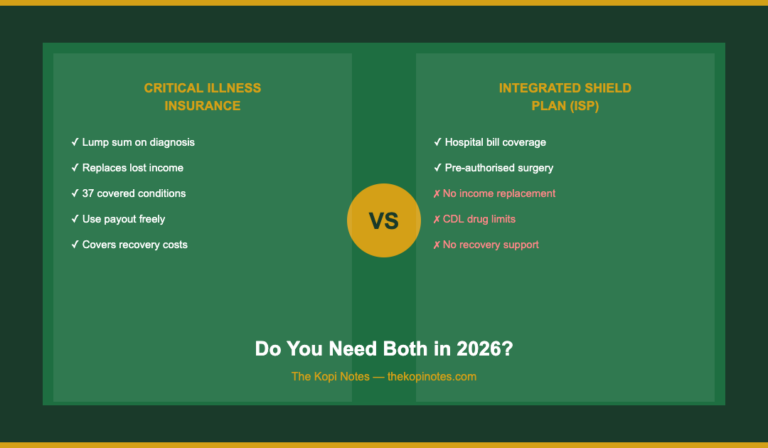
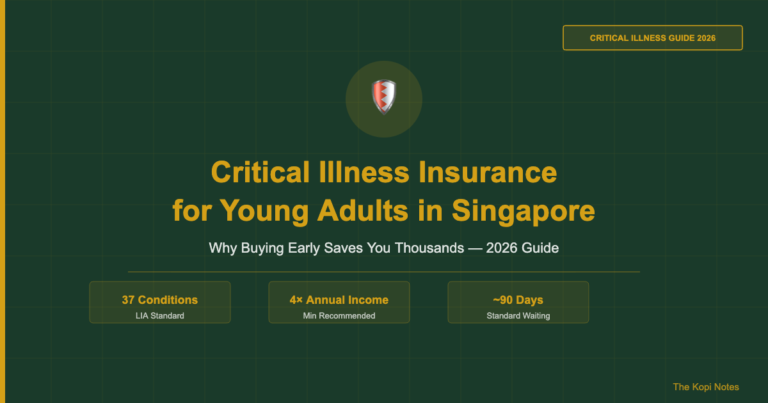
Standard critical illness insurance in Singapore pays a lump sum upon diagnosis of a qualifying illness at its severe stage. All insurers follow the same definitions for 37 conditions as defined in the LIA CI Framework 2024, which took effect on 1 October 2025 for all new policies.
The 37 standardised conditions include: Major Cancer, Heart Attack of Specified Severity, Stroke with Permanent Neurological Deficit, Coronary Artery By-pass Surgery, End Stage Kidney Failure, Alzheimer’s Disease, Parkinson’s Disease, Motor Neurone Disease, and 29 others covering cardiovascular, neurological, organ failure, and trauma categories.
Key features of standard CI insurance:
- One payout only — the sum assured is paid once upon diagnosis; the policy terminates
- Severe/late-stage conditions only — early or intermediate-stage events do not trigger a payout
- LIA-standardised definitions — the definition of “Heart Attack of Specified Severity” is identical across AIA, Prudential, Great Eastern, FWD, and all other LIA members
- Lower premiums — since only the worst-case scenario triggers a payout
Standard CI is the most common form of CI coverage in Singapore and is available either as a standalone policy or as a rider attached to whole life or term life insurance.
2. What Is Early Stage CI Insurance?
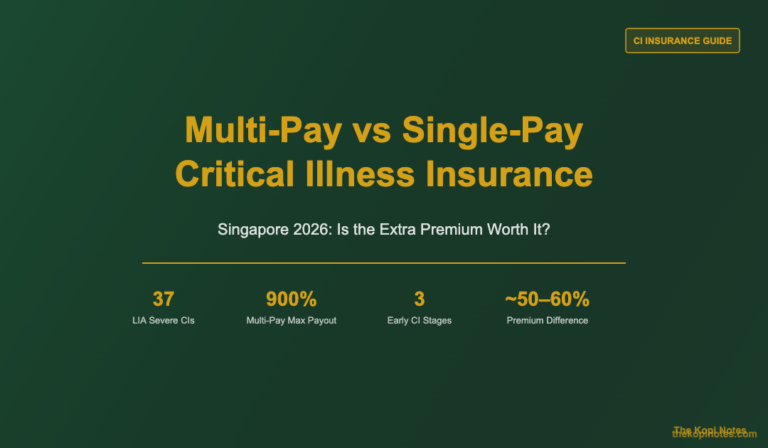
Early stage CI insurance — also called early critical illness, early CI rider, or multi-pay CI — pays out when you are diagnosed with a critical illness at its early or intermediate stage, before it progresses to severe. Unlike standard CI, the exact conditions covered and their definitions are set by each insurer independently (they are not LIA-standardised).
A key feature of early CI is that it often allows multiple payouts across different conditions or across progression stages of the same condition. For example, if you are diagnosed with early-stage breast cancer (a partial payout), receive treatment, then later develop coronary artery disease (another payout), an early/multi-pay CI plan may cover both events — up to the policy’s maximum payout multiplier.
Common early-stage conditions covered (insurer-specific, non-standardised):
- Carcinoma in situ — non-invasive cancer (pre-malignant); most commonly detected in breast, cervix, and bowel screening
- Early thyroid cancer — papillary micro-carcinoma of thyroid ≤1cm with no metastasis
- Prostate cancer at low clinical risk
- Ductal carcinoma in situ (DCIS) of the breast
- Stage 1 heart attack — minor/small area of heart muscle affected (below the LIA “specified severity” threshold)
- TIA (Transient Ischaemic Attack) — mini-stroke with no permanent neurological deficit
The trade-off: early CI costs significantly more. Depending on your age and health, expect to pay 2–3× the premium of a comparable standard CI plan for the same sum assured.
3. Key Differences: Early CI vs Standard CI
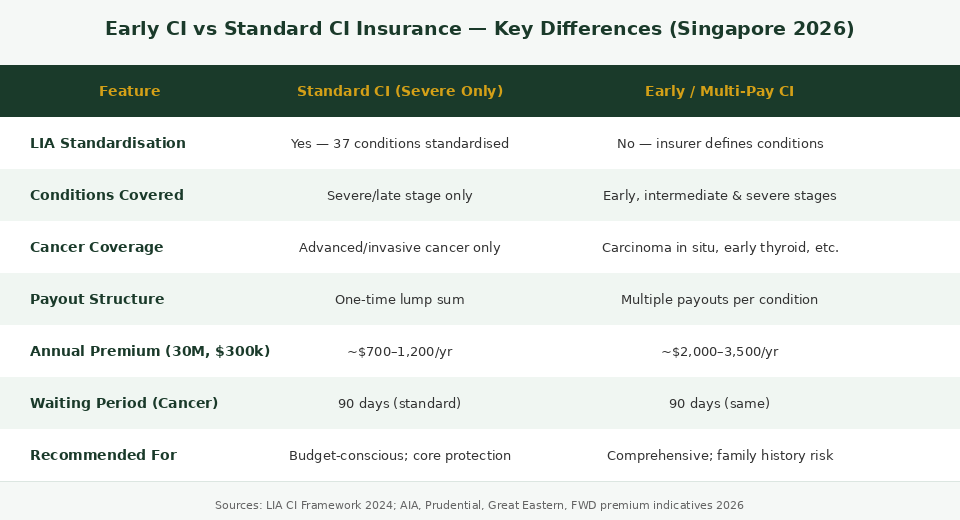
The most critical distinction: LIA standardisation. For standard CI, “Major Cancer” means the same thing regardless of which insurer you buy from — you can compare plans purely on premium, sum assured, and features. For early CI, the definition of “Early-Stage Cancer” at AIA is different from the definition at Prudential or Great Eastern. You must read the policy terms carefully, not just the brochure headline.
What this means in practice: a diagnosis of carcinoma in situ of the cervix may trigger a 25% payout at Insurer A, no payout at Insurer B (because they exclude that specific site), and a 50% payout at Insurer C. The devil is in the definitions.
4. Premium Cost Comparison
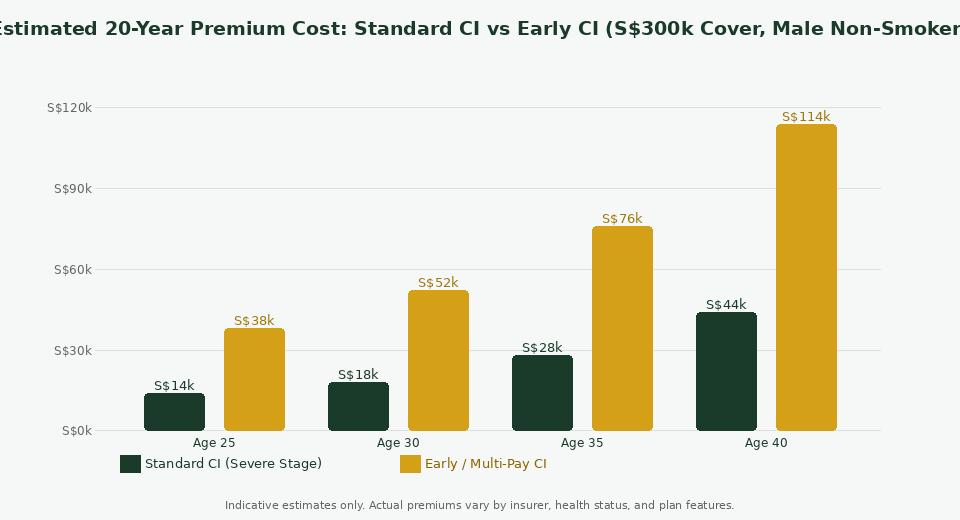
Below are estimated 20-year cumulative premiums for a non-smoking male with S$300,000 sum assured — standard CI versus early/multi-pay CI — at different entry ages:
| Entry Age | Standard CI (20yr est.) | Early / Multi-Pay CI (20yr est.) | Premium Difference |
|---|---|---|---|
| Age 25 | S$14,000 | S$38,000 | +S$24,000 (+171%) |
| Age 30 | S$18,000 | S$52,000 | +S$34,000 (+189%) |
| Age 35 | S$28,000 | S$76,000 | +S$48,000 (+171%) |
| Age 40 | S$44,000 | S$114,000 | +S$70,000 (+159%) |
Indicative estimates for male non-smoker, S$300k sum assured, 20-year cumulative premiums. Actual premiums vary by insurer and health status.
The premium gap is substantial. For most Singaporeans in their 20s and 30s, the additional S$24,000–34,000 in premiums over 20 years for early CI coverage could instead be invested in a diversified ETF portfolio or REIT income strategy. Whether that trade-off is worth it depends on individual risk factors.
5. Who Needs Early Stage CI Insurance?
Early CI makes the most financial sense for people with specific risk profiles. Consider it if:
| Risk Factor | Why Early CI Helps |
|---|---|
| Strong family history of cancer | Cancer often runs in families; early detection is more common if you screen regularly — you need a plan that pays on early finding |
| Women (breast/cervical cancer risk) | Carcinoma in situ and DCIS are common findings in mammograms — these do not trigger standard CI but do trigger early CI |
| Regular health screening participants | You are more likely to find conditions early — a plan that only pays on severe stage defeats the purpose of early detection |
| High-income earners with income protection needs | Even an early-stage diagnosis may require treatment, time off work, and lifestyle changes — the financial impact is real before severe stage |
| Those with dependants and high financial commitments | A mortgage, young children, or elderly parents means you cannot afford income gaps even from a non-severe illness |
Conversely, standard CI may be sufficient if you are young and healthy with no family history, on a tight budget, or already have a robust emergency fund that can cover short-term income loss from an early-stage diagnosis without requiring an insurance payout.
6. Major Singapore Early CI Plans — A Quick Overview
| Insurer & Plan | Type | Key Feature |
|---|---|---|
| AIA MultiPay CI Plan IV | Multi-pay early CI | Up to 900% sum assured across multiple claims; covers early, intermediate, and severe stages |
| Prudential PRUCritical Harvest | Early-stage rider | Attaches to PRULife / PRUCover; covers 3 stages per condition; includes mental health conditions |
| Great Eastern TotalCare Elite | Multi-stage CI | Covers 164 conditions across all stages; includes diabetic complications; widest condition list |
| FWD Big 3 Cancer | Specialised cancer plan | Focused on early, intermediate, and severe cancer only; much lower cost than full early CI; suitable as supplement |
| Singlife Multipay CI | Multi-pay early CI | Unlimited multiple claims; no waiting period between claims for different conditions; competitive pricing |
| HSBC Life Critical Protect 360 | Comprehensive multi-stage | Covers 120+ conditions; pays on early, intermediate, and severe; includes angioplasty and cancer recurrence |
For comparison purposes only. Always read the policy document for exact condition definitions and exclusions. Data as at Oct 2026.
7. Real-World Payout Examples
Consider two scenarios for the same person — female, age 35, S$200,000 sum assured:
Scenario A: Standard CI only
She is diagnosed with ductal carcinoma in situ (DCIS) of the breast — Stage 0 breast cancer. Her standard CI policy does not pay out. DCIS is carcinoma in situ and does not meet the LIA definition of “Major Cancer” (which requires invasive cancer). She undergoes surgery and partial loss of income with no CI payout. Her MediShield Life and Integrated Shield Plan cover her hospital bills, but the income replacement gap is uncovered.
Scenario B: Standard CI + Early CI rider
Same diagnosis. Her early CI rider pays out S$50,000 (25% of sum assured under her plan’s “Early Stage Cancer” definition), providing cash to cover her income gap, additional treatment costs, and caregiving needs. If the DCIS later progresses to invasive breast cancer (Major Cancer), her standard CI policy pays the remaining S$200,000.
This example illustrates the core benefit of early CI: you get paid when it matters most — when you are dealing with the diagnosis and recovery, not just when you reach the most severe outcome.
8. Which Should You Buy First?
The conventional wisdom from Singapore financial advisers and the LIA is:
- First, establish adequate standard CI coverage — S$150,000–300,000 for severe-stage protection. This is your foundation. Without this, an early CI plan alone leaves you underprotected for catastrophic events.
- Then, add early CI as a layer on top — either as a rider to your existing plan or as a standalone early CI policy, if budget allows.
- Consider a focused cancer plan as a cost-effective middle ground — products like FWD Big 3 Cancer or Singlife Cancer Cover cover cancer across all stages (early to severe) at a much lower premium than full multi-pay CI, since cancer accounts for ~55% of all CI claims.
For broader financial planning, many Singaporeans combine CI insurance with CPF investments via platforms like Endowus (referral code 2V343) for CPF-OA and SRS portfolio management, building both a protection layer and a wealth-growth layer. See our retirement planning calculator to model how your CI coverage interacts with your overall retirement readiness.
For passive income as part of your financial resilience plan, explore our guide to passive income strategies in Singapore or compare the best CI insurance plans in Singapore for 2026.
Frequently Asked Questions
Is early stage CI insurance worth it in Singapore?
What is the difference between early CI and multi-pay CI?
Can I have both standard CI and early CI insurance at the same time?
Does early CI cover cancer during the 90-day waiting period?
What happens if I already have standard CI — can I add early CI later?
Are early CI definitions the same across all Singapore insurers?
Compare the Best CI Insurance Plans in Singapore
See how AIA MultiPay, Prudential PRUCritical Harvest, Great Eastern TotalCare, FWD, and Singlife compare on conditions covered, premiums, and payout limits.
Get Free Insurance Advice
Speak with a licensed insurance advisor. No obligation, no cost.
By submitting this form, you agree to our Privacy Policy.
This article was researched with the help of AI. While we strive to keep all information accurate and up to date, there may be errors. If you notice any discrepancies, please contact us.