CSPX Index Rebalancing: How S&P 500 Changes Hit Your ETF (2026 Guide)
What quarterly reconstitution and ad hoc swaps actually do to your iShares Core S&P 500 UCITS ETF holdings.
CSPX (iShares Core S&P 500 UCITS ETF) is index rebalancing is the quarterly process where S&P Dow Jones Indices adds and removes companies from the S&P 500 — most recently effective 21 September 2026, with the next change effective 6 October 2026. CSPX’s fund manager must buy the new additions and sell the deletions to keep tracking the index, a process that happens automatically inside the fund without any action needed from Singapore investors.
Not financial advice. All figures are for educational reference only. Data verified as at 28 October 2026 against official S&P Dow Jones Indices announcements.
Table of Contents
Contents — Click to expand
What Is Index Rebalancing?
Index rebalancing (also called reconstitution) is the process an index provider uses to keep an index representative of the market it’s supposed to track. For the S&P 500, that provider is S&P Dow Jones Indices (S&P DJI), a joint venture between S&P Global, the CME Group and News Corp. Four times a year, S&P DJI’s index committee reviews the full universe of large-cap US companies and decides which ones belong in the 500-company benchmark and which ones no longer qualify.
CSPX — the iShares Core S&P 500 UCITS ETF, Ireland-domiciled and listed on the London Stock Exchange — exists purely to replicate that index as closely as possible. It uses full physical replication, meaning the fund actually buys the underlying shares rather than using derivatives. So when the index changes, the fund has to change with it. A Singapore investor holding CSPX in an IBKR or Saxo account never has to lift a finger during this process; the fund manager (BlackRock/iShares) handles every trade inside the fund.
This is different from a company simply growing or shrinking in value — that happens continuously and doesn’t require any trading. Reconstitution specifically refers to companies entering or leaving the index entirely, which forces the fund to buy a completely new stock or sell out of one it previously held.
How S&P 500 Quarterly Reconstitution Works
The S&P 500 follows a fixed quarterly review schedule. S&P DJI announces changes roughly two weeks ahead of the effective date, then the actual swap happens before the market opens on the Monday following the third Friday of March, June, September and December. In 2026, the four quarterly effective dates were 23 March, 22 June, and 21 September, with the next one projected for 21 December (the Monday after the third Friday, 18 December).
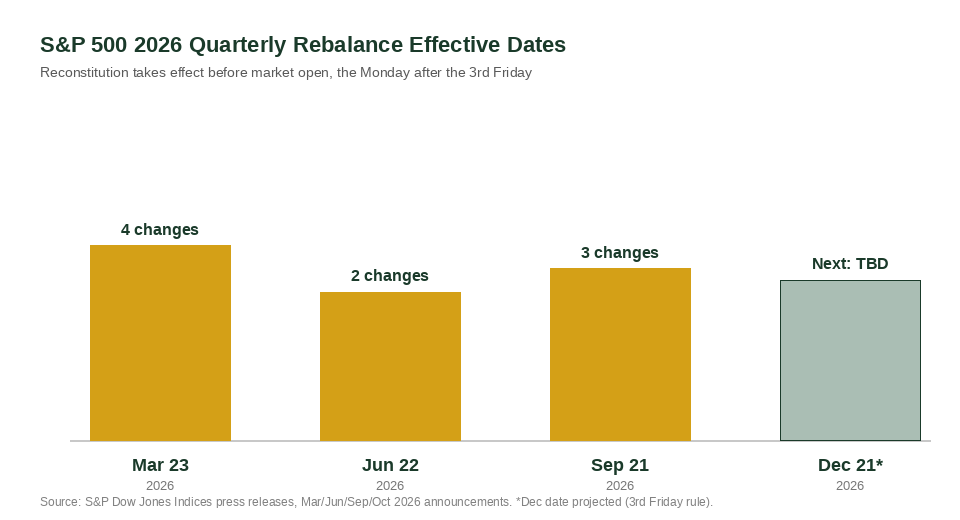
Source: S&P Dow Jones Indices press releases, March–October 2026 announcements.
On the effective date, CSPX’s portfolio managers execute all the required buys and sells in a single trading session, trying to minimise the price impact of moving large sums of money in and out of the affected stocks. Because CSPX tracks a highly liquid, large-cap index, this process is relatively orderly compared to small-cap or emerging-market reconstitutions — but it still generates real trading activity and real transaction costs inside the fund.
Who Decides What Gets Added or Removed
Unlike some indices that follow purely mechanical rules, the S&P 500 uses a semi-discretionary process run by the S&P US Index Committee. A company generally needs: a market capitalisation above S&P DJI’s minimum threshold (reviewed periodically and currently in the tens of billions of USD), positive cumulative earnings over the most recent four quarters combined, adequate trading liquidity, a US domicile, and a public float of at least 50% of shares outstanding. Meeting these criteria doesn’t guarantee inclusion — the committee still has discretion over timing and sector balance, which is why some eligible companies wait months before being added while others queue up for a replacement slot.
Deletions usually happen for one of three reasons: the company is acquired or taken private (as with Warner Bros. Discovery following its Paramount Skydance takeover in October 2026), it spins off a business unit and the resulting smaller company no longer meets the market-cap bar (Corteva’s spin-off of Vylor is the clearest 2026 example), or its market capitalisation falls persistently below the index’s minimum threshold relative to other candidates.
S&P 500 Changes So Far in 2026
CSPX investors who checked their holdings list at the start of 2026 would find it noticeably different today. Here are the confirmed quarterly and ad hoc changes through to late October 2026, verified against official S&P DJI announcements:
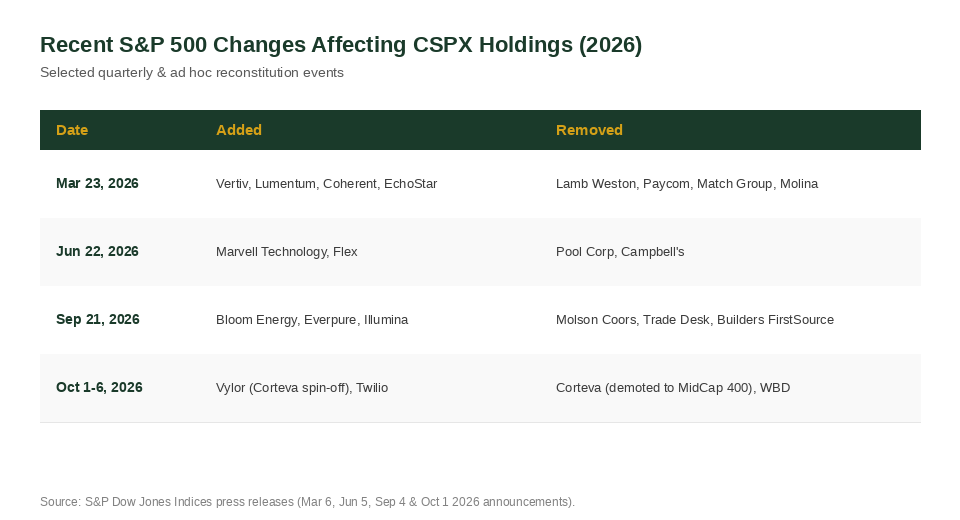
Source: S&P Dow Jones Indices press releases (6 March, 5 June, 4 September, 1 October 2026 announcements).
| Effective Date | Added to S&P 500 | Removed from S&P 500 |
|---|---|---|
| 9 Feb 2026 | Ciena | Dayforce |
| 23 Mar 2026 (quarterly) | Vertiv, Lumentum, Coherent, EchoStar | Lamb Weston, Paycom, Match Group, Molina Healthcare |
| 1 Jun 2026 | FedEx Freight | EPAM Systems |
| 22 Jun 2026 (quarterly) | Marvell Technology, Flex | Pool Corp, Campbell’s |
| 5 Aug 2026 | Ferguson Enterprises | Electronic Arts |
| 21 Sep 2026 (quarterly) | Bloom Energy, Everpure, Illumina | Molson Coors, The Trade Desk, Builders FirstSource |
| 1 Oct 2026 | Vylor (Corteva spin-off) | — |
| 6 Oct 2026 | Twilio | Warner Bros. Discovery; Corteva demoted to S&P MidCap 400 |
That’s roughly 20 individual stock changes to CSPX’s underlying holdings in under ten months — a reminder that even a “set and forget” index fund is quietly turning over its portfolio in the background all year round.
How Rebalancing Actually Affects CSPX
For a Singapore investor, the practical effect of rebalancing is close to invisible day-to-day, but it does ripple through the fund in three specific ways. First, portfolio composition shifts automatically: your proportional exposure to Illumina or Bloom Energy appears the moment the change takes effect, with no action needed on your end. Second, the fund incurs real trading costs executing the buys and sells, which show up as a small drag inside the fund’s net asset value (NAV) rather than as a separate fee charged to you — this is distinct from, but related to, the tracking difference discussed in our CSPX and VWRA tracking difference guide. Third, CSPX’s securities lending programme (which we cover in detail in our CSPX securities lending guide) has to unwind any loaned-out shares of a stock being deleted before it can be sold, which is one reason funds need the two-week notice period between announcement and effective date.
A worked example: suppose Singapore investor Priya holds SGD 50,000 in CSPX. On 21 September 2026, her proportional exposure to Molson Coors, The Trade Desk and Builders FirstSource was automatically replaced with proportional exposure to Bloom Energy, Everpure and Illumina — without her placing a single trade. If each outgoing stock represented roughly 0.02%–0.05% of the index (typical weights for S&P 500 constituents outside the top 50), her reallocation was in the order of SGD 10–25 per name, executed inside the fund at institutional trading costs far below what she’d pay rebalancing a DIY portfolio of individual stocks herself.
Ad Hoc Changes vs Quarterly Rebalances
Not every S&P 500 change waits for the quarterly cycle. Mergers, acquisitions, bankruptcies and spin-offs can force an “ad hoc” change at any time, announced on short notice. October 2026 is a good case study: Corteva completed the spin-off of its seed-treatment unit, Vylor, which joined the S&P 500 on 1 October the moment the spin-off closed. Days later, the newly smaller Corteva was judged no longer large enough for the S&P 500 and was demoted to the S&P MidCap 400, while Twilio was added in its place — but the specific trigger for Twilio’s inclusion was Warner Bros. Discovery’s removal following its takeover by Paramount Skydance, not Corteva’s demotion. S&P DJI handled both the spin-off reshuffle and the M&A-driven swap within the same week.
These ad hoc events matter more for CSPX’s trading desk than for individual investors, since they usually involve a single stock swap rather than the four-to-eight simultaneous changes of a quarterly rebalance. But they illustrate why CSPX’s holdings list is never static — corporate actions can force changes on any given week, not just four times a year.
Does Rebalancing Cost You Money?
Rebalancing does generate real costs — bid-ask spreads, brokerage commissions and market impact from trading large blocks of stock — and those costs are absorbed inside the fund, which can show up as a few basis points of tracking difference over a year. However, several factors offset this for CSPX specifically:
- TER already covers most of this. CSPX’s 0.07% p.a. total expense ratio is priced with the expectation of ongoing portfolio maintenance, including reconstitution trading.
- Securities lending revenue helps offset it. iShares lends out CSPX’s underlying shares to short-sellers and institutions, generating extra income that is shared back with the fund — partially cancelling out the rebalancing trading cost.
- S&P 500 liquidity keeps impact low. Because index additions and deletions are large-cap, heavily traded US stocks, CSPX’s trading desk can execute reconstitution trades with minimal price slippage compared to a small-cap or frontier-market index fund.
In practice, the net effect of rebalancing on CSPX’s annual tracking difference is typically a fraction of a basis point to a few basis points — far smaller than the TER itself, and immaterial for a long-term buy-and-hold Singapore investor. It is not a reason to avoid index investing; it is simply the operational cost of keeping a 500-stock portfolio current, which you would pay in a far more expensive and inefficient way trying to replicate the index yourself.
Frequently Asked Questions
How often does CSPX rebalance?
CSPX rebalances in line with the S&P 500’s quarterly reconstitution schedule — effective before market open on the Monday after the third Friday of March, June, September and December. It can also change outside this schedule when a constituent company is acquired, goes bankrupt, or is spun off, which S&P Dow Jones Indices calls an “ad hoc” change.
Do I need to do anything when CSPX rebalances?
No. All the buying and selling happens automatically inside the fund, managed by iShares (BlackRock). As a Singapore investor holding CSPX through a brokerage like IBKR, Saxo or moomoo, your shareholding count stays the same — only the fund’s underlying basket of stocks changes.
Does index rebalancing reduce my returns?
Rebalancing creates a small amount of trading cost inside the fund, which contributes marginally to tracking difference (the gap between CSPX’s return and the actual S&P 500’s return). For CSPX, this effect is typically a fraction of a basis point to a few basis points per year — far smaller than headline TER — and is partly offset by securities lending income.
When is the next S&P 500 rebalance after October 2026?
The next scheduled quarterly rebalance is projected for 21 December 2026 (the Monday following the third Friday, 18 December), pending official confirmation from S&P Dow Jones Indices, which typically announces specific changes about two weeks beforehand.
What's the difference between a quarterly rebalance and an ad hoc change?
A quarterly rebalance is the scheduled review that happens four times a year and can involve several companies being added and removed at once. An ad hoc change happens outside that schedule, usually triggered by a single corporate event like a merger, acquisition, bankruptcy or spin-off — such as Twilio replacing Warner Bros. Discovery in October 2026 following its takeover by Paramount Skydance.
Does rebalancing affect VWRA the same way?
VWRA tracks the FTSE All-World Index, which uses a different review schedule and provider (FTSE Russell) than the S&P 500. The same general principle applies — periodic reconstitution plus ad hoc changes for corporate events — but the specific dates, criteria and frequency differ. See our CSPX and VWRA tracking difference guide for how this plays out for each fund.
Want to see exactly how CSPX’s tracking difference compares to VWRA, or how its lending programme works? Read our CSPX & VWRA tracking difference guide and CSPX securities lending explained. For VWRA investors curious about liquidity costs on the LSE, see our VWRA liquidity and bid-ask spread guide.
Buying CSPX or VWRA through a low-cost broker matters more than most investors realise — small differences in commissions and FX spreads compound over decades. Compare your options and sign up with the Syfe referral code and sign-up bonus if you’re consolidating your brokerage and SRS investing in one place. And once your ETF portfolio is in place, run the numbers on your long-term plan with our Singapore retirement calculator.
Disclaimer: This article is for educational purposes only and does not constitute financial advice. ETF holdings, index methodology and reconstitution schedules can change without notice — always verify current data against the official iShares CSPX factsheet and S&P Dow Jones Indices announcements before making investment decisions. Past index changes are not indicative of future composition. Data verified as at 28 October 2026.
This article was researched with the help of AI. While we strive to keep all information accurate and up to date, there may be errors. If you notice any discrepancies, please contact us.