VWRA Liquidity & Bid-Ask Spread: What Trading on the LSE Really Costs Singapore Investors (2026 Guide)
VWRA’s on-screen volume looks thin — here’s why that doesn’t mean the spread is wide, and when it actually does widen.
VWRA’s bid-ask spread on the London Stock Exchange is usually only a few basis points, even though its on-screen trading volume looks thin compared to a US blue-chip stock. That’s because authorised participants can create or redeem VWRA shares directly against its underlying US$87.3 billion basket of stocks, not just against whatever is quoted on screen. The spread still widens outside LSE-NYSE overlap hours, during volatile markets, or if you place a market order instead of a limit order near VWRA’s live iNAV.
Not financial advice. All figures are for educational reference only. Data verified as at 19 October 2026 against Vanguard’s 30 September 2026 factsheet and justETF, unless otherwise noted.
Table of Contents
Contents — Click to expand
- What Is a Bid-Ask Spread, and Why Does VWRA’s Look Deceptive?
- The Two Layers of ETF Liquidity: Screen vs Underlying Basket
- How Market Makers Keep VWRA’s Spread Tight
- When VWRA’s Spread Widens (and Why)
- Best Times to Trade VWRA From Singapore
- Real Trading Cost Breakdown: Spread, FX and Commission
- Does Securities Lending Affect VWRA’s Liquidity?
- Who Should Actually Care About This?
- Frequently Asked Questions
What Is a Bid-Ask Spread, and Why Does VWRA’s Look Deceptive?
The bid-ask spread is the gap between the highest price a buyer will pay (the bid) and the lowest price a seller will accept (the ask) at any moment. For a single stock, a wide spread usually signals thin trading interest. Applying that same logic to VWRA — the Vanguard FTSE All-World UCITS ETF (USD) Accumulating, listed on the London Stock Exchange (LSE) under ticker VWRA (priced in USD) and VWRP (priced in GBP) — leads Singapore investors to the wrong conclusion.
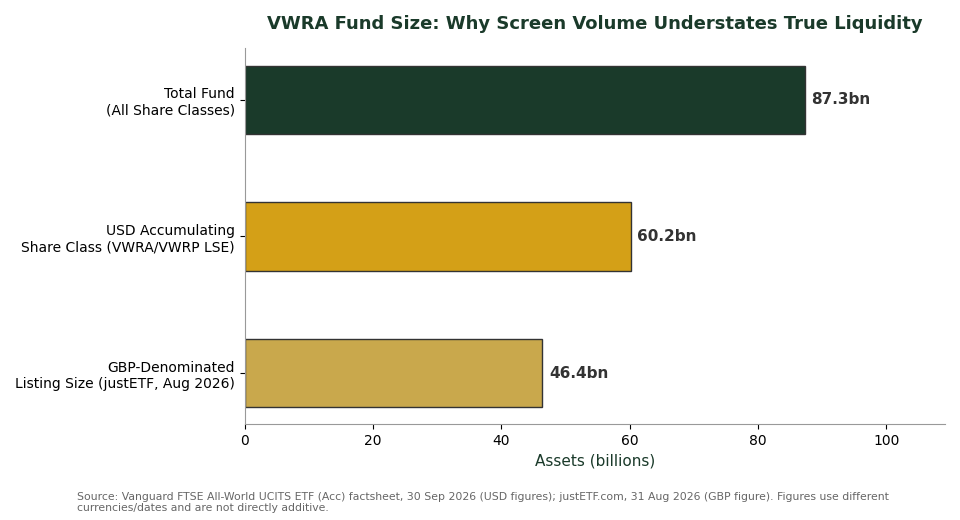
VWRA’s own on-screen trading volume on the LSE is genuinely modest next to a stock like Apple. If you judged VWRA’s liquidity purely by watching the order book tick over, you might assume the spread is wide and the fund is hard to exit. In practice, VWRA is one of the largest and most heavily traded UCITS ETFs in Europe, with total assets of US$87.295 billion as at 30 September 2026 (Vanguard factsheet, 30 Sep 2026). The disconnect between “thin-looking screen” and “deep fund” is exactly what this guide unpacks.
The Two Layers of ETF Liquidity: Screen vs Underlying Basket
Every ETF has two separate liquidity layers, and conflating them is the single most common mistake retail investors make when assessing spread risk.
Layer 1 — on-screen (secondary market) liquidity: this is what you see in your broker’s order book — the quoted bid, ask, and the volume of VWRA units changing hands between existing holders on the LSE that day. This is the layer that looks thin for VWRA relative to a mega-cap stock.
Layer 2 — primary market (basket) liquidity: this is the liquidity of the roughly 3,800 underlying stocks VWRA holds — companies like Apple, Microsoft and Nvidia that trade billions of dollars a day across global exchanges. Authorised participants (APs) — large banks and market-making firms — can create new VWRA units by delivering a basket of the underlying shares to Vanguard, or redeem VWRA units for the underlying basket, at any point during LSE trading hours. This creation/redemption mechanism means VWRA’s “true” liquidity is closer to the liquidity of its US$87.3 billion underlying portfolio than to whatever volume happens to print on the LSE order book that hour.
For a Singapore investor deciding whether VWRA is “liquid enough” to hold a six-figure SGD position in, Layer 2 is the one that actually matters. A fund tracking the full country, sector and stock allocation of the FTSE All-World Index, built almost entirely from the world’s most liquid large- and mid-cap stocks, cannot become genuinely illiquid just because LSE screen volume is quiet on a given Tuesday.
| VWRA Fact | Detail |
|---|---|
| Full Name | Vanguard FTSE All-World UCITS ETF (USD) Accumulating |
| LSE Tickers | VWRA (USD) / VWRP (GBP) |
| ISIN | IE00BK5BQT80 |
| Index Tracked | FTSE All-World Index (~3,800 holdings) |
| Domicile | Ireland |
| Replication | Physical (optimised sampling) |
| Total Assets | US$87.295 billion (30 Sep 2026) |
| USD Share Class Assets | US$60.194 billion (30 Sep 2026) |
| Ongoing Charges Figure (TER) | 0.14% p.a. |
Source: Vanguard FTSE All-World UCITS ETF (Acc) factsheet, 30 September 2026.
How Market Makers Keep VWRA’s Spread Tight
The LSE’s Exchange Traded Products market operates under a designated market-making framework: ETF issuers like Vanguard appoint registered market makers who commit to posting continuous two-way quotes on VWRA during LSE trading hours, in exchange for exchange fee rebates and other incentives. Because these market makers can hedge their VWRA inventory against the underlying basket (or against VWRA’s other listings on SIX Swiss Exchange, Euronext Amsterdam, Deutsche Börse and Borsa Italiana — all share the same ISIN, IE00BK5BQT80), they can afford to quote a tight spread even when retail order flow on the LSE screen is light.
This is the structural reason experienced ETF investors say “don’t judge an ETF’s liquidity by its screen volume alone.” A Singapore investor buying US$20,000 of VWRA in one trade is not competing against a shallow pool of other VWRA holders — they’re effectively accessing the liquidity of Apple, Microsoft, Nvidia and roughly 3,800 other global stocks, one step removed through the creation/redemption mechanism.
When VWRA’s Spread Widens (and Why)
None of this means the spread is always tight. VWRA’s spread genuinely widens in four situations Singapore investors should recognise:
1. Outside LSE-NYSE overlap hours. VWRA’s basket is ~60% US stocks by weight. When NYSE is closed, market makers are pricing US exposure off the previous close or off index futures rather than live prices, which pushes them to quote more defensively.
2. During the first and last 15 minutes of the LSE trading session. Opening and closing auctions on any exchange tend to carry wider spreads as the order book resets.
3. During sharp, fast-moving markets. When the underlying basket is moving quickly — a surprise Fed decision or a geopolitical shock — market makers widen quotes to protect themselves from being picked off on stale prices.
4. If you place a market order instead of a limit order. A market order accepts whatever the current ask is; it doesn’t check that price against VWRA’s indicative net asset value (iNAV), which Vanguard publishes continuously (Bloomberg code IVWRAUSD) precisely so investors can sanity-check the quoted price before trading.
Best Times to Trade VWRA From Singapore
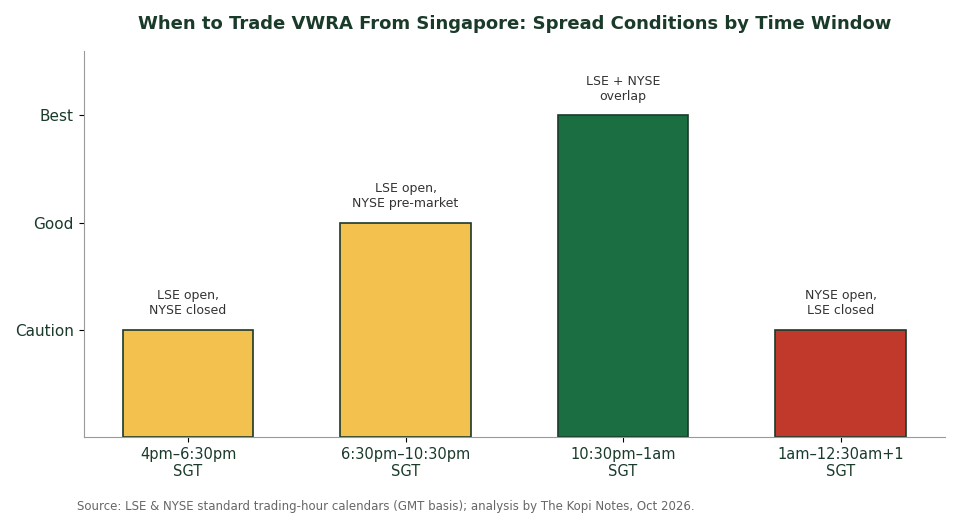
For a Singapore investor working in SGT, the practical takeaway from the market-hours point above is straightforward: the tightest VWRA spreads tend to fall in the window where both the LSE and NYSE are open simultaneously. Using standard GMT-basis trading hours (LSE 08:00–16:30 UK time; NYSE 09:30–16:00 ET), that overlap lands at roughly 10:30pm to 1:00am SGT — late, but it’s the window where market makers are pricing VWRA’s dominant US weighting off live NYSE quotes rather than a stale close.
| SGT Window | What’s Open | Spread Condition |
|---|---|---|
| 4:00pm – 6:30pm | LSE open, NYSE closed | Caution — early LSE session, US basket priced off prior close |
| 6:30pm – 10:30pm | LSE open, NYSE pre-market | Good — improving as US futures/pre-market firm up pricing |
| 10:30pm – 1:00am | LSE + NYSE overlap | Best — full live pricing on both legs of the basket |
| 1:00am – 12:30am (LSE close) | NYSE open, LSE after-hours/closed | Avoid — LSE order book has thinned out or closed |
Source: LSE and NYSE standard trading-hour calendars (GMT basis); analysis by The Kopi Notes, October 2026. Daylight-saving transitions in the UK and US shift these windows by roughly an hour for part of the year — always check current local exchange hours.
Real Trading Cost Breakdown: Spread, FX and Commission
The bid-ask spread is only one of three cost components a Singapore investor actually pays when buying VWRA — and it’s often the smallest. Consider a worked example: a Singapore investor converting SGD 20,000 into USD to buy VWRA through a broker.
Component 1 — Broker commission: a flat or percentage fee charged per trade, which varies by broker (Interactive Brokers, Syfe, FSMOne and others each price this differently — check your broker’s current schedule, since these change).
Component 2 — FX conversion spread: converting SGD to USD (or holding USD natively if your broker allows it) carries its own spread, separate from VWRA’s own bid-ask spread on the LSE. For investors funding regularly, this FX spread is frequently the largest single cost — larger than VWRA’s own spread in most conditions.
Component 3 — VWRA’s own bid-ask spread: as covered above, this is typically narrow for a fund of VWRA’s size when traded during the LSE-NYSE overlap with a limit order, but can be the largest cost component if you trade at the wrong time with a market order.
The practical lesson: don’t optimise for VWRA’s spread alone. A Singapore investor using an SRS account via a low-FX-cost platform and trading during the overlap window with a limit order is managing all three cost components at once, not just one.
Does Securities Lending Affect VWRA’s Liquidity?
VWRA participates in securities lending — Vanguard lends out portfolio holdings to generate incremental income for the fund, with J.P. Morgan Bank Luxembourg, S.A. acting as securities lending counterparty (justETF fund data, Aug 2026). This is a separate mechanism from the trading liquidity discussed above — it doesn’t affect your ability to buy or sell VWRA shares on the LSE day-to-day — but it is worth understanding as part of VWRA’s overall counterparty risk profile. We cover the mechanics of ETF securities lending, collateral and counterparty exposure in detail in our CSPX securities lending guide, which applies the same framework to VWRA’s physically-replicated structure.
Who Should Actually Care About This?
For most Singapore investors dollar-cost-averaging a few hundred to a few thousand SGD into VWRA each month, spread timing is a minor optimisation — the FX conversion cost and your broker’s commission structure matter more than shaving a basis point off VWRA’s spread. This matters more if you’re deploying a lump sum of SGD 50,000 or above in one trade, rebalancing a large existing position, or trading tactically around specific market events — in those cases, trading during the LSE-NYSE overlap with a limit order pinned near the live iNAV is a free, no-cost way to reduce slippage. It also matters if you’re comparing VWRA against a similarly-sized alternative like IWDA — both benefit from the same structural liquidity advantages as large, multi-listed UCITS ETFs, so liquidity alone isn’t usually the deciding factor between them.
If you’re building a long-term portfolio and want a clear starting framework, our Singapore REIT ETF guide and the retirement planning calculator are good next stops for sizing how much of your portfolio an ETF like VWRA should actually make up.
Frequently Asked Questions
Is VWRA's low trading volume on the LSE a sign it's hard to sell?
No. VWRA’s on-screen LSE volume looks modest, but authorised participants can create or redeem VWRA shares directly against its underlying basket of roughly 3,800 global stocks, which is itself highly liquid. VWRA’s “true” liquidity tracks the liquidity of that US$87.3 billion underlying portfolio, not just the volume printing on the LSE order book.
What is a good bid-ask spread for VWRA?
Neither Vanguard nor the LSE publishes an official average bid-ask spread figure for VWRA, so treat any specific basis-point number you see elsewhere with caution. In practice, spreads for large, multi-listed UCITS ETFs like VWRA are typically narrow for standard retail order sizes during LSE-NYSE overlap hours. The reliable way to check is to compare your broker’s live quoted price against VWRA’s indicative net asset value (iNAV, Bloomberg code IVWRAUSD) before you trade.
What time should Singapore investors trade VWRA for the tightest spread?
The window where both the London Stock Exchange and the New York Stock Exchange are open simultaneously — roughly 10:30pm to 1:00am Singapore time on a GMT basis — tends to offer the most reliable pricing, since VWRA’s dominant ~60% US weighting is being priced off live NYSE quotes rather than a stale previous close. This shifts by about an hour during UK/US daylight-saving periods.
Does VWRA's bid-ask spread matter more than FX conversion costs?
Usually not. For most Singapore investors converting SGD to USD to buy VWRA, the FX conversion spread charged by your bank or broker is typically a larger cost than VWRA’s own bid-ask spread, especially for smaller, regular purchases. Both matter, but FX costs deserve at least as much attention.
Should I use a market order or limit order for VWRA?
A limit order placed close to VWRA’s live iNAV gives you control over the price you pay or receive and protects you from an artificially wide quote during thin trading periods, such as the LSE’s opening or closing auction. A market order is simpler but accepts whatever the prevailing ask (when buying) or bid (when selling) happens to be at that instant.
Does VWRA's securities lending programme affect how easily I can sell it?
No. VWRA lends out a portion of its underlying holdings to generate incremental income, with J.P. Morgan Bank Luxembourg, S.A. as the lending counterparty, but this runs independently of the LSE trading and creation/redemption mechanism that determines your ability to buy or sell VWRA shares day-to-day.
Not financial advice. All figures are for educational reference only and were verified against Vanguard’s 30 September 2026 factsheet and justETF.com as at 19 October 2026. ETF trading involves risk, including currency risk and the possibility that spreads widen unexpectedly during volatile markets.
Ready to Start Investing in ETFs?
Open a brokerage account and buy your first ETF today. Use our referral links for exclusive sign-up bonuses.
This article was researched with the help of AI. While we strive to keep all information accurate and up to date, there may be errors. If you notice any discrepancies, please contact us.