CSPX Securities Lending Explained: How iShares Lends Your ETF Shares (2026 Guide)
What happens to your CSPX shares behind the scenes — the lending programme, the collateral rules, and the real counterparty risk for Singapore investors.
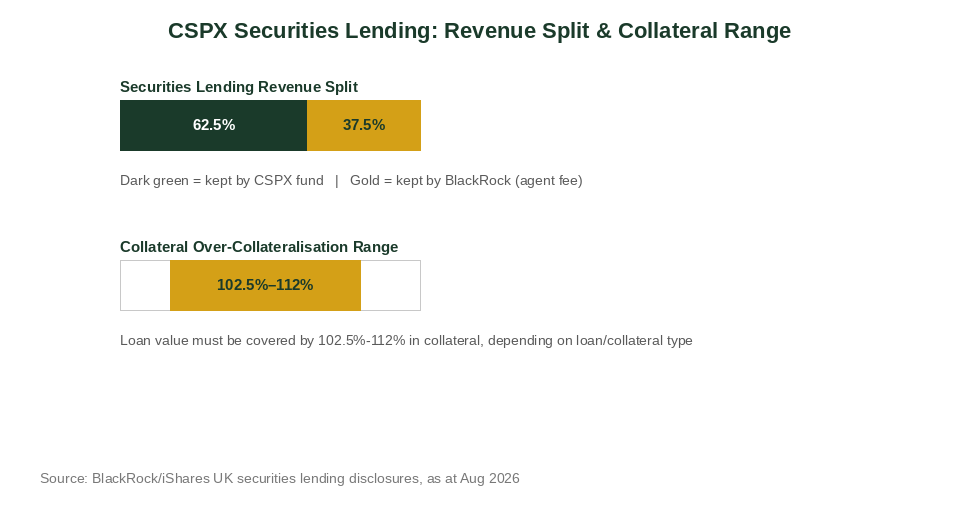
CSPX participates in BlackRock’s securities lending programme, which temporarily lends out the ETF’s underlying S&P 500 shares to borrowers against collateral worth 102.5%–112% of the loan value. The fund keeps 62.5% of lending revenue, with BlackRock retaining 37.5% as agent. As at 30 June 2026, iShares disclosed a 0.00% securities lending return for CSPX — but the programme remains structurally active, and it carries a small, real counterparty risk that Singapore investors should understand before buying.
Not financial advice. All figures are for educational reference only. Data as at August 2026 unless noted — always check the iShares product page for the latest disclosures.
Table of Contents
Why Securities Lending Catches Most CSPX Investors Off Guard
Most Singapore investors who buy CSPX (iShares Core S&P 500 UCITS ETF, listed on the London Stock Exchange) assume the fund simply holds 500 S&P 500 stocks and tracks the index, full stop. In reality, like almost every large physically-replicated ETF, CSPX participates in a securities lending programme: the fund temporarily lends out the shares it holds to borrowers — usually hedge funds and market makers who need the stock for short-selling or settlement purposes — in exchange for a fee and collateral.
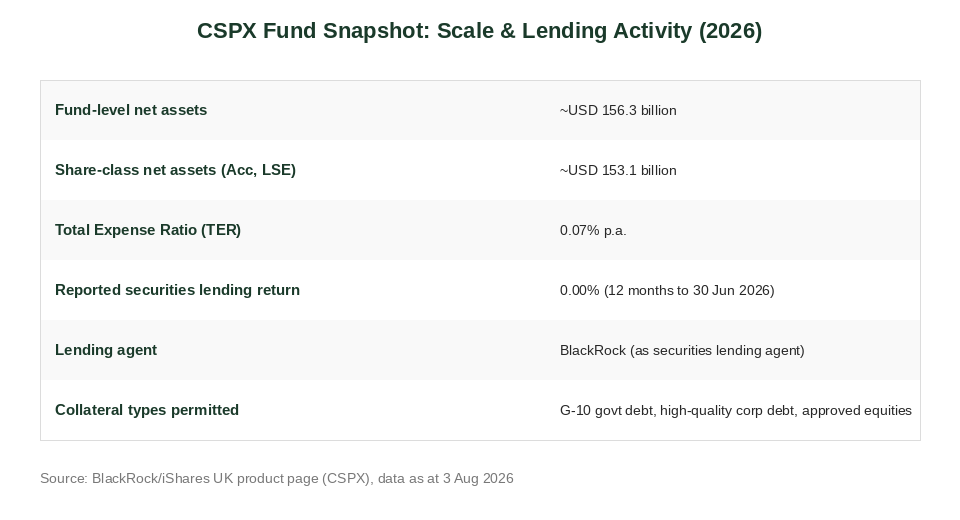
This isn’t a red flag unique to CSPX. Vanguard, State Street and virtually every major index fund provider runs similar programmes. But because it happens inside the fund structure, few retail investors in Singapore realise it’s happening at all, let alone understand who profits from it and what risk it introduces. For a UCITS ETF with roughly USD 156 billion in assets, even a small percentage of the portfolio out on loan at any given time represents a meaningful sum moving through counterparty exposure.
How CSPX’s Securities Lending Programme Works
BlackRock, as CSPX’s lending agent, lends a portion of the fund’s underlying S&P 500 shares to approved borrowers. In return, the borrower posts collateral — typically government bonds, high-quality corporate debt, or a basket of approved equities — valued above the loan amount. According to BlackRock’s published collateral framework, over-collateralisation typically ranges from 102.5% to 112% of the loan value depending on the loan type and collateral type used, meaning the fund is holding more value in collateral than the shares it lent out — figures published on the iShares CSPX product page.
The economics work like this: the borrower pays a lending fee. CSPX, as the lending fund, keeps 62.5% of that revenue; BlackRock keeps the remaining 37.5% as compensation for running the programme — sourcing borrowers, managing collateral, and absorbing operational and indemnification risk. This split is disclosed on iShares’ UCITS securities lending pages and is standard across BlackRock’s European ETF range.
Interestingly, iShares’ own disclosure for CSPX shows a 0.00% securities lending return for the 12 months to 30 June 2026 — meaning that in that specific reporting period, the additional return contributed to the fund from lending activity rounded to nil. This can happen when lending demand for S&P 500 constituents is low (large-cap US stocks are generally easy to borrow elsewhere, so fees are thin) or when the reporting period captures limited loan activity. It does not mean the programme is switched off; it means the measured net benefit to unitholders was negligible in that window.
CSPX Securities Lending: Key Facts at a Glance
| Metric | Detail |
|---|---|
| Fund-level net assets | ~USD 156.3 billion |
| TER (Expense Ratio) | 0.07% p.a. |
| Lending agent | BlackRock |
| Revenue split (fund / BlackRock) | 62.5% / 37.5% |
| Collateral over-collateralisation | 102.5%–112% of loan value |
| Reported lending return (12mo to Jun 2026) | 0.00% |
Source: BlackRock/iShares UK product disclosures for CSPX, data as at 3 August 2026.
What This Means for Singapore Investors
Singapore investors buying CSPX through brokers like Interactive Brokers, Saxo, or MooMoo are exposed to the fund’s securities lending activity indirectly — you don’t opt in or out, and it isn’t visible on your brokerage statement. The Monetary Authority of Singapore (MAS) does not directly regulate UCITS ETF securities lending practices, since CSPX is domiciled in Ireland and regulated under EU UCITS rules, which cap how much of a fund’s assets can be on loan at any one time and require robust collateral management. In practice, this is one of the more tightly regulated corners of the ETF structure.
For a Singapore investor holding SGD 50,000 in CSPX, securities lending activity has no direct line-item cost or benefit you’ll see — any net lending revenue is already folded into the fund’s NAV, which is one reason CSPX’s TER of 0.07% can feel even cheaper in practice when lending income partially offsets running costs. The risk side is the mirror image: if a borrower defaults and the posted collateral somehow fails to cover the shortfall (a low-probability but non-zero event, as the 2008 Lehman Brothers collateral-reinvestment episodes showed for some lending programmes), the fund — and by extension, your holding — could absorb a loss. This is distinct from, and in addition to, ordinary market risk on the S&P 500 itself.
This has no bearing on the well-documented LSE tax advantages that make CSPX attractive to SG investors in the first place — the 15% US dividend withholding tax under the Ireland-US treaty (versus 30% for US-domiciled ETFs) and the absence of US estate tax exposure remain unaffected by securities lending. Read our CSPX and VWRA tracking difference guide for how lending revenue and other factors feed into a fund’s actual tracking performance versus its benchmark index.
CSPX vs US-Listed ETFs: Securities Lending Compared
US-domiciled S&P 500 ETFs like VOO (Vanguard) and SPLG (State Street) also lend securities, but under 1940 Act rules rather than UCITS rules, with different disclosure norms and revenue-sharing caps. The table below summarises the structural differences relevant to a Singapore investor comparing CSPX against its US-listed peers.
| Feature | CSPX (LSE, Ireland) | VOO / SPLG (US-listed) |
|---|---|---|
| Regulatory regime | EU UCITS | US 1940 Act |
| Collateral requirement | 102.5%–112% | Typically 102%–105% (industry norm) |
| Lending revenue disclosure | Published on iShares product page | Disclosed in annual N-CSR filings |
| US dividend withholding tax (SG investor) | 15% | 30% |
| US estate tax exposure (SG investor) | None | Yes, above USD 60,000 |
The securities lending mechanics themselves are broadly comparable across providers — the meaningful difference for a Singapore investor remains the tax treatment, which continues to favour CSPX and other Ireland-domiciled, LSE-listed UCITS ETFs over US-listed equivalents.
What Singapore Investors Should Actually Do
Securities lending is not a reason to avoid CSPX. It is a standard, regulated feature of nearly every large index ETF, physically backed by over-collateralisation well above the loan value, and overseen under UCITS rules that are generally considered more conservative than equivalent US fund regulations. For most long-term Singapore investors building a core S&P 500 position, the practical impact of securities lending on your returns is negligible — CSPX’s 0.07% TER already makes it one of the cheapest ways to access the index, and the disclosed 0.00% lending return for the latest period means it currently isn’t even meaningfully subsidising that cost.
What’s worth doing: check the iShares product page periodically (lending returns and collateral terms can shift), understand that this risk exists alongside — not instead of — ordinary market risk, and don’t let a vague “they’re lending my shares” discomfort push you into a materially worse tax position with a US-listed alternative. If you’re opening a new brokerage account to hold CSPX, check the Syfe referral code and sign-up bonus for current promotions. If you’re building out a full portfolio around CSPX, our first ETF portfolio step-by-step guide and VWRA vs IWDA comparison cover how CSPX typically fits alongside broader global or ex-US exposure.
If you hold CSPX inside an SRS account, the securities lending mechanics are identical — SRS funds simply sit inside whichever brokerage holds your CSPX units. See our SRS account best platforms guide for how this fits into a broader retirement plan, and use our Singapore retirement calculator to model how a core CSPX position contributes to your long-term retirement number.
Not financial advice. This article explains fund mechanics for educational purposes and does not constitute a recommendation to buy or hold CSPX. Securities lending terms, collateral policies and disclosed returns can change — always verify current figures on the official iShares product page before making investment decisions.
Frequently Asked Questions
Does CSPX lend out the shares I own through my broker?
Yes, indirectly. You don’t own individual S&P 500 shares directly — you own units of the CSPX fund, which itself holds the underlying shares and may lend a portion of them to approved borrowers through BlackRock’s securities lending programme. This happens inside the fund structure and isn’t something you opt in or out of as a unitholder.
Is CSPX's securities lending programme safe for Singapore investors?
It’s regulated under EU UCITS rules, which require loans to be over-collateralised at 102.5%–112% of loan value and limit how much of the fund’s assets can be on loan at once. This makes it one of the more conservative securities lending frameworks globally, though it does carry a small residual counterparty risk in the event of a borrower default combined with a collateral shortfall.
Does securities lending reduce CSPX's expense ratio?
It can, since the fund keeps 62.5% of lending revenue, which is folded into the fund’s NAV and can partially offset running costs. However, iShares’ own disclosure shows a 0.00% securities lending return for CSPX for the 12 months to 30 June 2026, meaning the measured benefit in that period was negligible. CSPX’s TER of 0.07% is already very low regardless of lending income.
Can I buy CSPX using my CPF or SRS funds?
CSPX is not CPF-investable, since LSE-listed UCITS ETFs are not on the CPFIS list of approved instruments. It is generally compatible with SRS funds if your SRS-linked brokerage supports trading on the London Stock Exchange — check with your specific broker, as not all SRS-approved brokerages offer LSE access.
Do other S&P 500 ETFs like VOO also lend out shares?
Yes. Securities lending is standard practice across nearly all major physically-replicated index ETFs, including Vanguard’s VOO and State Street’s SPLG, which operate under US 1940 Act rules with broadly similar collateralisation standards. The mechanics are comparable; the main practical difference for Singapore investors remains the withholding tax and estate tax treatment, which favours Ireland-domiciled, LSE-listed funds like CSPX.
Where can I check the latest CSPX securities lending data myself?
The iShares product page for CSPX publishes current TER, AUM, and securities lending return figures, updated periodically. Since these figures change over time, it’s worth checking directly on iShares.com before making a decision, rather than relying solely on secondary sources.
Ready to Start Investing in ETFs?
Open a brokerage account and buy your first ETF today. Use our referral links for exclusive sign-up bonuses.
This article was researched with the help of AI. While we strive to keep all information accurate and up to date, there may be errors. If you notice any discrepancies, please contact us.