Convertible Bond ETFs for Singapore Investors: GLCB vs ICVT vs CWB (2026 Guide)
Convertible bond ETFs hold bonds that can convert into company shares, giving Singapore investors bond-like downside protection with some equity upside. GLCB (SPDR FTSE Global Convertible Bond UCITS ETF) trades on the LSE with a 0.70% fee, while US-listed ICVT (0.20%) and CWB (0.40%) are cheaper but carry 30% US dividend withholding tax and full US estate tax exposure above USD 60,000.
Not financial advice. All figures are for educational reference only. Data verified as at September 2026 unless otherwise noted.
Table of Contents
What Is a Convertible Bond ETF?
GLCB: The LSE-Listed UCITS Option
ICVT and CWB: The US-Listed Alternatives
Side-by-Side Comparison Table
Withholding Tax and US Estate Tax
Which Should Singapore Investors Choose?
Risks to Understand First
FAQ
What Is a Convertible Bond ETF?
A convertible bond is a corporate bond that the holder can convert into a fixed number of the issuing company’s shares. It pays a coupon like a regular bond, but its price also rises when the underlying stock rallies, and it typically falls less than the stock during a sell-off because the bond floor provides a price cushion. Companies issue convertibles to raise capital more cheaply than a straight bond, since investors accept a lower coupon in exchange for the equity upside.
A Singapore investor holding SGD 50,000 in a diversified convertible bond ETF is effectively buying a basket of these hybrid instruments across dozens of issuers, spanning technology, healthcare, and industrial names that use convertibles as a funding tool. This gives exposure to a distinct risk-return profile: lower volatility than pure equities, higher expected return than pure investment-grade bonds, and a naturally asymmetric payoff shape often described as “equity-like upside, bond-like downside.”
Three funds dominate global access to this asset class: GLCB (the LSE-listed UCITS option), and two US-listed funds, ICVT and CWB. Each uses a different mechanism to hold and track its convertible bond index, and each carries a different tax and fee profile for an SG-based investor.
GLCB: The LSE-Listed UCITS Option
The SPDR FTSE Global Convertible Bond UCITS ETF (ticker GLCB or GCVB on the London Stock Exchange, ISIN IE00BNH72088) is the main Ireland-domiciled, UCITS-compliant convertible bond ETF accessible to Singapore investors through brokers like IBKR, Saxo, and moomoo. It tracks the FTSE Global Focus Convertible Bond Index (the index was rebranded from the Refinitiv Qualified Global Convertible Index; the underlying methodology is unchanged), giving global convertible bond exposure across US, European, and Asian issuers rather than a US-only universe.
As an Ireland-domiciled fund, GLCB sits inside the UCITS tax treaty framework: Singapore investors pay 15% withholding tax on US-sourced income passed through the fund rather than the 30% non-treaty rate US-listed funds attract, and the fund itself is entirely outside US estate tax exposure regardless of portfolio size.
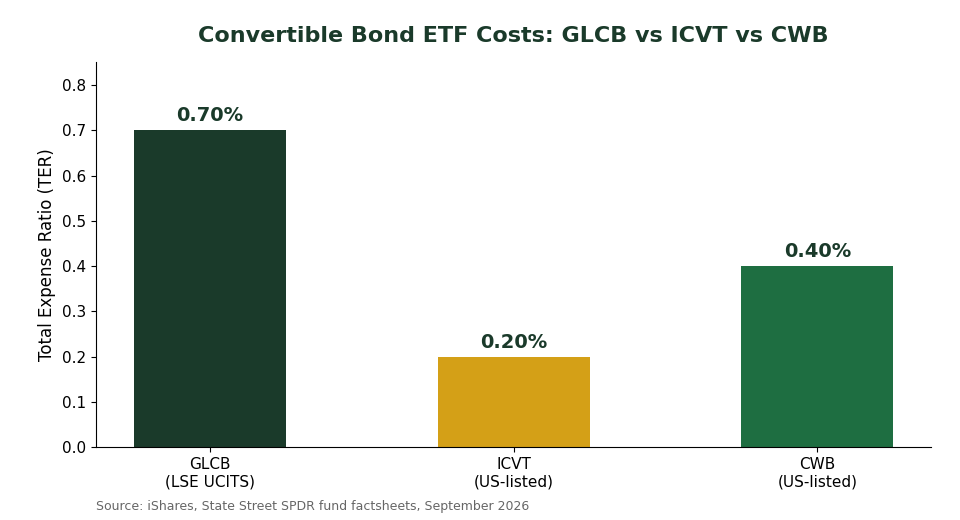
The trade-off is cost and scale. GLCB’s TER of 0.70% is more than triple ICVT’s 0.20% and 75% higher than CWB’s 0.40%, and at roughly USD 956.81 million in AUM it is meaningfully smaller than either US-listed fund. For a niche fixed-income sub-asset-class where liquidity and bid-ask spread matter, this is worth weighing before defaulting to the “UCITS is always better for SG investors” heuristic that applies cleanly to CSPX vs VOO.
ICVT and CWB: The US-Listed Alternatives
ICVT (iShares Convertible Bond ETF, listed on Cboe BZX) is the largest and cheapest of the three funds, with a TER of 0.20% and roughly USD 6.08 billion in AUM as at mid-2026. It tracks an index of US dollar-denominated convertible bonds with an issue size above USD 250 million, giving it a deep, liquid book but a US-issuer-concentrated portfolio rather than genuinely global exposure.
CWB (SPDR Bloomberg Convertible Securities ETF, NYSE Arca) sits between the two on cost, with a TER of 0.40% and roughly USD 5.58 billion in AUM. It tracks a broader Bloomberg US convertible securities benchmark and is one of the longest-running, most heavily traded funds in this category, making it the default reference point for US convertible bond exposure.
Both funds are US-domiciled and both funds are US-situs assets for estate tax purposes, meaning both share the same tax drag issues detailed further down: 30% non-treaty withholding tax on qualifying distributions, and exposure to US estate tax above the USD 60,000 non-resident-alien exemption threshold.
Side-by-Side Comparison Table
| Feature | GLCB (LSE UCITS) | ICVT (US-listed) | CWB (US-listed) |
|---|---|---|---|
| Exchange | London Stock Exchange | Cboe BZX | NYSE Arca |
| ISIN / Ticker | IE00BNH72088 (GLCB/GCVB) | ICVT | CWB |
| Domicile | Ireland (UCITS) | United States | United States |
| TER | 0.70% | 0.20% | 0.40% |
| AUM (approx., 2026) | USD 957 million | USD 6.08 billion | USD 5.58 billion |
| Geographic scope | Global convertibles | US dollar-denominated | US market-focused |
| US dividend WHT for SG investors | 15% (treaty rate) | 30% (non-treaty) | 30% (non-treaty) |
| US estate tax exposure | None | Yes, above USD 60k | Yes, above USD 60k |
Source: iShares fund fact sheet, State Street SPDR fund page, justETF, September 2026.
Withholding Tax and US Estate Tax
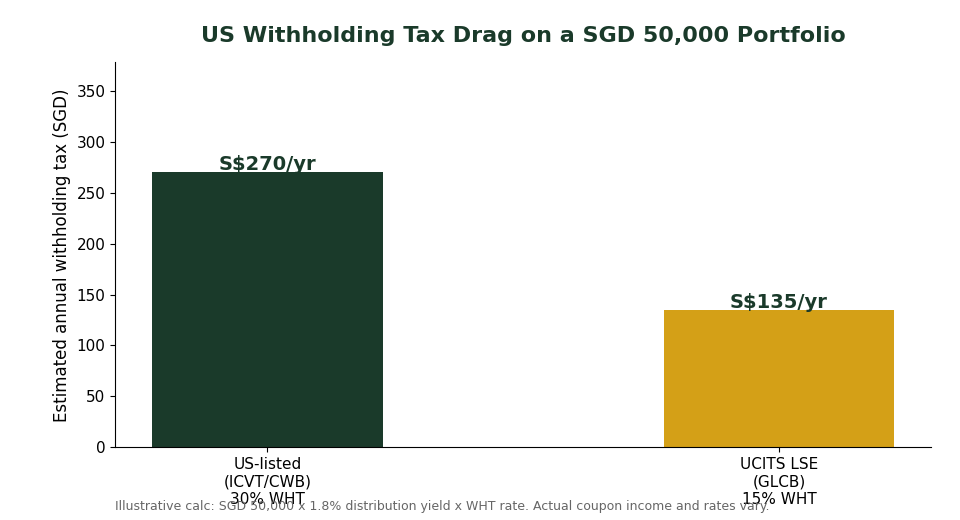
Both convertible bond exposures generate distributions that can include US-sourced dividend income passed through the underlying holdings’ equity conversion features and coupon interest. Because ICVT and CWB are US-domiciled funds, Singapore investors receive the full 30% non-treaty withholding tax rate on qualifying distributions, since Singapore and the US have no bilateral tax treaty. GLCB, domiciled in Ireland, benefits from the US-Ireland tax treaty applied at the fund level, cutting that rate to 15% for the portion of income sourced from US equity-like distributions.
On a SGD 50,000 position with an illustrative 1.8% blended distribution yield, this works out to roughly SGD 270 a year in withholding tax for the US-listed funds versus SGD 135 a year for GLCB — a real but modest gap that is smaller in absolute terms than GLCB’s extra 0.50 percentage points of annual TER on the same position (roughly SGD 250 a year in additional fees). For convertible bonds specifically, unlike equity-heavy funds such as CSPX vs VOO, the fee difference can outweigh the tax saving depending on portfolio size and holding period.
US Estate Tax Exposure by Portfolio Size
| US-Situs Portfolio Value | Estimated US Estate Tax (ICVT/CWB) | Estimated US Estate Tax (GLCB) |
|---|---|---|
| USD 100,000 | USD 10,800 | USD 0 |
| USD 250,000 | USD 57,800 | USD 0 |
| USD 500,000 | USD 142,800 | USD 0 |
Source: IRS non-resident alien graduated estate tax schedule (18%-40% above the USD 60,000 exemption, less the USD 13,000 unified credit), calculated September 2026.
Which Should Singapore Investors Choose?
Investors who already hold US-domiciled ETFs and are comfortable with the withholding tax and estate tax profile, or whose portfolio value keeps them well under the USD 60,000 non-resident-alien threshold for this specific holding, are likely better off in ICVT for its lower fee and deeper liquidity, or CWB if they want a longer track record and don’t mind the slightly higher cost.
Investors building a larger position, consolidating estate tax exposure across their whole US-situs asset base, or who simply prefer a single UCITS-only portfolio structure (the same logic that drives the CSPX/VWRA choice) should lean toward GLCB despite the higher fee, since it removes estate tax exposure entirely and cuts the withholding tax rate. Once a position grows past roughly USD 150,000-200,000, the estate tax risk on the US-listed alternatives typically outweighs GLCB’s extra annual cost.
Convertible bonds are usually a satellite allocation (5-15% of a fixed-income sleeve) rather than a core holding, so the absolute dollar amounts in play are often smaller than for a core global equity or aggregate bond allocation — worth factoring into how much the fee-versus-tax trade-off actually matters at your position size.
Risks to Understand First
Convertible bonds carry issuer credit risk like any corporate bond — if the issuing company defaults, the bond’s equity conversion feature is worthless and holders rank alongside other unsecured creditors. Many convertible issuers are growth companies with below-investment-grade or unrated credit profiles, so credit risk here is generally higher than in an aggregate investment-grade bond fund.
Convertibles are also interest-rate sensitive and equity-correlated at the same time: in a sharp equity sell-off with rising rates, the “bond floor” cushion can be thinner than expected, since the same conditions that hurt equity valuations often coincide with wider credit spreads. GLCB’s smaller AUM (under USD 1 billion) and LSE listing also mean wider typical bid-ask spreads than the two US-listed giants, a real cost for investors trading in and out actively rather than holding long-term.
None of the three funds should be assumed a substitute for a core global bond or equity allocation — treat this as a targeted, smaller allocation within a diversified Singapore REIT ETF guide-style income sleeve, not a stand-alone portfolio.
Frequently Asked Questions
Can Singapore investors buy convertible bond ETFs?
What is the difference between GLCB, ICVT, and CWB?
Do I pay withholding tax on convertible bond ETF distributions?
Are convertible bond ETFs subject to US estate tax?
Are convertible bonds riskier than regular bond ETFs?
How much of my portfolio should be in convertible bond ETFs?
Which broker should I use to buy GLCB from Singapore?
Related Reading
For broader fixed-income context, see our Singapore T-bills 2026 guide and Singapore Savings Bonds guide for lower-risk alternatives, or our Singapore REIT ETF guide and best S-REITs in Singapore 2026 for equity-income exposure. Model how these fit your broader retirement plan with our Singapore retirement calculator.
This article was researched with the help of AI. While we strive to keep all information accurate and up to date, there may be errors. If you notice any discrepancies, please contact us.