Defensive ETFs Singapore 2026: Best Low-Volatility Picks as Markets Rotate
How Singapore investors can add low-volatility ETF exposure through LSE-listed funds as the Fed holds rates and tech stocks wobble.
Defensive ETFs — also called low-volatility or minimum-volatility ETFs — hold shares in companies that historically swing less than the broader market, such as utilities and healthcare firms. Singapore investors can buy Ireland-domiciled options like iShares Edge MSCI World Minimum Volatility (MVOL) or Invesco S&P 500 Low Volatility (SPLW) on the London Stock Exchange through IBKR or Saxo, paying 15% US dividend withholding tax instead of 30%.
Not financial advice. All figures are for educational reference only. Data verified as at 21 July 2026 against justETF, iShares, Invesco and federalreserve.gov sources unless otherwise noted.
- Markets are rotating out of high-growth tech into defensive sectors after the Fed held rates at 3.50%–3.75% under new Chair Kevin Warsh, with June inflation still sticky at 3.5%.
- LSE-listed, Ireland-domiciled defensive ETFs like MVOL (TER 0.30%) and SPLW (TER 0.25%) give you low-volatility exposure with 15% US dividend withholding tax and no US estate tax risk — versus 30% WHT on the US-listed USMV or SPLV.
- Defensive ETFs cushion drawdowns, they don’t eliminate them — both MVOL and SPLW still lost money in past down years, so treat them as an equity risk-reducer, not a bond or fixed deposit substitute.
Table of Contents
Contents — Click to expand
What Is a Defensive / Low-Volatility ETF?
A defensive ETF holds a basket of stocks chosen because they have historically moved less than the broader market — not because they belong to any single “defensive” sector. Fund managers build these baskets using one of two main approaches, and the difference matters more than most articles admit.
The first approach, used by MSCI Minimum Volatility indices, runs an optimisation across an entire universe of stocks (say, the MSCI World) to build the single portfolio with the lowest total variance, subject to diversification constraints. The result can include growth names like Microsoft or Cisco Systems if their price behaviour happens to reduce overall portfolio risk — it’s a statistics-driven basket, not a sector bet.
The second approach, used by S&P Low Volatility indices, is far simpler: rank every stock in an index (say, the S&P 500) by trailing 12-month volatility, then take the 100 least volatile names. This tends to land you overwhelmingly in classic defensive sectors — utilities, real estate investment trusts (REITs), financials and consumer staples — because those businesses genuinely have steadier earnings and steadier share prices.
Both approaches are accumulating funds in their LSE-listed, Ireland-domiciled form, meaning dividends are reinvested inside the fund rather than paid out to you as cash. You still benefit from the withholding tax (WHT) treatment on those underlying dividends — it’s just applied inside the fund instead of showing up in your brokerage account.
Key Facts at a Glance
| ETF | Ticker (LSE) | Index | Domicile | TER | AUM |
|---|---|---|---|---|---|
| iShares Edge MSCI World Min Vol | MVOL | MSCI World Minimum Volatility | Ireland | 0.30% | €2,225m |
| Invesco S&P 500 Low Volatility | SPLW | S&P 500 Low Volatility | Ireland | 0.25% | €114m |
| Xtrackers MSCI World Min Vol 1C | XZMV* | MSCI World Minimum Volatility | Ireland | 0.25% | €1,104m |
| iShares MSCI USA Min Vol Factor (US) | USMV | MSCI USA Minimum Volatility | USA | 0.15% | — |
| Invesco S&P 500 Low Volatility (US) | SPLV | S&P 500 Low Volatility | USA | 0.25% | — |
*Ticker varies by exchange line; verify on your broker’s search before ordering. Source: justETF (MVOL) and justETF (SPLW) fund pages, TER and AUM as at July 2026.
Why Defensive ETFs Are Trending in July 2026
The US Federal Reserve held its target rate at 3.50%–3.75% at the 16–17 June 2026 meeting — the first policy meeting under new Fed Chair Kevin Warsh, who was confirmed by the Senate on 13 May 2026 and sworn in on 22 May, succeeding Jerome Powell. As of early July, futures markets priced roughly a 90% chance the Fed holds again at its next meeting on 28–29 July 2026.
Inflation is cooling but not fast enough. June 2026 headline CPI came in at 3.5% year-on-year, down from 4.2% in May, but still well above the Fed’s 2% target. That combination — a hawkish new chair, sticky inflation and a “higher for longer” rate backdrop — has triggered a rotation out of high-growth technology and semiconductor names (where investors are increasingly sceptical about near-term AI monetisation) and into more defensive, cash-generative sectors like energy, financials and healthcare.
For you as a Singapore investor, this doesn’t mean abandoning growth exposure entirely. It means understanding that a slice of low-volatility ETF exposure can reduce how hard your portfolio swings if this rotation continues — without requiring you to correctly time when tech comes back into favour.
Best Defensive / Low-Volatility ETFs for Singapore Investors
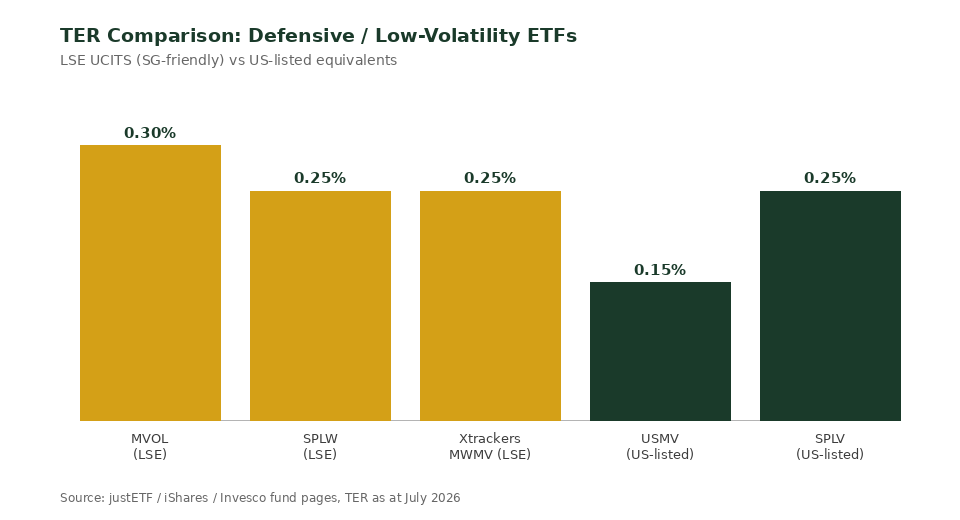
iShares Edge MSCI World Minimum Volatility UCITS ETF (MVOL) is the largest fund tracking the MSCI World Minimum Volatility index, with €2,225m in assets and 287 holdings across 23 developed markets. Its top holdings as at 29 May 2026 were Cisco Systems (1.56%), Duke Energy (1.43%), Johnson & Johnson (1.42%), The Southern Co. (1.37%) and Exxon Mobil (1.34%). Its largest sector is actually Technology at 26.0%, followed by Health Care (13.7%), Financials (12.3%) and Telecommunication (10.9%) — a reminder that “minimum volatility” is a statistical outcome, not a pure defensive-sector fund. Country exposure is US 62.9%, Japan 10.4%, Switzerland 4.3% and Canada 4.2%. One-year volatility stands at 8.16%, among the lowest of any broad-market ETF on this list.
Invesco S&P 500 Low Volatility UCITS ETF (SPLW) takes the simpler route: the 100 least volatile stocks in the S&P 500, equally weighted. That lands it firmly in classic defensive sectors — Utilities (26.8%), Financials (15.2%), Real Estate/REITs (14.6%) and Consumer Staples (10.7%) — with a smaller €114m fund size and a slightly higher one-year volatility of 11.53%, since it’s US-only rather than globally diversified. At 0.25% TER it’s cheaper than MVOL.
If you specifically want MVOL’s index (MSCI World Minimum Volatility) at a lower cost, the Xtrackers MSCI World Minimum Volatility UCITS ETF 1C tracks the same benchmark at 0.25% TER with €1,104m in assets — worth comparing against MVOL before you buy, since both are Ireland-domiciled, accumulating and LSE-listed.
All three are far more relevant to you than a US-listed fund like USMV (0.15% TER, cheapest headline fee) or SPLV (0.25% TER) — because those savings on the fee line are usually outweighed by the tax drag covered next.
Tax & Cost: LSE-Listed vs US-Listed
| ETF Type | Domicile | US Dividend WHT | US Estate Tax Risk |
|---|---|---|---|
| MVOL / SPLW (LSE) | Ireland | 15% | None |
| USMV / SPLV (US-listed) | USA | 30% | Yes (above USD 60,000) |
For a Singapore investor holding a defensive ETF portfolio, that 15-percentage-point WHT gap adds up. Assuming an illustrative 2.5% weighted dividend yield (defensive-sector funds like SPLW typically yield more than the broad market given their utilities/financials/staples tilt), a SGD 50,000 portfolio would see about SGD 187.50 a year withheld at the LSE-listed 15% rate versus SGD 375 at the US-listed 30% rate. On SGD 100,000, that’s SGD 375 versus SGD 750.
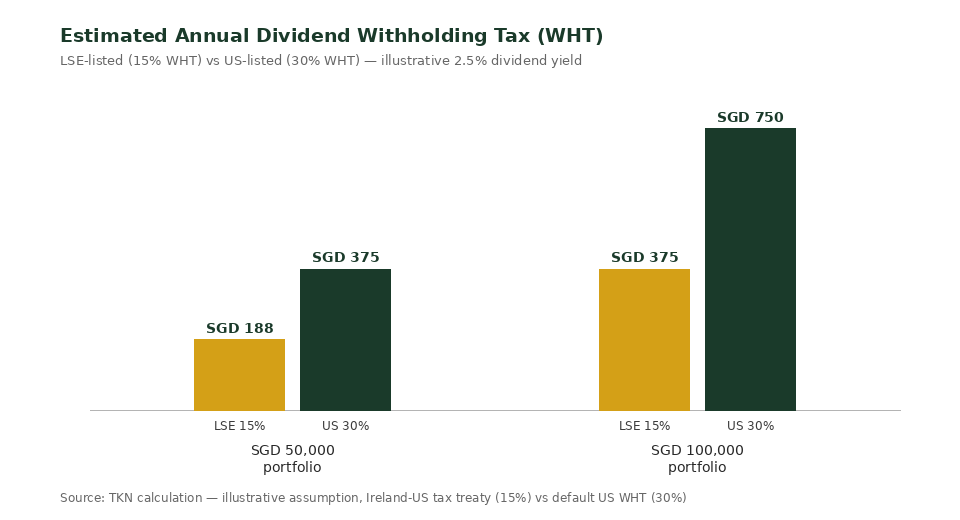
Source: TKN calculation, illustrative 2.5% assumed dividend yield; Ireland-US tax treaty (15%) vs default US withholding tax (30%).
How to Buy Defensive ETFs in Singapore
You buy MVOL, SPLW or the Xtrackers alternative the same way you’d buy any LSE-listed ETF like CSPX: fund your brokerage account, search by ticker or ISIN, select the London Stock Exchange listing, and place your order in USD or GBP depending on which line you pick.
Interactive Brokers (IBKR) is usually the most cost-effective choice for larger, recurring purchases — low commissions and access to both the USD and GBP lines of each fund. Saxo Markets offers a similar range with a more polished interface, at a slightly higher cost per trade. MooMoo Singapore and Syfe Brokerage are simpler for beginners who want a mobile-first experience, though check their specific LSE fee schedule before committing to a broker — see our IBKR vs Saxo vs MooMoo vs Syfe broker comparison for a full fee breakdown.
A practical limitation: LSE-listed ETFs like MVOL and SPLW are not eligible for CPF Ordinary Account investment (CPFIS-OA only covers a short list of SGX-listed funds). They are generally SRS-compatible if your broker supports SRS-linked cash for LSE trades — confirm this with your broker before assuming SRS funds can be deployed here. For the underlying tax mechanics behind why LSE-listed, Ireland-domiciled ETFs are the default choice for Singapore investors, see our full guide on why Singapore investors buy ETFs on the London Stock Exchange and our companion piece on US estate tax exposure for Singapore investors.
Risks to Consider
Lower volatility doesn’t mean no losses. Both MVOL and SPLW have posted negative years: MVOL fell 4.29% in 2022 and 2.27% in 2025, while SPLW fell 3.38% in 2023 and 8.28% in 2025. MVOL’s maximum drawdown since inception (from its 30 November 2012 launch) is 29.14%; SPLW’s maximum drawdown since its 2021 inception is 16.57%. These funds reduce how far you fall relative to the broad market — they don’t protect your capital outright.
Concentration is a second consideration. MVOL is still 62.9% US-listed companies and SPLW is 93.1% US, so you’re not getting meaningful diversification away from US equity market risk just by choosing a “defensive” label. Currency risk also applies: both funds are priced in USD or GBP, so SGD-based returns will move with exchange rates on top of the fund’s own performance.
Finally, defensive ETFs tend to lag in strong growth-led bull markets — that’s the trade-off for smoother returns in a downturn. And critically, they remain equity funds: there’s no principal guarantee, unlike a Singapore T-bill or fixed deposit. Treat a defensive ETF allocation as a way to smooth your existing equity exposure, not as a substitute for genuinely capital-safe instruments.
Frequently Asked Questions
What is a defensive ETF and how is it different from a normal index ETF?
A defensive (or low-volatility) ETF selects stocks specifically because they’ve historically moved less than the broader market, using either a portfolio-optimisation method (MSCI Minimum Volatility) or a simple volatility ranking (S&P Low Volatility). A normal index ETF like CSPX or VWRA simply holds every stock in an index weighted by market value, with no filtering for volatility.
Is MVOL the same fund as USMV?
No. MVOL (iShares Edge MSCI World Minimum Volatility UCITS ETF) is Ireland-domiciled, LSE-listed, and tracks the MSCI World Minimum Volatility index across 23 developed countries. USMV (iShares MSCI USA Min Vol Factor ETF) is US-domiciled, NYSE Arca-listed, and tracks only US stocks under the MSCI USA Minimum Volatility index. They share a fund manager and similar methodology but are different funds with different tax treatment for Singapore investors.
Can I buy MVOL or SPLW using my CPF or SRS funds?
LSE-listed ETFs like MVOL and SPLW are not on the CPFIS-OA approved investment list, so you cannot use CPF Ordinary Account funds to buy them directly. They are generally SRS-compatible if your broker supports SRS-linked trading on the London Stock Exchange — check with your broker first, since not all SRS-linked brokerage accounts cover LSE listings.
Which broker is best for buying defensive ETFs in Singapore?
Interactive Brokers (IBKR) and Saxo Markets both offer LSE access with competitive commissions and support for both the USD and GBP fund lines. MooMoo Singapore and Syfe Brokerage are simpler options for beginners, though it’s worth comparing their specific LSE fee schedules first, since fees vary by trade size and currency.
Did defensive ETFs actually lose less money in past downturns?
Generally yes, but not always by a wide margin, and not in every year. MVOL’s maximum drawdown since its 2012 inception is 29.14%, and its one-year volatility (8.16%) is meaningfully lower than a typical global equity fund. SPLW still fell 8.28% in 2025, showing that “defensive” reduces the size of losses on average — it doesn’t guarantee a good year every year.
Should I replace my bonds or fixed deposits with a defensive ETF?
No. Defensive ETFs are still equity funds with no principal guarantee and no fixed maturity date, unlike a Singapore T-bill, Singapore Savings Bond or fixed deposit. They’re better understood as a way to reduce volatility within your equity allocation, not a substitute for the capital-safe portion of your portfolio.
Ready to Add Defensive ETF Exposure?
Open a brokerage account and start building a more balanced portfolio today.
This article was researched with the help of AI. While we strive to keep all information accurate and up to date, there may be errors. If you notice any discrepancies, please contact us.