Retirement Calculator Singapore: How Much Do You Need to Retire? (2026 Guide)
CPF, SRS, ETFs, REITs and T-Bills — all factored into your Singapore retirement number.
A retirement calculator Singapore investors rely on must account for CPF payouts, inflation, and local living costs — factors generic global tools ignore. Most Singaporeans aged 65 need between SGD 480,000 and SGD 1.44 million saved outside CPF, depending on lifestyle. This guide shows you how to calculate your personal retirement number, which investments close the gap fastest, and how to use our free Singapore retirement calculator.
Not financial advice. All figures are for educational reference only. Data as at October 2026 unless noted.
Table of Contents
Why Singapore Needs a Different Retirement Calculator
Most retirement calculators are built for Americans or Europeans — they assume Social Security or a state pension as a baseline income and ignore the Singapore-specific picture entirely. A proper retirement calculator for Singapore must account for several local factors that dramatically change your number:
CPF LIFE payouts are a guaranteed annuity that reduces how much you need in your own savings. A person hitting the Full Retirement Sum (FRS) of SGD 213,000 (2026) in their CPF Retirement Account at age 55 can expect CPF LIFE payouts of roughly SGD 1,300–1,600 per month from age 65, for life. That alone covers basic living expenses for a frugal retiree.
Singapore’s cost of living is among the highest in Asia. The CPF Board’s Retirement Adequacy framework benchmarks a “basic” retirement at SGD 1,379 per month (2026 Minimum Sum payout estimate), but most retirees aspire to SGD 3,000–5,000 per month to maintain their current lifestyle.
No state pension, lower WHT: Singapore retirees receive no government pension outside CPF LIFE. This means personal savings and investments must do far more heavy lifting than in most OECD countries. The silver lining: Singapore has no capital gains tax and no dividend tax for individuals, making investing for retirement here exceptionally tax-efficient.
Healthcare inflation runs at 5–7% per year in Singapore — faster than general inflation. A healthcare provision of SGD 100,000–200,000 on top of MediShield Life and MediFund is a prudent buffer for anyone planning a 25+ year retirement.
How Much Does Retirement Cost in Singapore?
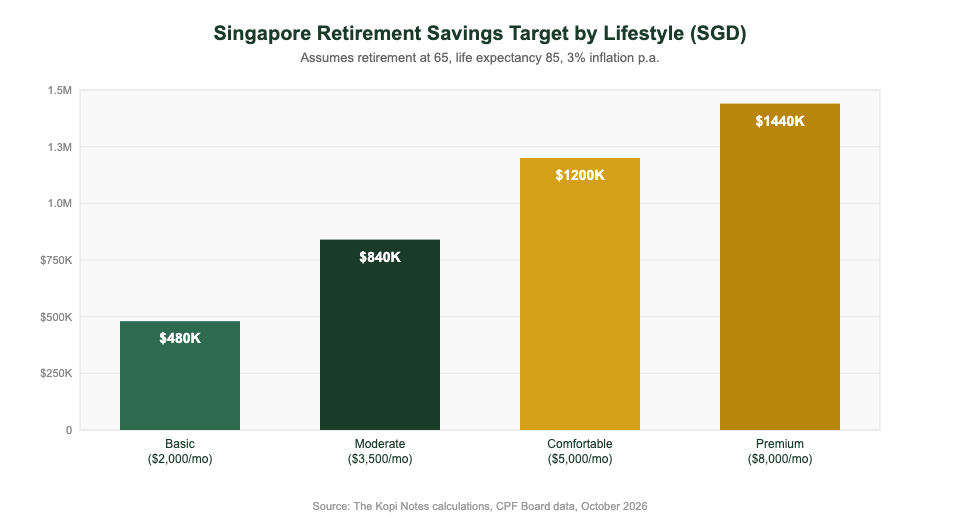
The first step in any retirement calculator is defining what retirement costs for you personally. Research by the Lee Kuan Yew School of Public Policy and the CPF Board points to four broad lifestyle tiers in Singapore:
| Lifestyle | Monthly Expenses | Annual Expenses | Savings Needed* |
|---|---|---|---|
| Basic (frugal, no frills) | SGD 2,000 | SGD 24,000 | SGD 480,000 |
| Moderate (typical HDB lifestyle) | SGD 3,500 | SGD 42,000 | SGD 840,000 |
| Comfortable (travel, dining) | SGD 5,000 | SGD 60,000 | SGD 1,200,000 |
| Premium (luxury, overseas trips) | SGD 8,000+ | SGD 96,000+ | SGD 1,440,000+ |
*Retirement at 65, life expectancy 85 (20-year horizon), 3% inflation p.a. Savings needed represents the non-CPF portion. CPF LIFE payouts are excluded from this calculation and reduce the required savings. Source: The Kopi Notes calculations, CPF Board data, October 2026.
These are the non-CPF savings you need — on top of whatever CPF LIFE will pay you. If your CPF LIFE payout is SGD 1,500/month and your target lifestyle costs SGD 3,500/month, your personal savings must fund SGD 2,000/month, which translates to roughly SGD 480,000 at retirement (using a 4% safe withdrawal rate over 20 years).
For context: a Singapore investor aiming for a moderate retirement with SGD 840,000 saved outside CPF, earning 4% annual returns, can safely withdraw SGD 33,600 per year (SGD 2,800/month) using the widely cited 4% rule — enough to top up SGD 1,500/month CPF LIFE payouts to SGD 4,300/month total income.
How to Use a Retirement Calculator Singapore (Step-by-Step)
Our free Singapore retirement calculator takes five inputs and outputs your personal retirement number in seconds. Here is how to use it correctly:
Step 1 — Enter your current age and target retirement age. Singapore’s official retirement age is 63 (as at 2026), but most financial planners recommend using 65 as the start of full retirement benefits, including CPF LIFE payouts under the standard plan.
Step 2 — Input your current savings and monthly investment amount. Include all liquid, investable assets (brokerage accounts, SRS, cash savings). Exclude your primary residence and your CPF OA/SA balances — these are addressed separately in the CPF LIFE projection field.
Step 3 — Set your expected return rate. Be conservative: use 4–6% for a balanced ETF/REIT portfolio. The Singapore T-bills rate of approximately 3.6% (October 2026) represents a risk-free baseline. Avoid inputting historical stock market highs (8–10%) as your base case — downturns happen, especially near retirement.
Step 4 — Enter your target monthly retirement income. Match this to one of the four lifestyle tiers above. Subtract your expected CPF LIFE monthly payout (use the CPF LIFE Estimator) to get the amount your personal savings must fund.
Step 5 — Review the output. The calculator shows: your projected nest egg at retirement, your monthly income shortfall or surplus, and how many years your savings last. If the numbers don’t work, experiment with increasing your monthly investment — even SGD 500/month more makes an enormous difference compounded over 20 years.
Worked Example: 35-Year-Old Singaporean Targeting Comfortable Retirement
Consider a 35-year-old earning SGD 6,000/month who wants a comfortable retirement (SGD 5,000/month) at age 65. Expected CPF LIFE payout: SGD 1,600/month. Personal savings needed to fund SGD 3,400/month shortfall over 20 years: approximately SGD 816,000.
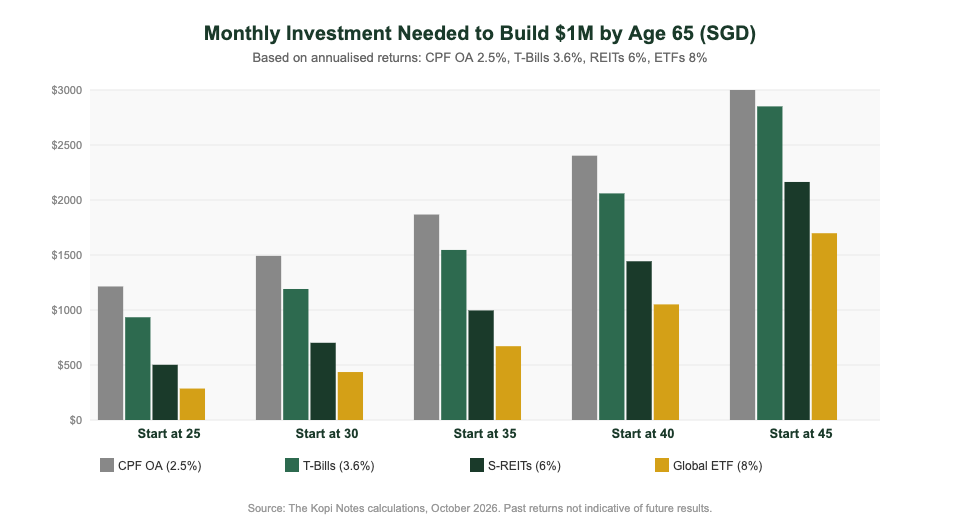
With 30 years of investment time and an 8% annual return (global equity ETF), this person needs to invest approximately SGD 650/month starting today. At 6% (REIT portfolio), the monthly contribution rises to SGD 945. At 3.6% (T-bills only), it jumps to SGD 1,610/month — nearly 2.5× more than an equity ETF investor. This illustrates why the choice of investment vehicle matters enormously when building for passive income in Singapore over the long run.
Retirement Investment Strategies: Closing the Gap
Once you know your retirement number, the question becomes: which investments get you there fastest, with acceptable risk? Singapore investors have four core building blocks:
1. CPF Top-Ups (Risk-Free, Guaranteed)
Topping up your CPF Special Account (SA) or Retirement Account (RA) earns a guaranteed 4% per annum — significantly higher than any bank savings account. Voluntary top-ups also earn a tax deduction of up to SGD 8,000 per year (own account) plus another SGD 8,000 for a family member’s account. This is the safest building block in any CPF investment strategy for Singapore retirees.
2. Singapore T-Bills and SSBs (Low Risk, Liquid)
6-month T-bills currently yield approximately 3.6% p.a. (October 2026) and can be purchased via CPF OA, SRS, or cash through DBS/POSB, OCBC, or UOB. Singapore Savings Bonds (SSBs) offer 10-year laddered yields averaging around 3.1–3.3% for newer issuances. These are appropriate for the 5–10 years before retirement, when capital preservation outweighs growth. Read our full Singapore T-bills 2026 guide for step-by-step purchase instructions.
3. S-REITs (Medium Risk, Income-Generating)
Singapore REITs currently trade at an average distribution yield of 6–7% p.a. (SGX data, October 2026). They provide quarterly or semi-annual cash distributions — ideal for pre-retirees who want growing income rather than just capital accumulation. The best S-REITs in Singapore 2026 offer exposure to industrial, commercial, and data centre assets with strong rental escalation clauses. REITs are CPF-investable (via CPFIS) and SRS-compatible.
4. Global ETFs (Medium-High Risk, Highest Long-Term Growth)
A globally diversified ETF tracking the MSCI World or S&P 500 has historically delivered 8–10% annualised total returns over 20-year periods. Ireland-domiciled ETFs listed on the London Stock Exchange — such as CSPX (S&P 500) or VWRA (global) — are the preferred vehicle for Singapore investors due to lower withholding tax (15% vs 30% for US-domiciled equivalents) and no US estate tax exposure.
| Investment | Expected Return | Risk Level | CPF/SRS Compatible | Best For |
|---|---|---|---|---|
| CPF Top-Up | 4.0% guaranteed | None | CPF ✓ | Risk-free foundation |
| T-Bills / SSBs | 3.1–3.6% | Very Low | CPF OA ✓ / SRS ✓ | Capital preservation |
| S-REITs | 6–7% (yield + growth) | Medium | CPFIS ✓ / SRS ✓ | Income generation |
| Global ETFs (LSE) | 8–10% (long-term) | Medium-High | SRS ✓ / Cash only | Maximum wealth accumulation |
Source: CPF Board, SGX, iShares, October 2026. Past returns are not indicative of future results. ETF returns are historical averages and may vary significantly.
Your 5-Step Retirement Action Plan
Once you have run the numbers through a retirement calculator, translate them into concrete actions:
Step 1: Maximise CPF contributions. Voluntary top-ups to CPF SA/RA (up to the Enhanced Retirement Sum of SGD 426,000 for 2026) earn a guaranteed 4% p.a. and provide tax deductions. This is the most efficient risk-free saving tool available to Singapore residents.
Step 2: Open an SRS account and automate monthly contributions. SRS contributions (up to SGD 15,300/year for Singapore citizens) are fully tax-deductible in the year of contribution. Invest SRS funds immediately into T-bills, REITs, or ETFs — idle SRS cash earns just 0.05% p.a. Consider opening with Syfe (use referral code SRPRFFFCD) for automated SRS ETF investing with no minimum investment amount.
Step 3: Build your investment portfolio by age. A rough rule of thumb: (110 – your age)% in equities (ETFs), the rest in income assets (REITs, T-bills). A 40-year-old would have roughly 70% ETFs and 30% REITs/bonds. Rebalance annually and shift toward income assets as you approach retirement.
Step 4: Track your progress annually. Re-run the retirement calculator every January with your updated savings balance and market returns. Adjust your monthly contribution if you are off track — it is far easier to catch a shortfall at 40 than at 60.
Step 5: Plan the drawdown strategy. At 65, CPF LIFE payouts start automatically. For your SRS and brokerage accounts, withdraw SRS in equal amounts over 10 years (from age 62) to minimise tax. Use a bucket strategy: 2 years of living expenses in cash, 3–5 years in T-bills/bonds, remainder in REITs and ETFs for continued growth.
Not financial advice. The figures and strategies above are for educational reference only. Consult a licensed financial adviser for personalised retirement planning. Regulations may change — verify all CPF figures directly with the CPF Board.
Frequently Asked Questions
How much do I need to retire comfortably in Singapore?
Most financial planners recommend a retirement fund of SGD 800,000 to SGD 1.2 million outside of CPF for a comfortable retirement in Singapore (SGD 4,000–5,000/month lifestyle). This is in addition to CPF LIFE payouts, which typically provide SGD 1,300–1,800/month for those who hit the Full Retirement Sum of SGD 213,000 (2026). Running a retirement calculator with your specific CPF balance and desired income will give you a personalised figure.
What is the CPF Full Retirement Sum (FRS) for 2026?
The CPF Full Retirement Sum (FRS) for 2026 is SGD 213,000, set in your CPF Retirement Account by age 55. Members who hit the FRS receive CPF LIFE monthly payouts of approximately SGD 1,380–1,560 per month from age 65, for life. The Enhanced Retirement Sum (ERS) is SGD 426,000, yielding approximately SGD 2,110–2,370/month. For the most current figures, check the CPF Board’s official website as amounts are adjusted annually.
Can I use a retirement calculator with CPF and SRS inputs?
Yes — our Singapore retirement calculator includes CPF LIFE payout projections, SRS balance fields, and separate rows for investable assets and expected returns by asset class. Generic global calculators omit these inputs, which is why they produce inaccurate numbers for Singaporeans. Use TKN’s free retirement planning calculator at the link in this article for a complete Singapore-specific projection.
What rate of return should I use in a retirement calculator?
Use a conservative blended rate based on your actual asset mix. A reasonable guide: CPF SA at 4%, T-bills at 3.5%, S-REITs at 5–6% (yield only, excluding capital gains uncertainty), and global equity ETFs at 6–8% (conservative long-term estimate). Avoid using the stock market’s peak 10-year historical returns as your base case — a sequence-of-returns risk near retirement could significantly reduce your portfolio. Use 5–6% as your default blended rate for a balanced portfolio.
At what age should I start retirement planning in Singapore?
The earlier the better — starting at 25 versus 35 can halve the monthly investment needed to reach the same retirement goal, due to compound interest. However, it is never too late to start. Even beginning at 45 with aggressive savings and a high-return portfolio (global ETFs + REITs) can close a significant gap by 65. The key action regardless of age: calculate your retirement number today, open an SRS account, and automate a monthly investment.
Is CPF enough for retirement in Singapore?
CPF alone is sufficient only for a very frugal retirement. CPF LIFE’s maximum Enhanced Retirement Sum payout of approximately SGD 2,370/month (2026) covers basic needs but not a comfortable lifestyle with travel, healthcare costs, and discretionary spending. Most Singaporeans need to supplement CPF LIFE with personal savings in SRS, a brokerage portfolio of ETFs and REITs, and potentially rental income. Running a retirement calculator with your current CPF balance will show exactly how large the shortfall is.
Start Building Your Retirement Nest Egg Today
Use our free retirement calculator to find your number, then open an investment account to start working towards it.
This article was researched with the help of AI. While we strive to keep all information accurate and up to date, there may be errors. If you notice any discrepancies, please contact us.