Quantum Computing ETF Singapore: How to Buy QNTM & WQTM (2026 Guide)
Yes, Singapore investors can buy a quantum computing ETF. VanEck’s QNTM and WisdomTree’s WQTM are both Irish-domiciled UCITS funds listed on the London Stock Exchange, giving you exposure to D-Wave, IonQ, Rigetti and quantum-linked mega-caps like Microsoft and IBM — without the US estate tax risk that comes with buying a US-listed quantum fund like QTUM directly.
Not financial advice. All figures are for educational reference only. Data as at 6 August 2026 unless noted.
- Quantum computing ETFs are still a nascent, high-volatility theme — think of this as a small satellite position, not a core holding.
- QNTM (VanEck) and WQTM (WisdomTree) are both LSE-listed UCITS ETFs you can buy through IBKR, Saxo or Syfe — no US estate tax exposure like a US-listed fund such as QTUM carries.
- WQTM has the lower TER at 0.50% vs QNTM’s 0.55%, but QNTM tracks a narrower, more concentrated “pure-play” index.
Table of Contents
What Is a Quantum Computing ETF?
Why Singapore Investors Are Watching This Theme
VanEck Quantum Computing UCITS ETF (QNTM)
WisdomTree Quantum Computing UCITS ETF (WQTM)
QNTM vs WQTM vs QTUM Compared
How to Buy a Quantum Computing ETF in Singapore
Risks You Need to Know
Frequently Asked Questions
What Is a Quantum Computing ETF?
A quantum computing ETF is a basket of stocks tied to quantum technology — the chipmakers, cloud platforms and pure-play quantum companies racing to build computers that solve problems classical computers can’t. Instead of picking one speculative stock like IonQ or Rigetti, you own a diversified slice of the whole race.
Here’s why that matters. Quantum computing is still pre-commercial. Most “pure-play” quantum stocks generate little or no revenue today. By spreading your bet across 25–90 companies in one fund, you reduce the risk that a single company’s setback wipes out your position.
Two Singapore-accessible options exist: the VanEck Quantum Computing UCITS ETF (QNTM) and the WisdomTree Quantum Computing UCITS ETF (WQTM). Both are UCITS (Undertakings for Collective Investment in Transferable Securities) funds — an EU regulatory wrapper that Singapore investors like because it’s domiciled in Ireland, not the US.
Why Singapore Investors Are Watching This Theme
If you’ve followed the AI ETF and semiconductor ETF rally over the past two years, quantum computing is the next frontier tech theme getting the same treatment. Google, Microsoft, IBM and Amazon are all pouring capital into quantum research, and pure-play names like IonQ, Rigetti and D-Wave have seen their share prices swing wildly on every commercialisation headline.
For you as a Singapore investor, the appeal isn’t just the technology story. It’s also structural. Both QNTM and WQTM trade on the London Stock Exchange in USD, settle through the same brokers you already use for CSPX and VWRA, and sidestep the US estate tax exposure that comes with holding US-listed ETFs directly.
That said, this is a thematic, high-volatility satellite position — not a core holding. Treat it the way you’d treat a small allocation to any early-stage tech theme.
VanEck Quantum Computing UCITS ETF (QNTM)
QNTM launched on 21 May 2025 as Europe’s first dedicated quantum computing ETF. As at 4 August 2026, it holds US$856.0 million in assets and carries a Total Expense Ratio (TER) — the annual cost you pay as a fund holder — of 0.55%.
The fund tracks the MarketVector Global Quantum Leaders Index, a modified equal-weighted basket of roughly 30 companies (see the official VanEck QNTM fund page for live holdings). VanEck screens for firms that either derive most of their revenue from quantum computing or are investing heavily in quantum research, so you get a mix of pure-play names and diversified tech giants.
QNTM Key Facts
- ISIN: IE0007Y8Y157
- Exchange: London Stock Exchange (ticker QNTM)
- TER: 0.55% per year
- Inception: 21 May 2025
- AUM: US$856.0 million (as at 4 Aug 2026)
- SFDR classification: Article 6
- Index: MarketVector Global Quantum Leaders Index
WisdomTree Quantum Computing UCITS ETF (WQTM)
WQTM listed on the LSE on 3 September 2025 (trading from 27 August 2025), a few months after QNTM. As at 4 August 2026, it manages US$359.4 million in assets with a TER of 0.50% — five basis points cheaper than QNTM.
It tracks the WisdomTree Classiq Quantum Computing UCITS Index, built with input from quantum industry experts. Holdings are weighted by “relevancy and purity” scores, capped at 15% per stock, and rebalanced quarterly (full holdings on the official WisdomTree WQTM fund page). As at the same date, top holdings included D-Wave Quantum (5.75%), Rigetti Computing (5.28%), IonQ (4.23%), Microsoft (3.78%) and IBM (3.38%) — with the US making up 62% of the country allocation and Japan a notable 11%.
WQTM Key Facts
- ISIN: IE000W8WMSL2
- Exchange: London Stock Exchange (USD ticker WQTM, GBX ticker QWTM)
- TER: 0.50% per year
- Inception: 27 August 2025
- AUM: US$359.4 million (as at 4 Aug 2026)
- Structure: Physical, fully replicated, accumulating
- Index: WisdomTree Classiq Quantum Computing UCITS Index
QNTM vs WQTM vs QTUM Compared
For context, here’s how the two UCITS options stack up against the largest US-listed quantum fund, Defiance Quantum ETF (QTUM) — a NASDAQ-listed fund with US$5.6 billion in assets and a longer track record since 2018.
| Fund | Domicile | TER | AUM | Holdings | Inception |
|---|---|---|---|---|---|
| QNTM (VanEck) | Ireland (UCITS) | 0.55% | US$856.0m | ~30 | 21 May 2025 |
| WQTM (WisdomTree) | Ireland (UCITS) | 0.50% | US$359.4m | ~25-40, rebalanced quarterly | 27 Aug 2025 |
| QTUM (Defiance) | United States | 0.40% | US$5.6bn | 86 | Sep 2018 |
Source: VanEck QNTM fund page, WisdomTree WQTM fund page, Defiance ETFs — all as at 4 August 2026.
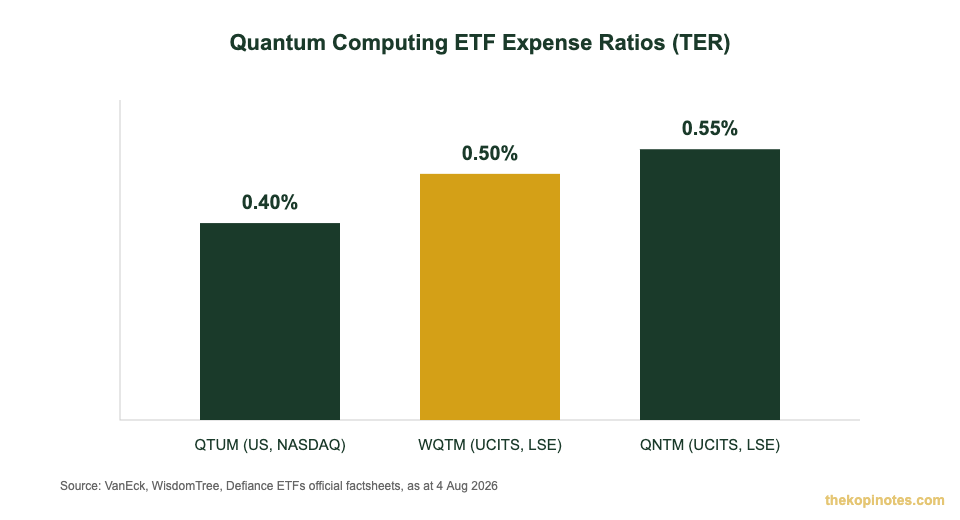
QTUM looks cheaper on paper at 0.40%, and it has a longer track record with $5.6 billion in assets. But for you as a Singapore investor, the TER gap is only part of the story — the tax treatment matters just as much.
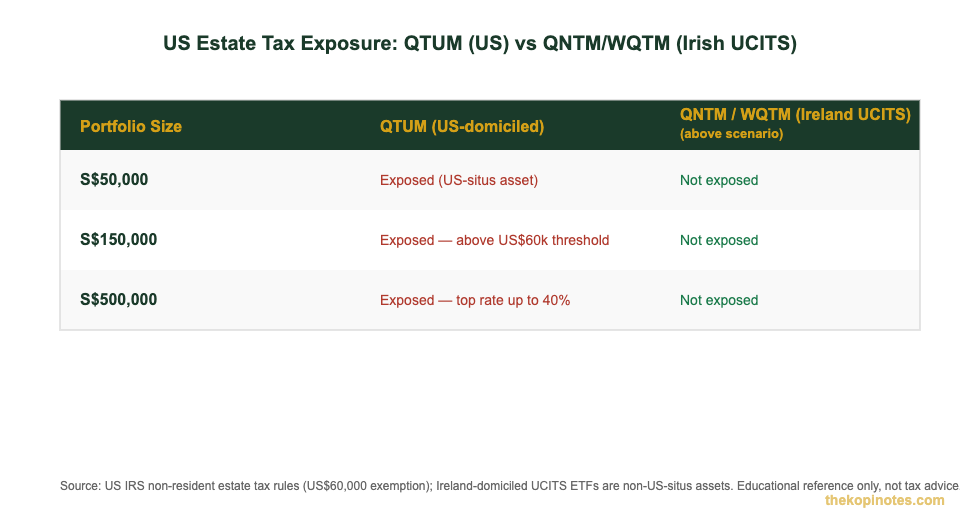
US-listed ETFs like QTUM are classified as US-situs assets under IRS rules. If you’re a non-resident alien and your US-situs assets exceed US$60,000 at death, your estate can face US estate tax at rates up to 40% on the excess (see the IRS guidance for nonresidents with US assets). QNTM and WQTM, as Ireland-domiciled UCITS funds, are not US-situs assets — so this risk doesn’t apply, even though both funds hold the same underlying US quantum stocks.
There’s a second tax layer too: dividend withholding tax (WHT) — the tax deducted at source before a dividend reaches your fund. Quantum computing companies pay minimal dividends today, so this matters less here than it does for an income-focused ETF like VWRA. Still, the same structural principle applies: Irish UCITS funds benefit from the US-Ireland tax treaty’s reduced 15% WHT rate on US dividends, versus the 30% default rate non-treaty investors face holding US stocks directly.
How to Buy a Quantum Computing ETF in Singapore
Buying QNTM or WQTM works the same way as buying CSPX or VWRA. Here’s the process:
- Open a brokerage account that offers LSE access. IBKR, Saxo, Tiger Brokers and moomoo all support LSE trading. Syfe also offers commission-free access to select global ETFs, so check whether QNTM or WQTM is on their supported list before funding.
- Search the ticker. Use “QNTM” for VanEck’s fund or “WQTM” (USD) / “QWTM” (GBX) for WisdomTree’s fund on the LSE exchange listing — not the US OTC or other cross-listings.
- Check the currency. Both funds trade in USD on the LSE. Factor in your broker’s FX conversion spread if you’re funding from SGD.
- Size the position appropriately. Given the volatility of this theme, most advisors suggest capping thematic satellite positions like this at 5% or less of your total portfolio.
- Hold within a taxable brokerage account. These aren’t yet CPFIS-approved or SRS-eligible, so you’ll be investing with cash.
If you’re building out a broader ETF portfolio around this, our robotics ETF guide and AI-powered ETF comparison cover adjacent frontier-tech themes worth cross-referencing before you allocate.
Risks You Need to Know
Quantum computing ETFs carry real risks you shouldn’t gloss over. Here’s what to weigh before you buy:
- Commercialisation risk. Quantum computing that outperforms classical computers at commercially useful scale hasn’t arrived yet. Timelines could stretch years longer than expected.
- Concentration risk. With only 25–30 “pure-play” companies globally, both QNTM and WQTM lean on mega-caps like Microsoft, IBM and Alphabet to fill out the portfolio — meaning you’re not getting pure quantum exposure even when you think you are.
- Volatility. Pure-play names like Rigetti and D-Wave have swung 20%+ in single sessions on commercialisation headlines. Expect sharp drawdowns.
- Liquidity risk. Both funds are newer and smaller than established thematic ETFs — bid-ask spreads can widen during volatile periods.
- Currency risk. Both trade in USD; SGD-based investors bear FX fluctuation on top of fund performance.
The bottom line: this is a speculative, early-stage theme. Position it as a small, deliberate bet — not a core building block of your portfolio.
Frequently Asked Questions
Can Singapore investors buy a quantum computing ETF?
What's the difference between QNTM and WQTM?
Is QTUM better than QNTM or WQTM for Singapore investors?
Are quantum computing ETFs CPFIS or SRS eligible?
How much of my portfolio should I put into a quantum ETF?
Do quantum computing ETFs pay dividends?
Ready to Build Your ETF Portfolio?
This article is for educational purposes only and does not constitute financial advice. The Kopi Notes is not a licensed financial advisor. ETF prices, expense ratios and holdings change over time — always verify current figures on the official fund provider websites (VanEck, WisdomTree) before investing. Some links on this page are referral links; The Kopi Notes may earn a commission at no extra cost to you.
This article was researched with the help of AI. While we strive to keep all information accurate and up to date, there may be errors. If you notice any discrepancies, please contact us.