Best AI-Powered ETFs for Singapore Investors in 2026
RBOT, WTAI, AIAI and BOTZ compared — fees, fund size, and how to buy them tax-efficiently from Singapore.
AI-powered ETFs give Singapore investors low-cost, diversified exposure to artificial intelligence and robotics stocks without picking individual winners. The main options — iShares Automation & Robotics (RBOT), WisdomTree AI (WTAI), L&G AI (AIAI) and Global X Robotics & AI (BOTZ) — are all Ireland-domiciled UCITS ETFs on the London Stock Exchange, giving Singapore investors 15% US dividend withholding tax and no US estate tax exposure.
Not financial advice. All figures are for educational reference only. Data verified as at 13 July 2026 unless noted.
- AI ETFs let you buy a basket of AI and robotics stocks instead of betting on one company like Nvidia.
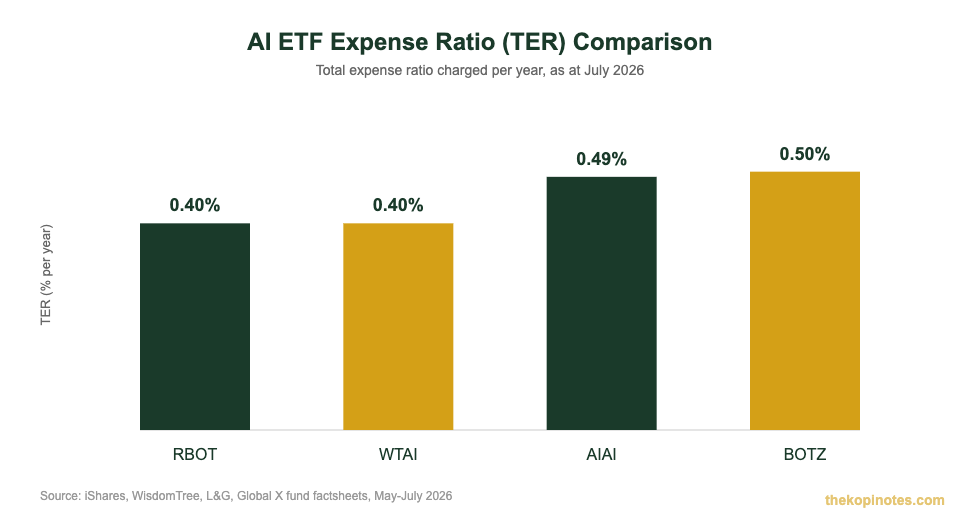
- RBOT and WTAI are the cheapest at 0.40% TER. Both trade on the LSE, so you pay 15% US withholding tax instead of 30%.
- You can buy them through IBKR, Saxo, or moomoo. None are CPF-approved, but some brokers let you fund with SRS.
Table of Contents
What Are AI-Powered ETFs?
An AI-powered ETF is a fund that holds a basket of stocks tied to artificial intelligence, robotics, or automation. “AI-powered” describes the theme the fund invests in — not an AI system managing your money. The fund still tracks a fixed index, just like CSPX tracks the S&P 500.
These ETFs hold companies across the AI supply chain. That includes chipmakers like Nvidia and AMD, industrial robotics firms like FANUC and ABB, and software companies building AI tools. Instead of guessing which single AI stock will win, you own a slice of dozens of them.
This matters if you’re worried about picking the wrong stock. However, that diversification is still narrow compared to a broad market ETF like VWRA, which spreads risk across thousands of companies worldwide. AI ETFs concentrate risk in one theme, which cuts both ways — bigger gains in a boom, sharper drops in a correction.
Prefer a broader tech tilt instead of pure-play AI and robotics names? Our guide to AI and technology ETFs in Singapore covers Nasdaq 100 and S&P 500 IT-sector options like EQQQ and IITU, which spread risk across the wider tech sector rather than concentrating in AI and robotics specialists.
Key Facts at a Glance
| Metric | RBOT | WTAI | AIAI | BOTZ |
|---|---|---|---|---|
| Provider | iShares | WisdomTree | L&G | Global X |
| Index Tracked | iSTOXX FactSet Automation & Robotics | Nasdaq CTA AI Index | ROBO Global AI Index | Indxx Global Robotics & AI Index |
| TER | 0.40% p.a. | 0.40% p.a. | 0.49% p.a. | 0.50% p.a. |
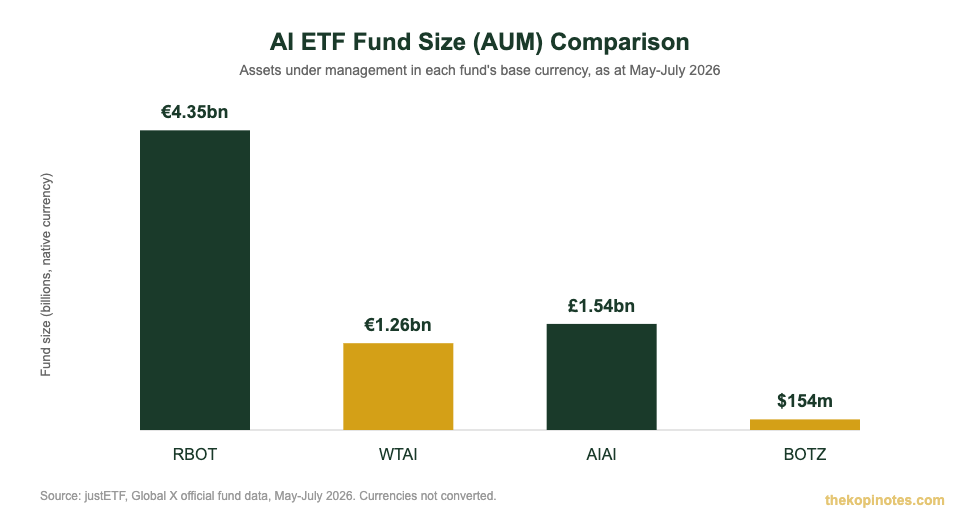
| Fund Size (AUM) | €4.35 billion | €1.26 billion | £1.54 billion | USD 154 million |
| Domicile | Ireland | Ireland | Ireland | Ireland |
| Structure | Accumulating | Accumulating | Accumulating | Accumulating |
| LSE Ticker | RBOT (USD) / RBTX (GBP) | WTAI | AIAI (USD) / AIAG (GBP) | BOTZ |
Source: justETF fund data; iShares, WisdomTree, L&G and Global X factsheets, May–July 2026.
Why AI ETFs Are Trending in 2026
AI-themed ETFs are having a record year. In the first half of 2026, 23 AI and big data ETFs pulled in a combined USD 8.5 billion of new money, pushing their total assets to roughly USD 19.6 billion. That’s according to industry tracker ETF Trends.
This is part of a much bigger wave. The global ETF industry crossed USD 15 trillion in assets and topped USD 1 trillion in net inflows before summer 2026 — the fastest pace on record. Investors are chasing exposure to AI capital spending, from GPU chips to data centre infrastructure.
However, not everyone is convinced the rally is healthy. Investor Michael Burry has warned about “token maxing” and AI valuations resembling past bubbles. Read our breakdown of Michael Burry’s AI warning before you size a position. The bottom line: strong flows don’t guarantee strong future returns.
Best AI ETFs for Singapore Investors
All four ETFs above are Ireland-domiciled and listed on the London Stock Exchange (LSE). That structure matters more than most investors realise. A US-listed thematic AI ETF charges Singapore investors 30% withholding tax on dividends and exposes your estate to US estate tax above USD 60,000. The LSE-listed, Ireland-domiciled versions cut that withholding tax to 15% and remove the estate tax risk entirely.
| ETF Type | Domicile | Listing | US Dividend WHT | US Estate Tax Risk |
|---|---|---|---|---|
| RBOT / WTAI / AIAI / BOTZ (UCITS) | Ireland | London Stock Exchange | 15% | None |
| US-listed thematic AI ETF (e.g. BOTZ US, ARKQ) | USA | NYSE / Nasdaq | 30% | Yes (above USD 60k) |
Source: iShares, WisdomTree, L&G, Global X fund documents; IRS estate tax rules for non-resident aliens.
RBOT — iShares Automation & Robotics UCITS ETF
RBOT is the largest and cheapest fund in this comparison at €4.35 billion AUM and a 0.40% TER. It tracks 132 companies in the iSTOXX FactSet Automation & Robotics index, with roughly 56% US exposure and 16% Japan exposure. Top holdings include Intel, AMD, and Advantest. Over the year to late May 2026, RBOT returned +43.11%, though it also fell 13.2% at its worst point in the same period. That swing shows why this isn’t a “set and forget” holding.
WTAI — WisdomTree Artificial Intelligence UCITS ETF
WTAI tracks the Nasdaq CTA Artificial Intelligence Index and matches RBOT’s 0.40% TER. At €1.26 billion AUM, it’s smaller than RBOT but still liquid enough for most retail order sizes. WTAI leans more toward AI software and infrastructure names rather than industrial robotics, so its sector mix differs from RBOT even though the fees are identical.
AIAI — L&G Artificial Intelligence UCITS ETF
AIAI tracks the ROBO Global Artificial Intelligence Index at a 0.49% TER, with £1.54 billion under management. It’s a reasonable middle-ground option if you want a slightly different index methodology from RBOT or WTAI, though the extra 0.09% TER versus RBOT adds up over a multi-decade holding period.
BOTZ — Global X Robotics & Artificial Intelligence UCITS ETF
BOTZ tracks the Indxx Global Robotics & AI Thematic Index at a 0.50% TER — the highest of the four. Its UCITS version only holds about USD 154 million in assets as at July 2026, far smaller than RBOT. Smaller AUM can mean wider bid-ask spreads, so factor that into your order sizing if you pick BOTZ over the larger alternatives.
How to Buy AI ETFs in Singapore
You buy RBOT, WTAI, AIAI, or BOTZ the same way you’d buy CSPX or VWRA — through a broker with LSE access. Here’s how on each major platform.
Interactive Brokers (IBKR): Fund your account, search the ticker (e.g. “RBOT”), and select the London Stock Exchange listing in USD or GBP. IBKR has the lowest commission for larger trade sizes, which matters more as your position grows.
Saxo Markets: Similar process — search the ticker, confirm you’re selecting the LSE-listed, Ireland-domiciled share class (not a US-listed lookalike with the same name), and place your order in USD or GBP.
moomoo Singapore: moomoo also offers LSE access for these ETFs. If you’re deciding between brokers, read our moomoo brokerage Singapore review for a full fee breakdown first.
Syfe Brokerage: If you’d rather not manage individual ETF purchases yourself, Syfe’s brokerage platform is the simplest starting point for beginners. Check the Syfe referral code and sign-up bonus before opening an account.
One practical tip: always double-check the ISIN, not just the ticker, before you buy. Several of these funds have similarly-named US-listed cousins that carry the 30% withholding tax and US estate tax exposure discussed above.
Risks to Consider
AI ETFs are not a “safer” version of a broad market ETF. Here’s what to weigh before you buy.
Concentration risk. RBOT’s top 10 holdings make up over 45% of the fund. If a handful of chipmakers stumble, the whole ETF feels it — unlike CSPX or VWRA, which spread risk across hundreds or thousands of companies.
Valuation risk. After a year of double and triple-digit gains across AI-themed funds, valuations are stretched. Some voices, including Michael Burry in his widely discussed AI warning, argue parts of the AI trade resemble past speculative bubbles. That doesn’t mean a crash is coming — but it means you shouldn’t treat recent returns as a baseline for future ones.
Currency and liquidity risk. These ETFs trade in USD or GBP, so your SGD returns will move with exchange rates too. Smaller funds like BOTZ, at just USD 154 million AUM, can also have wider spreads than RBOT’s €4.35 billion.
Thematic drift. “AI” is a broad label. Two AI ETFs tracking different indexes can hold very different companies. Always check the actual top 10 holdings before assuming two funds are interchangeable.
For most Singapore investors building a long-term retirement portfolio, a broad market ETF like CSPX should still form your core holding. AI ETFs work better as a smaller satellite position — many investors cap thematic ETFs at 5-10% of their total portfolio, though this depends on your own risk tolerance.
Not financial advice. This article does not consider your personal financial situation. AI ETFs carry higher volatility and concentration risk than broad market ETFs. Speak to a licensed financial adviser before making investment decisions.
Frequently Asked Questions
What is an AI-powered ETF and how does it work?
An AI-powered ETF is a fund that tracks an index of companies involved in artificial intelligence, robotics, or automation. It works like any other ETF — you buy one unit and instantly own a small slice of every company in the index, without an AI system actively managing the fund.
Is RBOT the same as buying Nvidia stock directly?
No. RBOT holds Nvidia as one of over 130 positions, alongside chipmakers, robotics firms, and industrial automation companies. Buying RBOT gives you diversified exposure to the AI theme, while buying Nvidia directly concentrates all your risk in a single company.
Can I buy AI ETFs using my CPF or SRS funds?
None of RBOT, WTAI, AIAI, or BOTZ are approved under the CPF Investment Scheme (CPFIS), so you cannot use CPF Ordinary Account funds to buy them. Some brokers do support SRS (Supplementary Retirement Scheme) funding for LSE-listed ETFs — check with your broker directly, as support varies by platform.
Which AI ETF has the lowest fees for Singapore investors?
RBOT and WTAI are tied for the lowest total expense ratio at 0.40% per year. AIAI charges 0.49% and BOTZ charges 0.50%. Over a long holding period, that fee gap compounds, so cost is worth weighing alongside index methodology and holdings.
Are AI ETFs riskier than broad market ETFs like CSPX or VWRA?
Generally yes. AI ETFs concentrate your money in one theme and often in a small number of top holdings, while CSPX and VWRA spread risk across hundreds or thousands of companies in every sector. AI ETFs can outperform in a strong AI rally but also fall harder in a sector-specific downturn.
Which broker is best for buying AI ETFs in Singapore?
Interactive Brokers (IBKR) typically offers the lowest commissions for larger trade sizes and full LSE access. Saxo Markets and moomoo Singapore are solid alternatives, while Syfe Brokerage is the simplest option if you’re new to buying individual ETFs yourself.
Ready to Start Investing in AI ETFs?
Open a brokerage account and buy your first ETF today. Use our referral links for exclusive sign-up bonuses.
This article was researched with the help of AI. While we strive to keep all information accurate and up to date, there may be errors. If you notice any discrepancies, please contact us.