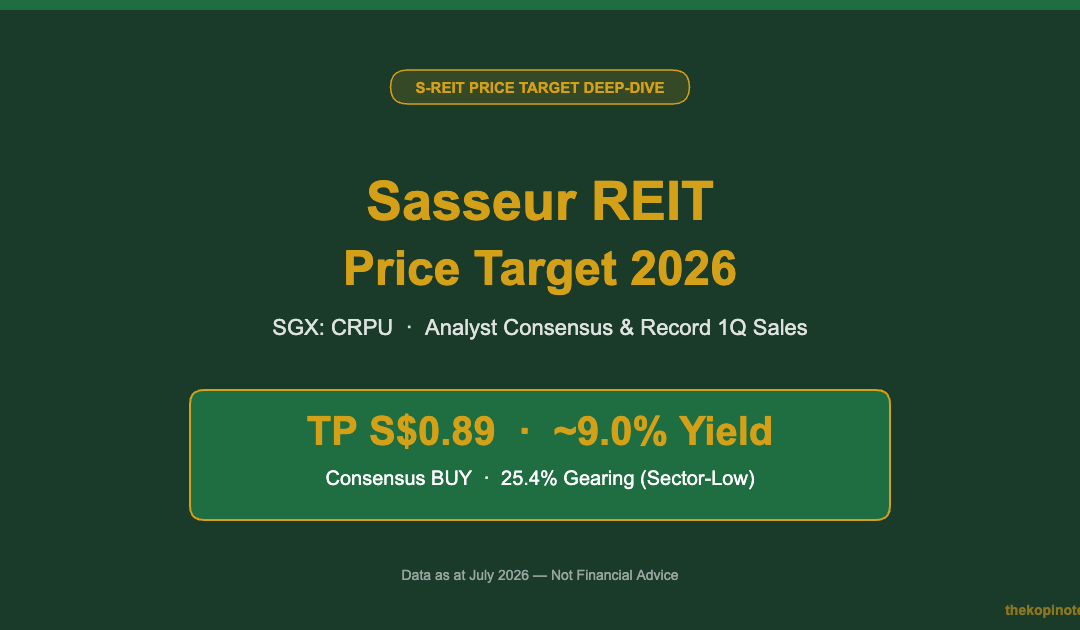
Sasseur REIT Price Target 2026 (SGX: CRPU): Analyst Consensus, Record 1Q Sales & Is It Still a Buy?
Sector-low 25.4% gearing, a ~9.0% yield, and a S$0.89 consensus target — here’s the full 2026 breakdown for Singapore investors.
Sasseur REIT (SGX: CRPU) trades around S$0.68 with a trailing yield near 9.0%. The 2026 analyst consensus price target sits at S$0.89 — about 31% above the current price — backed by record 1Q outlet sales, a sector-low 25.4% gearing ratio, and falling financing costs. Here’s what’s driving the numbers and whether Sasseur REIT still deserves a place in your portfolio.
Not financial advice. All figures are for educational reference only. Data as at July 2026 unless noted.
- Sasseur REIT (CRPU) trades at S$0.68 with a ~9.0% trailing yield — among the highest of any S-REIT
- Analyst consensus price target is S$0.89 (range S$0.87–S$0.93), implying ~31% upside and a BUY rating
- Gearing fell to a sector-low 25.4% in 1Q 2026, giving management S$862.5M of headroom for acquisitions
Sasseur REIT at a Glance
Sasseur REIT (SGX: CRPU) is Singapore’s first — and still only — outlet mall REIT. It listed on the SGX Mainboard in March 2018. The REIT owns four retail outlet malls in China: Chongqing (Liangjiang), Chongqing (Bishan), Hefei, and Kunming.
Unlike most S-REITs, Sasseur doesn’t lease space directly to shops. Instead, it uses an Entrusted Manager Agreement (EMA) — basically, a professional outlet operator runs each mall and pays Sasseur REIT rent made up of a fixed portion plus a variable portion linked to outlet sales. When Chinese shoppers spend more, Sasseur earns more.
As at July 2026, units trade around S$0.68, giving a trailing yield near 9.0% — one of the highest in the S-REIT sector. That yield has caught investor attention, especially after a record first quarter.
| Metric | Value |
|---|---|
| Ticker | SGX: CRPU |
| Share Price | S$0.68 |
| Trailing Yield | ~9.0% |
| FY2025 DPU | 6.138¢ (+0.9% YoY) |
| Gearing (1Q 2026) | 25.4% (sector-low) |
| Cost of Debt (1Q 2026) | 3.9% |
| Portfolio | 4 outlet malls, China |
| Occupancy (1Q 2026) | 98.5% |
| Analyst Consensus | BUY, TP S$0.89 |
Source: Sasseur REIT 1Q 2026 business update, FY2025 results announcement, SGinvestors.io — July 2026
Record 1Q 2026: What’s Driving the Rally
Sasseur REIT’s 1Q 2026 business update, released in April 2026, was its strongest quarter since listing. Portfolio outlet sales hit RMB1,390.4 million — up 11.4% year-on-year and a first-quarter record.
That sales growth flowed straight into rental income. EMA rental income rose 5.7% in RMB terms to RMB185.5 million, or S$34.2 million in SGD (+5.1%). The fixed rental component grew a contractual 3.0% to RMB122.3 million, while the sales-linked variable component jumped 11.5% to RMB63.2 million — proof the EMA structure is working as designed in an up-cycle.
Two other numbers stood out. Portfolio occupancy held at 98.5%, among the highest of any S-REIT. And Sasseur REIT’s VIP membership base crossed 5 million shoppers, a sign of deepening customer loyalty at its outlet malls.
Management also flagged 2026 as a year for “accretive acquisition.” In practice, that means Sasseur REIT could use its low gearing and ample debt headroom to buy new properties and grow DPU further. More on that below.
DPU History: FY2023–FY2025
Sasseur REIT’s DPU (Distribution Per Unit — basically how much cash each unit pays you per year) dipped in FY2024 before recovering in FY2025.
| Fiscal Year | DPU (S¢) | YoY Change | Distributable Income |
|---|---|---|---|
| FY2023 | 6.249¢ | — | — |
| FY2024 | 6.082¢ | -2.7% | — |
| FY2025 | 6.138¢ | +0.9% | S$85.7M (+2.8%) |
Source: Sasseur REIT FY2025 results announcement, 26 Feb 2026
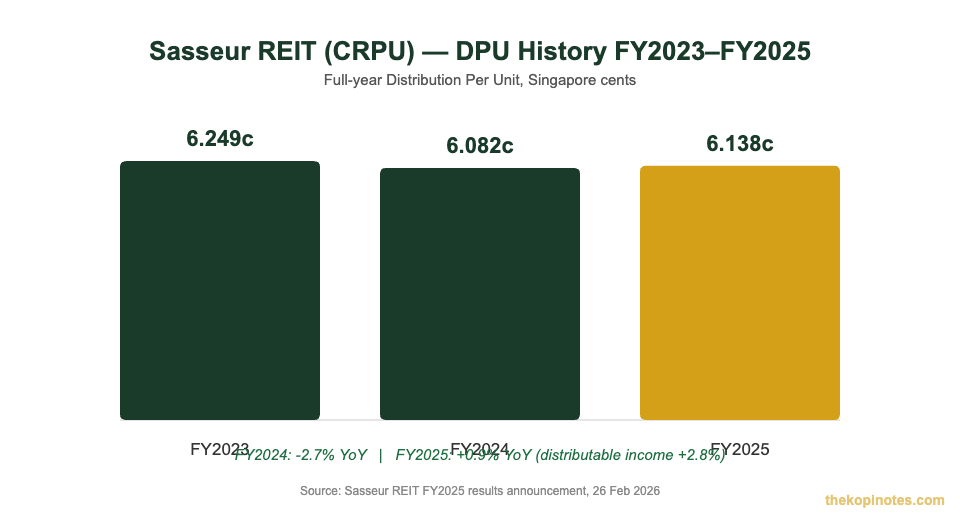
FY2024’s 2.7% DPU decline reflected a tougher year for Chinese consumer spending and higher financing costs. FY2025’s rebound came from a mix of stronger outlet sales and — importantly — falling finance costs.
Sasseur REIT’s weighted average cost of debt dropped from 5.3% to 4.4% in FY2025, then fell further to 3.9% by 1Q 2026. Lower interest expense means more cash flows through to unitholders as distributions.
Distributable income for FY2025 rose 2.8% year-on-year to S$85.7 million. That’s the number that actually funds your distributions. DPU growth without distributable income growth is a warning sign — but here, both moved in the same direction.
Analyst Price Targets 2026: What the Street Expects
This is where Sasseur REIT gets interesting for value-focused investors. At a share price of S$0.68, analyst consensus points to a 2026 target price of S$0.89 — an implied upside of about 31%.
| Metric | Value |
|---|---|
| Current Share Price | S$0.68 |
| Low Target | S$0.87 |
| Consensus Target | S$0.89 |
| High Target | S$0.93 |
| Implied Upside (Consensus) | ~31% |
| Consensus Rating | BUY |
Source: SGinvestors.io analyst consensus, July 2026
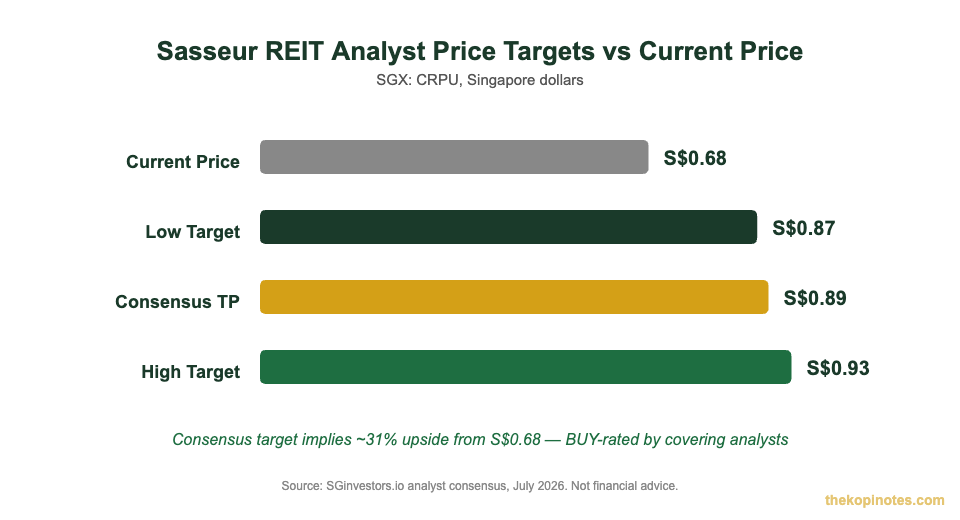
Individual analyst targets range from S$0.87 to S$0.93, with a consensus BUY rating. That’s a meaningfully wide gap between price and fundamentals-based valuation — the kind of gap that shows up when a small-cap REIT’s operational improvement (record sales, falling gearing, lower cost of debt) hasn’t yet been fully priced in.
That said, price targets are analyst opinions, not guarantees. Sasseur REIT’s small market cap and concentrated China exposure mean it can stay “cheap” relative to target prices for longer than larger, more liquid REITs. Treat the consensus target as one data point, not a promise.
Balance Sheet Strength: Why 25.4% Gearing Matters
Gearing — how much of a REIT’s assets are funded by debt — is one of the first things you should check before buying any S-REIT. High gearing means more refinancing risk and less room to raise fresh debt for acquisitions.
Sasseur REIT’s aggregate leverage fell to 25.4% in 1Q 2026, among the lowest in the entire S-REIT sector, where the average sits closer to 38–40%. That leaves Sasseur REIT with roughly S$862.5 million of debt headroom before it approaches MAS’s regulatory gearing limits.
Combined with a falling cost of debt (3.9% and dropping), this gives Sasseur REIT two levers most small-cap REITs don’t have: room to make accretive acquisitions, and a shrinking interest burden that protects distributions if China’s consumer market slows.
Portfolio Overview: Sasseur’s Four China Outlet Malls
Sasseur REIT’s entire portfolio sits in China, spread across four outlet malls:
- Chongqing (Liangjiang) — the REIT’s flagship, largest asset by value
- Chongqing (Bishan) — the REIT’s second Chongqing property
- Hefei — Anhui province
- Kunming — Yunnan province, flagged by some analysts as the current soft spot in the portfolio
These are second-tier Chinese cities, chosen deliberately. Sasseur’s strategy targets fast-growing consumer markets outside China’s saturated first-tier cities like Shanghai and Beijing.
This concentration cuts both ways. It gives Sasseur REIT direct exposure to China’s resilient outlet-shopping trend — a category that has outperformed traditional retail through China’s broader consumption slowdown. However, it also means Sasseur REIT has none of the geographic diversification that larger S-REITs like the best S-REITs in Singapore 2026 typically offer.
How Sasseur REIT Compares to Other High-Yield S-REITs
| REIT | Ticker | Trailing Yield | Gearing | Note |
|---|---|---|---|---|
| Sasseur REIT | CRPU | ~9.0% | 25.4% | Sector-low gearing, China outlet malls |
| Alpha Integrated REIT (formerly Sabana) | M1GU | ~8.95% | 36.1% | Post-internalisation, SG industrial |
| Elite Commercial REIT | MN9U | ~8.8% | ~38.6% | UK govt tenants, no refinancing until 2028 |
| First REIT | AW9U | ~8.7% | ~42.1% | S$260.5M refinancing due in 2026 |
| Starhill Global REIT | P40U | ~7.2% | — | Retail/office, Wisma Atria & Ngee Ann City |
Source: Company filings, REITsweek, SGinvestors.io — July 2026
Sasseur REIT’s ~9.0% yield sits at the very top of the S-REIT sector — but so does its risk profile. Elite Commercial REIT and First REIT offer comparable yields with different trade-offs: Elite Commercial REIT leans on UK government tenants (currency and geopolitical risk), while First REIT faces a chunkier 2026 refinancing task at higher gearing. For a broader ranking, see our highest yield REITs in Singapore 2026 roundup.
Sasseur REIT’s edge is its balance sheet. At 25.4% gearing, it has more breathing room than every REIT in this comparison table — which matters if China’s economy hits a rough patch and Sasseur needs to refinance or raise capital.
Risks to Watch Before You Buy
No REIT yielding 9% is risk-free. Here’s what could go wrong.
China consumption slowdown. Sasseur’s variable rental income is directly tied to outlet sales. If Chinese consumer spending weakens, the sales-linked component of rent falls with it.
Currency risk. Sasseur REIT earns rental income in RMB but distributes in SGD. A weaker RMB against the Singapore dollar shrinks your distributions, even if underlying Chinese sales hold steady.
Single-country, single-format concentration. All four properties are outlet malls in China. There’s no diversification across property types or countries to cushion a localised downturn.
Related-party structure. The EMA model means Sasseur Group — the REIT’s sponsor — also operates the malls. This concentrates operational control (and potential conflicts of interest) in one related entity, though FY2025’s results suggest the arrangement has performed well so far.
Kunming softness. At least one recent report flagged Kunming as a comparatively weaker performer within the portfolio, and noted the portfolio’s lease structure under the EMA model runs shorter than a typical S-REIT lease — worth watching in future updates.
Should You Buy, Hold or Sell Sasseur REIT?
For income-focused investors comfortable with China consumer exposure and RMB currency risk, Sasseur REIT’s combination of a ~9.0% yield, sector-low gearing, and a BUY-rated analyst consensus makes a reasonable case for a small allocation.
If you already hold Sasseur REIT, the 1Q 2026 numbers — record sales, falling cost of debt, rising occupancy — support holding through the next few quarters, especially with management flagging acquisition plans that could lift DPU further.
If you’re risk-averse, or you already have meaningful China exposure elsewhere in your portfolio (through ETFs, other REITs, or direct equities), Sasseur REIT’s concentration risk may outweigh the yield premium. In that case, a diversified S-REIT option might suit you better than a single-name bet.
This isn’t a recommendation to buy, hold, or sell — it’s a framework. Your decision should depend on your existing portfolio, risk tolerance, and how comfortable you are with China-specific and currency risk. For more DPU history and dividend mechanics, see our Sasseur REIT dividend and DPU guide, or our earlier buy, hold or sell breakdown for additional context.
How to Buy Sasseur REIT in Singapore
You can buy Sasseur REIT units through any SGX-linked brokerage account, using cash, SRS, or — subject to current CPFIS eligibility — CPF Ordinary Account funds.
- Open a brokerage account — FSMOne, Syfe, or Interactive Brokers (IBKR) all offer SGX access.
- Fund your account via cash, SRS, or CPF-OA (check the current CPFIS-OA list to confirm Sasseur REIT’s eligibility before transacting).
- Search “CRPU” or “Sasseur REIT” in your broker’s trading platform.
- Decide on a position size. Given the concentration risks above, most advisors would suggest keeping any single small-cap REIT to a modest slice of your overall portfolio.
- Place your order and track your distributions — Sasseur REIT typically pays out semi-annually.
If you’re building a broader income portfolio, our best S-REITs in Singapore 2026 guide and Singapore retirement calculator can help you see how Sasseur REIT fits alongside other holdings. If you’re opening a new IBKR account, referral code jianxiong368 may qualify you for sign-up perks — check IBKR’s current promotion terms before applying.
Frequently Asked Questions
What is Sasseur REIT's share price today?
What is Sasseur REIT's dividend yield?
What is the analyst price target for Sasseur REIT in 2026?
Is Sasseur REIT a good buy in 2026?
What properties does Sasseur REIT own?
Is Sasseur REIT CPF or SRS eligible?
How often does Sasseur REIT pay dividends?
What is Sasseur REIT's gearing ratio?
What is an EMA in Sasseur REIT's structure?
This article was researched with the help of AI. While we strive to keep all information accurate and up to date, there may be errors. If you notice any discrepancies, please contact us.