Sasseur REIT 2026: Should You Buy, Hold or Sell? (SGX: CRPU)
A 2026 buy/hold/sell analysis — 9.5% yield, EMA structure risks, DPU trajectory and Singapore investor verdict.
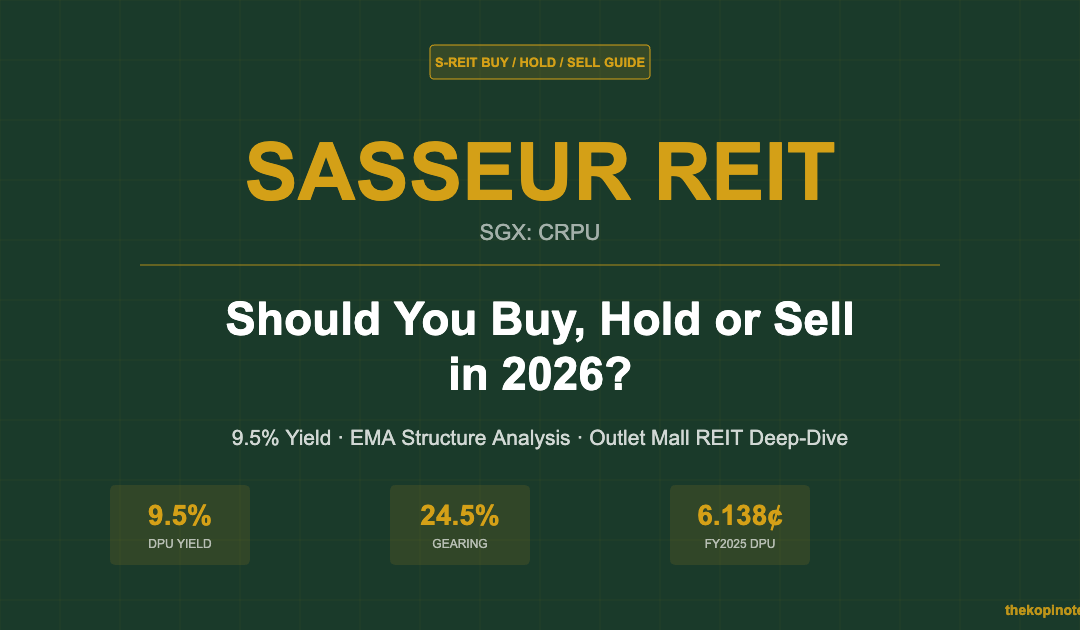
Sasseur REIT (SGX: CRPU) is Singapore’s only China outlet mall REIT, offering a headline yield of approximately 9.5% on its FY2025 DPU of 6.138 Singapore cents. The REIT uses an Entrusted Management Agreement (EMA) structure, where income is partially fixed and partially variable — a key risk for investors. In 2026, with low gearing of 24.5% and improving outlet retail traffic in China, the buy/hold/sell case for Sasseur REIT hinges on whether you accept the EMA’s structural complexity and China macro risk in exchange for one of Singapore’s highest REIT yields.
Not financial advice. All figures are for educational reference only. Data as at June 2026 unless noted.
Table of Contents
Contents — Click to expand
- What Is Sasseur REIT?
- Key Facts at a Glance 2026
- Understanding the EMA Income Structure
- DPU History and Trend Analysis
- The Bull Case: Why Buy Sasseur REIT in 2026
- The Bear Case: Risks and Red Flags
- Sasseur REIT vs Peer S-REITs
- 2026 Verdict: Buy, Hold or Sell?
- How to Buy Sasseur REIT in Singapore
- Frequently Asked Questions
What Is Sasseur REIT?
Sasseur REIT (SGX: CRPU) is the first outlet mall REIT listed in Asia, making its Singapore Exchange debut in March 2018. The REIT owns four premium outlet malls located in Chongqing (2 malls), Hefei, and Kunming — all in the People’s Republic of China. These are not standard shopping malls: outlet malls target aspirational consumers seeking branded goods at significant discounts, a format that has proven resilient even in slower economic periods.
As at June 2026, the portfolio spans approximately 271,683 sqm of gross floor area across the four properties. The malls attract over 20 million shopper visits annually and house brands including Coach, Calvin Klein, Samsonite, Adidas, and over 200 other international and domestic labels. Sasseur Asset Management (a subsidiary of the Sasseur Group in China) manages the properties under an Entrusted Management Agreement.
The REIT is structured as a Singapore-listed business trust, with Sasseur Group holding approximately 68% of units. This concentrated sponsor ownership is both a risk (liquidity, alignment questions) and a potential positive (skin in the game).
Key Facts at a Glance 2026
| Metric | Detail |
|---|---|
| Full Name | Sasseur REIT |
| SGX Ticker | CRPU |
| FY2025 DPU | 6.138 Singapore cents |
| Approximate Yield (Jun 2026) | ~9.5% at S$0.645 |
| Aggregate Leverage | 24.5% (one of the lowest in S-REITs) |
| Portfolio | 4 outlet malls in Chongqing, Hefei, Kunming |
| GFA | ~271,683 sqm |
| Income Structure | EMA — fixed base + variable component |
| Distribution Frequency | Semi-annual (June and December) |
| Sponsor | Sasseur Group (China); ~68% unitholding |
| CPF / SRS Eligible | Yes (CPF Investment Scheme — OA) |
Source: Sasseur REIT Annual Report FY2025, SGX filings, as at June 2026.
Understanding the EMA Income Structure
Unlike most S-REITs that collect fixed rent from tenants, Sasseur REIT receives income through an Entrusted Management Agreement (EMA) with the Sasseur Group. This is the single most important concept for any investor to understand before buying Sasseur REIT.
Under the EMA, the income distributed to unitholders has two components:
- Fixed component: A guaranteed base amount, calculated as a fixed percentage of the appraised value of each outlet mall property. This provides a floor to distributions regardless of the malls’ actual sales performance.
- Variable component: A share of the actual retail sales generated by each outlet mall, above the fixed entitlement. This is where Sasseur REIT benefits when outlet retail is booming — but also where distributions can fall short in a downturn.
The EMA structure means investors are essentially exposed to the retail sales performance of four outlet malls in China’s second- and third-tier cities, rather than the rental income stream of a traditional property REIT. In 2020, when COVID shut the malls for weeks, EMA income collapsed — FY2020 DPU dropped from 6.821¢ to just 4.975¢, a 27% fall. That risk profile is unlike almost any other S-REIT.
The positive side: the fixed component provides a partial floor. Even in FY2020, Sasseur REIT continued to pay distributions. And unlike traditional rental structures, EMA income benefits directly from outlet mall sales growth — giving investors genuine upside exposure to China’s aspirational consumer recovery.
For a Singapore investor evaluating Sasseur REIT in 2026, the EMA question is really this: do you believe China’s outlet mall consumer spending will stay stable or grow? If yes, the 9.5% yield is compelling. If you are cautious on Chinese domestic consumption, the EMA structure amplifies downside risk.
DPU History and Trend Analysis
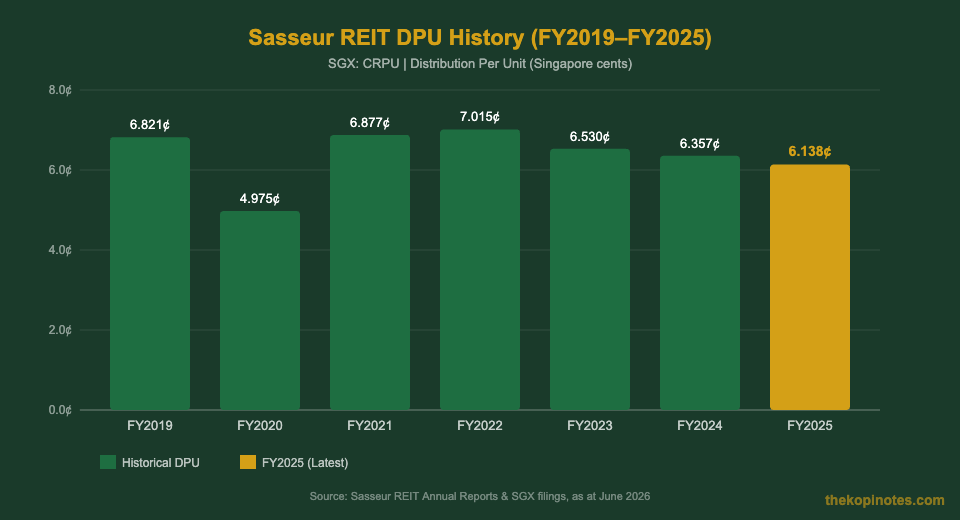
The DPU trajectory tells the full Sasseur REIT story. From its pre-COVID peak of 6.821¢ in FY2019, DPU collapsed to 4.975¢ in FY2020 as COVID lockdowns shut the malls. The recovery was swift: FY2021 (6.877¢) and FY2022 (7.015¢) actually exceeded pre-COVID levels, driven by pent-up demand and the reopening of luxury outlet shopping in China.
Since FY2022, DPU has been on a declining trend: FY2023 (6.530¢), FY2024 (6.357¢), FY2025 (6.138¢). This three-year decline reflects softening Chinese consumer sentiment, currency headwinds (RMB depreciation reducing SGD-equivalent distributions), and weaker tenant sales at the Hefei and Kunming malls. The Chongqing malls have remained stronger.
At the current trajectory, the risk for 2026 is whether DPU stabilises or continues falling. On a positive note, 1H2026 outlet mall traffic data from the Sasseur Group suggests a recovery in footfall driven by domestic tourism and the government’s stimulus programmes targeted at consumption. However, this has not yet fully translated into higher EMA income as tenant average spending per visit remains compressed.
| Financial Year | DPU (S¢) | YoY Change | Key Driver |
|---|---|---|---|
| FY2019 | 6.821¢ | — | Pre-COVID full-year baseline |
| FY2020 | 4.975¢ | -27.1% | COVID lockdowns — malls closed Q1 2020 |
| FY2021 | 6.877¢ | +38.2% | Reopening, pent-up demand recovery |
| FY2022 | 7.015¢ | +2.0% | Strong outlet retail, post-zero-COVID |
| FY2023 | 6.530¢ | -6.9% | Consumer sentiment softened; RMB headwinds |
| FY2024 | 6.357¢ | -2.6% | Tepid Chinese retail; FX drag |
| FY2025 | 6.138¢ | -3.5% | Continued softness; Hefei/Kunming weaker |
Source: Sasseur REIT Annual Reports FY2019–FY2025, SGX filings.
The Bull Case: Why Buy Sasseur REIT in 2026
For Singapore investors willing to accept the unique risks of a China outlet mall REIT, Sasseur REIT offers several compelling reasons to buy in 2026.
1. Highest yield in the S-REIT universe with low gearing. At approximately 9.5%, Sasseur REIT’s dividend yield is among the highest of any SGX-listed REIT. Crucially, this yield is not supported by excessive borrowing — aggregate leverage of just 24.5% is near the lowest in the S-REIT sector, well below MAS’s 50% regulatory ceiling. For a Singapore investor seeking high passive income Singapore strategy, this combination of high yield and low financial leverage is rare.
2. Outlet retail is structurally resilient in China’s current environment. As Chinese consumers face tighter budgets in a slower growth environment, outlet malls (offering branded goods at 30–70% discounts) are actually gaining share from full-price department stores. This is the “trading down” trend that benefited outlet retail in the US and Europe post-2008 and post-2020. The 2025 data from Sasseur Group shows stable footfall even as same-mall retail sales per visit slightly contracted. If the Chinese government’s consumption stimulus measures gain traction in 2H 2026, outlet retail could be an early beneficiary.
3. Significant EMA fixed component as a distribution floor. Even if retail sales disappoint, the fixed component of EMA income provides a floor. Based on historical data, the fixed EMA component contributes roughly 50–60% of total EMA income, meaning Sasseur REIT would still distribute at a meaningful level even if variable component income fell sharply. This structural floor differentiates it from a pure variable-income play.
4. Potential for REIT rerating if DPU stabilises. The market is pricing Sasseur REIT at a historically wide P/NAV discount (approximately 0.7× NAV as at June 2026) due to the declining DPU trend. If FY2026 DPU stabilises or reverses to growth, the yield compression and rerating could deliver significant capital gains on top of the 9.5% income. This is an asymmetric setup for patient investors.
5. Qualified for CPF investment and SRS. Unlike many offshore REITs, Sasseur REIT is CPF Investment Scheme (CPFIS-OA) eligible, allowing Singapore investors to put their CPF Ordinary Account savings to work at ~9.5% yield vs the CPF OA’s standard 2.5% p.a. interest rate. See our CPF investment strategy guide for how to integrate CPFIS into a retirement plan.
The Bear Case: Risks and Red Flags
Sasseur REIT is not for every investor. The risks are real and specific — understand them before buying.
1. Three consecutive years of declining DPU. From the FY2022 peak of 7.015¢, DPU has declined every year: -6.9% in FY2023, -2.6% in FY2024, and -3.5% in FY2025. If this trend continues, the 9.5% yield will be an overstatement of future income. A 5% further DPU decline would bring yield to approximately 9.0% — still high, but the trend is the concern.
2. China macro and geopolitical risk. All four properties are in China, exposing unitholders to 100% concentration in a single country with meaningful geopolitical and regulatory risk. RMB/SGD currency movements directly affect DPU in Singapore cents — every 5% depreciation in RMB reduces SGD-denominated DPU by approximately 5%. With RMB under periodic pressure, this FX headwind is a persistent drag on distributions.
3. EMA structure complexity and trust in the sponsor. The EMA income model requires investors to trust the Sasseur Group’s reported retail sales figures, as independent verification is limited. Sasseur Group’s 68% unitholding means minority unitholders have limited governance leverage. The EMA was renewed in 2023 for a further 5-year term, providing some stability — but investors are effectively betting on the sponsor’s integrity and operational excellence.
4. Property concentration in Tier 2/3 cities. Chongqing’s two malls are the portfolio anchors (contributing ~60% of EMA income), while Hefei and Kunming have been the underperforming properties. If China’s economic slowdown hits Tier 2/3 cities harder than Tier 1 cities, portfolio diversification within Sasseur REIT provides limited protection.
5. Low trading liquidity. Sasseur REIT’s daily traded volume on SGX is relatively thin compared to larger S-REITs. Investors looking to build or exit a significant position may face market impact costs. This makes Sasseur REIT more suitable as a buy-and-hold income position than a trading vehicle.
Sasseur REIT vs Peer S-REITs
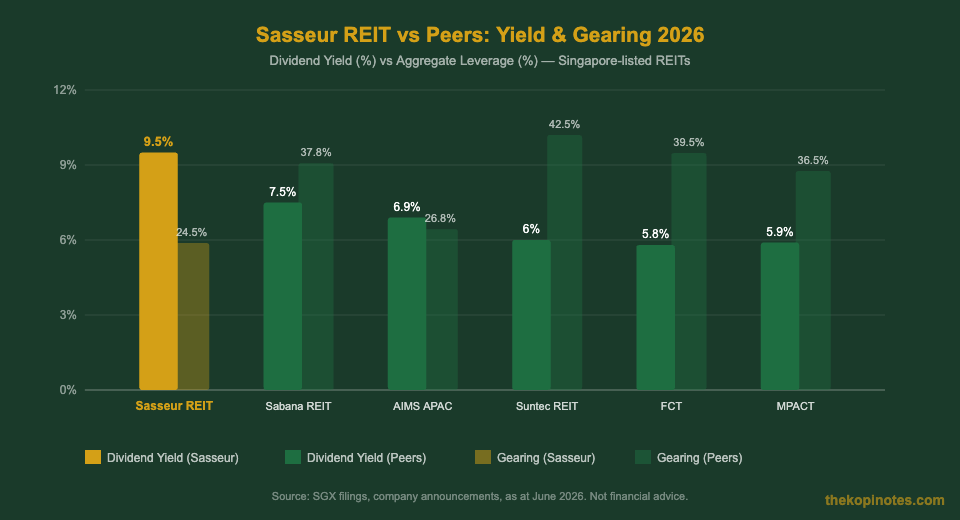
Comparing Sasseur REIT to its S-REIT peers in 2026 reveals both its yield advantage and its risk premium. No other S-REIT comes close to 9.5% yield at sub-25% gearing — that spread reflects the China single-country concentration, EMA complexity, and declining DPU trend. For a full ranking of best S-REITs in Singapore 2026, see our full comparison guide.
| REIT | Yield | Gearing | Geography | Structure | CPF |
|---|---|---|---|---|---|
| Sasseur REIT (CRPU) | ~9.5% | 24.5% | China only | EMA | Yes |
| Sabana REIT (M1GU) | ~7.5% | 37.8% | Singapore | Standard | Yes |
| AIMS APAC (O5RU) | ~6.9% | 26.8% | SG + AU | Standard | Yes |
| Suntec REIT (T82U) | ~6.0% | 42.5% | SG+AU+UK | Standard | Yes |
| FCT (J69U) | ~5.8% | 39.5% | Singapore | Standard | Yes |
| MPACT (N2IU) | ~5.9% | 36.5% | Multi-Asia | Standard | Yes |
Source: SGX filings, company announcements, as at June 2026. Trailing 12-month DPU yield. Not financial advice.
2026 Verdict: Buy, Hold or Sell?
HOLD for existing unitholders. The 9.5% yield at 24.5% gearing is a strong income case, but the three-year declining DPU trend makes this a “wait and see” situation. Unitholders who bought for income are still receiving strong distributions — selling at current levels would crystallise a capital loss for most entry prices. Hold, monitor the 1H2026 EMA income announcement (expected August 2026), and reassess if DPU falls below 5.5¢ on a 12-month forward basis.
CAUTIOUS BUY for new investors. For income-focused investors who have done their homework on the EMA structure and are comfortable with China retail exposure, the current entry point offers asymmetric upside. The P/NAV discount (~0.70x) is near historical lows. A small position — no more than 5–8% of a REIT portfolio — sized to reflect the single-country concentration risk, is defensible. Use our Singapore retirement calculator to model how Sasseur REIT income fits into a broader income portfolio.
AVOID if: You need predictable, growing income. You have no view on Chinese consumer spending. The EMA structure is confusing to you. You are already significantly invested in China assets. In that case, consider higher-quality S-REITs from our best S-REITs in Singapore 2026 list, which offer lower but more predictable yields.
How to Buy Sasseur REIT in Singapore
Sasseur REIT (SGX: CRPU) is listed on the Singapore Exchange and can be purchased through any SGX-connected broker.
Step 1: Choose a broker. FSMOne referral code P0544985 gives access to SGX stocks with one of the lowest brokerage fees (0.08% min S$10). Alternatively, use the Syfe referral code SRPRFFFCD for a commission-free fractional investment option via Syfe Brokerage.
Step 2: Fund your account. Transfer SGD via FAST. Sasseur REIT trades in minimum lots of 100 units. At ~S$0.645 per unit, a minimum lot costs approximately S$64.50.
Step 3: Search CRPU on the SGX market. Always confirm the SGX counter code before placing an order. Use a limit order (not market order) to control your entry price, especially given Sasseur REIT’s lower daily liquidity.
CPF Investment (CPFIS-OA): Sasseur REIT is eligible for CPF Ordinary Account investment. You must have at least S$20,000 in your CPF OA and retain S$20,000 after the investment. Your CPF investment strategy should factor in the risk profile of Sasseur REIT versus safer CPF OA interest.
SRS: Sasseur REIT can also be purchased using SRS funds. The SRS tax deduction (up to S$15,300/year for Singapore citizens and PRs) combined with a 9.5% yield makes the after-tax return attractive. Use our retirement planning calculator to model the compounding effect.
Not financial advice. All investment decisions should be made based on your personal financial situation and risk tolerance. Data as at June 2026.
Frequently Asked Questions
Should I buy Sasseur REIT in 2026?
Sasseur REIT is a cautious buy for income-focused investors who understand the EMA structure and China retail exposure. At ~9.5% yield and 24.5% gearing, the income case is compelling — but the three consecutive years of declining DPU (FY2023–FY2025) make this a high-risk, high-reward position. It is suitable as a small allocation (5–8% of a REIT portfolio) for investors with a view on Chinese consumer recovery, not as a core anchor holding.
What is the EMA structure in Sasseur REIT?
EMA stands for Entrusted Management Agreement. Instead of traditional fixed rent, Sasseur REIT receives income from the Sasseur Group that has two parts: a fixed base component (providing a distribution floor) and a variable component tied to actual outlet mall retail sales. This means distributions go up when Chinese consumers spend more at the malls, and fall when sales drop. It is a fundamentally different income model from most S-REITs, which makes Sasseur REIT more volatile but potentially higher-yielding in good years.
Is Sasseur REIT eligible for CPF investment?
Yes. Sasseur REIT (SGX: CRPU) is approved under the CPF Investment Scheme (CPFIS) for Ordinary Account (OA) funds. You need a minimum of S$20,000 in your CPF OA and must retain at least S$20,000 after any investment. At a ~9.5% yield vs the CPF OA’s 2.5% base rate, the yield pickup is significant — but so is the risk. CPFIS investments are not guaranteed, and any capital loss comes from your CPF savings.
What is Sasseur REIT's DPU for FY2025?
Sasseur REIT’s DPU for FY2025 was 6.138 Singapore cents per unit, paid in two semi-annual distributions. This represents a decline of approximately 3.5% compared to FY2024’s DPU of 6.357¢. At a share price of approximately S$0.645 as at June 2026, this translates to a trailing dividend yield of approximately 9.5%. FY2026 interim results are expected in August 2026.
Why is Sasseur REIT's yield so high compared to other S-REITs?
Sasseur REIT’s ~9.5% yield is significantly higher than the S-REIT sector average of around 6–7% because of the risk premium investors demand for: (1) 100% China concentration with RMB currency exposure, (2) the complex EMA income structure rather than standard fixed rental income, (3) three consecutive years of declining DPU, and (4) the relatively niche outlet mall sector. High yield in S-REITs often reflects elevated risk — always investigate why before chasing yield.
What are the main risks of investing in Sasseur REIT?
The main risks are: (1) China macro risk — all four malls are in China, exposing investors to Chinese consumer spending trends, regulatory changes, and RMB currency movements; (2) EMA structure complexity — income depends on the Sasseur Group’s reported retail sales; (3) declining DPU trend since FY2022, with no confirmed reversal yet; (4) sponsor concentration — Sasseur Group holds ~68% of units, limiting minority unitholders’ governance influence; (5) lower SGX liquidity compared to large-cap S-REITs.
How does Sasseur REIT compare to other high-yield S-REITs?
Sasseur REIT offers the highest yield (~9.5%) among major SGX-listed REITs, with the added benefit of low gearing at 24.5%. Sabana REIT offers ~7.5% yield but is a Singapore-only industrial REIT with higher gearing (37.8%) and a recently internalised manager. AIMS APAC REIT offers ~6.9% with similar gearing (26.8%) and a growing DPU track record. For investors who want high yield with lower geopolitical risk, AIMS APAC or Sabana REIT are alternatives to consider.
Can I buy Sasseur REIT using SRS funds?
Yes. Sasseur REIT is SRS-eligible and can be purchased through any SRS-approved brokerage account. Using SRS funds to invest in Sasseur REIT provides a tax deduction on your SRS contribution (up to S$15,300 per year for Singapore citizens and PRs), and SRS withdrawals at retirement age are taxed at 50% of the amount. The combination of a 9.5% yield with the SRS tax benefit makes Sasseur REIT particularly attractive for high-income earners in the 15–22% personal income tax bracket. Ensure your risk tolerance matches the investment horizon before using SRS funds.
Start Building Your S-REIT Income Portfolio
Open a brokerage account to invest in Sasseur REIT and other high-yield S-REITs. Use our referral links for sign-up bonuses.
This article was researched with the help of AI. While we strive to keep all information accurate and up to date, there may be errors. If you notice any discrepancies, please contact us.