Keppel DC REIT vs Digital Core REIT: Which Data Centre S-REIT Should You Buy in 2026?
Yield, gearing, occupancy and AI-driven growth compared for Singapore investors
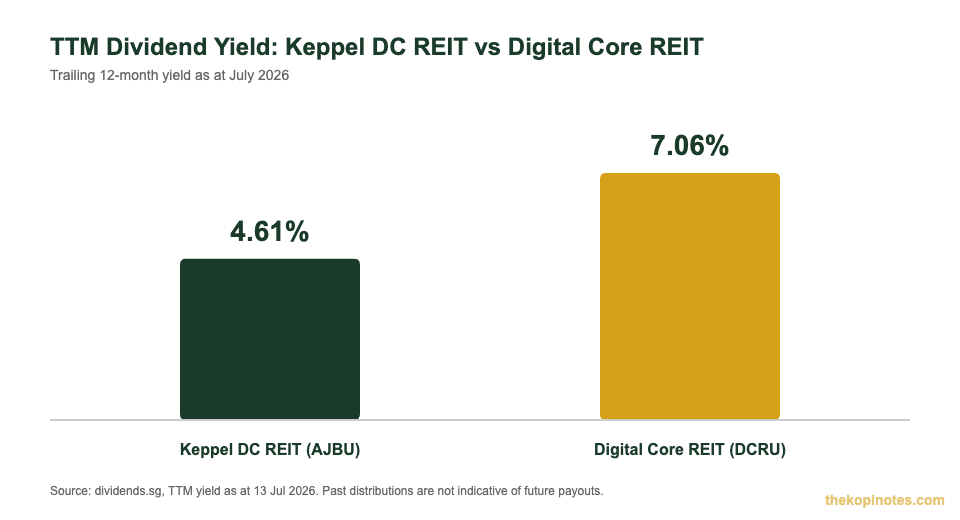
Keppel DC REIT (AJBU) and Digital Core REIT (DCRU) are Singapore’s two pure-play data centre S-REITs. Keppel DC REIT offers a lower 4.61% yield backed by a larger S$6.3 billion, 25-asset APAC-and-Europe portfolio, while Digital Core REIT pays a higher 7.06% yield from a smaller US$1.8 billion, 11-asset global portfolio with USD-denominated units.
Not financial advice. All figures are for educational reference only. Data as at July 2026 unless noted.
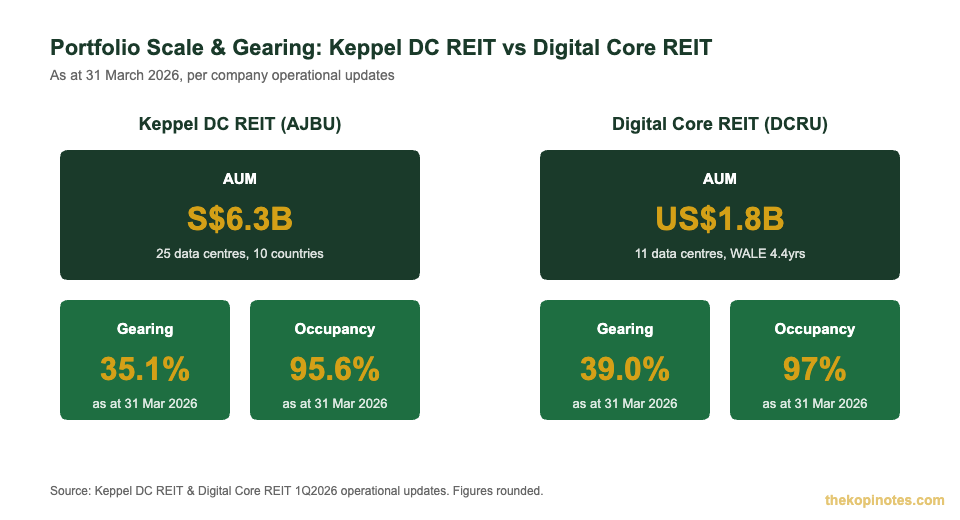
- Keppel DC REIT (AJBU): 4.61% yield, S$6.3B AUM, 25 data centres in 10 countries, 35.1% gearing — the larger, lower-yield, SGD-denominated option.
- Digital Core REIT (DCRU): 7.06% yield, US$1.8B AUM, 11 data centres, 39.0% gearing — the higher-yield, USD-denominated option with more concentrated risk.
- Both ride the same AI and hyperscale demand wave — your pick depends on currency comfort, risk appetite, and whether you want yield or portfolio scale.
Table of Contents
Contents — Click to expand
What Are Data Centre S-REITs?
Data centre REITs own the physical buildings that house servers for cloud providers, banks, and AI companies. You don’t need to understand server racks to invest — you just need to know these buildings collect rent, and that rent gets paid out to you as a unitholder.
Singapore has two listed pure-play data centre REITs: Keppel DC REIT and Digital Core REIT. Both compete for the same tenants — hyperscalers like AWS, Microsoft, and Google — but they’ve built very different portfolios.
Here’s why this matters right now. AI training and inference workloads are driving unprecedented demand for data centre capacity across Asia and the US. That tailwind is pushing both REITs’ occupancy and rental reversions higher in 2026. For the bigger picture, see our guide to Singapore data centre REITs and the AI boom.
Keppel DC REIT (SGX: AJBU) at a Glance
Keppel DC REIT listed in December 2014 as Asia’s first pure-play data centre REIT. Since then, it has grown into the region’s largest data centre landlord by portfolio count. For a deeper dive on its share price history, see our full Keppel DC REIT share and DPU analysis.
As at 31 March 2026, Keppel DC REIT held 25 data centres across 10 countries, worth roughly S$6.3 billion in assets under management (AUM). Singapore alone makes up 62.7% of that AUM, with Japan at 13.6% and the rest spread across Asia Pacific and Europe.
In 1Q2026, the REIT posted DPU of 2.833 cents, supported by strong rental reversions of +50.3% as older contracts renewed at today’s higher market rents, according to The Edge Singapore. Occupancy held steady at 95.6%, and gearing sat at a conservative 35.1% — among the lowest in the S-REIT sector.
| Metric | Keppel DC REIT (AJBU) |
|---|---|
| Listed | December 2014, SGX Mainboard |
| Portfolio | 25 data centres, 10 countries |
| AUM | ~S$6.3 billion |
| TTM Dividend Yield | 4.61% |
| 1Q2026 DPU | 2.833 cents |
| Occupancy | 95.6% (31 Mar 2026) |
| Gearing | 35.1% |
| Cost of Debt | 2.6% |
| Unit Currency | SGD |
Source: Keppel DC REIT 1Q2026 operational update; dividends.sg. Data as at July 2026.
Digital Core REIT (SGX: DCRU) at a Glance
Digital Core REIT listed in December 2021, sponsored by Digital Realty — the world’s largest owner and operator of data centres. That sponsor relationship gives Digital Core REIT first right of refusal on Digital Realty’s stabilised assets, a genuine acquisition pipeline advantage.
The portfolio is smaller and more concentrated: 11 data centres worth about US$1.8 billion in AUM, with a weighted average lease expiry (WALE) of 4.4 years. Committed occupancy stood at 97% as at 31 March 2026 — higher than Keppel DC REIT’s, though on a much smaller base, per Growbeansprout’s coverage of the 1Q26 update.
Digital Core REIT generated US$11.7 million in distributable income in 1Q2026. Management has also been buying back units — 7.1 million units at an average price of US$0.486 — which added roughly 0.3% to DPU. Aggregate leverage stood at 39.0%, with 80% of debt on fixed rates and a weighted average debt maturity of 3.5 years.
One standout deal: after six months of downtime, the REIT signed a new 10-year lease with a global cloud provider at a 20% positive rental revision, expected to contribute US$13.3 million in annual net property income once ramped up.
| Metric | Digital Core REIT (DCRU) |
|---|---|
| Listed | December 2021, SGX Mainboard |
| Portfolio | 11 data centres, WALE 4.4 years |
| AUM | ~US$1.8 billion |
| TTM Dividend Yield | 7.06% |
| 1Q2026 Distributable Income | US$11.7 million |
| Committed Occupancy | 97% (31 Mar 2026) |
| Aggregate Leverage | 39.0% |
| Fixed-Rate Debt | 80% |
| Unit Currency | USD (dividends paid in SGD) |
Source: Digital Core REIT 1Q2026 business update; dividends.sg. Data as at July 2026.
Head-to-Head Comparison Table
Here’s everything side by side.
| Metric | Keppel DC REIT | Digital Core REIT |
|---|---|---|
| Ticker | AJBU | DCRU |
| Listed | Dec 2014 | Dec 2021 |
| Sponsor | Keppel Capital / Keppel T&T | Digital Realty |
| Portfolio | 25 data centres, 10 countries | 11 data centres |
| AUM | S$6.3B | US$1.8B |
| Geographic Focus | APAC (Singapore 62.7%) + Europe | US, Canada + APAC |
| TTM Dividend Yield | 4.61% | 7.06% |
| Gearing | 35.1% | 39.0% |
| Occupancy | 95.6% | 97% |
| Unit Currency | SGD | USD |
| Distribution Frequency | Semi-annual | Semi-annual |
Source: Company 1Q2026 operational updates; dividends.sg. Data as at 13 July 2026.
Dividend Yield & Payout Comparison
If you put SGD 50,000 into each REIT today, here’s roughly what you’d collect in distributions over a year, before accounting for currency movements or brokerage fees.
| Investment | Keppel DC REIT (4.61%) | Digital Core REIT (7.06%) |
|---|---|---|
| SGD 10,000 | ~SGD 461/year | ~SGD 706/year |
| SGD 50,000 | ~SGD 2,305/year | ~SGD 3,530/year |
| SGD 100,000 | ~SGD 4,610/year | ~SGD 7,060/year |
Illustrative only, based on TTM yield. Actual distributions vary by quarter and are not guaranteed.
However, higher yield isn’t automatically better. Digital Core REIT’s payout is bigger partly because the market is pricing in more risk — a smaller, younger portfolio with higher gearing and currency exposure. Keppel DC REIT’s lower yield reflects a larger, more diversified, lower-geared REIT. That’s the classic yield-versus-safety tradeoff.
Growth Drivers: AI and Hyperscale Demand
Both REITs benefit from the same tailwind: AI training and inference is pushing global data centre demand higher than supply can keep up with. Here’s why that matters for you as a unitholder.
When a data centre lease expires, the landlord can often re-let the space at a much higher rent than the old contract. Keppel DC REIT’s +50.3% rental reversion in 1Q2026 is a direct result of this — old 2018-2020 leases rolling into 2026 pricing.
Digital Core REIT’s new 10-year lease at a 20% positive rental revision tells the same story from a different angle: even after six months of vacancy, the REIT could still command a premium because hyperscaler demand for ready capacity remains intense.
Currency and Geographic Risk
This is the most overlooked difference between the two REITs. Keppel DC REIT’s units and distributions are in SGD — what you see is what you get, with no currency conversion.
Digital Core REIT’s units trade in USD, though distributions are ultimately paid to you in SGD. That means your actual returns depend on the SGD/USD exchange rate on top of the REIT’s operating performance. If the US dollar weakens against the Singapore dollar, your distribution income shrinks in SGD terms — even if Digital Core REIT’s underlying business is doing fine.
Geographically, Keppel DC REIT is APAC-heavy (Singapore alone is 62.7% of AUM), giving you concentrated exposure to a market you probably already understand. Digital Core REIT’s portfolio sits mostly in the US and Canada, which diversifies you away from Singapore but adds US regulatory and geopolitical variables to the mix.
Risks to Watch
Neither REIT is risk-free. Here’s what could go wrong with each.
Keppel DC REIT risks: Singapore concentration (62.7% of AUM) means any local moratorium on new data centre power allocation could cap future growth. The REIT also carries legacy assets with older, lower-rent leases still working through the reversion cycle.
Digital Core REIT risks: A much smaller portfolio (11 assets) means a single tenant default or vacancy has an outsized impact on distributable income — exactly what happened during the six-month downtime before the recent 10-year lease signing. Currency risk from USD-denominated units adds another layer of volatility. Gearing at 39.0% also leaves less headroom before hitting the MAS-regulated 50% aggregate leverage cap than Keppel DC REIT’s 35.1%.
Both REITs also share sector-wide risks: rising interest rates increase financing costs, and any slowdown in AI capital expenditure by hyperscalers would soften rental reversion momentum across the board.
Which Should You Buy? Decision Framework
| Your Profile | Better Fit | Why |
|---|---|---|
| Want stable SGD income, no currency risk | Keppel DC REIT | SGD-denominated units and distributions, larger diversified portfolio |
| Prioritise yield, comfortable with USD exposure | Digital Core REIT | 7.06% yield vs 4.61%, backed by Digital Realty sponsor pipeline |
| Want lower gearing / conservative balance sheet | Keppel DC REIT | 35.1% gearing vs 39.0% |
| Want US/global data centre exposure | Digital Core REIT | Portfolio concentrated in US and Canada |
| Want to avoid single-tenant concentration risk | Keppel DC REIT | 25 assets vs 11 spreads tenant risk further |
You don’t have to choose just one. Some Singapore investors hold both — Keppel DC REIT for portfolio stability and SGD income, Digital Core REIT for higher yield and diversification away from Singapore. Position sizing matters more than picking a single “winner” here.
How to Buy Keppel DC REIT and Digital Core REIT in Singapore
Both AJBU and DCRU trade on the SGX Mainboard, so you can buy them through any Singapore brokerage.
- Open a brokerage account — FSMOne offers low-commission SGX trading with referral code P0544985.
- Fund your account via bank transfer, or check whether your broker includes these REITs under CPFIS before committing CPF Ordinary Account funds.
- Search the ticker — “AJBU” for Keppel DC REIT, “DCRU” for Digital Core REIT.
- Place a limit order rather than a market order to control your entry price, especially for DCRU which trades in USD.
- For diversified exposure without picking a single REIT, consider a robo-advisor like Syfe (referral code SRPRFFFCD), which offers REIT-inclusive portfolios.
- Track your combined REIT income against your retirement goals using our retirement planning calculator.
For a broader view of high-yield options in the sector, see our roundup of best S-REITs in Singapore 2026.
Frequently Asked Questions
Which pays a higher dividend, Keppel DC REIT or Digital Core REIT?
Digital Core REIT currently pays a higher trailing 12-month yield of 7.06%, compared to Keppel DC REIT’s 4.61%, as at July 2026. However, Digital Core REIT’s higher yield reflects a smaller, more concentrated portfolio and higher gearing (39.0% vs 35.1%).
Is Keppel DC REIT bigger than Digital Core REIT?
Yes. Keppel DC REIT holds 25 data centres across 10 countries worth about S$6.3 billion in AUM, versus Digital Core REIT’s 11 data centres worth roughly US$1.8 billion. Keppel DC REIT is the larger, more diversified REIT by both count and value.
Does Digital Core REIT carry currency risk for Singapore investors?
Yes. Digital Core REIT’s units are denominated in USD, though distributions are paid out in SGD. This means your actual returns depend on the SGD/USD exchange rate as well as the REIT’s underlying performance. Keppel DC REIT, by contrast, is fully SGD-denominated.
Can I buy Keppel DC REIT or Digital Core REIT using my CPF or SRS?
You can buy both using SRS funds through most Singapore brokerages, subject to your broker’s platform rules. CPF Ordinary Account (CPFIS) eligibility varies and should be checked directly with your broker before committing OA funds, as eligibility lists change periodically.
Which REIT has better rental growth momentum in 2026?
Both show strong momentum. Keppel DC REIT posted +50.3% rental reversion in 1Q2026 as older leases renewed at current market rates. Digital Core REIT signed a new 10-year lease at a 20% positive rental revision after a period of vacancy. Both trends reflect strong hyperscaler and AI-driven demand for data centre capacity.
What is the gearing limit for Singapore REITs, and how close are these two?
MAS caps aggregate leverage for S-REITs at 50%. Keppel DC REIT’s gearing of 35.1% leaves more debt headroom than Digital Core REIT’s 39.0%, giving Keppel DC REIT more room to make debt-funded acquisitions without breaching the regulatory ceiling.
Should I buy both Keppel DC REIT and Digital Core REIT?
Many Singapore investors hold both to balance Keppel DC REIT’s stability and SGD income against Digital Core REIT’s higher yield and geographic diversification. The right split depends on your currency comfort, risk tolerance, and existing REIT exposure — this isn’t a one-size-fits-all decision.
Ready to Add Data Centre REITs to Your Portfolio?
Open a brokerage account with FSMOne to start building REIT income today.
This article was researched with the help of AI. While we strive to keep all information accurate and up to date, there may be errors. If you notice any discrepancies, please contact us.