CPF MediSave Cap 2026: What Happens When You Hit the $75,500 Limit?
Complete guide for Singapore CPF members — understand the BHS, contribution redirects, and how to optimise your CPF strategy.
The CPF MediSave cap for 2026 is $75,500, officially called the Basic Healthcare Sum (BHS). Once your MediSave hits this ceiling, excess mandatory contributions flow automatically to your Special Account (if below age 55) or Retirement Account (if 55 and above). The BHS increases every year to track healthcare inflation. Voluntary top-ups above this cap are not permitted, making it essential for Singapore workers to plan their CPF strategy around this limit.
Not financial advice. All figures are for educational reference only. Data as at November 2026 unless noted.
What Is the CPF MediSave Cap (Basic Healthcare Sum)?
The CPF MediSave cap is formally known as the Basic Healthcare Sum (BHS) — the estimated savings needed to cover a member’s basic subsidised healthcare expenses throughout retirement. It is set and reviewed annually by the CPF Board, typically announced in the second half of the year and taking effect on 1 January.
For members aged below 65, the BHS is a moving target: it increases every year, meaning your MediSave cap rises alongside you. Once you turn 65, however, your BHS is locked in at the prevailing figure at the time you reach 65 — it will not rise further.
The BHS mechanism exists for a deliberate design reason. CPF separates savings into three pools: housing and everyday needs (Ordinary Account), retirement income (Special / Retirement Account), and healthcare (MediSave). The BHS caps how much you accumulate in MediSave so that once your healthcare buffer is deemed sufficient, all additional contributions shift to building your retirement nest egg. It also ensures members who hit the cap still benefit from CPF’s guaranteed 4% p.a. interest on MediSave, with excess flowing into similarly interest-bearing accounts.
Importantly, the MediSave cap does not limit your ability to use MediSave for medical expenses. You can still draw on your MediSave for hospitalisation, approved outpatient treatments, MediShield Life premiums, and Integrated Shield Plan (ISP) riders — regardless of whether your balance is at, near, or above the BHS.
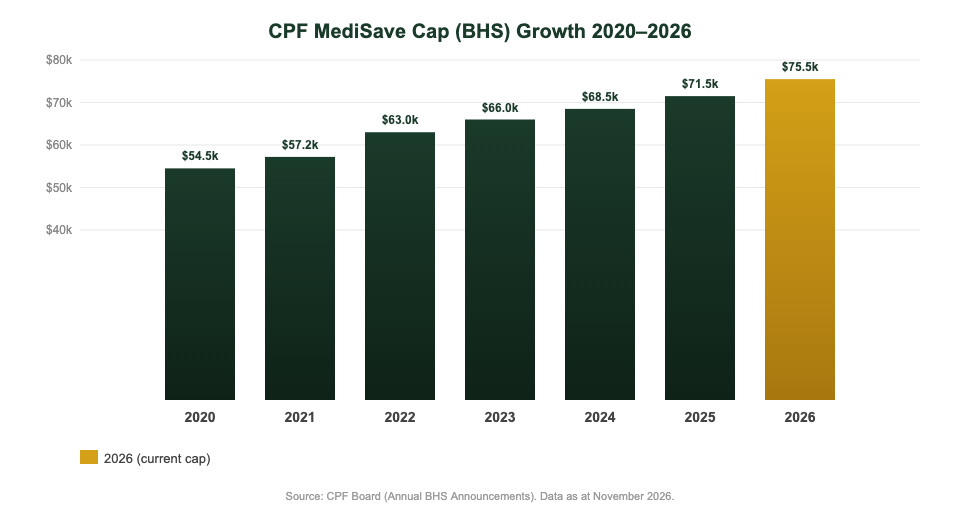
MediSave Cap Amounts 2020–2026
The BHS has risen steadily over the past six years, averaging roughly 4–6% annual growth to match Singapore’s healthcare cost inflation. For 2026, the BHS stands at $75,500.
| Year | BHS / MediSave Cap | Annual Increase |
|---|---|---|
| 2020 | $54,500 | — |
| 2021 | $57,200 | +$2,700 |
| 2022 | $63,000 | +$5,800 |
| 2023 | $66,000 | +$3,000 |
| 2024 | $68,500 | +$2,500 |
| 2025 | $71,500 | +$3,000 |
| 2026 | $75,500 | +$4,000 |
Source: CPF Board (Annual BHS Announcements). Data as at November 2026.
What Happens When You Hit the MediSave Cap?
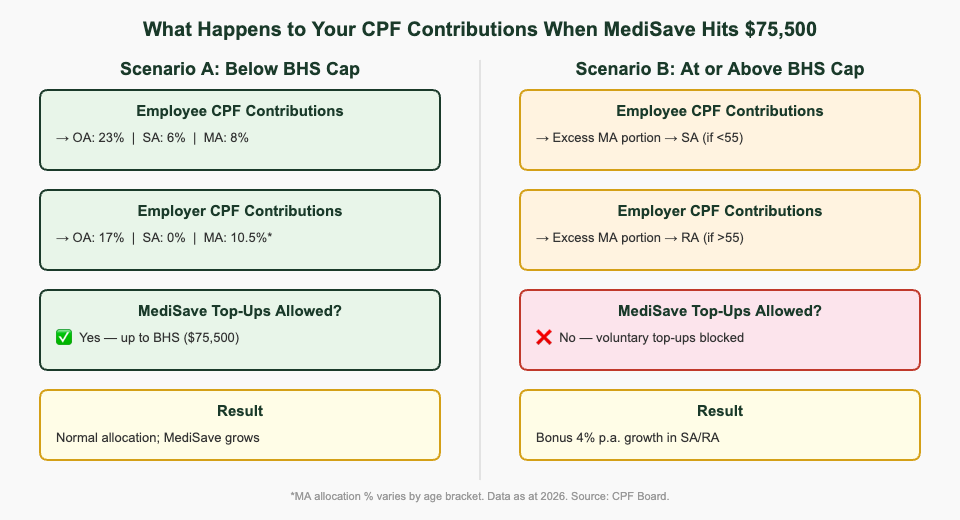
Once your MediSave account balance reaches or exceeds the BHS of $75,500, your monthly CPF contributions trigger an automatic redirection mechanism. Here’s exactly what occurs:
For members below age 55: The portion of mandatory CPF contributions that would normally flow into MediSave is redirected to your Special Account (SA). The SA earns 4% p.a. (floor rate, guaranteed), the same rate as MediSave, so you don’t lose any interest advantage. However, your SA is earmarked for retirement — it cannot be withdrawn for everyday expenses until age 55, and full withdrawals are subject to the Full Retirement Sum (FRS) requirement.
For members aged 55 and above: Excess MediSave contributions are redirected to the Retirement Account (RA). The RA also earns 4% p.a. floor rate, plus a 1% extra interest on the first $30,000 of combined CPF balances. Funds in your RA form the basis for your monthly CPF Life payouts.
A worked example: Wei Ling, age 38, earns $6,000/month. She has recently hit the MediSave cap of $75,500. Previously, 10.5% of her employer’s CPF contribution went to her MediSave — approximately $315/month from her employer. Now that portion flows to her Special Account. At 4% p.a. compounding, this $315/month redirect contributes an additional ~$23,000 to her SA over 5 years (vs. going nowhere productive before the redirect kicked in).
One nuance: government-granted MediSave top-ups — such as those under the Pioneer Generation Package, Merdeka Generation Package, or MediFund — are not blocked by the BHS cap. These continue to be credited into your MediSave even if you are at the cap.
| Situation | MediSave Contribution | Redirect Destination | Interest Rate |
|---|---|---|---|
| Below BHS cap | Normal (flows into MA) | N/A | 4% p.a. |
| At/above BHS, age <55 | Redirected | Special Account (SA) | 4% p.a. |
| At/above BHS, age 55+ | Redirected | Retirement Account (RA) | 4–5% p.a.* |
| Govt grants (PGP, MGP) | Always credited | MediSave | 4% p.a. |
*RA earns 4% p.a. floor rate plus 1% extra interest on first $30,000 combined CPF balances. Source: CPF Board, 2026.
How to Check Your MediSave Balance (And How Close You Are to the Cap)
Monitoring your MediSave balance against the BHS is straightforward:
- Log in to my.cpf.gov.sg using your Singpass credentials
- Navigate to “My CPF” → “My Accounts”
- Your MediSave balance is displayed, alongside the current BHS ($75,500)
- The page calculates how much “headroom” remains before your MediSave cap — this is the amount you can still voluntarily top up
Alternatively, use the CPF Mobile App (available on iOS and Android). The app shows real-time balances and highlights if you are within $5,000 of the BHS cap. You can also request the monthly CPF statement, which clearly notes your MediSave allocation each month.
If you are within $10,000–$20,000 of the cap, now is the time to plan — especially if you were considering a voluntary MediSave top-up for tax relief purposes (see next section).
Can You Voluntarily Top Up MediSave? Tax Relief and Limits Explained
Yes — voluntary cash top-ups to your MediSave are permitted, subject to the BHS cap. Once your balance reaches $75,500, the CPF portal will reject further voluntary top-up applications.
The key incentive for voluntary MediSave top-ups is the income tax relief under the CPF Retirement Sum Topping-Up (RSTU) Scheme:
- Cash top-ups to your own MediSave (or SA/RA) qualify for up to $8,000 per year in tax relief
- Cash top-ups to a loved one’s MediSave (or SA/RA) qualify for an additional $8,000 per year in relief
- Combined, a Singapore taxpayer could reduce taxable income by up to $16,000 per year via RSTU top-ups
For a Singapore resident in the 15% marginal tax bracket, topping up $8,000 to MediSave saves approximately $1,200 in income taxes — a meaningful return on top of the 4% p.a. guaranteed interest on the topped-up amount.
Important caveat: Top-ups to MediSave are locked in. Unlike Ordinary Account savings, MediSave can only be withdrawn to pay for approved medical expenses. It cannot be used for housing, investment, or early retirement withdrawals. Ensure you have sufficient liquid savings outside CPF before making large voluntary top-ups.
Use the Singapore retirement calculator to model the cumulative impact of MediSave top-ups on your overall CPF balance at age 55 and 65.
CPF Strategy Around the MediSave Cap in 2026
Whether you are approaching the BHS or already at it, here are the key strategic considerations:
1. Top up MediSave before the cap — if it makes tax sense
If your MediSave balance is significantly below $75,500 and you are in the 11.5% marginal tax bracket or above, voluntary top-ups offer a compelling guaranteed return (4% p.a. + tax savings). Those in the higher 22% or 24% brackets benefit even more.
2. Once capped, let the SA/RA redirect work for you
Many Singaporeans worry when their MediSave hits the cap. In reality, the redirect mechanism is a positive outcome — your contributions continue earning 4% p.a. in your SA or RA, building the retirement nest egg you will depend on via CPF Life passive income payouts.
3. Use MediSave actively
If your MediSave is at the cap and you want to create new headroom (allowing future top-ups for tax relief), the only way is to use your MediSave for eligible expenses — hospitalisation bills, Integrated Shield Plan premiums, approved chronic disease treatments. This is not a strategy you would engineer artificially, but it does mean there is a natural “breathing room” cycle for most members.
4. For near-retirees: monitor the RA contribution impact
If you are approaching 55 and your MediSave is near the cap, any excess redirected to your RA contributes toward the Enhanced Retirement Sum (ERS). For 2026, the ERS is $426,000. Exceeding it means any further RA contributions are returned in cash — a consideration if you are planning voluntary CPF top-ups separately. For comprehensive planning, explore the best S-REITs in Singapore 2026 and other dividend assets to supplement CPF Life payouts.
5. Consider SRS alongside CPF
Once your CPF MediSave is capped and your SA/RA is on a good trajectory, the Supplementary Retirement Scheme (SRS) offers another tax-deferred investment vehicle. SRS contributions (up to $15,300/year for Singaporeans) reduce taxable income while allowing investments in Singapore-listed equities, unit trusts, ETFs, and Singapore Savings Bonds. See also our guide on Singapore T-bills 2026 as a low-risk SRS complement.
Frequently Asked Questions
What is the CPF MediSave cap for 2026?
The CPF MediSave cap for 2026 is $75,500, set by the CPF Board as the Basic Healthcare Sum (BHS). This cap increases annually to account for rising healthcare costs in Singapore. Members who turn 65 in 2026 will have their BHS permanently fixed at $75,500 for the rest of their lives.
What happens when my MediSave balance exceeds the BHS?
When your MediSave hits or exceeds $75,500, the portion of your mandatory CPF contributions that would normally go to MediSave is automatically redirected. If you are below 55, it flows to your Special Account (SA). If you are 55 or above, it flows to your Retirement Account (RA). Both accounts earn the same 4% p.a. guaranteed interest as MediSave, so you do not lose any returns.
Can I withdraw MediSave to bring the balance below the cap?
MediSave withdrawals are restricted to approved medical purposes only — hospitalisation bills, MediShield Life and Integrated Shield Plan premiums, approved chronic disease outpatient treatments, and select preventive health screenings. You cannot make a cash withdrawal from MediSave simply to create headroom below the BHS cap. The only way to reduce your balance is through legitimate medical expenditure.
Does MediSave interest earned count toward the cap?
Yes — interest credited to your MediSave account each year counts towards the BHS cap. MediSave earns 4% p.a. interest (with an additional 1% on the first $20,000 of MediSave for members below 55). This means members approaching the BHS may hit the cap from interest alone, even without making contributions. Once the cap is reached, subsequent interest credited may cause the balance to momentarily exceed the cap, but this is permitted — only new contributions are blocked.
Can I still use MediSave if my balance is at the cap?
Yes, absolutely. The BHS cap limits how much you can accumulate in MediSave — it does not restrict your ability to use it. You can continue using your MediSave balance for all eligible purposes including hospitalisation, surgical procedures, approved outpatient treatments, and MediShield Life / ISP premium payments. Using your MediSave also reduces your balance, creating headroom for future voluntary top-ups if desired.
Can I make a voluntary MediSave top-up if I am close to the cap?
Yes, but only up to the BHS limit. If your MediSave is $68,000 and the BHS is $75,500, you can voluntarily top up a maximum of $7,500 in cash. The CPF online portal will calculate the exact amount permitted and reject any application that would cause your balance to exceed the BHS. Voluntary cash top-ups to MediSave qualify for income tax relief of up to $8,000 per year under the Retirement Sum Topping-Up Scheme.
Will the MediSave cap continue to increase after 2026?
Yes — the CPF Board reviews and increases the BHS annually to keep pace with long-term healthcare cost inflation in Singapore. The BHS has risen from $54,500 in 2020 to $75,500 in 2026 — an increase of 38.5% over six years. While exact future increases are not announced in advance, the CPF Board has committed to raising the BHS annually until further notice. For members below 65, this means the cap rises every year, giving you slightly more room to accumulate in MediSave.
Plan Your Retirement Beyond CPF
CPF is a strong foundation, but the best retirement plans layer in dividend income, S-REITs, and low-cost ETFs. Use our free tools to start planning today.
This article was researched with the help of AI. While we strive to keep all information accurate and up to date, there may be errors. If you notice any discrepancies, please contact us.