Singapore’s 4 Retirement Ages in 2026: Why 64, 65, 69 and Your SRS Age Aren’t the Same
Statutory retirement age, re-employment age, CPF LIFE payout age, and your personal SRS withdrawal age — four different triggers, four different rules.
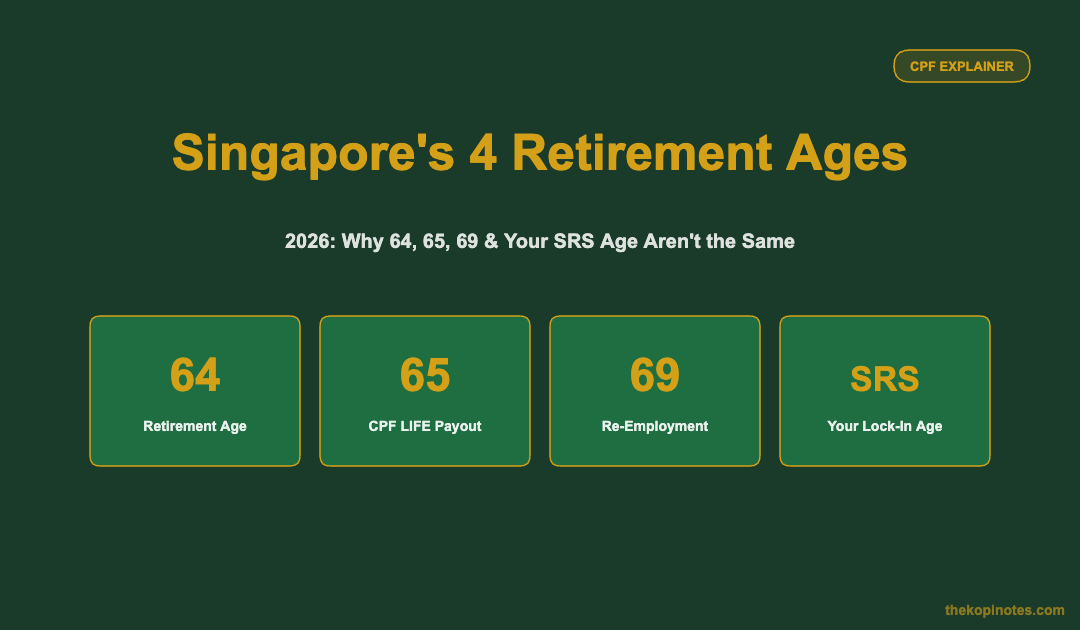
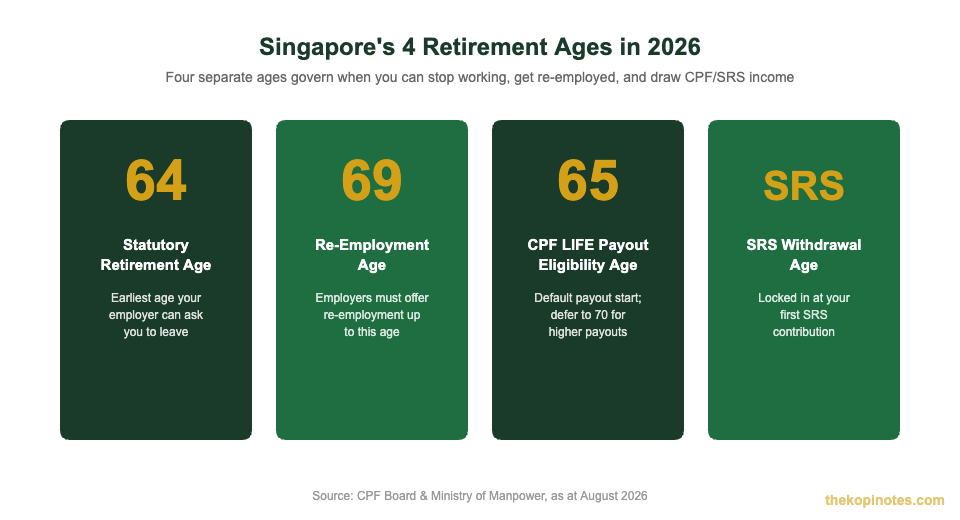
Singapore doesn’t have one retirement age — it has four. Your statutory retirement age (64), re-employment age (69), CPF LIFE payout eligibility age (65) and your personal SRS withdrawal age (locked in when you first contribute) all trigger at different times and control different things. Mixing them up could cost you money or a wasted year of planning.
Not financial advice. All figures are for educational reference only. Data as at August 2026 unless noted.
- Your statutory retirement age (64) and re-employment age (69) govern your job — not your CPF money.
- CPF LIFE payouts start at 65 by default, but you can defer to 70 for up to ~40% more each month.
- Your SRS withdrawal age is personal — it locked in the day you made your first SRS contribution, not today’s rules.
Free download: The Singapore Money Playbook — 7 money mindset shifts written for Singapore, with the CPF-adjusted retirement number most guides get wrong (PDF + Notion).
Table of Contents
Why Singapore Has Four “Retirement Ages”
Here’s a mix-up we see all the time. Someone hits Singapore’s new statutory retirement age of 64 and assumes their CPF LIFE payouts kick in automatically. They don’t. The age that ends your job protection is not the age that starts your CPF income — and it’s definitely not the age your SRS account unlocks.
Singapore’s retirement system runs on four separate clocks. Each one was set by a different law or scheme, for a different reason, and none of them move together. That’s confusing — but once you see all four side by side, the planning gets a lot easier.
Age #1: Statutory Retirement Age (64)
Your statutory retirement age is the earliest age your employer can legally ask you to leave on account of age alone. Under the Retirement and Re-employment Act, this rose from 63 to 64 on 1 July 2026, for employees born on or after 1 July 1963. A further rise to 65 is planned by 2030.
This protection only kicks in if you’re a Singapore citizen or permanent resident who joined your employer before turning 55. Before this age, your employer can’t dismiss you purely because of your age — they’d need a valid reason like poor performance or misconduct.
We’ve covered how this specific change affects your money in more depth in our guide to Singapore’s retirement age 64 change, including what it means for your investment horizon.
Age #2: Re-Employment Age (69)
Once you hit your statutory retirement age, your employer isn’t off the hook. Under the same Act, they must offer re-employment to eligible employees up to the re-employment age — now 69, up from 68, also effective 1 July 2026. This is set to rise again to 70 by 2030.
Re-employment isn’t a guarantee of your exact same job or pay. Employers can offer a different role, on different terms, as long as it’s reasonable. Eligibility also depends on things like at least two years of service and a satisfactory performance record.
So in practice: 64 is when your original job protection ends, and 69 is the outer limit of when your employer must still try to keep you working, in some capacity.
Age #3: CPF LIFE Payout Eligibility Age (65)
Here’s the one that trips people up most: your CPF LIFE payout eligibility age is fixed at 65 for everyone, and it is not linked to the statutory retirement or re-employment age changes. The CPF Board confirms this directly — raising the retirement age to 64 does not push your CPF payout age to 64 too. It stays at 65.
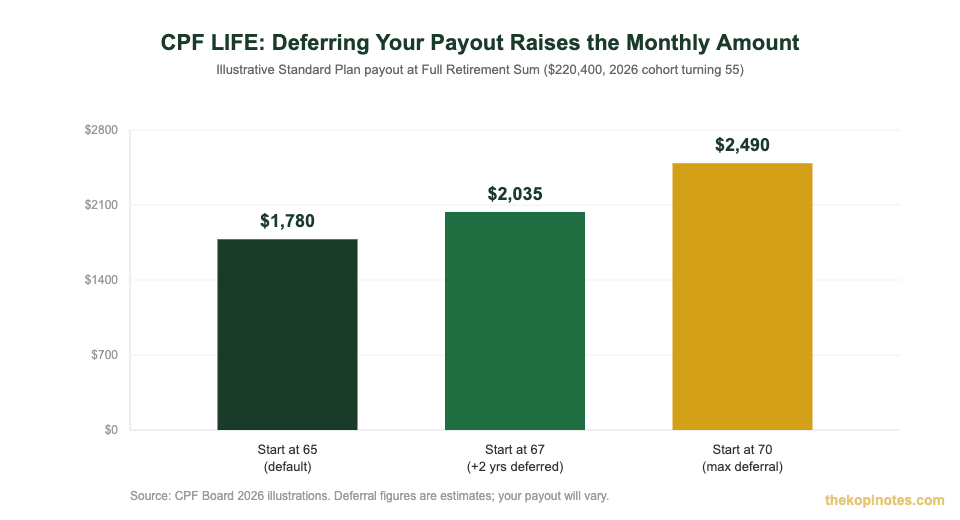
You don’t have to start payouts at 65, though. You can defer your CPF LIFE payout start for up to five years, all the way to age 70. Each year you defer, CPF adds up to 7% to your eventual monthly payout — compounded, that’s a meaningful bump.
Using CPF Board’s 2026 illustration for a member turning 55 this year with the Full Retirement Sum ($220,400), the Standard Plan pays roughly $1,780 a month starting at 65. Defer to 70, and that could grow to around $2,490 a month — about 40% more, for the rest of your life.
| Payout Start Age | Illustrative Monthly Payout | vs Starting at 65 |
|---|---|---|
| 65 (default) | $1,780 | Baseline |
| 67 (+2 years deferred) | ~$2,035 | +~14% |
| 70 (max deferral) | ~$2,490 | +~40% |
Source: CPF Board 2026 payout illustrations (Standard Plan, Full Retirement Sum). Deferral figures are estimates based on CPF’s stated up-to-7%-per-year bonus, compounded — your own payout depends on your actual Retirement Account balance and plan choice.
Whether deferring makes sense depends on your health, other income sources, and whether you need the cash sooner rather than later. Run your own numbers with the CPF LIFE Estimator, and check the full breakdown by retirement sum tier in our CPF LIFE Payout Table.
Age #4: Your SRS Withdrawal Age (It’s Personal)
The fourth age is the one most people have never heard of — and it’s different for every SRS account holder. Your SRS withdrawal age locks in based on the statutory retirement age in force on the date of your first SRS contribution, not today’s rules and not your current age.
So if you made your first SRS contribution back when the statutory retirement age was 62 or 63, your SRS withdrawal age is locked at that figure — even though the retirement age has since moved to 64. Someone who opens an SRS account for the first time today locks in at 64 instead.
Withdraw from SRS at or after your locked-in age, and only 50% of the amount is taxable (up to $40,000 a year tax-free with no other income). Withdraw earlier, and you face a 5% penalty plus 100% of the amount becomes taxable. We go through the full mechanics, including how to check your own locked-in age, in our dedicated SRS withdrawal age guide.
All 4 Ages Side by Side
| Age Type | 2026 Threshold | Can You Change It? | What It Governs |
|---|---|---|---|
| Statutory Retirement Age | 64 | No — set for everyone | Earliest age employer can end your job on age grounds |
| Re-Employment Age | 69 | No — set for everyone | Latest age employer must offer continued employment |
| CPF LIFE Payout Age | 65 (default) | Yes — defer to 70 | When your monthly CPF LIFE income starts |
| SRS Withdrawal Age | Locked at first contribution | No — fixed once locked | When SRS withdrawals get the 50%-taxable concession |
Source: CPF Board, MOM (Retirement and Re-employment Act), as at August 2026.
What This Means for Your Retirement Planning
Once you separate the four ages, the planning gets a lot clearer. Here’s how to use each one:
If you plan to stop working at 64. Your CPF LIFE payouts won’t start for another year. You’ll need a bridge — savings, T-bills, dividend-paying S-REITs, or part-time work — to cover that gap before age 65.
If your employer offers re-employment past 64. You can keep earning income right up to 69, on top of letting your CPF Retirement Account keep compounding at up to 6% a year (for balances up to $30,000 in your combined accounts, tapering down above that). That extra time can meaningfully grow your eventual payout.
If you’re deciding whether to defer CPF LIFE. Deferring to 70 raises your monthly income for life, but only pays off if you don’t urgently need the cash at 65 and you expect to live long enough to benefit. Use the CPF LIFE Estimator (linked above) to model both scenarios with your own numbers.
If you’re not sure about your own SRS lock-in age. Check your SRS operator’s records for the date of your first contribution, then match it against the statutory retirement age that applied that year — the mechanics are covered in full in the SRS withdrawal age guide linked above.
For a full picture of how all your retirement income sources — CPF, SRS, and your own investments — fit together, try the Singapore Retirement Calculator.
Building the Income to Bridge These Gaps?
If you’re planning to retire before your CPF LIFE payouts start, a low-cost investing platform can help you build the bridge income you’ll need.
Frequently Asked Questions
Is Singapore's retirement age the same as my CPF payout age?
No. Your statutory retirement age (64 from 1 July 2026) is about your job — it’s the earliest age your employer can end your employment on age grounds. Your CPF LIFE payout eligibility age is fixed separately at 65 for everyone, regardless of the retirement age.
What is Singapore's re-employment age in 2026?
69, up from 68, effective 1 July 2026. Eligible employees who reach the statutory retirement age must be offered re-employment by their employer up to this age, subject to conditions like service length and performance.
Can I start CPF LIFE payouts before age 65?
No. 65 is the earliest CPF LIFE payout eligibility age for all members, and this hasn’t changed alongside the statutory retirement age increases. You can, however, defer payouts later than 65, up to age 70.
Is it always better to defer my CPF LIFE payout to age 70?
Not necessarily. Deferring raises your eventual monthly payout by up to roughly 7% per year, compounded — but it only pays off if you don’t need the income sooner and expect to live long enough to benefit from the higher payout. If you have limited other income at 65, starting payouts on time may make more sense.
Why is my SRS withdrawal age different from someone else's?
Your SRS withdrawal age locks in based on the statutory retirement age that applied on the date of your first SRS contribution — not the current retirement age. Two people with SRS accounts opened in different years can have different locked-in withdrawal ages, even though they’re the same age today.
What happens if I want to keep working after the re-employment age of 69?
Your employer isn’t legally required to keep offering re-employment past 69. That said, plenty of Singaporeans continue working past this age through mutual agreement, contract roles, or by transitioning into part-time or consulting arrangements — it’s just no longer a statutory requirement on the employer’s part.
This article is for general educational purposes and is not financial, tax, or legal advice. Retirement age, re-employment age, CPF LIFE and SRS rules can change — always verify current figures with the CPF Board, MOM, or your SRS operator before making decisions. Data accurate as at August 2026.
This article was researched with the help of AI. While we strive to keep all information accurate and up to date, there may be errors. If you notice any discrepancies, please contact us.